
The most famous university isn’t always the right choice for your computer science goals. If you want to study computer science in USA from Pakistan, use your academic background, intended degree, budget, and career interests to build your shortlist instead of relying on rankings alone.
It’s understandable to feel unsure about where to begin. U.S. universities set different prerequisites, English proficiency standards, testing policies, document requirements, and deadlines. Tuition and visa preparation add further decisions. A clear sequence makes the process easier to manage, but no shortlist or application can guarantee admission or a visa.
This guide takes you from assessing your academic profile and comparing computer science programs to preparing application documents, planning costs, and understanding the F-1 student visa process. It explains why university admission and visa applications are separate stages, and how to plan for each without missing important deadlines. A profile assessment and careful document preparation can help you build a practical plan for your next steps.
Key Takeaways
- Start your plan to study computer science in USA from Pakistan by matching the degree level and program requirements to your academic profile.
- Compare curriculum, entry criteria, location, and total budget alongside rankings to find programs that fit your priorities.
- Build an application checklist for transcripts, qualification records, identification, and any other materials each university requests.
- Plan for tuition, housing, insurance, travel, and personal expenses. Review scholarship eligibility and terms with each institution.
- Track requirements, deadlines, submissions, and decisions for each university. Prepare for the F-1 visa process as a separate step after admission.
Why study computer science in the USA from Pakistan?
Studying computer science in the United States gives Pakistani students the opportunity to explore different academic approaches, from foundational computing concepts to specialised areas of technology. Universities vary in how they structure degrees, teach and assess courses, support students, and set admission requirements. Compare each program with your preparation and goals rather than assuming every U.S. university offers the same experience.
A U.S. computer science degree is a university qualification that develops knowledge and practical understanding of computing through a curriculum set by the institution. Students typically consider undergraduate study, such as a bachelor’s degree, or graduate study, such as a master’s or PhD. The route available to you depends on your previous qualifications and the specific program’s entry criteria. For context on degree levels and the wider system, see Higher education in the United States.
What can a computer science degree include?
Coursework may cover software development, computer systems, data, and artificial intelligence, along with mathematical or theoretical foundations. The balance varies by program: one may offer a broad core, while another provides more room for electives or specialised study. Compare module descriptions and course plans rather than relying on a degree title alone.
Match the subjects with your interests and previous preparation. If you’re drawn to AI, for example, review the computing and mathematics coursework offered, along with any stated prerequisites. This helps you judge whether the curriculum is a good academic fit.
Is a U.S. degree the right fit for your goals?
Before deciding to study computer science in USA from Pakistan, weigh four factors: your academic interests, preferred learning environment, flexibility about location, and realistic budget. Consider whether you want a broad foundation or a focused curriculum, and whether the campus setting suits your preferences. Program formats and expectations vary, so assess each option on its own.
Keep career goals in view, but separate them from promises about results. A degree can support your learning and help you develop relevant knowledge, but it doesn’t guarantee employment or a particular career path. Identify the skills and subjects you want to pursue, then explore career opportunities after studying abroad as part of your planning. A structured profile assessment can help connect your previous studies and priorities with programs to consider.
How to choose a U.S. computer science program that fits your profile
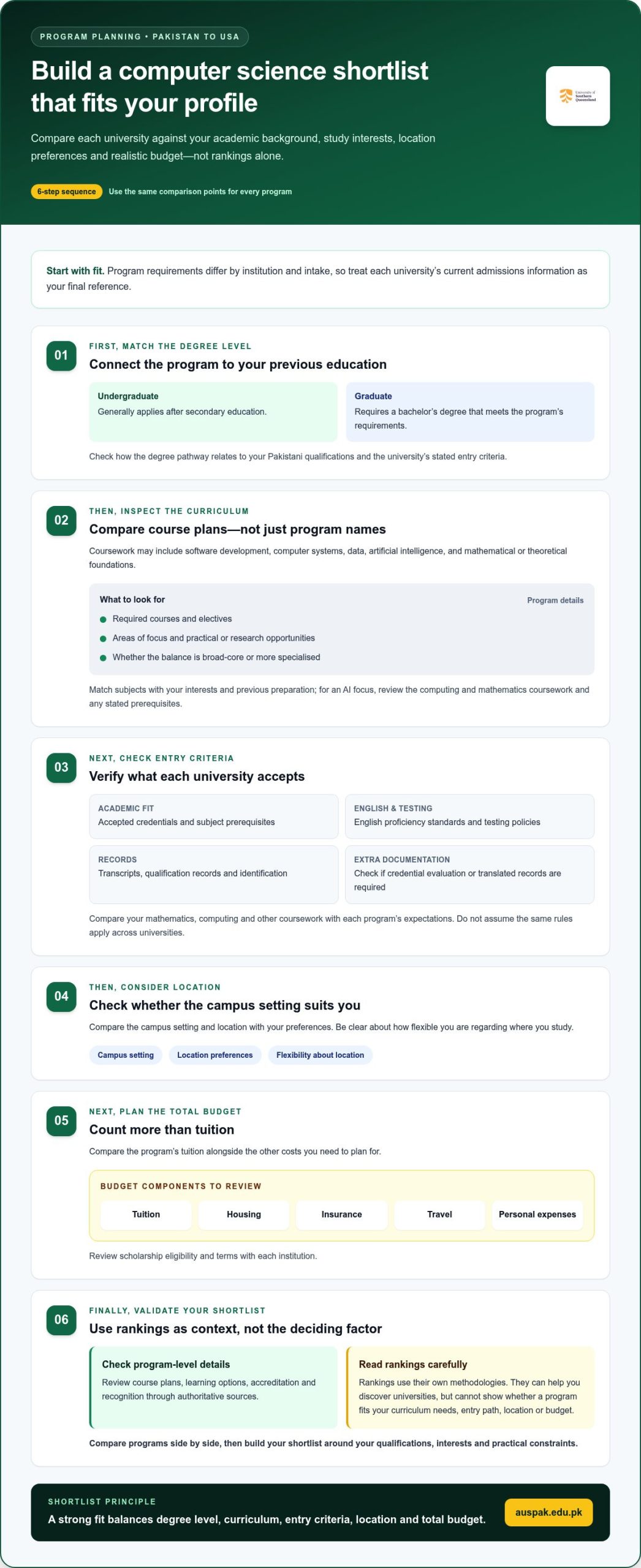
Build your shortlist around academic fit and practical constraints, not ranking position alone. Compare the same details for each university to see which programs match your qualifications, interests, and budget. Requirements can change by institution and intake, so use each university’s current admissions pages as your final reference.
| Comparison category | What to review |
|---|---|
| Degree level | Whether you’re applying for undergraduate or graduate study, and how the program relates to your previous qualifications. |
| Curriculum | Required courses, electives, areas of focus, and practical or research opportunities. |
| Entry criteria | Accepted credentials, subject prerequisites, English proficiency requirements, and any testing or document policies. |
| Location | Campus setting, location preferences, and whether you’re flexible about where you study. |
| Total budget | Tuition and estimated housing, insurance, travel, and personal expenses for the program. |
Check academic eligibility before shortlisting
Undergraduate applicants generally apply after secondary education, while graduate applicants need a bachelor’s degree that meets the program’s requirements. The Pakistani credentials each university accepts, along with its subject prerequisites, are institution-specific. Compare your mathematics, computing, and other academic coursework with each program’s stated expectations. Check whether credential evaluation, translated records, or additional documentation is required, and don’t assume the same rules apply across universities. EducationUSA provides official guidance for international students researching U.S. study.
Compare curriculum, accreditation, and rankings carefully
Look beyond the program name. Review course plans to see how much emphasis is placed on subjects that interest you, and whether experiential learning, research, or other academic options are available. Verify relevant institutional accreditation and recognition details through authoritative sources. Rankings are different: they assess institutions using their own methodologies.
Rankings can help you discover universities, but they can’t tell you whether a particular curriculum, entry pathway, location, or budget suits your circumstances. Treat them as one input, then compare program-level details. For additional context, read QS World University Rankings explained.
To study computer science in USA from Pakistan, turn your research into a realistic shortlist. AusPak International provides profile assessment, document verification, and university application processing to help you organise your options and prepare applications. These services support your planning but don’t determine admission outcomes. Explore university application support as you plan your next steps.
How to prepare a strong computer science application from Pakistan
A clear process helps you manage different university portals, deadlines, and document instructions. Because each institution may ask for different materials, organise each application separately and check that every submission is accurate.
- Shortlist programs. Select options that align with your academic background, interests, and practical priorities.
- Verify requirements. Review each program’s current admissions page for eligibility, deadlines, English proficiency evidence, testing policies, and required documents.
- Prepare documents. Gather academic records and other materials, following each institution’s format, translation, and submission instructions.
- Submit applications. Complete each university’s application carefully and retain confirmation of submission.
- Track decisions. Record application status and check for updates or requests for additional information.
Prepare academic records and English proficiency evidence
Follow each university’s instructions for transcripts, qualification records, and credential documentation. Accepted English tests and required scores can vary by institution, program, and intake, so don’t rely on a score or policy from another university. Check current testing rules with each institution. Keep identification and academic documents organised, and follow the university’s guidance on originals, certified copies, translations, or other formats.
Make your statement and supporting documents specific
Connect your previous studies with the computer science areas you want to explore, and explain why the selected program fits your academic direction. Use relevant coursework, projects, or research interests to support your statements. For example, describe your role in a programming project and what you learned instead of making broad claims about your abilities. Keep every detail truthful and consistent across the application. Essays, recommendation letters, portfolios, and standardised tests may be required, optional, or not requested, depending on the university and program. A department page such as Stanford Computer Science illustrates the range of academic interests a computer science program may cover, but use each target university’s instructions to shape your application. See university application assistance for related planning guidance.
Application checklist
- Program-specific eligibility, deadlines, and submission instructions reviewed
- Transcripts, qualification records, and identification prepared as directed
- English proficiency and any testing policies verified with the university
- Required essays, recommendations, portfolios, or other requested materials assembled
- Applications submitted and decisions or follow-up requests tracked
Requirements differ, so use this as a planning checklist, not a universal document rule. If you plan to study computer science in USA from Pakistan, profile assessment and document verification can help you organise your application journey, but they don’t guarantee admission. Explore application support to get help managing the process.
How to plan finances and the F-1 student visa process
Financial preparation is part of choosing a program, not a task to leave until after admission. Build a budget for each university and make a separate plan for the student visa process. Scholarships and other financial support vary by institution, applicant, and program. Check eligibility rules, deadlines, award terms, and renewal conditions with the university, and don’t base your plan on funding you haven’t been offered.
Build a realistic study budget
Start with each university’s published cost estimate. Check what it includes and the period it covers, then add likely expenses based on your intended living arrangements. Separate recurring costs from one-time costs to see what you’ll need before departure and throughout your studies.
- Tuition and university charges: Review the program’s current published figures and any listed fees.
- Housing and personal expenses: Estimate accommodation, food, local transport, and everyday needs based on your plans.
- Insurance and travel: Check the institution’s health insurance requirements and plan for travel-related costs.
- Visa-related fees: As of October 2026, the listed fees are $350 for the I-901 SEVIS fee and $185 for the DS-160/MRV application fee. A $250 Visa Integrity Fee is also listed upon visa issuance, bringing mandatory government fees to approximately $785, excluding other costs. Verify current amounts and payment instructions through official sources before paying.
Prepare a realistic funding plan and keep financial documents accurate and consistent with the amounts and sources you describe. Check which costs are included in university estimates so you don’t overlook expenses or count the same item twice.
Understand the student visa sequence
University admission and an F-1 visa are separate processes. Students generally first need admission to an institution authorised to enrol international students and the immigration document it issues, Form I-20. The visa application has its own eligibility and decision requirements. Admission doesn’t guarantee visa issuance.
Current procedures may include paying the SEVIS I-901 fee, completing the DS-160, paying the visa application fee, and attending an interview. Follow the latest instructions from the U.S. Department of State and Study in the States, including guidance on required documents and timing. Requirements and fees can change, so verify them before each step.
If you plan to study computer science in USA from Pakistan, AusPak International’s application processing and visa documentation services can help you organise your paperwork and plan the process. Get support with your university application and visa planning.
Your next steps toward studying computer science in the USA
Turn your research into a manageable plan. If you want to study computer science in USA from Pakistan, take these steps in order:
- Define your degree level. Decide whether you’re preparing for undergraduate or graduate study, based on your previous qualifications and academic goals.
- Assess your profile. Review your academic record, relevant mathematics and computing coursework, interests, and preparation against program criteria.
- Shortlist suitable programs. Compare course content, entry requirements, location, and total budget rather than relying on rankings alone.
- Map deadlines. Record each university’s application dates, testing policies, and document requirements for your intended intake.
Keep a separate tracker for every university. Useful columns include application and English-test requirements, documents to prepare, submission dates, application status, and decision updates. This makes differences between institutions visible and helps you follow up on missing materials instead of assuming one checklist applies everywhere.
Create a personal application timeline
Work backwards from each program’s deadline, then allow time for academic records, English testing where required, essays, and recommendation requests. Leave room to gather documents and respond to university requests for additional information. Deadlines and admissions policies can change by intake, so revisit the official university pages as you plan and before submitting. Set calendar reminders for important dates.
Get structured support for your application
A profile assessment can help you organise your academic information and identify programs to consider. Document review and application submission support can help you manage the process and align materials with university instructions. AusPak International supports students with counselling, application processing, and document preparation for international study.
Keep expectations clear: universities make admission decisions, and the relevant authorities decide visa applications. Support can help you prepare and track your application, but it can’t guarantee either outcome. Start by clarifying your degree level and building your university tracker, then work through each requirement one step at a time.
Explore study-abroad application support for guidance as you organise your next steps.
Take the next step toward your U.S. study plan
A strong plan to study computer science in USA from Pakistan starts with academic fit, not rankings alone. Compare each program’s curriculum, entry criteria, location, and total budget with your profile, then prepare documents according to each university’s instructions. Treat admission and the F-1 visa process as distinct stages, and map deadlines early so you can plan each application carefully.
You don’t have to organise every decision at once. Start by defining your degree level, assessing your academic background, and building a university-by-university tracker. AusPak International supports students with profile assessment, document verification, and application submission. This practical support can help you manage the process, while universities and relevant authorities make their own decisions.
Explore your study-abroad application options with AusPak International and take a clear, informed step toward your goals. Start with your academic profile and shortlist, then get support to organise your application and documentation.
Frequently Asked Questions
Can Pakistani students study computer science in the USA?
Yes, Pakistani students can apply to U.S. universities for undergraduate or graduate computer science programs. Admission depends on meeting each university’s academic, English-language, and application requirements. For an F-1 visa, applicants generally need admission to an institution authorised to enrol international students and must complete a separate visa process. Applying is possible, but neither admission nor visa issuance is guaranteed. Plan both stages carefully.
What qualifications do I need to study computer science in the USA from Pakistan?
Qualifications depend on the degree level and university. Undergraduate applicants generally need secondary education credentials accepted by their chosen institution. Graduate applicants typically need a bachelor’s degree that meets the program’s requirements. Universities may also set prerequisites in mathematics, computing, or other subjects. Check how each institution assesses Pakistani qualifications, whether it requests credential evaluations or additional records, and what English proficiency evidence it accepts.
Do U.S. universities require the SAT or GRE for computer science applicants?
Not universally. Undergraduate computer science programs may require SAT or ACT scores, accept them optionally, or use test-free policies. Graduate programs set their own GRE rules; as of 2026, some computer science departments have waived the GRE, while others may require or recommend it. Check the current policy for your specific program and intake, since requirements can differ between departments at the same university.
How much does it cost to study computer science in the USA?
Costs depend on the university, degree, location, and living arrangements. For international students, annual tuition for an MS in Computer Science can range from approximately $25,000 to $65,000, based on the research available for this guide. Tuition is only part of the budget. Also plan for housing, insurance, travel, personal expenses, and any fees not included in the university’s published estimate.
What documents are needed to apply to a U.S. computer science program from Pakistan?
Requirements vary by university and program. Applicants may need academic transcripts, qualification records, identification or passport details, and English-test results if required. Some programs also request a statement of purpose, recommendation letters, a résumé, test scores, or project materials. Follow each university’s instructions for document formats, translations, and submission methods. Don’t assume one application checklist will cover every program on your shortlist.
How do I apply for an F-1 student visa after receiving U.S. university admission?
After admission, follow the university’s instructions for receiving Form I-20, then review current U.S. government guidance on the F-1 process. It generally involves paying the SEVIS I-901 fee, completing the DS-160, paying the visa application fee, and arranging an interview. Prepare the documents specified in official instructions, including financial evidence where required. Admission doesn’t guarantee visa issuance, and procedures can change, so verify details before applying.
Can I get a scholarship to study computer science in the USA?
Scholarships and other financial support may be available, but eligibility, award amounts, deadlines, and conditions vary by institution and funding program. Some awards may depend on academic achievement, financial need, degree level, or a separate application. Review university funding pages early and confirm renewal terms and what costs an award covers. Build a budget that doesn’t rely on a scholarship until you’ve received and understood a formal offer.
When should I apply to U.S. universities for a computer science degree?
Apply according to each university’s deadline for your intended intake, and start preparing well in advance. For Fall 2027, many U.S. universities open applications between August and October 2026. PhD deadlines are often around December 1 or 15, 2026, while some master’s deadlines extend into early 2027. These are planning references, not universal dates. Verify deadlines, test policies, and document timelines with each program.