
Your grades may not meet direct-entry requirements, but that doesn’t automatically close the door to an Australian degree. For students in Pakistan, pathway programs for Australian universities can offer a structured route forward. A pathway is a bridge, not a guaranteed shortcut: progression, entry conditions and credit depend on the specific course and institution.
Choosing between foundation studies, a diploma and an English-language course can feel confusing because each addresses a different academic or language need. Completing a pathway also doesn’t necessarily mean automatic progression or credit towards a degree.
This 2026 guide explains what common pathways are designed to do and how to compare their entry requirements, progression conditions, potential credit and study-readiness demands. You’ll also learn what academic records and other information to prepare before exploring an application. With a clear view of your background and goals, you can assess which route may suit you and take the next step with greater confidence.
Key Takeaways
- Compare foundation, diploma and English-language routes by the learner profile and study focus each is designed for.
- Use your intended degree, academic record, subject prerequisites and English readiness to narrow down pathway programs for Australian universities.
- Review progression thresholds, assessment requirements and stated credit arrangements before deciding how a pathway may lead towards degree study.
- Prepare relevant academic transcripts, completion certificates, identity documents and English evidence when required for an application.
- AusPak International can support your planning with profile assessment, counselling, document verification and application processing.
What are Australian University Pathway Programs?
Australian university pathway programs are preparatory or alternative study routes that can help students work towards entry into a degree. They may build academic skills, address subject preparation or help meet specified entry requirements when an applicant’s existing qualifications don’t align with a degree’s direct-entry criteria.
Meeting the requirements for a pathway is not the same as receiving a guaranteed place in a degree. You may need to complete the pathway successfully and satisfy further academic, subject, English-language or other conditions before progressing. Programme names, availability and progression rules vary between Australian institutions, so base your decision on the written terms for the specific course.
How does a pathway connect to a university degree?
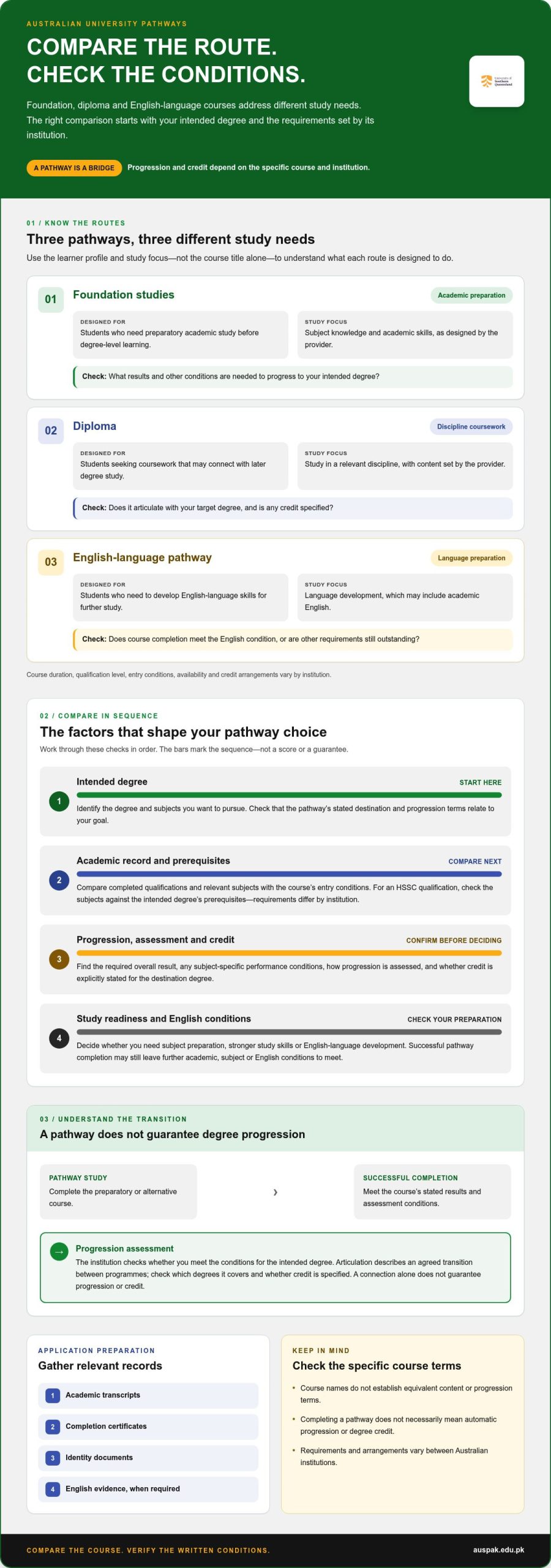
The usual sequence is pathway study, successful completion and then a progression assessment. The institution assesses whether you have met the conditions for the intended degree. These may include a required overall result or a particular performance in specific subjects. A pathway can provide a defined route, but progression depends on the stated conditions, not simply on enrolling or completing the course.
Articulation means an agreed transition from one programme into later study, such as a pathway course connecting to a degree. The arrangement may identify which degrees it covers and whether completed study receives credit. A connection between programmes does not, by itself, mean every student will progress or receive credit. Check the destination degree and conditions in the course information.
When might an international student consider a pathway?
A pathway may be worth comparing if you don’t qualify for direct entry or want further preparation before beginning Australian higher education. For example, a student from Pakistan with an HSSC qualification may need to compare previous subjects with the intended degree’s prerequisites and entry criteria. The answer depends on the student’s academic record and the institution’s requirements, not on one rule that applies to everyone.
A pathway can also suit students seeking structured preparation in relevant subjects or time to strengthen study skills before starting a degree. It isn’t necessary for every international applicant. If your qualifications already meet a degree’s direct-entry requirements, compare direct entry with pathway study rather than assuming an additional course is required.
- Start with the degree goal. Identify the course and subjects you want to pursue.
- Compare your academic profile. Check your completed qualifications and relevant subjects against the stated entry conditions.
- Understand the transition. Find the progression threshold, assessment conditions and any stated credit arrangement.
For Pakistani students, counselling and profile assessment can help organise these questions around your academic history and goals. AusPak International supports applications to Australian universities through counselling, document verification and application processing, helping students assess pathway options before deciding on their next step.
Foundation, diploma, and English pathways: how the main routes differ
These pathway programs for Australian universities serve different purposes, so start by identifying the gap you need to address. Academic pathways build subject readiness, while English pathways focus on language readiness. A course’s title alone won’t tell you whether it leads towards your intended degree or what conditions apply.
| Route | Intended learner profile | Main study focus | Progression question |
|---|---|---|---|
| Foundation studies | Students who need preparatory academic study before degree-level learning | Subject knowledge and academic skills, as designed by the provider | What results and other conditions are required to progress to the intended degree? |
| Diploma | Students seeking a coursework route that may connect with later degree study | Study in a relevant discipline, with course content set by the provider | Does this diploma articulate with the target degree, and is credit specified? |
| English-language pathway | Students who need to develop English-language skills for further study | Language development, which may include academic English | Does completing the course meet the relevant English condition, or are other requirements still outstanding? |
The table is a starting point, not a promise of a particular route or outcome. Duration, qualification level, entry conditions, available courses and credit arrangements vary by institution. The Universities Admissions Centre outlines different University admission pathways in Australia, but the target institution’s current course information sets the conditions for its programmes.
Foundation studies and diploma pathways
Foundation study provides preparatory academic learning, with subjects and structure determined by the institution. A diploma involves coursework and may have a progression or credit arrangement with a degree. Before relying on that connection, check the stated credit, destination degree and required results in the institution’s course information. Similar course labels don’t necessarily mean equivalent content or progression terms.
English-language pathways and combined study options
English-language preparation focuses on language development. Completing it doesn’t automatically establish degree eligibility or satisfy every other entry condition. Some universities offer combined or packaged study routes linking English preparation with further study. Treat a package as an option only when the institution describes that route and its conditions. For separate test context, consult this IELTS guide for Australian student visas.
For students in Pakistan, matching the route to the actual gap matters more than choosing a familiar-sounding category. AusPak International’s Australian university counselling and profile assessment can help you compare options against your academic record and goals. Explore Australian university application support as you plan your next step.
How to compare Australian university pathway programs before choosing
A useful comparison starts with your intended degree, not the pathway title. Check whether each option matches your academic profile, the subjects you’ve studied and your English readiness. Then compare what you must achieve to progress, what the route may count towards, and how the full study sequence fits your plans from Pakistan.
Use this checklist to assess each option consistently:
- Degree destination: Does the pathway connect to the degree and field you want, or would you need to apply for a different programme afterwards?
- Academic fit: Do your completed qualifications and subjects meet the pathway’s entry conditions? Identify any prerequisite subjects you may need.
- English readiness: What English evidence or level does the pathway require? Are separate English conditions listed for the degree?
- Progression threshold: What marks, subject results or other requirements must you meet to proceed?
- Assessment and credit: How is your performance assessed? Does the institution specify credit or advanced standing towards the destination degree?
Which progression conditions matter most?
Separate the conditions for completing the pathway from those for entering the degree. A course may require successful completion, while degree progression may also depend on particular marks, prerequisite subjects, attendance requirements or an application step. Read the official programme materials for the exact rules, including deadlines and assessments that affect your study sequence. Progression is conditional on the provider’s published rules.
For example, if your intended degree has subject prerequisites, check whether the pathway includes the required subject preparation and whether results must meet a stated threshold. Don’t rely on broad descriptions such as “pathway to degree”. Find the conditions that apply to your chosen destination.
How can students compare recognition and study outcomes?
Look for a clear statement of what happens after successful completion. A pathway may specify credit towards a named degree, advanced standing or a separate application for degree entry. These are different outcomes. Check the destination degree and any stated credit in the institution’s official materials rather than assuming similar course names have the same recognition.
A pathway certificate is not the same qualification as the degree awarded after completing degree study. Understanding the distinction helps you see what each stage contributes to your academic record. For broader context on entry routes and applications from Pakistan, see the Australian university admission guide for Pakistani students.
Plan beyond entry conditions, too. Map the pathway and degree as one study sequence, including transition points, application timing and where you expect to live during each stage. This helps you assess the practical commitment without treating a pathway as a shortcut or assuming progression is automatic.
AusPak International’s counselling and profile assessment can help you compare pathway options against your academic record and degree goal. Explore Australian university admission support as you organise your next steps.
How Pakistani students can assess eligibility and prepare a pathway application
A well-prepared application begins with a clear destination. For Pakistani students considering pathway programs for Australian universities, the right route depends on the intended degree, previous subjects and results, and the pathway institution’s current entry criteria. Requirements differ by institution and programme, so use the official course information rather than assuming one set of rules applies everywhere.
Follow a clear sequence:
- Identify your degree goal. Note the subject area and degree you want to pursue, then focus on pathways that lead towards a relevant course.
- Review pathway criteria. Compare your qualifications, subjects and results with the published entry requirements, including any English-language conditions.
- Gather your records. Prepare the documents requested for your programme and check whether translations or certified copies are required.
- Submit the application. Follow the institution’s instructions for forms, supporting evidence and submission method.
- Track the response. Save the submission confirmation, monitor messages and note deadlines for providing further information or responding to an offer.
Depending on the institution and programme, documents to prepare may include:
- Academic transcripts and examination results
- Certificates showing completed qualifications
- Identity documents requested by the institution
- English-language test results or other accepted evidence, when required
What should applicants review before submitting?
Check that your previous subjects and academic results match the pathway’s published criteria. Review instructions for file format, translation, certification and submission, where applicable. Keep copies of every document and record key application milestones, such as the date submitted and any follow-up requested. These checks make it easier to respond accurately if the institution needs additional information.
Application preparation involves more than collecting paperwork. The university application assistance guide offers broader guidance on organising an application, while profile assessment can help relate your academic record to the pathway you’re considering.
How does pathway admission relate to a student visa?
Admission and a student visa are separate processes with distinct requirements. An offer to study, including an offer for a pathway course, does not determine the outcome of a visa application. Read current Australian student visa guidance for the applicable process and terminology, and avoid relying on older material that uses outdated terms. Keep visa questions separate from the institution’s academic entry and progression conditions.
Before applying, bring together your degree goal, academic records and any English evidence you already have. AusPak International supports Pakistani students with Australian university counselling, profile assessment, document verification and application processing, helping organise the next steps around your pathway plan.
Get support preparing your Australian university application.
Plan your Australian pathway with informed application support
Choosing among pathway programs for Australian universities takes more than matching a qualification to an entry requirement. Your intended degree, academic history and the institution’s published progression rules all shape which route makes sense. Foundation study, a diploma and an English-language programme serve different purposes, so keep the destination degree in view as you compare options and plan each step.
For students in Pakistan, application guidance can bring the planning into focus. AusPak International provides Australian university counselling, profile assessment, document verification and application processing. It partners with over 40 Australian universities, giving students a broad network to explore. That partnership does not mean every university offers every pathway or that every route suits every academic profile. Programme availability and progression terms are specific to the institution and course.
What application guidance can help students organise
Profile assessment relates your academic history to the criteria published by the university, helping you identify questions about qualifications, subjects or results before you apply. Document verification and application submission provide practical support with organising records and following university processes. Keep the pathway conditions beside the intended degree requirements throughout planning, so the route you consider remains connected to your goal.
As you prepare, keep a working file that includes:
- Your intended degree and preferred study area
- Academic records relevant to pathway entry
- Published progression conditions and any stated credit arrangements
- Application documents, submission details and key correspondence
This reference helps keep decisions consistent as you move from comparing routes to preparing an application. It can also help you spot when a course’s stated progression destination differs from your intended degree.
Take the next step towards an Australian university pathway
Foundation, diploma and English-language options address different preparation needs. The right comparison depends on your study goal and academic record, while the institution’s current progression terms explain what successful completion can lead to. Read those terms closely, including the destination course and any conditions, before committing to a study plan.
AusPak International’s education consultancy team can discuss your plans, assess your profile and support the application process. The aim is to help you understand the route and its requirements, not to promise an offer or visa outcome. Start planning with informed guidance.
Discuss your Australian university study plans with AusPak International.
Turn your Australian study goal into a clear next step
Your next move doesn’t need to answer every question at once. Start by defining the degree you want to work towards and the academic preparation you’re ready to undertake. That gives you a practical basis for discussing pathway programs for Australian universities and deciding which details need closer attention before you apply.
Bring your academic history and questions into your planning conversation. A clear view of your priorities can make the options feel more manageable, while careful attention to each institution’s current conditions keeps expectations realistic. Your route should support your study ambitions, not be chosen on the assumption that progression or a visa is automatic.
AusPak’s team can help you consider your profile and organise the university application process, including document and visa documentation guidance. Take the next step with informed support: Explore your Australian university pathway options with AusPak.
With a considered plan and the right questions in hand, you can move towards your Australian study goal with greater confidence.
Frequently Asked Questions
Are pathway programs for Australian universities available to international students?
Yes, international students can apply to pathway programs for Australian universities when the institution accepts applicants with their qualifications and the specific course is open to them. For a student applying from Pakistan, eligibility may depend on prior education, age or other programme-specific criteria. Check the course’s international applicant information and any conditions attached to studying in Australia rather than assuming every pathway accepts overseas students.
Do pathway programs guarantee admission to an Australian university degree?
No. Admission to a pathway course does not guarantee entry to a degree. A progression arrangement may require you to meet academic conditions, apply by a deadline or satisfy other stated requirements. For instance, passing a pathway course may not be enough if the degree requires a particular result in a relevant subject. Treat progression as conditional and use the institution’s current rules to understand what happens after study.
Can a pathway program give credit towards an Australian bachelor’s degree?
It can, if the university’s arrangement specifies credit or advanced standing for the pathway and the degree you plan to enter. Credit isn’t automatic simply because the courses are connected. Look for written information identifying the destination bachelor’s degree and the amount or type of credit that may apply. If the documents describe a separate application instead, plan for degree admission to be assessed through that process.
How long does an Australian university pathway program take?
There isn’t one standard duration. The time required depends on the programme, its study structure and your enrolment route. An English course, foundation programme and diploma may follow different schedules. Before choosing, check the institution’s stated start and end dates, study periods and transition timing into the degree. This helps you plan the overall study sequence without assuming that a pathway adds the same amount of time in every case.
Do Pakistani students need IELTS for an Australian pathway program?
Not necessarily. English evidence requirements vary by institution and course, and the accepted evidence may differ between a pathway and its destination degree. Check the exact application instructions for your chosen programme, including whether IELTS is required or another form of evidence is accepted. Treat university admission and student visa requirements as separate matters. Meeting one set of English conditions doesn’t automatically satisfy the other.
Can students change universities after completing a pathway program?
Possibly, but completing a pathway at one institution doesn’t ensure that another university will accept it for entry or grant credit. The new institution may assess your academic record, subjects and qualification under its own admission rules, and you may need to submit a fresh application. Before relying on a transfer plan, compare the receiving university’s course-specific entry and credit policies with the pathway you’re taking.
Is a foundation program the same as a diploma pathway?
No. A foundation programme is generally designed as preparatory academic study, while a diploma is a coursework qualification that may have a specified connection to degree study. Their level, subject content and progression arrangements can differ by institution. For example, a foundation course may focus on preparation for further study, while a diploma may align with a particular discipline. Compare the actual course structure and outcomes, not just the name.