
The highest-ranked Australian data science master’s may not be the right one for you. For Pakistani applicants comparing masters in data science in Australia for international students, the better choice depends on how course content, entry prerequisites and specialisations match your previous study and career direction.
Rankings and graduate outcomes offer useful context, but they don’t tell the whole story. Programmes can differ in their balance of statistics, programming, machine learning and applied projects. Entry requirements may also favour applicants with particular preparation in mathematics or computing. Comparing those differences can help you focus on courses that fit your background, rather than building a shortlist around reputation alone.
This 2026 guide explains how to compare course structures, common entry requirements and application steps. You’ll learn what to check as an international applicant and how to turn your research into a practical application plan. AusPak International supports students with Australian university counselling, profile assessment, application processing and document verification to help organise the next steps.
Key Takeaways
- Compare course content, electives and practical projects against your academic background and career direction.
- For masters in data science in Australia for international students, check how each course’s prerequisites match your previous study.
- Use the same comparison criteria for every course, including curriculum, study format and published outcomes.
- Prepare in sequence: review course criteria, map your previous study, gather academic records and organise each application.
- AusPak International supports profile assessment, document verification and Australian university application processing.
What a Master’s in Data Science in Australia Can Teach You
Data science combines statistics, computing and knowledge of a subject area to examine data and support decisions. A data scientist might use statistical methods to test a pattern, programming tools to prepare information, and knowledge of a field such as health or finance to interpret the results. For a foundational overview, see What is Data Science?
In brief: Data science develops methods and models for working with data. Data analytics more often examines data to explain trends or answer defined questions, while business analytics applies analysis to business decisions and performance. These fields overlap, and universities may use the terms differently.
That distinction matters when comparing masters in data science in Australia for international students. Similar course titles don’t guarantee similar learning. Curricula, prerequisites, electives and the balance between theory and applied work can vary by course. Treat the topics below as examples to look for, not a universal set of required subjects.
Which technical and analytical skills might the degree develop?
Programming, statistics and machine learning can form a connected workflow. A student may write code to prepare data, use statistical reasoning to examine relationships, then apply a machine-learning method to build or assess a model. The goal is not only to use a technique, but also to judge whether it suits the question and how confidently its results can be interpreted.
Depending on the course, topics may include databases, data management, visualisation, statistical modelling and large-scale data systems. Check the subject list to see which topics are compulsory, optional or not included. Strong foundations can also help students identify limitations in data, avoid misleading conclusions and consider how a model’s output should inform a decision.
How do projects and specialisations shape the learning experience?
Specialisations can let students direct electives towards an area of interest, but the streams available depend on the course. Some programmes combine technical and analytical study with a major project. That is one possible course design, not a template for every Australian master’s. Compare the actual streams and subjects listed for each programme.
Applied work can show how students bring methods together. A capstone or team project may involve defining a question, preparing data, choosing analytical techniques and presenting findings. Project formats differ, so check whether work is individual or group-based, what students are expected to produce and whether the project is compulsory.
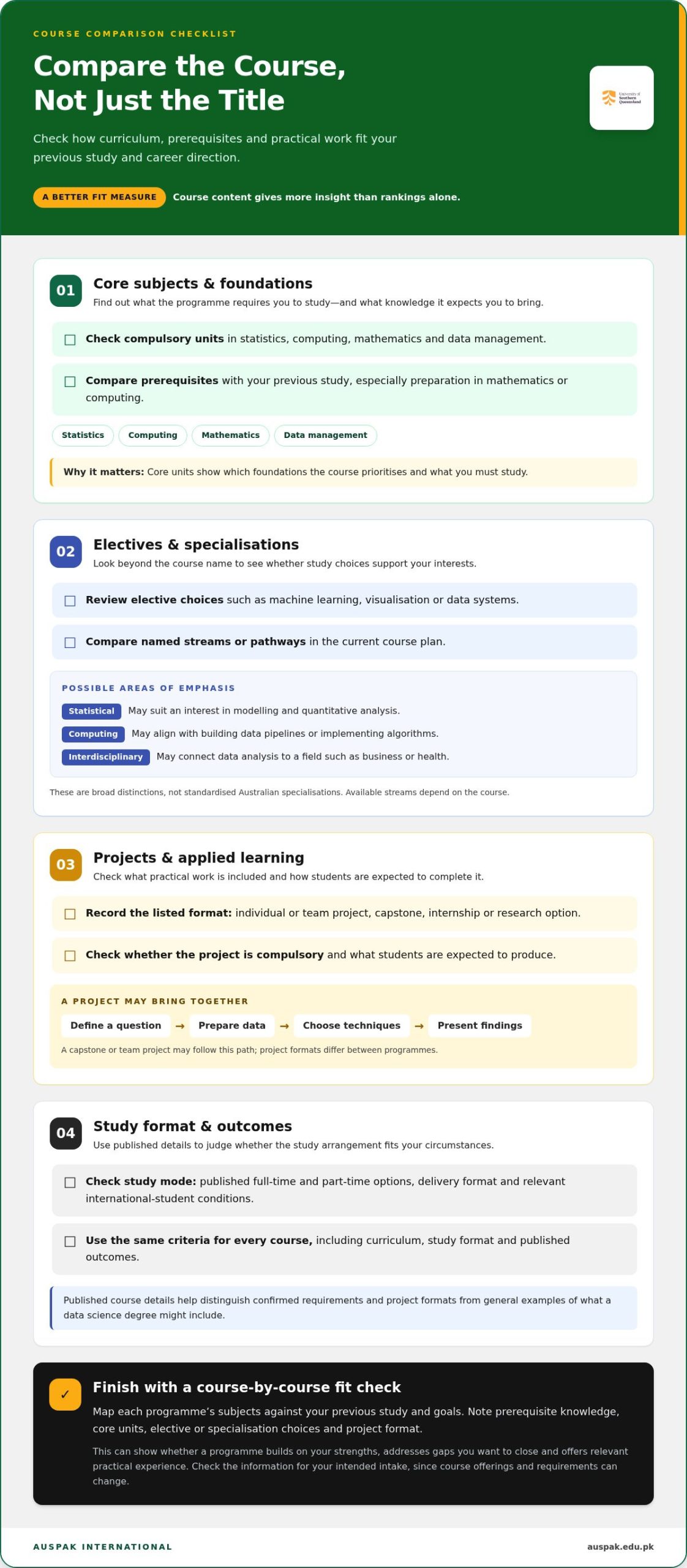
Before shortlisting, open each university’s current course page and map its subjects against your previous study and goals. Note prerequisite knowledge, core units, elective or specialisation choices and project format. This reveals whether a programme builds on your strengths, addresses gaps you want to close and offers relevant practical experience. Check the information for your intended intake, since course offerings and requirements can change.
How Australian Data Science Master’s Courses Differ
A course title is only a starting point. Programmes can differ in how deeply they teach mathematical theory, how much emphasis they place on computing and how students apply skills through projects. Use current university course pages to distinguish confirmed details, such as compulsory subjects and listed project formats, from general examples of what a data science degree might include.
Course content is a stronger fit measure than rankings alone: it shows whether the subjects, prerequisites and practical work match your preparation and goals. Use this comparison table to organise your research. The examples are prompts for what to investigate, not claims that every university offers each option.
| Feature | What to compare | Why it matters |
|---|---|---|
| Core subjects | Check compulsory units in statistics, computing, mathematics or data management. | Shows which foundations the course prioritises and what you must study. |
| Electives | Look for choices in areas such as machine learning, visualisation or data systems. | Reveals how much room you have to shape your study around an interest. |
| Specialisations | Compare the streams or pathways named in the current course plan. | Indicates whether the course supports a more focused direction. |
| Projects | Record whether the course lists individual or team projects, a capstone, internship or research option. | Clarifies how applied work fits into the programme. |
| Study mode | Check published full-time and part-time options, delivery format and relevant international-student conditions. | Helps you assess whether the schedule and format suit your circumstances. |
Which specialisation best matches your academic and career direction?
Some courses may lean towards statistical methods, computational systems or applying data science across disciplines. A statistical emphasis may suit students interested in modelling and quantitative analysis. A computing focus may align with building data pipelines or implementing algorithms, while an interdisciplinary approach can connect analysis to a field such as business or health. These are broad distinctions, not standardised Australian specialisations.
Course structures can include foundational, statistical and computational streams, sometimes in combination. Treat any one course’s structure as an example rather than a national template. Compare each programme’s current plan, including elective availability and prerequisites, to see whether a stream builds on your previous study or requires knowledge you still need to develop.
How should you assess projects, study mode and learning support?
Project labels can conceal important differences. A team assignment may prioritise collaboration and shared delivery, while an individual research project may call for more independent investigation. A capstone or internship may offer another way to apply learning, but only where the course lists that option. Check what students are expected to produce and how projects are assessed.
Then consider teaching format and academic support. Compare the published delivery mode, full-time or part-time availability and support for learning technical subjects. International applicants should also review the current study conditions that apply to them. If you’re weighing the masters in data science in Australia for international students, AusPak International’s Australian university counselling can help you compare your academic profile with course options.
How to Compare Data Science Master’s Programs Before Applying
Turn your shortlist into a side-by-side comparison, using the same questions for every course. This makes it easier to distinguish a programme that looks impressive on paper from one that suits your academic preparation, preferred learning style and plans after graduation. Record evidence from each university’s current course page and international-student information rather than relying on summaries alone.
| Comparison area | What to record | Question to ask yourself |
|---|---|---|
| Curriculum | Compulsory subjects, electives and listed specialisations | Will I develop the skills I want, and are there subjects I need to strengthen? |
| Entry fit | Required prior study, prerequisite subjects and English criteria | Does my academic record meet the published criteria? |
| Study format | Duration, delivery details and available study modes | Does the format fit my circumstances and intended intake? |
| Projects | Published details on capstones, team assignments, internships or research | Will the practical work help me demonstrate relevant skills? |
| Outcomes | Career examples, relevant skills and available career support | Are these examples aligned with the direction I’m considering? |
For a student with a mathematics background and limited coding experience, a course with clear computing foundations may be a priority. An applicant who has studied computer science and wants to deepen statistical modelling may instead favour a programme with advanced quantitative electives. These are starting points, not admissions predictions. Compare your transcript with each institution’s own prerequisites.
How can rankings and career outcomes be interpreted responsibly?
Subject rankings can provide context about a university’s standing against selected indicators, but they don’t establish whether a particular course suits your profile. Look beyond the position: inspect the curriculum, entry criteria and practical opportunities. Career examples published by a university describe possible directions, not guaranteed employment. Compare the skills taught, project options and career support the institution says it provides.
What should international students compare beyond the course title?
Check each official course page for current duration, delivery details, start dates and availability for international applicants. Review international tuition information directly on the university’s website, since third-party figures can be outdated or refer to a different intake. Compare published details on academic support, student services and practical learning, then note the source and date beside each finding.
For a practical decision, mark each comparison row as a strong fit, a question to resolve or a mismatch. Give extra attention to entry fit and course structure before using rankings to distinguish otherwise suitable options. This evidence-based approach helps narrow the choices for masters in data science in Australia for international students without treating reputation as a substitute for course requirements. AusPak International’s Australian university counselling can help you align your academic profile with course options as you build a shortlist.
Use that shortlist as your working plan. Australian university counselling can support profile assessment and application preparation as you move from comparing courses to organising submissions.
Entry Requirements and Application Preparation for Pakistani Applicants
Entry criteria for a data science master’s vary by institution and course. A related bachelor’s degree may be relevant, but it doesn’t establish eligibility by itself. Universities can set different academic thresholds, prerequisite subjects and English-language requirements. Treat each course page as its own checklist, and don’t assume a general profile guarantees admission.
Use this sequence to move from course research to a complete application:
- Review entry criteria. Open the current course page for your intended intake and note the required degree, academic standard, prerequisite knowledge and English-language evidence.
- Map your prior study. Match subjects on your transcript to the stated prerequisites, such as mathematics, statistics or computing. Record gaps or unclear equivalencies for profile-specific review.
- Gather records. Prepare the documents requested by each university, following its instructions for format, translations and certification.
- Submit the application. Complete the required application steps and check that all supporting evidence is included before submission.
For broader context on applying from Pakistan, use an Australian university admission guide for Pakistani students alongside each institution’s current international applicant information. AusPak counselling can provide guidance based on your academic record and course shortlist.
How do you assess academic eligibility and prerequisites?
Start with your transcript, not the degree title alone. List the relevant units you completed and compare their content with the course’s exact prerequisite wording. One programme may ask for prior knowledge in mathematics, statistics, computing or an equivalent area; another may set different criteria. If a subject’s relevance is unclear, include its course content in your profile assessment rather than assuming it will count.
Which documents should you organise for university applications?
Common document categories include academic transcripts, degree evidence, identity details and English-language evidence where required. These are examples, not a universal checklist. Universities can differ in how they accept records, translations and certified copies, so follow the current instructions for each application. Planning an English test? An IELTS guide for Australian student visa applicants can help you understand test preparation, while the university’s admissions page remains the reference for its course requirement.
Keep a separate checklist for every course and note which documents are ready, need translation or require clarification. AusPak International supports students with profile assessment, document verification and university application processing, helping organise records and submissions. Get support with your Australian university application based on your academic profile and course shortlist.
Plan Your Australian Data Science Master’s Application with AusPak
A clear application plan connects your academic background to a suitable course, then turns your shortlist into organised submissions. For international students pursuing a masters in data science in Australia, AusPak International supports Australian university counselling, profile assessment, document verification and application processing. It partners with more than 40 Australian universities, giving students a range of institutions to consider. Each university’s current course information determines which data science programmes are available.
Move through the process in sequence:
- Clarify your goals. Identify the subjects, project experience and career direction you want from a master’s.
- Assess your profile. Review your academic background against course prerequisites and entry criteria.
- Shortlist courses. Compare suitable options using current university information on curriculum, intake and requirements.
- Prepare documents. Organise academic records and other supporting evidence according to each application’s instructions.
- Submit applications. Complete the required university submissions and track follow-up actions and deadlines.
AusPak International can support profile assessment, document verification and the organisation and submission of university applications. This structure helps you move from research to applications with a clearer view of what each shortlisted course requires. Get support with your Australian university application.
What can application counselling help you organise?
Profile assessment connects your previous study and academic records with course options whose published requirements may fit your background. Counselling through AusPak International can also help you refine a shortlist before preparing separate applications. Document verification and application processing support the next stages: organising records, checking them against submission requirements and coordinating university applications. Requirements remain institution-specific, and universities make their own course decisions.
What happens after you receive an offer?
Read the offer carefully. Review any conditions, the university’s instructions and the deadlines for responding or completing required steps. Keep copies of correspondence and note what remains outstanding. An offer is an important milestone, but you must follow the institution’s process to progress your enrolment.
AusPak International also provides student visa documentation guidance to help students organise supporting paperwork. Visa decisions are made by the relevant authorities, so application support cannot guarantee an outcome. Use current official information for visa requirements and instructions, and account for the requirements that apply to your circumstances.
Planning doesn’t end with an offer. AusPak International’s onshore arrival support is a practical part of the study journey for students preparing to begin in Australia. Together, course selection, application preparation and post-offer planning provide a structured path from your initial shortlist towards starting your studies.
Turn Your Course Shortlist into a Clear Next Step
Your next move is to turn research into a focused plan: choose courses that suit your academic preparation, identify what each application requires and set a timeline for gathering documents. A considered shortlist gives you a stronger basis for each application than choosing by course title or reputation alone.
For Pakistani students exploring masters in data science in Australia for international students, AusPak International can help connect your profile with course options and organise university submissions. The consultancy works with more than 40 Australian universities. Its application support includes profile assessment, document verification and submission. These steps can help you prepare, while admission decisions remain with each university.
Start with the academic records and course options you’ve already identified. Start planning your Australian data science master’s application with AusPak, and move forward with a clear, informed plan.
Frequently Asked Questions
What are the entry requirements for a Master’s in Data Science in Australia?
Entry requirements depend on the university and specific course. Applicants commonly need a bachelor’s degree in a related area, such as computing, mathematics, engineering or IT. Some courses set a minimum academic standard, often around 65% or higher, and require relevant subject knowledge. English evidence may also be needed; IELTS 6.5 with no band below 6.0 is a common benchmark, not a universal rule. Check the current course criteria.
Can I study data science in Australia without a computer science degree?
Yes, a computer science degree isn’t the only possible background. Applicants with studies in mathematics, statistics, engineering or another relevant field may be considered, depending on the course’s prerequisites. For example, a mathematics graduate may need to demonstrate programming knowledge, while an IT graduate may need stronger evidence of quantitative preparation. Compare your transcript with the published criteria and include relevant subject details in your profile assessment if course descriptions don’t match your unit titles.
How long does a Master’s in Data Science take in Australia?
There isn’t one duration that applies to every course. Some programmes list a duration of 1.5 years, while others offer a one-year entry option. These examples don’t describe every university, and advanced entry conditions can affect the study plan. Check the course page for the duration that applies to your qualifications, intended study load and intake before planning your schedule.
What subjects are covered in a data science master’s?
Subjects can include statistical modelling, programming, machine learning and data visualisation, with electives varying by course. To judge the balance, inspect the unit descriptions: one course may emphasise mathematical methods, while another may give more space to computing systems or applied projects. Check which subjects are compulsory, whether electives are offered in your intended year and whether you meet any prerequisites before selecting a programme.
Are data science master’s programs in Australia available to international students?
Yes, Australian universities offer data science master’s courses for international applicants, although course availability and entry conditions differ by institution and intake. For masters in data science in Australia for international students, use each university’s international course page to check eligibility, start dates and application instructions. A course page written for domestic applicants may have different details, so make sure the information specifically applies to overseas students.
How should Pakistani students apply for a data science master’s in Australia?
Begin by selecting an intake and reviewing the university’s application instructions for the course. Prepare academic records, degree evidence, identity details and any English-language documents requested. If documents aren’t in English, follow the university’s translation and certification rules. Keep a separate checklist for each application, note submission dates and retain copies of uploaded files. AusPak International can assist with profile assessment, document verification and university application processing.
Does a Master’s in Data Science guarantee a job in Australia?
No degree can guarantee employment. Job prospects depend on factors such as your skills, practical experience, communication and the roles available when you graduate. Employers value hands-on experience, so examine whether a course includes substantial projects and opportunities to demonstrate applied ability. Treat university career examples as possible pathways rather than promises, and build evidence of your skills through coursework, projects or relevant experience.