
A UK Student visa interview isn’t compulsory for every applicant, but UKVI may ask you to complete a credibility interview. Preparing for UK student visa interview questions and answers for Pakistanis means being ready to explain your study plans clearly, including whether you have relatives in the UK and why studying is your main reason for travelling.
It’s natural to feel unsure about questions on family connections, finances or your university choice. Having relatives in the UK isn’t a reason to hide them: answer honestly, then explain how your course fits your academic and career plans. Clear, consistent answers are more useful than memorised scripts.
This guide provides sample answers and practical ways to tailor them to your circumstances. You’ll learn how to discuss your course, university choice, funding, campus facilities, accommodation and UK relatives, as well as what to expect if you’re invited to interview. Prepare the key facts, practise speaking naturally and approach the interview with confidence.
Key Takeaways
- Prepare to explain how your course connects to your academic background and future career plans.
- Answer questions about relatives in the UK truthfully, and make clear how studying fits your travel plans.
- Be ready to describe who is funding your studies and how you plan to cover tuition, accommodation and living costs.
- Research your university’s teaching approach, facilities and student community so you can explain why it suits you.
- An interview isn’t compulsory for every applicant, but preparing clear, honest answers can help you respond confidently if invited.
1. How did you learn about university and course?
What questions are asked in UK student visa credibility interviews? You may be asked how you found your university, why you chose the course, what you’ll study and how it supports your career. For UK student visa interview questions and answers for Pakistanis, prepare to explain your research and plans in your own words.
Describe how you researched the university and course. For example, explain how you compared course pages, entry requirements, module lists and teaching methods. Name the university and programme accurately, then identify a detail that influenced your decision. A particular module might match an academic interest or help you build a skill relevant to your intended career.
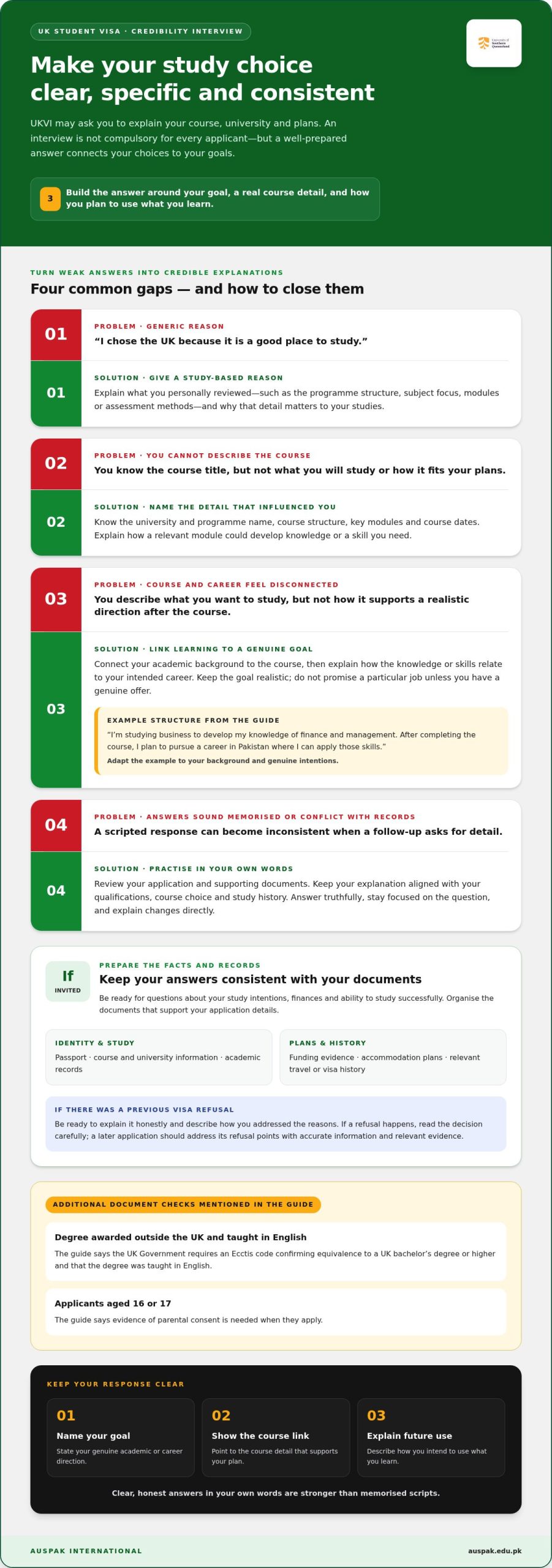
When asked, “Why did you choose the UK?”, connect your answer to your studies, such as the programme structure or subject focus. Then explain why that university suits your goals. Refer to details you personally reviewed, including published modules, assessment methods or practical learning. Avoid general claims about the UK or saying the university is “perfectly” suited without explaining why.
A sample answer could be: “I found this programme while comparing UK university course pages with my previous studies in business. I chose this university because its course includes marketing strategy and data analysis. Those subjects fit the skills I want to develop for a marketing career in Pakistan.” Adapt the example to your academic history and programme. Don’t memorise it word for word.
Know the course structure, key modules and course dates shown in your university information. Explain how a relevant module develops knowledge or skills you need. Link that learning to a realistic career direction, rather than promising a particular job. If asked about tuition fees, know the amount stated in your course documents and how it fits your funding plan.
Review your application and supporting documents before the interview. Your explanation should align with your qualifications, course choice and study history. If you use a degree awarded outside the UK and taught in English, the UK Government requires an Ecctis code confirming equivalence to a UK bachelor’s degree or higher and that it was taught in English. According to the UK Government, applicants aged 16 or 17 need evidence of parental consent when they apply.
Practising UK student visa interview questions and answers for Pakistanis works best when you use facts about your own course. Note the research that influenced your choice, then practise explaining it aloud. Keep answers focused: say what you learned, identify the course detail that mattered and connect it to your career plans. This makes your response clear without sounding scripted.
2. Is UK Student Visa Interview Compulsory?
A UK Student visa applicant may be asked to complete a credibility interview with a UKVI officer. An in-person interview isn’t mandatory for every applicant, and the possibility can depend on nationality, application type and visa history. Prepare for questions about your study intentions, finances and ability to study successfully, even if you haven’t been invited yet.
For an interview, organise current documents that support the details in your application. Keep your passport, course and university information, academic records, funding evidence, accommodation plans and relevant travel or visa history accessible. Your answers should match those records. If you’ve had a previous visa refusal, be ready to explain it honestly and describe how you addressed the reasons.
Be specific about your academic and career goals. Explain what you plan to do after your course and how the qualification supports that direction. If you plan to return to Pakistan, connect your studies to a realistic career goal there. For example, a student pursuing a computing degree could explain how its subject knowledge relates to the kind of technology work they hope to pursue after graduation. Avoid promising a particular job unless you have a genuine offer.
A strong answer gives a clear sequence: name your goal, show how the course supports it, and describe how you intend to use what you learn. For example: “I’m studying business to develop my knowledge of finance and management. After completing the course, I plan to pursue a career in Pakistan where I can apply those skills.” Adapt the answer to your academic background and genuine intentions.
Common red flags include answers that conflict with your application, vague reasons for choosing a university and not knowing what you’ll study. Memorised scripts can also sound inconsistent when a follow-up question asks for detail. Answer truthfully, stick to the question and explain any change in your academic history or plans directly.
If an interview is unsuccessful and your application is refused, read the decision and its reasons carefully. A later application should address the refusal points with accurate information and relevant evidence. Whether an appeal is available depends on the decision and the grounds involved. Don’t assume an appeal or a new application is automatic.
Before the interview, review your application from start to finish. Practise explaining your course, funding, accommodation and career plans in your own words. Check that your documents are organised and your answers agree with them. Clear, concise responses help the officer understand why you chose this programme and how it fits your academic and career goals.
3. Funding tuition and living expenses
Expect questions about who will pay your tuition fees and living costs, where the funds come from and how you’ll manage your budget. Give a clear account that matches your application and supporting documents. Identify each funding source, such as personal savings, a parent’s sponsorship, a scholarship or financial aid, and explain how it contributes to your studies.
Before the interview, make a simple budget using your actual course and accommodation information. Separate tuition from housing, food, transport and other living expenses. Know which costs are already paid, which remain due and who is responsible for each. If a parent is your sponsor, explain your relationship, their role in funding your course and your understanding of the arrangement.
For example, you might say: “My father is sponsoring my studies. He’ll contribute to my tuition and living expenses, and I’ve brought the documents that show the funding arrangement.” Use this only if it reflects your situation. If you’re using savings or a scholarship, name the source and explain what it covers. Don’t describe a scholarship as full funding if it covers only part of your costs.
Prepare to explain your accommodation plan alongside your budget. State whether you intend to use university accommodation or another arrangement, and show that you’ve considered its cost in relation to your available funds. If your plans have changed since applying, explain what changed and how you’ve adjusted your budget. A specific explanation is more useful than saying you’ll “manage somehow.”
Keep supporting paperwork for each funding source organised. Match the names, amounts and dates in your explanation to the documents you’re presenting. If a parent or another sponsor is paying, don’t present their funds as your personal savings. Be ready to describe the sponsor’s contribution accurately and answer follow-up questions about where the funds came from.
Don’t present part-time work as the main way you’ll pay for your course. Explain that studying is your priority, and describe any work only in line with your visa conditions and as a possible contribution to living expenses. Don’t build your budget around work opportunities you haven’t secured. Your tuition plan and essential living costs should have a credible funding source independent of uncertain future income.
A practical rehearsal is to answer three questions aloud: “Who is funding your studies?”, “Where does the money come from?” and “How will you cover accommodation and living costs?” Keep each answer direct, then add a relevant detail from your documents. Honest, consistent answers help show that you understand your financial plan and can focus on your course.
4. University facilities, teaching and community involvement
Prepare to explain why your chosen UK university fits your course, not just why you want to study abroad. Review its official course page and identify teaching methods that matter to your subject, such as laboratory sessions for science or studio work for design. Then connect a relevant feature to how you plan to learn. This shows that your choice reflects academic preparation rather than a general preference for the UK.
Research the university’s facilities through its official website and course information. Focus on resources linked to your programme, such as specialist equipment, a library collection, a clinical simulation space or careers guidance. Don’t list facilities without explaining their relevance. For example, a student choosing a science course could explain how laboratory access supports practical learning. Refer only to facilities you found in information about your university.
Teaching and assessment are also useful details to understand. Check whether your course describes lectures, seminars, group projects, placements or independent study. A credible response explains how those methods suit your academic goals. For example: “I expect to learn through seminars and individual research. That structure will help me develop my subject knowledge and communicate my findings clearly.” Adapt the answer to the methods your course actually uses.
Learn about the city where your university is based, too. Use the university’s location and student information to understand the campus setting, transport options and local study environment. If asked why you chose that city, connect your answer to practical considerations or university life rather than making unsupported claims. Your response should fit your accommodation plan and the location stated in your application.
Community involvement can show that you’ve considered life beyond lectures. Look at student societies, cultural groups or volunteering opportunities described by your university. Choose an example that genuinely interests you, then explain how you might participate while keeping studies as your priority. Don’t claim you’ve joined a group before arriving. A simple answer could be: “I’m interested in the university’s debating society because it would help me practise public speaking.”
Be prepared to discuss semester breaks. Explain whether you plan to return to Pakistan or remain in the UK, and give a truthful reason. For example, you might say you plan to visit family in your home country, or stay in the UK to rest or continue course-related work. Keep your answer consistent with your travel history, accommodation arrangements and academic calendar. Don’t invent a trip or activity to make your answer sound more convincing.
Before an interview, write brief notes on your university’s teaching approach, relevant facilities, student community and city. Practise explaining each choice in your own words. Specific preparation helps you answer follow-up questions clearly and show that you’ve researched the university you plan to attend.
5. Whether a UK student visa interview is compulsory
A UK Student visa interview isn’t compulsory for every applicant. UKVI may ask you to complete a credibility interview, but an in-person interview isn’t mandatory for every application. Whether you’re interviewed can depend on your nationality, application type and visa history. The practical takeaway is simple: prepare as if you may be invited, but don’t assume every applicant attends one.
A credibility interview helps an officer assess your study intentions, financial circumstances and ability to study successfully in the UK. Questions may cover your course, university, funding, accommodation and plans after graduation. Your answers should show that you understand your own application. For example, be prepared to explain why you selected your course and how you’ll meet its academic demands.
Don’t wait for an interview invitation to review your application. Check that you can explain the information you submitted, including your course dates, tuition arrangements and where you plan to live. If you listed a sponsor, know who they are and what they’re funding. If you have relatives in the UK, be honest about the connection and explain that study is your main reason for travelling.
Prepare brief notes, not a memorised script. Include the course name, university, relevant modules, funding source, accommodation plan and career direction. Practise answering aloud in your own words. If the officer asks a follow-up, answer that point directly instead of repeating a prepared paragraph. Consistency matters: your spoken explanation should agree with your application and supporting documents.
Previous travel or visa history may also come up. Give truthful, consistent answers about earlier visits and UK visa applications. If you’ve had a visa refusal, explain the circumstances honestly and how you addressed the reasons. Don’t hide a relevant detail or guess at information. If you need a moment to recall a date or document detail, answer carefully rather than inventing a response.
For the interview, follow the appointment instructions, arrive prepared and keep supporting documents organised and readily available. Speak clearly to the officer and answer the question asked. You can prepare for likely topics without claiming to know the exact questions in advance. A clear account of your plans is more useful than polished but inaccurate wording.
Pakistani applicants who want structured support with their application and interview preparation can explore UK student visa guidance. Use the preparation to understand your documents and explain your genuine study plans confidently.
AusPak International: Australian University Admission Support
AusPak International provides UK Student Visa Consultancy for Pakistani students preparing their applications and interview responses. Turn to this support when you need help understanding the visa process and organising your next steps. If you’re considering study in Australia instead, AusPak International also offers Australian University Admission Support; Canada Study Permit Assistance and Onshore Arrival Support are available for students pursuing those pathways.
Use this guidance to review your study plans, application details and supporting documents, then prepare to explain your genuine reasons for studying abroad. The right next step depends on your destination and where you are in the application process.
For guidance with your study plans, contact AusPak International or visit auspak.edu.pk.
Take Your Next Study Step with Confidence
Your interview preparation can be a practical starting point for a well-planned study journey. Use your notes to identify gaps in your course knowledge, funding plan or application documents, then resolve them before your next application step. Preparing for UK student visa interview questions and answers for Pakistanis isn’t about memorising a perfect script. It’s about understanding your plans well enough to explain them honestly and consistently.
If you’d like guidance with the process, AusPak International offers UK Student Visa Consultancy for Pakistani students. Its services also include Australian University Admission Support and Canada Study Permit Assistance for students considering different study destinations. Choose guidance that fits your destination and current stage, and keep your own goals at the centre of each decision.
Contact AusPak International for guidance as you plan your next step. A clear plan can help you move forward with purpose.
Frequently Asked Questions
Do you have any relatives in the UK?
Answer yes or no truthfully, then explain the relationship and whether it affects your plans. If you have an aunt in the UK, for example, say so plainly. Don’t hide the connection or present it as the reason for travelling if study is your main purpose. Keep your response consistent with your application and explain how you’ll manage your studies independently.
Do you plan to return to your home country?
Explain your genuine plans after studying, including whether you intend to return to Pakistan and how the qualification could support your career there. For example, describe the type of work you hope to pursue and which course skills may be relevant. Don’t claim a job is secured unless it is. Your answer should reflect your real intentions, not what you think an interviewer wants to hear.
Have you applied for a UK visa before?
Answer accurately and include relevant previous UK visa applications, whether approved or refused. If you experienced a refusal, explain its reason as you understand it and what has changed or been addressed since then. Don’t omit an application because it was unsuccessful. Review your travel and visa history beforehand so you can give a consistent account without guessing dates or details.
Have you made any accommodation arrangements in the UK?
Describe your current plan clearly, distinguishing between a confirmed booking and accommodation you’re still arranging. For example, name the type of housing you intend to use and explain how you researched its location in relation to your university. Be ready to discuss the expected cost and how it fits your budget. Don’t describe a tentative option as a completed booking.
How did you learn about the university and course?
Describe the research that led you to the programme, such as comparing university course pages or reviewing entry requirements. Then give one detail that influenced your choice, such as a module related to your academic interests. For instance, you might mention that a course’s research focus matched a subject you studied previously. Keep the example true to your application.
How will this course help you in your career?
Connect a skill or subject area in your course to a realistic career direction. For example, a student taking a data-focused business programme could explain how analytical skills relate to their intended field in Pakistan. Describe how the course supports your development rather than promising a specific salary or job outcome. Your response should make sense alongside your education history and stated plans.
How will you sponsor your studies in the UK?
Name the person or source funding your studies, then explain what it will cover. If a parent is sponsoring you, state your relationship and describe their contribution; if you’re using savings or a scholarship, identify that source accurately. Keep the explanation consistent with your financial documents. Don’t describe another person’s savings as your own or rely on unconfirmed work income as your main funding plan.
Is a UK Student visa interview compulsory?
No, an in-person interview isn’t mandatory for every applicant, though a UKVI officer may ask you to complete a credibility interview. Whether you’re interviewed can depend on your nationality, application type and visa history. Prepare for questions about your studies and intentions even if no interview is guaranteed. If invited, follow the appointment instructions and answer based on your actual application.