
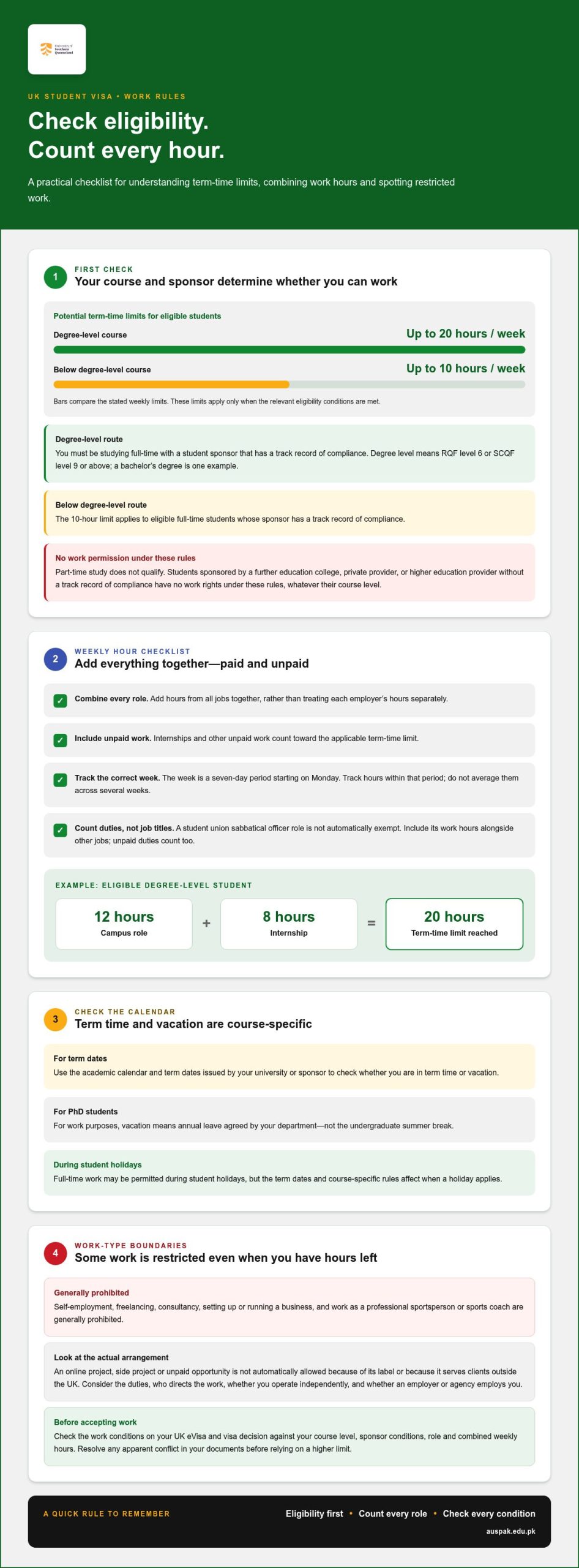
Yes, you can work in the UK on a Student visa, but the part-time work restrictions on a UK Student visa depend on your course level and sponsor. During term time, eligible degree-level students can work up to 20 hours a week; eligible students studying below degree level can work up to 10 hours a week.
It’s understandable to focus on the weekly limit, but staying within it also means counting hours across all jobs and unpaid work. Your course schedule and the type of role matter too, since some activities are prohibited even when you have hours available.
This guide explains who can work, when full-time work may be allowed, and how to count hours across paid and unpaid roles. It also covers restrictions on self-employment, professional sport and other work, so you can make informed plans before accepting a job.
Key Takeaways
- Eligible degree-level students can work up to 20 hours a week during term time; eligible students studying below degree level can work up to 10.
- Add hours from every job and unpaid work together, and don’t average them across weeks.
- Self-employment, freelancing, and work as a professional sportsperson or sports coach are generally prohibited.
- Full-time work may be permitted during student holidays, but term dates and course-specific rules affect when a holiday applies.
- Your course level and the type of student sponsor determine whether you have work permission and which limit applies.
Can I work as a Student Union Sabbatical Officer?
A Student Union sabbatical officer role doesn’t, by its title alone, establish how many hours you may work. The relevant limit depends on your Student visa work conditions, course level and sponsor. For eligible students studying a degree-level course, the term-time limit is 20 hours per week; for eligible students below degree level, it’s 10 hours per week.
Degree level for these work-hour rules means a qualification at RQF level 6 or SCQF level 9 or above. A bachelor’s degree course is one example of degree-level study. The 20-hour limit applies only when the Student visa holder is studying full-time with a student sponsor that has a track record of compliance.
Below degree level, the 10-hour limit applies to eligible full-time students whose sponsor has a track record of compliance. Students sponsored by a further education college, private provider, or higher education provider without that track record have no work rights under these rules, whatever their course level. Part-time study also doesn’t qualify for the work permissions described here.
Paid and unpaid work both matter. An internship, for example, counts toward the applicable 10- or 20-hour term-time limit, even if it offers no salary. If a sabbatical officer role involves work, include its hours when calculating the weekly total rather than treating the position’s title as an exemption.
To check whether your course is in term time or vacation, consult the academic calendar and term dates issued by your university or sponsor. PhD students should treat vacation differently: for work purposes, it means annual leave agreed by their department, not the undergraduate summer break.
Check the work conditions on your UK eVisa and visa decision before accepting hours beyond your usual schedule. Your 90-day travel vignette or eVisa should show restricted work permission; compare its wording with your course and sponsor conditions. If the documents appear to conflict, get the discrepancy resolved before relying on a higher limit.
For example, an eligible degree-level student working 12 hours in a campus role and 8 hours in an internship reaches the 20-hour term-time limit. A sabbatical officer role must be considered alongside any other work, and unpaid duties count too. The week is a seven-day period starting on Monday, so track shifts within that period instead of averaging hours over several weeks.
These distinctions are central to the part-time work restrictions for a UK Student visa: your course level sets the potential limit, while sponsor eligibility and visa conditions determine whether work is permitted. Check all three before accepting a role, including a student union position.
Prohibited self-employment and business activity
A UK Student visa generally doesn’t allow self-employment or setting up a business. This includes freelance work, consultancy and running a business while studying, even if the activity takes place online or serves clients outside the UK. The restriction concerns the work arrangement, not simply whether you receive payment.
For example, a student who invoices for graphic design projects as a freelancer is self-employed. The same applies to a student providing paid consultancy independently. Casual work may also fall outside the permitted employment route if the student isn’t on an employer’s or agency’s employee payroll. Permitted employment must still be assessed against the visa conditions and applicable work-hour limits.
Work can count even without wages. UKVI treats paid and unpaid work, course-related placements, business activity, self-employment and professional activity as work. Calling an arrangement an internship, side project or unpaid opportunity doesn’t by itself remove the restriction. Consider the actual duties and relationship: who directs the work, whether you operate independently, and whether an employer or agency employs you.
A specific exception applies from 25 November 2025. People endorsed for an Innovator Founder visa who have applied for that route fall within the stated exception to the self-employment restriction. It doesn’t create a general permission for other international students to freelance or establish companies.
Employers also have responsibilities. Before employment begins, a UK employer must check the student’s right to work, including any applicable hours restriction. A student’s permission to work isn’t unlimited just because a college or company offers a role. The student’s status and visa conditions still determine what work is allowed.
Breaching work conditions can have serious consequences. A student who exceeds permitted hours or undertakes prohibited work could be prosecuted, required to leave the UK before completing their studies, and prevented from obtaining another visa in the future. A breach may also lead the Home Office to cancel permission. The stated maximum penalty includes imprisonment of up to six months or an unlimited fine.
Employers face separate exposure. A business can face a civil penalty of up to £60,000 for each illegal worker. If an employer knew or had reasonable cause to believe the student was working illegally, the stated consequences can include up to five years’ imprisonment and an unlimited fine. These risks make accurate right-to-work checks and clear employment arrangements essential.
Before accepting a freelance project, forming a company, or taking casual work, distinguish independent activity from employment on an employer’s or agency’s payroll. If your plans involve a UK Student visa application, UK Student Visa Consultancy can help you understand visa requirements before you make study and work plans.
Calculating hours across multiple jobs and unpaid work
Count every job together, not separately. If your term-time limit is 20 hours per week, a campus shift, a second employer’s rota and an internship all use the same weekly allowance. Unpaid work counts too, so an unpaid placement doesn’t create extra hours outside your visa conditions.
For example, a student working 12 paid hours in a café, five hours in a university role, and three unpaid internship hours reaches 20 hours. Adding another shift would take the total over that limit. Keep a record of actual hours worked across each role, including unpaid duties, rather than relying only on contract hours or scheduled shifts.
The relevant week is any seven-day period starting on a Monday. Student visa holders can’t average permitted hours across weeks. Working fewer hours one week doesn’t create extra hours for the next. Track each Monday-to-Sunday period separately, including work for every employer and organisation.
Use a simple weekly record with the date, employer or placement, and hours worked. Add the entries before accepting another shift. For instance, if your first job uses 14 hours and an unpaid internship uses four, only two hours remain under a 20-hour limit that week. This running total helps prevent an apparently small extra duty from exceeding the cap.
Work-hour limits aren’t the only restriction. A Student visa holder can’t fill a permanent full-time vacancy, even if the employer offers the role during a holiday. A fixed-term contract outside term may allow full-time hours if it ends on a specified date, but it must still comply with the visa conditions.
Can a UK Student visa holder work full-time after completing their course? Yes. After the course formally ends, they may work full-time while the visa remains valid, provided the job isn’t a permanent vacancy. The course’s formal end date matters: finishing classes or examinations earlier doesn’t necessarily mean the course has ended.
Some roles have separate restrictions regardless of available hours. Student visa holders generally can’t work as doctors or dentists in training unless they’re on a recognised foundation programme. A placement that isn’t an assessed, integral part of the course also remains subject to the weekly work limit.
The Home Office may question a student’s working hours if their earnings appear higher than those of most students. Immigration compliance therefore involves both hours and the nature of the work. Before accepting a second job or extra duties, add up paid and unpaid time, check whether the role is permitted, and confirm it isn’t a prohibited permanent vacancy.
Prohibited professional sport and entertainment work
A UK Student visa doesn’t allow an international student to work as a professional sportsperson or entertainer. This restriction applies even if the role fits within the student’s available work hours. A degree, postgraduate course or vacation period doesn’t remove it.
Sport-related work includes employment as a professional sports coach. The restriction can also apply because of a person’s sporting history, not only their current job title. A student registered with a professional or semi-professional sports team during the previous four years may fall within the restriction. Academy and development squads count as part of this history.
Past representation matters too. The restriction covers people who represented a national, state, or regional team during the previous two years, from under-17s upwards. For example, a student who represented a regional under-17 team within that period should consider this history before accepting professional sport work. The same applies to national and state teams.
Having a sporting agent also matters. The restrictions cover people who have engaged a sporting agent in the last twelve months. When assessing a paid playing, coaching or entertainment opportunity, consider your recent team registration, representative history and agent relationship, as well as the proposed duties.
These limits differ from the general permission to undertake most types of work. Student visa holders may do many ordinary jobs, including hospitality work or labouring, subject to their visa conditions. But available hours don’t make professional sport or entertainment work permissible. The nature of the role remains decisive.
Look beyond the employer’s name. A university, sports club, event company or production business may offer different kinds of roles. The key question is whether the duties amount to work as a professional sportsperson, sports coach or entertainer. A general administrative job at a sports venue differs from playing professionally, but the actual responsibilities must fit that distinction.
Before accepting an offer, read the job description and identify the expected duties, team status and professional commitments. Then compare those details with your sporting history, including academy or development squad registration within the previous four years and team representation within the previous two. A casual label, unpaid arrangement or limited schedule doesn’t exempt you from the restriction.
For postgraduate students and others balancing studies with an opportunity, separate two questions: is the type of work permitted, and do its hours fit the visa limit? Both conditions apply. If an opportunity involves professional sport or entertainment, having room within a weekly limit doesn’t override the prohibition.
Restrictions and exceptions to permitted work
A UK Student visa work permission depends on more than the term-time hours allowance. Course status, sponsor type, scheduled study periods and the nature of the role all matter. For example, a student sponsored by a further education college, private provider or higher education provider without a track record of compliance has no work rights, regardless of course level.
Eligible students subject to the 20-hour rule may work full-time during student holidays. For undergraduates and taught master’s students, work beyond 20 hours is allowed outside full term time or an applicable extended term, subject to scheduled course work. The institution’s calendar helps identify relevant periods. A PhD student’s vacation for work purposes is annual leave agreed by their department, not the usual undergraduate summer holiday.
Course placements have a separate exception. A placement must be planned and arranged as an assessed course component, integral to the course, and referred to on the Confirmation of Acceptance for Studies. Qualifying degree-level courses at compliant higher education providers may allow placements up to 50 per cent of the course. The cap can also apply to study abroad programmes or longer placements required by UK statute.
An assessed, integral placement may be full-time while the student also works up to 20 hours per week in other employment. That exception does not automatically cover an ordinary internship or work experience. A placement that isn’t assessed and integral remains subject to the weekly work limit, so its label alone doesn’t determine the applicable permission.
Other restrictions apply even during vacations. Some work restrictions may apply to Student visa holders. They’re also prohibited from working as a doctor or dentist in training unless they’re on a recognised foundation programme. A student can’t work for a company where they hold 10% or more of its shares, including shares held in trust, or where they hold a statutory role such as director.
Separate visa routes carry different permissions. A short-term study visa doesn’t permit employment, although its holder may volunteer under the applicable conditions. A Student visa holder’s permission is governed by their visa conditions, so graduation alone doesn’t create unrestricted work rights. After a course formally ends, full-time work may be permitted while the visa remains valid, but not in a permanent vacancy.
Before accepting an offer, compare its duties and contract with your course schedule, sponsor, and visa conditions. For an eligible graduate, a Graduate visa is a separate route: eligible bachelor’s or master’s graduates may work for up to two years after graduation, and eligible PhD graduates for up to three years. If you’re planning study in Canada instead, explore Canada Study Permit Assistance for support with that distinct permission process.
AusPak International: Australian University Admission Support
AusPak International can support your study plans from Pakistan. Its UK Student Visa Consultancy is relevant when you’re preparing a UK study application and want guidance on visa requirements, including conditions that shape work permission. Understanding those rules before departure helps you plan employment around your studies.
If you’re considering another destination, AusPak International also provides Australian University Admission Support and Canada Study Permit Assistance. For students who have secured a place abroad and are preparing to settle in, Onshore Arrival Support can help with the transition after arrival.
Choose support that matches your destination and stage of planning. Contact AusPak International to discuss your study-abroad plans.
Plan your next step with clarity
Your study destination shapes more than your course choice. It also influences how you plan your career goals, finances and transition into student life. Consider the experience you want after graduation, then align your education plans with the visa conditions for that destination. A clear plan can help you make decisions before deadlines and commitments narrow your options.
Understanding the part-time work restrictions for a UK Student visa is one part of preparing to study abroad. AusPak International offers UK Student Visa Consultancy, Australian University Admission Support and Canada Study Permit Assistance for students exploring these pathways. Choose guidance that fits your destination and stage of the application process.
Take the next step by contacting AusPak International for support. Bring your study plans into focus and move forward with confidence.
Frequently Asked Questions
Can I work in the UK?
Yes, if your immigration permission allows it and you meet the Student visa work conditions. The work rules discussed here apply to international students studying full-time; course level and sponsor status affect eligibility and hours. A visitor cannot work in the UK. Before accepting a role, consider both the kind of work and your current study status, since permission to work isn’t automatic for everyone entering the country.
Are You Allowed to Work Part-Time on a UK Student Visa?
Yes, eligible Student visa holders can work part-time during term time. The applicable limit is 20 hours a week for qualifying degree-level study, or 10 hours a week for eligible study below degree level. Your sponsor must meet the relevant compliance conditions. Treat internships and other unpaid work as work when planning shifts, and include them in your total rather than viewing them as extra time outside your allowance.
Full-Time Work During Holidays: Allowed or Not?
Eligible Student visa holders can work full-time during official student holidays. Use your university’s published academic calendar to identify these periods rather than assuming a gap between classes is a vacation. For a PhD student, work-related vacation means annual leave agreed by the department, not automatically the undergraduate summer break. Scheduled work or an extended term can affect whether full-time work is permitted.
What Types of Jobs Are Allowed?
Eligible Student visa holders can take many ordinary jobs, including hospitality work or labouring, subject to their visa conditions and weekly limit. They may work for an employer that doesn’t hold a sponsor licence. For example, a student might take an employee role in a café, provided the hours fit their permission. The actual duties and employment arrangement matter, not just the job title or workplace.
What would happen to my work permission if I suspended study or withdrew from my course?
Your Student visa work permission is based on full-time study, so a suspension or withdrawal can change the basis on which you were allowed to work. Don’t assume your previous work allowance continues unchanged after your course status changes. For example, if you pause your studies, consider whether you still meet the full-time study condition before continuing shifts. Working outside your visa conditions can have immigration consequences.
How many hours can UK Student visa holders work during term time?
Eligible degree-level students can work up to 20 hours a week during term time, while eligible students below degree level can work up to 10 hours. A week means a seven-day period starting on Monday, and hours can’t be averaged across several weeks. If you work for more than one employer, add each role’s hours for the same week to understand your total.
What are the UK Student visa work rules during official university vacations?
Eligible students may work full-time during official vacations, subject to their visa conditions and course schedule. The university’s term dates determine when a vacation applies; a study break or a few days without classes doesn’t necessarily qualify. PhD students should use departmental-approved annual leave. After a course formally ends, full-time work may be possible while the Student visa remains valid, but permanent full-time vacancies remain prohibited.
Which types of work are prohibited on a UK Student visa?
Student visa holders generally can’t be self-employed, freelance or establish a business. They’re also prohibited from working as professional sportspersons, sports coaches or entertainers, and from filling permanent full-time vacancies. Work as a doctor or dentist in training is prohibited unless it’s part of a recognised foundation programme. A role can remain prohibited even when you have unused hours, so assess the work itself as well as its schedule.