
Credit transfer across borders is assessed course by course, not granted automatically because you’ve completed a similar degree stage. When transferring university credits internationally, universities consider whether your previous institution is recognized, how your courses and learning outcomes compare with their curriculum, and your academic record. For students at HEC-approved universities in Pakistan, some UK and Malaysian universities may offer second- or third-year entry.
It’s understandable to want a clear answer before committing to graduate study abroad, especially when transferring university credits internationally can affect your study plan. This guide explains how universities assess international credits, which academic records support a request, and why institutional recognition and course equivalency matter. You’ll also learn how to approach study-abroad credit requests and consider the options available to Pakistani students.
Key Takeaways
- Transfer rules vary by destination and university, so entry level depends on the institution’s policy and your completed coursework.
- Course syllabi, assignments, and learning outcomes can help admissions teams compare your previous study with their curriculum.
- Institutional recognition matters: some universities assess undergraduate credits only from institutions recognized by the relevant national authority or accrediting body.
- For study-abroad credits, align courses with your degree requirements and understand the receiving university’s approval process before you enrol.
- For an Australian study pathway, AusPak International’s university admission support can help you navigate application processing.
Country-specific university transfer flexibility
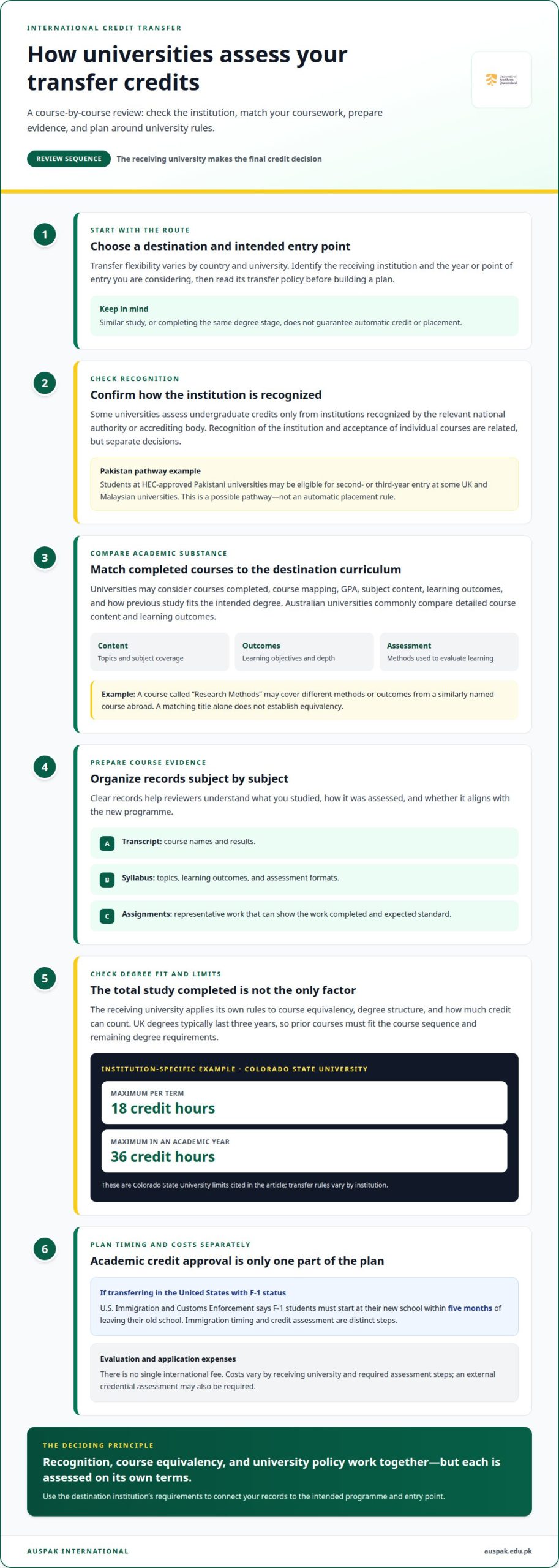
Transfer flexibility depends on the destination country and the receiving university’s rules. Compare degree structure, course requirements, academic performance, and any immigration deadlines before choosing a transfer route.
National Transfer Policies
National transfer policies are the country- and university-level rules that shape how previous study may count toward a new degree. In the United States, Canada, Turkey, and Australia, credit decisions depend on university policies, completed courses, course mapping, and GPA. Similar coursework can therefore receive different outcomes at different institutions.
Compare the receiving university’s rules before planning a transfer. Colorado State University, for example, accepts no more than 18 credit hours per term and 36 credit hours in any academic year. Those limits show why the total amount of completed study is not the only factor. A student also needs to understand how the institution applies its own limits to the proposed transfer.
Degree structure also affects timing. UK degrees typically last three years, which can make transfer timing more challenging. Students entering after previous study need to match completed courses to the receiving course sequence and remaining degree requirements. An entry point that seems suitable based on year alone may not fit the curriculum.
For a U.S. transfer involving F-1 status, immigration timing is another separate consideration. U.S. Immigration and Customs Enforcement says F-1 students must start at their new school within five months of leaving their old school. Credit assessment and immigration timing are distinct steps, so students should plan both rather than treating academic approval as the only requirement.
Pakistan HEC Credit Rules
For international transfers involving Pakistan, HEC approval is relevant to the recognition of a Pakistani home institution. Students at HEC-approved local universities may be eligible to transfer credits to UK and Malaysian universities for second-year or third-year entry. This is a possible pathway, not an automatic placement rule.
For a Pakistani student bringing credits from a foreign university into Pakistan, HEC approval alone does not determine whether those courses count toward a particular degree. The receiving university’s policy and assessment of completed courses decide how credits apply. Recognition of an institution and acceptance of individual courses are related, but separate decisions.
Start by identifying your destination and proposed entry point, then review the university’s transfer policy. For applications to UK or Malaysian universities from an HEC-approved Pakistani university, clarify how previous courses relate to the intended year of entry. For study in Australia, course assessment commonly involves detailed comparisons of course content and learning outcomes. Keep the destination’s academic requirements central throughout.
Before making a transfer plan, organize your transcript and course information for the receiving university’s review. A country’s general approach can help set expectations, but the institution’s policy determines which completed study fits its degree structure. Treat country rules as a starting point, then compare each course with the intended programme’s requirements.
International credit evaluation and course equivalency
There is no single international fee for evaluation and transfer applications. Expenses depend on the receiving university and the required assessment steps. Credit decisions also depend on subject content, learning outcomes, academic records, and how previous study fits the intended degree.
Course Equivalency Review
Course equivalency review compares completed coursework with the receiving university’s requirements. Universities in the USA, Canada, Turkey, and Australia apply their own policies, considering courses completed, course mapping, and GPA.
Australian universities commonly compare course details and learning outcomes. A course title alone may not show whether a subject covered the same material or reached comparable academic depth. Reviewers may examine topics, learning objectives, and assessment methods against the destination course.
For example, a previous course called “Research Methods” may cover different methods or outcomes from a similarly named course abroad. The university compares academic substance and degree relevance, not just matching labels. GPA is also one consideration in transfer decisions across the named destinations.
Course Records for Assessment
Course records help a university assess the content and rigour of completed study. A transcript lists course names and results, while syllabi describe topics, learning outcomes, and assessment formats.
Assignments can provide further evidence of the work completed and the expected standard. Keep relevant syllabi, assignments, and other course materials organized by subject. This makes it easier to link each completed course to the corresponding destination requirement.
A useful preparation step is to group documents by course rather than sending unrelated files together. For each subject, include its syllabus and representative assignments where available. Clear records help reviewers understand what you studied, how it was assessed, and whether it aligns with the new programme.
Evaluation and Application Costs
Evaluation and application costs are charges for reviewing credentials and submitting a transfer request. The total varies according to the receiving university’s process and whether it requires an external credential assessment.
Potential expenses may include an application charge, an external evaluation, or document preparation such as translation. The applicable costs depend on the destination and the documents required for your application. Transfer processes can differ between universities, even within the same country.
Build a cost checklist around the actual steps: application submission, credential assessment if required, and document preparation. Separate these items to see which expenses come from the university and which relate to supporting records. Don’t assume one quoted evaluation covers every part of a transfer application.
Preparing a Transfer Request
A transfer request formally asks a university to assess previous study for possible degree credit. Organize your transcript, syllabi, learning outcomes, and relevant assignments before preparing the application.
Next, map each completed course to a destination requirement. Note where the subject matter and learning outcomes align, and flag differences the reviewer may need to assess. Include GPA information and follow the receiving university’s submission process.
For an Australian application, review your Australian study options as you plan the admission route alongside your academic records.
Recognition of international institutions
Institutional recognition is the receiving university’s assessment of whether your previous institution meets acceptable academic or regulatory standards. It is a threshold question: credit review may depend on the status of the institution where you studied.
Colorado State University generally considers undergraduate transfer credit from international tertiary institutions only when the institution is recognized by its home country’s ministry of education or a similar accrediting body. This example shows why a university’s reputation or course titles alone may not establish eligibility. The receiving institution also considers recognition within the relevant national framework.
For a Pakistani applicant, distinguish the status of the previous institution from that of individual courses. HEC approval relates to Pakistani universities, while a foreign institution’s recognition is considered in its own national context. A Pakistani student transferring from an overseas university should understand which authority or accrediting body recognizes that institution in its home country.
Recognition and credit equivalency are separate stages. An institution may meet the receiving university’s recognition criteria, but that does not mean every course will count toward the new degree. The university still considers completed courses, their relevance, and its transfer policy. Recognition may establish that an institution is eligible for consideration, while a course-by-course review determines how specific study applies.
Prepare a clear record of where each qualification was completed. Include the institution’s full name as it appears on academic records, the country, and the programme details shown on your transcript. If names differ across documents, use the records to explain the connection rather than assuming the reviewer will identify it. Keep documents grouped by institution, especially if your education includes more than one campus or provider.
Use this sequence to organize a recognition review:
- Identify the institution that awarded or delivered the previous study.
- Determine the relevant home-country ministry or similar accrediting body.
- Present academic records that connect the institution name with your completed programme.
- Review the receiving university’s recognition criteria before interpreting course outcomes.
If you’re moving between Pakistan and another country, don’t treat one country’s recognition decision as universal. Recognition by a home-country authority can support an application, but the destination university applies its own admission and transfer requirements. Colorado State University’s approach is one institutional example, not a rule for every destination.
Once you understand the institution’s status, assess individual courses against the intended degree. Keeping these decisions separate helps clarify whether your transfer question concerns the institution, a particular course, or both.
Graduate study-abroad credit requests
A study-abroad credit request asks a university to count coursework completed through an overseas programme toward a degree. For graduate students, planning starts with the home university’s transfer policy, since requirements vary between institutions.
Begin before selecting a programme. Discuss your plan with an academic advisor and ask about the university’s procedures, required documents, and course approval process. An early conversation can help you determine whether proposed coursework supports your graduate degree or falls outside its requirements. It also gives you time to choose a programme that fits your academic plan.
Course relevance is central. Select subjects that complement your major or fulfil a specific degree requirement, rather than choosing a programme solely for its location. For example, a graduate student in an environmental field could look for overseas courses addressing relevant topics in their study plan. The receiving university assesses each course against its own requirements, so broad subject similarity alone does not establish a match.
Accreditation is another key consideration. It indicates that a study-abroad programme’s courses meet academic criteria, which can support credit-transfer assessment. Recognized academic standards give the university a basis for evaluating course quality. Accreditation does not replace the home university’s review: course content and degree relevance still matter.
Use this sequence to prepare a stronger request:
- Review your home university’s credit-transfer policy and approval procedure.
- Discuss the proposed programme with your academic advisor early.
- Choose courses connected to your major or graduate degree requirements.
- Consider accredited programmes and any existing university partnerships.
- Keep course descriptions and relevant academic records together for review.
Partnerships can make the process more straightforward. Some universities have agreements with study-abroad programmes that support credit transfers. If a programme is connected to your university, ask your academic advisor how that relationship fits the institution’s process. A partnership can clarify the route, but course selection should still align with your degree plan.
Short-term study abroad needs the same advance planning as a longer academic exchange. Requirements vary between universities, so a decision from one institution cannot be assumed to apply at another. Keep the intended destination, course content, academic standards, and graduate requirements in view as you develop your request.
For Pakistani students planning graduate study abroad, a practical first step is to map proposed courses to degree requirements and discuss the plan with an academic advisor. Starting early helps identify relevant programmes and the procedures that shape a credit request.
International university credit transfer options
Transfer pathways include direct university applications, formal partnerships, and study routes using shared credit frameworks. There is no universal credit total: acceptance depends on the receiving university’s policy and course assessment.
Credits may be lost when courses don’t match degree requirements or institutional recognition standards. Unmatched prerequisites and course sequences can also extend the time needed to graduate.
International Transfer Pathways
An international transfer pathway is a route for carrying completed study into a degree at another university or destination. The European Credit Transfer and Accumulation System (ECTS) is widely accepted globally for study-abroad credit transfer.
ECTS can provide a shared framework for describing study, but the receiving university still applies its own transfer policy. Another option is a formal partnership between universities or between a university and a study-abroad programme. These arrangements can make credit transfer more straightforward by clarifying the academic route.
For a Pakistani student considering study abroad, compare pathways by their academic structure. With a direct transfer, the destination university assesses previous courses. A partnership may connect the student’s current institution with a receiving programme. A study-abroad route may allow selected overseas courses to count toward an existing degree.
Each route serves a different goal. Direct transfer suits students seeking to continue their degree elsewhere. Partnerships can establish an agreed academic route. Study-abroad courses can contribute to an existing programme when they match its requirements.
Credits Accepted Toward a Degree
Accepted credits are previous courses that the receiving university applies toward a student’s new degree requirements. International universities do not accept a single standard number of credits; the total depends on institutional policy, course mapping, and the applicant’s academic record.
A university may accept courses that fit its curriculum while excluding those that don’t meet specific requirements. For example, a course may relate to the same broad subject but fail to cover the learning needed for a required module. The receiving institution assesses how each course contributes to the intended programme.
Separate the total requested from the total that advances graduation. Some accepted study may count as elective credit rather than replace a required course. Ask how the university will apply each approved course within the degree structure, including prerequisites and remaining requirements.
Credit Loss and Graduation Delays
Credit loss occurs when a receiving university does not apply a completed course toward the new degree. Graduation delays can follow when required subjects remain incomplete or courses must be taken in sequence.
Course differences can create gaps even when previous study seems relevant. A missing prerequisite may prevent enrolment in an advanced course, while an unmatched core subject may need to be completed again. Degree calendars and course availability can also affect the time needed to finish.
Reduce avoidable uncertainty by mapping courses to degree requirements before choosing a transfer route. Ask an academic advisor about remaining requirements and how approved credits fit the programme sequence. For Australian study planning, explore Australian university admission support alongside your academic pathway.
AusPak International: Australian University Admission Support
AusPak International supports students from Pakistan preparing applications to Australian universities. If you’re considering an Australian transfer route, its Australian University Admission Support can help you move from researching options to preparing an admission application. Keep your transcripts and course records organized so the university can consider your previous study during its assessment.
For other parts of an overseas study plan, AusPak International also offers UK Student Visa Consultancy, Canada Study Permit Assistance, and Onshore Arrival Support. These services address visa and arrival needs, while the receiving university makes the academic decision on credit recognition.
Discuss your Australian study plans and next application steps with Contact AusPak International.
Make Your Next Academic Move With Clarity
Your next step is to turn your study history into a clear plan for the degree you want to pursue. Before making commitments, identify the programme and destination that fit your goals, then organize your academic records around that path. This gives the receiving university useful context for assessing your previous study and helps you plan for any remaining courses.
For students in Pakistan, transferring university credits internationally is part of a broader study-abroad decision. The receiving university assesses academic credit, while application planning can help you prepare for the admission process. Choose a destination, clarify your intended course of study, and get your records ready for the next step.
For guidance with your study plans, contact AusPak International. A well-prepared plan can help you approach your next academic chapter with confidence.
Frequently Asked Questions
How does credit transfer work for international transfer students?
Credit transfer starts with an application to a university in your intended destination, followed by an academic review of your previous study. The admissions team determines which courses fit the new programme and how they apply to its requirements. Before accepting an offer, compare the proposed study plan with your transcript and ask how any outstanding requirements affect your expected course sequence.
How do international universities evaluate and transfer credits from foreign institutions?
Universities assess whether the previous institution meets their recognition standards, then consider course content, learning outcomes, academic performance, and programme fit. The review may distinguish between courses that replace required subjects and those that count only as electives. For example, a course related to your major might still not satisfy a core requirement if its academic coverage differs from the destination programme.
What documents are required to transfer university credits internationally?
Prepare an official transcript and supporting course records, such as syllabi, learning outcomes, and relevant assignments. These materials help explain what each course covered and how the work was assessed. Keep documents grouped by institution and course, and make sure the transcript clearly identifies the qualification and completed subjects. The receiving university’s application instructions determine which records it needs for assessment.
How do course equivalency and credit-hour conversion work across countries?
Course equivalency compares academic content and outcomes, while credit-hour conversion relates to study units used by different education systems. There is no universal conversion ratio that guarantees equivalent credit across countries. A receiving university considers its own course structure, the subject matter studied, and the requirements of your intended degree. Ask how it will apply assessed courses within the programme, not just how it converts units.
Can credits from an online or unaccredited university be transferred internationally?
Online courses may be considered only if the receiving university’s rules allow the institution and courses to be assessed. Online delivery alone doesn’t determine whether credit will transfer; institutional recognition and course relevance also matter. For example, Colorado State University generally considers undergraduate transfer credit from international tertiary institutions recognized by their home ministry of education or a similar accrediting body. Other universities set their own criteria.
What are the application steps and deadlines for international credit transfer?
Start by identifying the degree and entry term, then review the university’s transfer instructions and application calendar. Submit the admission application with the academic records it requests, and provide course details for assessment. Deadlines differ by institution and intake, so plan for both the admission deadline and any separate document-submission dates. For short-term study abroad, discuss course approval with your academic advisor before enrolling.
How can students compare international credential evaluation agencies and university transfer policies?
First, determine whether the university requires an external credential evaluation or conducts its own review. If an agency evaluation is required, compare its stated report scope and document requirements with the university’s instructions. Then review the university’s policy separately, including recognition criteria, course assessment, and how accepted credits apply to the degree. An agency report supports the assessment; it doesn’t replace the university’s transfer decision.