
The career impact of studying abroad goes beyond earning a qualification in another country. It can help you develop communication, adaptability and problem-solving skills, gain a broader professional perspective, and build cross-cultural connections. These strengths can support your career when you can show employers how you applied them.
It’s natural to ask whether studying internationally will make a practical difference when you return to Pakistan or apply for roles elsewhere. Its value depends not only on where you study, but also on what you learn, how you engage with people and opportunities, and how clearly you connect the experience to your career goals. This article explains how overseas study can develop transferable skills, broaden your professional network and help you communicate your strengths to employers, while showing how to make the experience relevant to your next step.
Key Takeaways
- Identify transferable skills you can develop overseas, such as communication, adaptability and problem-solving.
- Build professional connections by engaging with classmates, faculty and people in your field across cultures.
- Use exposure to different perspectives to strengthen your ability to approach challenges and ideas in new ways.
- In applications and interviews, connect specific experiences abroad to the skills and responsibilities of the role.
- Prepare for diverse workplaces by practising how to collaborate and communicate across cultural differences.
1. How does study abroad help your career?
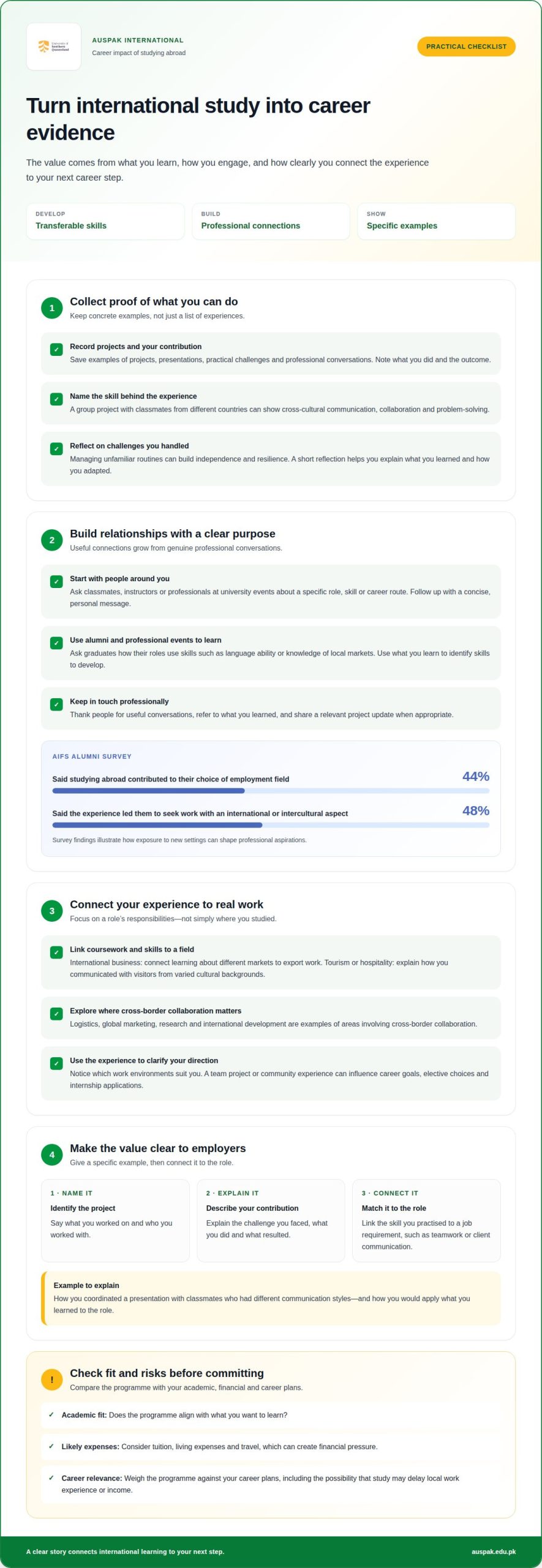
The career impact of studying abroad depends on how you turn international experience into evidence of useful skills. A group project with classmates from different countries, for example, can demonstrate cross-cultural communication, collaboration and problem-solving. Managing unfamiliar routines also builds independence and resilience. Employers can understand these strengths when you describe what you did, the challenge you faced and the result.
International connections can help you explore career paths beyond the classroom. A conversation with a lecturer, classmate or professional at a university event might show you what working in a particular field is like. Make the interaction useful by asking about a specific role, skill or career route, then following up with a concise message. Your network becomes more valuable when you build genuine professional relationships instead of simply collecting contacts.
International experience can be especially relevant in sectors involving regular cross-border interaction. For example, a student interested in international business could connect coursework about different markets to export work. Someone considering tourism or hospitality could discuss communicating with visitors from varied cultural backgrounds. Logistics, global marketing, research and international development also involve cross-border collaboration. The strongest fit depends on a role’s actual responsibilities, not just where you studied.
Living and learning abroad can clarify which work environments suit you. A student who enjoys collaborating with an international project team might explore roles involving multinational colleagues or clients. Another may develop a stronger interest in local community work after comparing approaches in different settings. These insights can shape career goals, elective choices and internship applications. They are most useful when you can explain how a specific experience influenced your decision.
Present your international experience clearly in your CV and interviews. Name the project, explain your contribution and identify the skill you practised. For example, describe how you coordinated a presentation with classmates who had different communication styles. Then connect that example to a job requirement, such as teamwork or client communication. In an interview, explain what you learned and how you would apply it to the role. This makes your experience concrete instead of leaving employers to guess its value.
Studying abroad also involves career and financial risks. Tuition, living expenses and travel can create financial pressure, while time spent studying may delay local work experience or income. Before committing, compare the programme’s academic fit, likely expenses and relevance to your career plans.
Build a record of outcomes as you study. Keep examples of projects, presentations, practical challenges and professional conversations. A short reflection after each experience can help you identify skills, such as adapting a presentation for a new audience. When you begin applying for roles, these details make it easier to choose relevant examples and explain how international learning supports your next career step.
2. Professional networking and global job opportunities
Set a career direction before expanding your international network. For example, a graduate interested in public health can seek conversations with researchers, programme staff and classmates involved in community projects. This focus helps turn introductions into useful insights about roles, further study and workplace expectations across cultures.
Study abroad can also reveal career interests you hadn’t considered. In the AIFS alumni survey, 44% of respondents said studying abroad contributed to their choice of employment field. Another 48% said the experience led them to seek work with an international or intercultural aspect. These findings illustrate how exposure to new settings can shape professional aspirations.
Start with the people around you. A course instructor may know alumni in your field, while a classmate may share information about an internship or professional association. Ask focused questions about their work, then follow up with a short message referring to a specific point. This helps build a professional relationship without making every conversation feel like a job request.
Alumni networks can extend your connections beyond campus. Use a university’s alumni directory or professional events to find graduates working in relevant sectors. For example, ask an alumnus in international marketing how their role uses language skills and knowledge of local markets. A thoughtful question gives the conversation direction and helps you identify skills to develop.
Keep your network active with simple, professional habits. After a useful conversation, send a brief thank-you message and mention what you learned. Later, share a relevant project update or congratulate a contact on an achievement they have shared publicly. LinkedIn can help you maintain connections, but a personal, specific message is more useful than a generic request to connect.
International contacts can help you understand global job opportunities, but a connection alone does not determine eligibility or hiring outcomes. Work requirements, qualifications and local recruitment practices differ by role and country. Use conversations to learn about those expectations, then apply that knowledge to your skills, applications and career goals.
Professional development can continue after graduation. Join a relevant webinar, attend an industry event or take part in a cross-border project through your university community. Each setting lets you practise introducing your work, listening across cultures and explaining your professional interests. Repeated interactions can build confidence and help you develop a diverse network.
If Canada is part of your study plans, connect destination planning with your longer-term goals. Canada Study Permit Assistance can support the study-permit process, while your own research into employers, industries and professional communities helps you prepare for opportunities during and after study.
3. Global perspective and innovative thinking
Studying abroad can change how you approach a familiar problem. For example, a Pakistani business student in Germany might compare how local customers respond to product packaging. This means considering cultural expectations, purchasing habits and communication choices. Rather than assuming one solution fits every market, the student learns to examine the context before recommending an idea.
A global perspective develops through everyday decisions as well as coursework. A student in Canada who joins a group project with classmates from different countries encounters varied approaches to planning, feedback and deadlines. Listening to those perspectives can reveal assumptions that go unnoticed in familiar settings. A practical step is to ask teammates how they reached a decision, then consider which ideas could improve the shared result.
Exposure to a different academic environment can also strengthen adaptability. Imagine a student accustomed to lecture-based classes joining a seminar where students debate readings. They need to prepare questions, contribute clearly and respond to unfamiliar arguments. Reviewing feedback after each discussion helps them adjust their communication instead of treating a different classroom style as an obstacle.
Innovative thinking often starts with comparing methods. A student studying environmental policy in Sweden, for instance, could examine how a course frames public transport challenges, then compare that approach with a case from Pakistan. The aim is not to copy another country’s model. It is to identify which ideas depend on local conditions and which could be adapted for another community.
Cross-cultural teamwork provides another opportunity to practise flexible thinking. In a design assignment, one teammate may prioritise a clear user journey, while another focuses on affordability or accessibility. Define the problem together, list each group member’s constraints and test possible solutions against them. This makes differences a source of insight rather than simply a cause of disagreement.
To make global-mindedness useful after graduation, record specific moments when your thinking changed. Note the original problem, the different perspective you encountered and the adjustment you made. For example, a student might describe how feedback from an international project group led them to revise a research presentation. This shows adaptability through action, rather than as an abstract personal quality.
Employers can better understand international learning when you connect it to the work involved. A candidate for a client-facing role might describe adapting a presentation for an audience with different expectations. Someone applying for a research role could explain how comparing approaches helped them question an initial assumption. These examples show how global learning can inform practical decisions, collaboration and innovative problem-solving.
4. Preparing students to share experience with employers
Studying abroad can support employability when you connect what you learn to a role’s requirements. A graduate applying for a research position, for example, can describe comparing sources, adapting a project and presenting findings. This gives employers evidence of relevant skills rather than asking them to rely on the study destination alone. International study strengthens an application most when its examples match the job description.
No single country offers the best post-study work option for every Pakistani student. Compare destinations such as Canada, the United Kingdom and Australia in light of your subject, career plans and eligibility for current post-study routes. A destination’s value depends on whether its study and work options align with the role you intend to pursue.
Post-study work visa rules vary by destination, qualification and individual eligibility. If considering Canada, the United Kingdom or Australia, understand the applicable route, requirements and application timing before making study plans. Treat visa permission and career prospects as separate considerations: permission to work does not itself secure employment in a particular field.
Studying abroad does not automatically lead to better career outcomes than studying in Pakistan. A Pakistani university may provide relevant local knowledge and connections, while overseas study may offer experience in a different academic or professional setting. Compare course content, practical learning and career pathways with your intended work. For example, a student aiming for a Pakistan-focused role should weigh local industry knowledge alongside international exposure.
Prepare a clear explanation for applications and interviews. First, identify a responsibility from the vacancy, such as analysing information or serving clients. Then choose a specific example from your international education, state your role and describe the result. A student who organised research for a multicultural group project could explain how they clarified different viewpoints and delivered a shared presentation.
Keep your examples precise. Instead of writing “developed global skills,” explain how you adjusted a presentation after classmates interpreted a case differently. In a cover letter, connect that learning to the advertised role. During an interview, describe the challenge, your action and the outcome, then explain how the same approach could help with a similar workplace task.
Employers assess how relevant your evidence is to the role, not simply whether you have an overseas qualification. A university project, internship or research assignment can demonstrate communication, initiative or analytical ability when you describe it accurately. Match each example to a requirement, avoid overstating your responsibility, and explain concisely how the experience informs your professional direction.
5. Adapting to diverse workplace environments
A diverse workplace brings different communication styles, feedback habits and expectations into one team. A student who has completed a group assignment with international classmates has practised listening, clarifying responsibilities and coordinating different approaches. Those habits can help when joining a project team with colleagues across departments or cultures. The aim is not to assume everyone works alike, but to find a clear way forward together.
In the AIFS alumni survey, 86% of respondents said study abroad influenced their ability to adapt to diverse workplace environments. That experience can include learning how classmates prefer to discuss ideas, how instructors deliver feedback, or how a team divides work. Consider a seminar where students challenge an argument directly. Responding thoughtfully, rather than interpreting disagreement as personal criticism, can prepare you for constructive discussion at work.
Take practical steps to adapt in a new workplace. First, observe how the team shares updates and makes decisions. Then clarify expectations with focused questions, such as who is responsible for a task and when colleagues need progress reports. If a meeting includes unfamiliar terms, summarise your understanding and invite corrections. These actions reduce confusion without requiring you to abandon your own communication style.
Communicating across language differences also calls for care. In a project meeting, use clear wording, avoid unexplained idioms and pause to confirm important details. If a colleague interprets an instruction differently, restate the task and agree on the next action. This supports accurate collaboration, whether you are working in English with international colleagues or returning to a Pakistani workplace with varied communication styles. For those preparing for global roles, structured training from language institutions like Learning Explorer can also help build fluency and confidence across multilingual workplace settings.
Adaptability also means solving problems when plans change. Imagine a team’s presentation materials are delayed before a client meeting. A graduate could suggest dividing the remaining work, preparing a simpler version and agreeing on who will communicate the change. Study and group projects offer opportunities to practise prioritising, adjusting plans and keeping teammates informed when circumstances shift.
Alumni and academic connections can help you understand workplace norms before joining a new team. Ask a graduate in your intended field how their organisation handles feedback or collaboration. Compare their example with your classroom experience, then identify one behaviour to practise, such as sharing progress earlier. This turns a professional conversation into practical preparation, not just a contact to keep.
After a project or placement, write down one situation that tested your flexibility. Record what changed, how you responded and what you would repeat next time. A specific example, such as revising a task plan after a teammate’s schedule changed, gives you a usable reference for future professional development. To plan an international education pathway, explore study options for your next step.
AusPak International: Canada Study Permit Assistance
AusPak International provides Canada Study Permit Assistance for Pakistani students planning to study in Canada. This can be a relevant next step once you have identified a Canadian study pathway and are ready to address the permit process. Keep your academic plans and career goals in view so your chosen programme supports the direction you want to take after graduation.
Study permit preparation is one part of planning for international education. Your course choice, application materials and longer-term objectives all shape the decisions ahead. AusPak International also offers Australian University Admission Support and UK Student Visa Consultancy for students considering those destinations.
If you plan to study in Canada, contact AusPak International to discuss Canada Study Permit Assistance.
Turn international learning into your next career move
Make your study plans serve a clear professional direction. Start by identifying the kind of work you want to explore, then consider which programme and destination can support that goal. A practical plan connects your academic choices with the experience you want to gain and the opportunities you hope to pursue after graduation.
The career impact of studying abroad is easier to explain when you keep your purpose in view throughout the journey. Choose learning experiences that help you explore your interests, and record how they shape your next decisions. Your plans may evolve as you encounter new subjects, people and workplaces. That growth can help you make informed choices instead of treating an overseas qualification as an end in itself.
For guidance on planning your next step, contact AusPak International to discuss your plans. Approach the journey with curiosity and a clear sense of direction. Your next opportunity starts with a thoughtful decision.
Frequently Asked Questions
How does study abroad help your career?
Studying abroad can help you develop professional skills while learning how work and study operate in another setting. For example, completing a research assignment overseas can give you experience interpreting unfamiliar material, meeting academic expectations and presenting findings to a new audience. These experiences can help you assess which work environments suit you. Keep a record of projects and responsibilities so you can use relevant examples when applying for roles.
How will studying abroad make you stand out when looking for a job?
International study can distinguish your application when you explain what you did instead of relying on the destination alone. A portfolio entry might describe a research presentation, your contribution and the feedback you incorporated. You can then connect that evidence to a vacancy’s requirements. This gives employers a clearer view of your judgment and preparation, making your application more specific than a broad claim about being adaptable or globally minded.
What are the main benefits of studying abroad?
Key benefits can include exposure to another education system, opportunities to communicate across cultures and greater independence in managing unfamiliar routines. For instance, a student who joins a campus society can practise introducing ideas and collaborating with people outside their usual circle. Overseas study can also help clarify your interests by exposing you to different subjects and learning formats before you choose a career direction or further specialisation.
What percentage of international students find jobs after graduation?
About 97 percent of study abroad alumni find a job within 12 months of graduation. This figure describes study abroad alumni as a group; it isn’t a personal employment forecast. Your own job search depends on factors such as your qualification, relevant experience, target role and location. Use the figure as context, then assess your preparation by reviewing the roles you want and the evidence your applications can show.
Do employers value international degrees and overseas work experience?
Employers can value overseas qualifications and work experience when they clearly relate to the role. For example, a candidate for a research position can explain how an overseas project involved collecting evidence, meeting deadlines or presenting results. Employers also consider the qualification’s relevance and the applicant’s demonstrated abilities. Make your application clear by naming the course or work experience, describing your contribution and connecting it to the advertised responsibilities.
Which degrees and fields of study lead to the strongest career outcomes abroad?
No single degree leads to the strongest outcomes for every student or destination. The best fit depends on your career interests, the programme’s practical content and the roles you plan to pursue. For example, a student considering international business could compare courses by their market analysis, project work and placement opportunities. Review job descriptions in your target field, identify recurring requirements and use them to guide your course selection.