
In 2026, the Australian Department of Home Affairs prioritizes logical consistency over mere document submission, which means a simple checklist approach isn’t enough to secure your future. You’ve likely spent months researching universities and gathering paperwork, yet the fear of a single error leading to a visa refusal remains a heavy burden for many Pakistani applicants. It’s understandable to feel overwhelmed by the shifting Genuine Student (GS) requirements and the complexities of financial document verification in a competitive landscape. A single administrative oversight can derail your dreams, potentially impacting your future travel history for years.
This guide helps you identify and fix the most common mistakes in Australian student visa application submissions to ensure a successful outcome. We’ll provide a clear path through the confusion of financial proof requirements and the nuances of the GS statement. You’ll gain a comprehensive understanding of how to build a rejection-proof application that stands up to the highest scrutiny. From verifying bank statements in USD ($) to aligning your career goals with your chosen course, this checklist serves as your professional roadmap for 2026.
Key Takeaways
- Master the shift from GTE to the Genuine Student (GS) requirement to ensure your statement of purpose demonstrates authentic academic intent for 2026.
- Learn how to document a transparent history for your source of funds to avoid common mistakes in Australian student visa application submissions.
- Identify the essential validity periods for English language proficiency tests and how to professionally explain any academic or professional gaps.
- Understand the severe impact a visa refusal has on your permanent global travel record and how to protect your non-refundable financial investments.
- Discover the benefits of a professional profile assessment to identify potential red flags before your documents reach the Department of Home Affairs.
Why Accuracy Matters: The Cost of a Visa Refusal in 2026
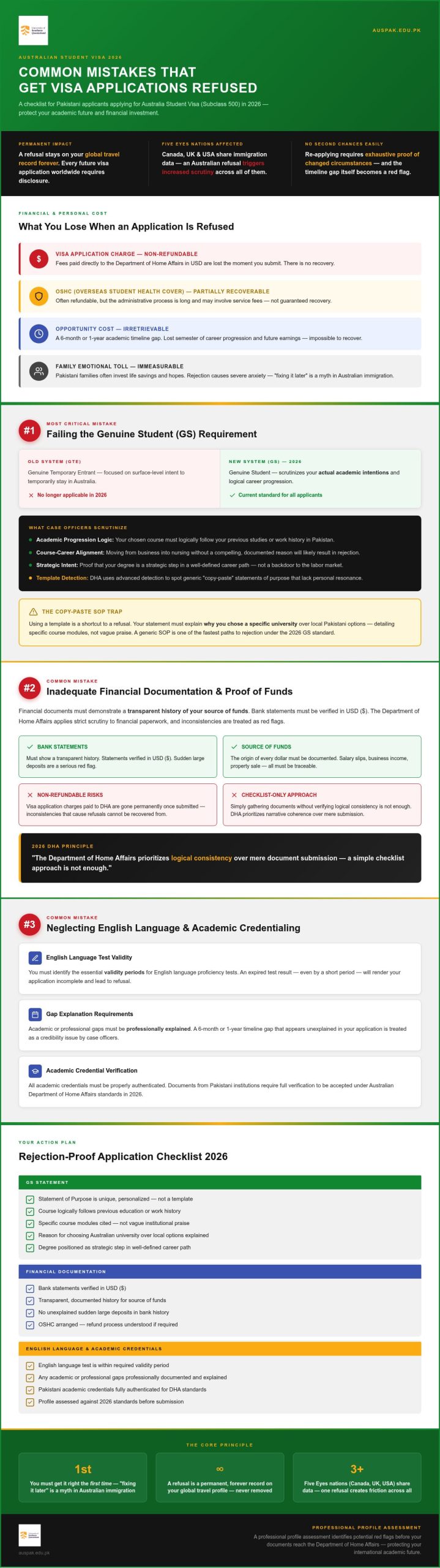
In 2026, the Australian Department of Home Affairs has set a high bar for entry. The transition from the old GTE system to the rigorous Genuine Student (GS) requirement means that minor oversights are no longer overlooked. A refusal is a permanent record that remains on your global travel profile forever. When you apply for a student visa in the future, even for other countries, you must disclose this rejection. This disclosure creates immediate friction with “Five Eyes” nations, including Canada, the UK, and the USA, as these countries share immigration data. A rejection in Australia can trigger increased scrutiny elsewhere, potentially closing doors to global education long before you’ve even started. Avoiding common mistakes in Australian student visa application processes is not just about getting into a university; it’s about protecting your international reputation.
The Long-Term Impact on Your Academic Career
A refusal creates an immediate gap in your academic timeline. Explaining a six-month or one-year delay to admissions officers or case officers is incredibly difficult. You’ll need to provide exhaustive evidence to prove that your circumstances have changed significantly before re-applying to Australia. This uphill battle often leads to further disappointment. Partnering with the best study abroad consultants Pakistan offers is your first line of defense. Expert guidance ensures your profile is assessed against 2026 standards before you submit, minimizing the risk of a life-altering refusal. A single misstep in your GS statement can lead to a rejection that is hard to justify in any future academic pursuit.
Financial and Emotional Drain
The financial consequences of a poorly prepared application are immediate and steep. While some tuition fees might be refundable, the visa application charge is gone the moment you hit submit. Consider the following lost costs and burdens:
- Visa Application Charges: These are non-refundable fees paid directly to the Department of Home Affairs in USD ($).
- Overseas Student Health Cover (OSHC): While often refundable, the administrative process can be long and may involve service fees.
- Opportunity Cost: The loss of a full semester’s worth of potential career progression and future earnings.
Beyond the money, the emotional toll on Pakistani families is immense. Parents often invest their life savings and hopes into their children’s international education. A rejection leads to a sense of failure and high levels of anxiety. “Fixing it later” is a myth in Australian immigration. You must get it right the first time to avoid common mistakes in Australian student visa application filings that could have been caught by an experienced specialist. Precision is your only guarantee for peace of mind.
Mistake #1: Failing the Genuine Student (GS) Requirement
The 2026 landscape has shifted significantly. The Australian Department of Home Affairs now utilizes the Genuine Student (GS) requirement, which moves beyond the previous GTE criteria to scrutinize your actual academic intentions. This change ensures that applicants are entering the country to pursue a high-quality education rather than seeking a backdoor to the labor market. One of the most common mistakes in Australian student visa application processes today is treating the GS statement as a mere formality. Case officers are trained to identify “academic progression,” meaning your chosen course must logically follow your previous studies or work history in Pakistan. If you’re moving from a business background into a completely unrelated field like nursing without a compelling, documented reason, your application will likely face rejection. You must prove that your degree is a strategic step in a well-defined career path. For a full breakdown of the official criteria, you should review the Australian Student visa subclass 500 requirements.
The ‘Copy-Paste’ SOP Trap
Using a template is a shortcut to a refusal. DHA uses advanced detection to spot generic content that lacks personal resonance. Your statement must be unique. Why did you choose a specific university over local options in Pakistan? Don’t just say it’s a good school. Detail specific course modules that aren’t available locally. Mention the university’s research facilities or unique industry links. This level of detail shows you’ve done your homework. If you’re feeling stuck, getting Australian University Admission Support can help you articulate your academic goals more effectively.
Demonstrating Strong Ties to Pakistan
A successful application must convince the case officer that you’ll return home after your studies. Many students fail because they don’t document their ties to Pakistan. You need more than just a verbal promise. Provide evidence of family businesses, property ownership, or specific job offers waiting for you upon your return. Link your Australian degree directly to the Pakistani job market. Explain how the skills you’ll gain will fill a specific gap in the local economy. Showing a clear, lucrative career path back home is the best way to prove you aren’t just looking for a way to stay in Australia indefinitely. Precision in these details reduces the risk of being labeled a “non-genuine” applicant.
Mistake #2: Inadequate Financial Documentation and Proof of Funds
One of the most critical common mistakes in Australian student visa application submissions is failing to provide a clear, traceable financial history. In 2026, simply showing a balance in your account is no longer sufficient. The Department of Home Affairs (DHA) requires evidence that funds are genuinely available for your tuition and living expenses throughout your stay. This means demonstrating a “source of funds” that is logical and documented. If you show a massive deposit made just weeks before your application, case officers will flag it as “sudden money.” This lack of history suggests the funds were borrowed temporarily to meet visa requirements rather than being legitimate personal savings. To avoid this, you must calculate your budget using the updated 2026 Cost of Living index, which ensures your financial planning matches current inflationary realities in USD ($).
Bank Statement Discrepancies
Sudden money is a primary reason for refusal in Pakistan. DHA typically expects a stable 3-to-6 month transaction history. They look for consistent income patterns rather than erratic spikes. Verification protocols have also become more sophisticated. Australian authorities now work closely with Pakistani financial institutions to verify the authenticity of bank records. If your statements don’t match the digital records held by the bank, or if the “informal” income from a family business isn’t backed by official tax filings, your application is at risk. Transparency is your best asset. Don’t assume that a high balance alone will satisfy a case officer who is trained to spot inconsistencies.
Sponsorship and Affidavit Errors
Relying on too many sponsors is another trap that complicates your profile. Ideally, your sponsors should be immediate family members. Using distant relatives or family friends with no documented close relationship often leads to skepticism regarding the actual availability of those funds. Each sponsor must provide comprehensive documentation to prove their financial capacity. This includes:
- Official FBR tax returns from the last three years.
- Stamped salary slips or employer reference letters.
- Proof of business registration for self-employed sponsors.
- Clear evidence of the relationship between the sponsor and the student.
Using unverified income that hasn’t been declared to the tax authorities is a major common mistakes in Australian student visa application error. For a detailed breakdown of how to plan your finances and select the right institution, refer to the Australia University Guide 2026 for Pakistani Students. This resource helps you align your bank balance with the actual costs you’ll face upon arrival, ensuring your financial narrative is both credible and complete.
Mistake #3: Neglecting English Language and Academic Credentialing
English proficiency and academic credentials form the bedrock of your profile. Submitting an expired test score is one of the most avoidable yet common mistakes in Australian student visa application filings. In 2026, the Department of Home Affairs (DHA) strictly enforces a two-year validity period for English tests. It’s a frequent point of confusion: a university might accept a three-year-old score for an offer letter, but the visa office will reject it. You also need to navigate the choice between IELTS and PTE. While both remain valid for 2026, PTE is often favored for its faster processing times, whereas IELTS Academic remains the preferred choice for research-heavy degrees and specific professional registrations. Accuracy here is non-negotiable.
The “Document Fraud” trap is perhaps the most dangerous risk for Pakistani applicants. Even an accidental error in a graduation date or a typo in a work experience letter can trigger Public Interest Criterion (PIC) 4020. If the DHA believes you’ve submitted “false or misleading” information, you could face a ten-year ban from entering Australia. This penalty is absolute and applies even if the mistake was unintentional. Ensuring every date on your CV matches your transcripts and bank statements is the only way to safeguard your future.
IELTS Requirements and Validity
A frequent error among students is booking the ‘General Training’ module instead of the ‘Academic’ IELTS. The DHA requires the Academic version for all Subclass 500 applications. You must also realize that you’re serving two masters: the university and the government. Universities often demand a higher band score, such as a 6.5 or 7.0, while the visa office may have a lower minimum. You must meet the higher of the two. If you’re unsure about your current level, consult our IELTS for Australian Student Visa guide for preparation strategies tailored to the 2026 standards.
Verifying Academic History
For Pakistani students, HEC attestation is a mandatory step that shouldn’t be left until the last minute. Case officers look for a “clean” timeline from your matriculation to your current status. If you’ve spent time working, you must document it with appointment letters and salary slips that align with your financial records. Every academic gap over 6 months needs a documented justification. Whether you were preparing for exams or gaining professional skills, an unexplained gap is often viewed as a lack of genuine academic intent. To identify potential red flags in your academic timeline, book a Free IELTS Mock Test and profile assessment with our counselors to ensure your application is airtight.
How AusPak International Minimizes Your Risk of Refusal
AusPak International has served as a trusted navigator for Pakistani students since 1995. With over 30 years of experience and partnerships with 40+ Australian universities, we understand the intricacies of the Department of Home Affairs’ evolving standards. Our role is to ensure you don’t fall victim to the common mistakes in Australian student visa application processes that lead to unnecessary heartbreak. We perform a comprehensive profile assessment before you even commit to a university, identifying potential red flags in your academic history or financial documentation that could trigger a refusal. This proactive approach allows us to address inconsistencies before they ever reach a case officer’s desk.
Our End-to-End Visa Consultancy
We don’t just provide a checklist; we offer a strategic roadmap. Our experts help you select courses that demonstrate clear academic progression, which is vital for satisfying the rigorous 2026 Genuine Student (GS) test. We’ve seen how a poorly articulated statement can derail an otherwise perfect application, so we provide dedicated assistance in drafting a GS statement that reflects your unique journey and strong ties to Pakistan. This level of university application assistance is considered the industry gold standard because it bridges the gap between your aspirations and official requirements. Additionally, our onshore office in Melbourne provides a unique layer of security, offering arrival support once you land in Australia to ensure your transition is as smooth as your application process.
Pre-Departure and Arrival Services
Before you hit ‘submit’ on your application, our team conducts a final, exhaustive review of your documents. We ensure that every bank statement, tax return, and academic transcript is verified and aligned with your narrative. If your profile requires a visa interview, we provide detailed briefings on what to expect and how to communicate your intentions clearly to case officers. We understand that the financial stakes are high, with visa fees and health insurance costing hundreds of dollars in USD ($), so we leave nothing to chance. Precision at this stage is what separates a successful applicant from one who faces a lengthy and costly appeal process.
You don’t have to face this complex system alone. By partnering with a specialist who has navigated three decades of immigration changes, you significantly reduce the risk of common mistakes in Australian student visa application filings. We invite you to book a free consultation today to begin your 2026 journey with confidence. Our team is ready to help you build a rejection-proof application that secures your future in Australia while protecting your global travel record.
Secure Your Academic Future in Australia for 2026
Navigating the 2026 visa landscape requires more than just filling out forms; it demands a strategic alignment of your past achievements and future goals. By addressing the common mistakes in Australian student visa application submissions early, you protect your global reputation and financial investment. Logical consistency in your GS statement and absolute transparency in your financial documentation remain the most critical factors for a successful outcome in the current regulatory environment.
Since 1995, AusPak International has acted as a trusted navigator for students across Pakistan. With 40+ partner universities and a dedicated onshore office in Melbourne to assist you after arrival, we provide the institutional expertise required to manage complex immigration requirements. Don’t let administrative errors derail your aspirations. Start your risk-free Australian visa assessment with AusPak International today. Your journey toward a world-class education is within reach, and we’re here to ensure you arrive there safely.
Frequently Asked Questions
What is the most common reason for Australian student visa rejection in Pakistan?
The most frequent reason for refusal among Pakistani applicants is failing to meet the Genuine Student (GS) requirement or providing inconsistent financial evidence. Case officers often identify common mistakes in Australian student visa application filings when bank statements don’t show a clear source of funds. If your academic progression doesn’t align with your professional goals, or if your financial history appears erratic, the Department of Home Affairs will likely question your authentic intentions to study.
How much bank balance is required for an Australian student visa in 2026?
For 2026, you must demonstrate access to funds that cover your first year of tuition fees plus the standard cost of living. The Australian government typically requires approximately $19,300 USD ($) for living expenses, though this amount adjusts periodically for inflation. You also need to account for travel costs and health insurance. Ensure these funds are held in a verified bank account with a clear, documented history of at least three to six months.
Can I apply for an Australian student visa with a study gap?
You can definitely apply with a study gap, but you must provide a logical and documented justification for that period. Whether you were gaining professional work experience, completing certifications, or managing family responsibilities, every gap longer than six months needs evidence. Failing to explain these intervals is one of the common mistakes in Australian student visa application submissions. Clear appointment letters and salary slips can help prove that your time away from academia was productive.
What is the difference between GTE and the new GS requirement?
The Genuine Student (GS) requirement replaced the GTE system to focus more on your academic sincerity and career trajectory. While GTE looked at your intent to stay temporarily, the GS test evaluates whether your chosen course is a logical step for your future. Case officers now prioritize your understanding of the course modules and how the degree will benefit your career in Pakistan. It’s a more rigorous assessment of your educational value and long-term goals.
Does Australia conduct interviews for student visas from Pakistan?
Australia doesn’t conduct mandatory interviews for every applicant, but the Department of Home Affairs reserves the right to request one. These interviews typically focus on your GS statement, your choice of university, and your financial capacity. If you’re called for an interview, you’ll need to speak confidently about your course structure and how you plan to fund your stay. Preparation is key to ensuring your verbal answers match your written documentation and academic profile.
How long does the Australian student visa processing take in 2026?
Processing times for the Subclass 500 visa in 2026 generally range from four to eight weeks for the higher education sector. However, these times can fluctuate based on the volume of applications and the completeness of your file. Decision times are often faster for students who submit front-loaded applications with all medicals and biometrics completed. Delays usually occur when the DHA needs to request additional information or verify complex financial records with local institutions.
Can I appeal an Australian student visa refusal?
You can appeal a refusal if you have merit review rights, which usually applies to applications lodged while you’re already in Australia. For offshore applicants in Pakistan, a formal appeal through the Administrative Appeals Tribunal is often complex and time-consuming. In most cases, it’s more efficient to address the specific reasons for refusal and submit a fresh, corrected application. Analyzing the previous rejection letter is essential to avoid repeating the same errors in your next submission.
Is health insurance (OSHC) mandatory for the visa application?
Overseas Student Health Cover (OSHC) is an absolute requirement for your visa application. You must maintain this insurance for the entire duration of your stay in Australia. Your visa can’t be granted without proof of payment for a policy that starts before you arrive. This insurance covers your medical expenses and hospital care while studying. Most universities include OSHC in their initial deposit, but you’re free to choose any government-approved provider that meets your needs.