
With Pakistan now classified under Evidence Level 3 by the Australian Department of Home Affairs, the margin for error in your study visa application has effectively vanished. You’re likely feeling the pressure of rising visa rejection rates and the confusing transition from the GTE to the new Genuine Student (GS) requirement. Securing an Australian university admission for Pakistani students in 2026 requires more than just high marks; it demands a strategic alignment with strict financial and evidentiary standards that have recently become more rigorous.
We understand the uncertainty that comes with proving a bank balance of up to 13 million PKR or meeting the new AUD $29,710 living cost threshold. It’s a complex journey. We’ve simplified it. This guide serves as your professional roadmap to secure your academic future by breaking down every phase of the application process into manageable steps. We’ll preview the essential criteria for CRICOS registered institutions, explain the shift in financial documentation for 2026, and outline the pathway toward post-study work opportunities in Australia.
Key Takeaways
- Master the 2026 policy shifts and Evidence Level 3 criteria to safeguard your application against common visa rejection pitfalls.
- Meet the precise academic benchmarks and English proficiency scores required by elite CRICOS-registered institutions for the upcoming intake.
- Navigate the Genuine Student (GS) mandate to ensure your Australian university admission for Pakistani students aligns with the latest Department of Home Affairs standards.
- Execute a professional, step-by-step roadmap that transitions your academic profile from Pakistan to a world-class Australian campus.
- Secure your future with a dual-shore consultancy that provides expert guidance in Pakistan and dedicated arrival support directly in Melbourne.
Navigating Australian University Admissions in 2026
The year 2026 marks a transformative era for Pakistani scholars aiming for Australian shores. While the international student landscape in Australia has always been competitive, recent policy shifts have moved Pakistan into a higher scrutiny bracket. This Evidence Level 3 status means that every document, from your bank statement to your academic transcripts, undergoes rigorous verification. Success in Australian university admission for Pakistani students now hinges on strategic planning rather than just meeting basic eligibility.
The transition from the Genuine Temporary Entrant (GTE) to the Genuine Student (GS) requirement is the most significant hurdle you’ll face. Unlike the previous subjective assessment, the GS criteria focus on your academic trajectory and the tangible value your chosen course adds to your career in Pakistan. You must prove that your primary intention is high-quality education. The Australian Qualifications Framework (AQF) provides the essential structure for this transition. Most Pakistani four-year bachelor’s degrees align with AQF Level 7, allowing direct entry into Master’s programs, provided your GPA meets specific faculty benchmarks.
Why Australia Remains a Top Choice for Pakistanis
Australia’s appeal isn’t just about the scenery; it’s about global prestige. In the 2026 QS World University Rankings, several Australian institutions remain in the global top 50, offering degrees that hold immense weight in the Pakistani job market. Beyond the classroom, the Post-Study Work Visa (Subclass 485) provides a vital bridge for graduates to gain international experience in sectors where firms like PK Services are redefining excellence within the Australian construction industry. This professional exposure, combined with a vibrant Pakistani diaspora in cities like Melbourne and Sydney, ensures that students feel both culturally connected and professionally empowered to succeed.
Understanding the 2026 Regulatory Landscape
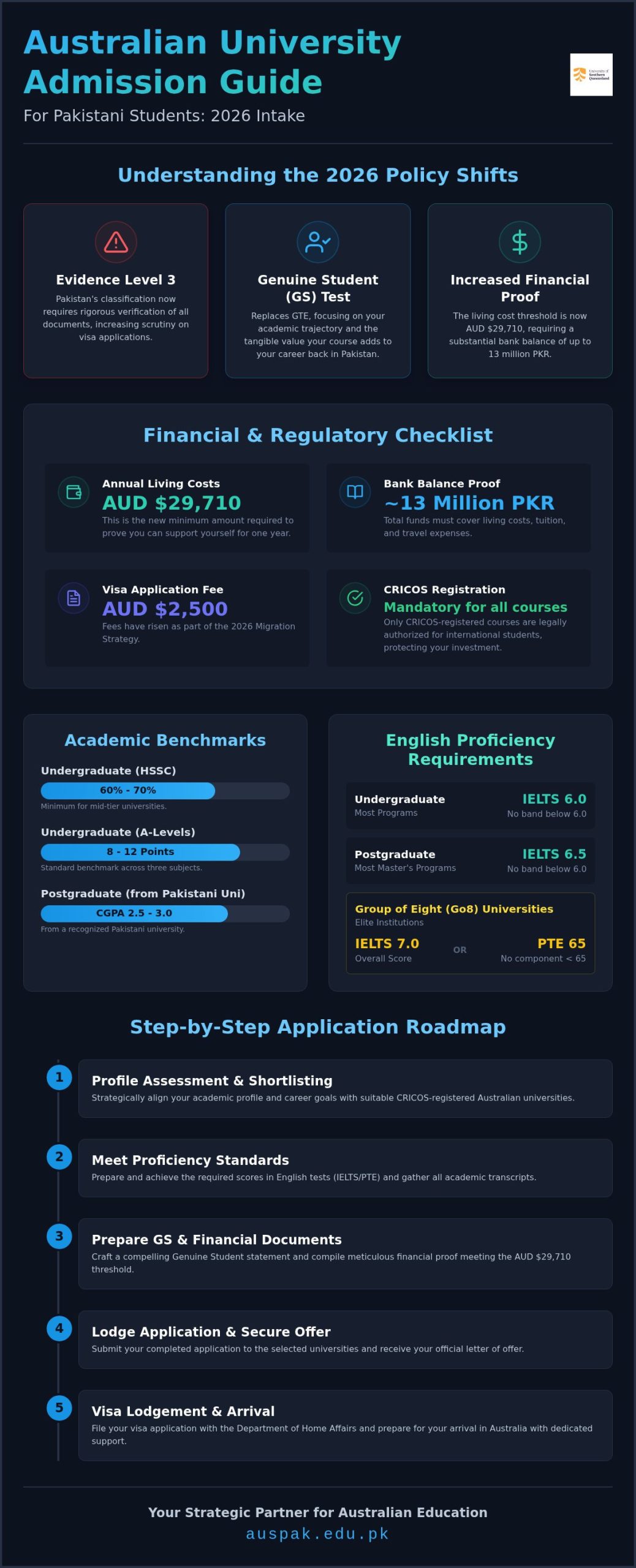
The Australian government’s 2026 Migration Strategy has introduced tighter controls to ensure system integrity. Visa application fees have risen to AUD 2,500, and the financial capacity requirement now stands at AUD 29,710 for annual living expenses. It’s vital to choose CRICOS-registered courses. These are the only programs legally authorized to be offered to international students, providing a layer of protection for your financial investment. Working with an established partner like AusPak ensures you navigate these regulatory waters without missing critical deadlines. We help you align your profile with these evolving standards to ensure your Australian university admission for Pakistani students is both successful and secure.
Academic and English Proficiency Standards for Pakistani Applicants
Entering the 2026 academic cycle requires a precise understanding of how your Pakistani credentials translate into the Australian system. For undergraduate entry, students from a Higher Secondary School Certificate (HSSC) background typically need a minimum of 60% to 70% for mid-tier universities. A-Level applicants are assessed on a points system where 8 to 12 points across three subjects are standard benchmarks. Postgraduate candidates generally require a CGPA of 2.5 to 3.0 from a recognized Pakistani university to secure an Australian university admission for Pakistani students. If you have academic gaps or are switching career paths, your application must include a detailed Statement of Purpose that justifies the transition through professional experience or foundational courses.
Language proficiency remains a non-negotiable pillar of your application. While IELTS is the traditional choice, PTE Academic has gained massive popularity across Pakistan due to its faster results and computer-based format. According to the Official Australian Government guide for international students, your test results must be valid at the time of both your admission and visa lodgement. Selecting the right test depends on your comfort level with computer-delivered versus paper-based assessments.
English Language Requirements: Beyond the Basics
It isn’t just the overall score that counts; the “no band less than” requirement is often the deciding factor for admission. Most undergraduate programs demand an overall IELTS 6.0 with no band below 6.0, while postgraduate courses often push this to 6.5. For the prestigious Group of Eight (Go8) universities in 2026, you’ll typically need an overall IELTS score of 7.0 or a PTE score of 65 with no component score below 65. If you’re unsure of your current level, taking a free IELTS mock test is a practical first step to identify specific areas for improvement before booking your official exam.
Academic Prerequisites for Popular Study Fields
High-demand sectors like Engineering, IT, and Nursing have specialized entry barriers. Engineering programs often require specific mathematics and physics prerequisites from your HSSC or A-Level curriculum. Nursing is particularly strict, frequently requiring an IELTS score of 7.0 in all four components. For students with a two-year Pakistani diploma, credit transfers can significantly shorten your study duration in Australia. To avoid delays, ensure all transcripts are attested by the HEC or IBCC, as Australian institutions require verified documentation to finalize your Letter of Offer. Achieving the high marks necessary for these prerequisites often requires specialized support; for instance, the online tutoring model at ikamvalearning.co.za for Grade 10 to 12 learners shows how targeted help can prepare students for the academic rigors of international education.
Overcoming the Genuine Student (GS) and Financial Requirements
The most common hurdle in securing an Australian university admission for Pakistani students isn’t your academic transcript; it’s the clarity of your intent and the transparency of your finances. The Department of Home Affairs now utilizes the Genuine Student (GS) requirement to filter applicants who aren’t primarily focused on high-quality education. Rejections often stem from a failure to explain why a specific Australian degree is more valuable than local alternatives within Pakistan. You must provide a granular analysis of how your chosen course directly translates into a higher salary or a specialized role within the Pakistani job market upon your return.
Financial scrutiny has reached an all-time high for Evidence Level 3 countries like Pakistan. You’re required to demonstrate a robust financial capacity that covers your first year of tuition, travel expenses, and living costs. For the 2026 intake, your bank statements must show a consistent history, typically held for at least three to six months before lodgement. Acceptable sources include personal savings, educational loans from recognized Pakistani banks, or sponsorship from immediate family members. Adhering to Australian Department of Education regulations ensures that your funding is viewed as stable and accessible for the duration of your stay. Pakistani students who are also evaluating other English-speaking destinations should review the study in UK student visa Pakistan guide for 2026 to compare financial and documentation requirements across both systems. Similarly, if you’re weighing North American options, understanding how to apply for Canada study permit from Pakistan under the revised 2026 standards can help you make a fully informed decision about which destination best suits your academic and financial profile.
Mastering the Genuine Student (GS) Requirement
Your Statement of Purpose (SOP) is no longer a mere formality. It’s a strategic document that must align with the new GS criteria by addressing your personal circumstances in Pakistan and your potential future in your home country. You need to provide evidence of strong “home ties,” such as family businesses, property, or specific career offers, to prove your intent to return. Be prepared for a potential interview with the Australian High Commission. They’ll expect you to speak confidently about your course modules, the university’s campus location, and why you didn’t choose a similar program in a different country.
Financial Documentation: A Checklist for Success
Precision in your financial paperwork is vital to avoid a visa refusal. Beyond the bank balance, you must provide tax returns and salary slips for your sponsors to verify that the “Source of Funds” is legitimate and sustainable. For the 2026 academic year, a single international student must show a minimum of AUD $29,710 to cover their first year of living expenses in Australia. Ensure your bank provides a balance confirmation letter and that all foreign currency conversions are calculated accurately against the current exchange rate to meet the minimum threshold without falling short.
Step-by-Step Application Roadmap from Pakistan to Australia
Your journey begins with a comprehensive profile assessment. This stage is the foundation of a successful Australian university admission for Pakistani students, where we evaluate your HSSC, A-Levels, or Bachelor’s results against specific faculty prerequisites. Once we identify the right institutional fit, we lodge your application to secure a Letter of Offer. You’ll likely receive a Conditional Offer first, which typically requires you to submit final semester results or achieve a specific English test score. An Unconditional Offer is only issued once every academic and administrative requirement is fully met.
The next critical phase involves fee payment and obtaining your Confirmation of Enrolment (CoE). To generate this document, you must pay your first semester’s tuition and secure Overseas Student Health Cover (OSHC). The CoE is the “golden ticket” required for your Student Visa (Subclass 500) application. After submitting your visa through the ImmiAccount portal, you’ll need to visit a VFS Global center in Islamabad, Lahore, or Karachi for biometric collection. This sequential approach ensures that your file is complete and meets the high scrutiny standards applied to Pakistani applicants in 2026.
Timing Your Application for 2026 Intakes
Timing is everything when navigating the Australian academic calendar. The February intake remains the primary window, generally offering a broader range of scholarship opportunities and course selections. For students targeting the 2026 mid-year (July) intake, it’s advisable to have your applications finalized by March or April. If you’ve already completed your exams and have final transcripts in hand, you can utilize a ‘fast-track’ timeline to secure your spot early. Early submission is vital because visa processing for Evidence Level 3 countries can take longer than anticipated during peak periods.
Essential Documentation for a Complete File
A meticulous document checklist is your best defense against processing delays. You’ll need to prepare attested copies of your academic transcripts and degree certificates from the HEC or IBCC. Your English proficiency reports, whether IELTS, PTE, or TOEFL, must be valid and meet the specific “no band less than” requirements of your chosen program. Additionally, ensure your passport has at least six months of validity and keep your National ID (CNIC) ready for identity verification. To ensure every detail of your application is handled with professional precision, reach out for Australian University Admission Support tailored to your academic goals.
Why AusPak is Your Strategic Partner for Australian Education
Since 1995, AusPak International has served as the primary gateway for thousands of Pakistani scholars. We’ve spent over 30 years refining our processes to become the most trusted name in the industry. While other agencies might offer basic advice, we provide a comprehensive strategic partnership. Our deep integration with over 40 prestigious Australian universities gives our students a distinct advantage during the selection process. We understand the specific hurdles involved in Australian university admission for Pakistani students, and we’ve built our reputation on overcoming them with professional precision.
The “Dual-Shore” Advantage is our most significant differentiator. Most consultancies stop their support once the visa is granted. We believe that’s where the most challenging part of your journey actually begins. By maintaining a fully operational onshore office in Melbourne, we provide a level of continuity that is rare in the consultancy sector. You’ll have access to professional guidance both in your home city in Pakistan and on the ground in Australia. This physical presence ensures that you’re never navigating a new country alone.
Our end-to-end service model covers every possible requirement for a successful transition. It begins with a free IELTS mock test to ensure you’re ready for the academic rigors of an Australian campus. From there, we handle the complex task of Genuine Student (GS) vetting and professional visa documentation. This exhaustive approach reduces the anxiety associated with Evidence Level 3 scrutiny. We don’t just help you get admitted; we help you succeed in your new environment from day one.
Exclusive Support for AusPak International Students
Our unique Melbourne-based onshore office acts as your first point of contact upon arrival. We help you navigate the practicalities of Australian life, from opening a local bank account to understanding public transport systems. Finding accommodation in major hubs like Melbourne or Sydney is increasingly difficult for international students. Our onshore team provides the local insights and support needed to secure a safe and affordable place to live while you settle into your studies. Learn more about our Onshore Support in Melbourne.
Start Your Journey Today
The 2026 intakes are closer than they appear. Waiting until the last minute often leads to rushed documentation and avoidable errors in your GS statement. Take the first step by booking a free profile assessment with our senior counselors. We have a nationwide presence across Pakistan, making it easy for you to access expert advice in person or online. Our team is ready to analyze your academic history and map out a clear path to your chosen career. Book Your Free Consultation with AusPak International.
Secure Your Global Future in 2026
The landscape of international education is shifting, but your academic aspirations remain within reach. Success in 2026 demands a precise alignment with the new Genuine Student requirement and a robust demonstration of financial stability. By following a structured roadmap and meeting the elevated English proficiency standards, you position yourself for a successful visa grant and long-term career growth. Navigating Australian university admission for Pakistani students requires a partner who understands both the local Pakistani context and the evolving Australian regulatory environment.
AusPak International has been the trusted navigator for Pakistani scholars since 1995. With direct partnerships across 40+ Australian universities and a dedicated onshore office in Melbourne, we provide the security and support you need at every phase of your transition. Don’t leave your future to chance when expert guidance is available. Start Your Australian Dream: Book a Free Profile Assessment with AusPak. Your journey toward a world-class education begins with a single, strategic step today.
Frequently Asked Questions
Can Pakistani students work while studying in Australia in 2026?
Yes, Pakistani students can work up to 48 hours per fortnight while their course is in session. This limit is lifted during scheduled course breaks, allowing for unlimited work hours. If you’re enrolled in a Master’s by Research or a Doctoral degree, you aren’t subject to any work hour restrictions. This flexibility helps you manage living costs while gaining professional experience in the Australian market.
What is the minimum IELTS score required for an Australian student visa from Pakistan?
The minimum IELTS score for a student visa is typically an overall 6.0, though most universities require 6.5 for postgraduate entry. High-demand fields like Nursing or Engineering often demand a 7.0 or higher. Achieving these benchmarks is a critical step for a successful Australian university admission for Pakistani students, as it proves your ability to succeed in a rigorous academic environment.
How much bank balance is required for an Australian student visa in 2026?
You must demonstrate a bank balance that covers your first year of tuition, travel costs, and a minimum of AUD $29,710 for living expenses. For most Pakistani applicants, this total requirement ranges between 9 million and 13 million PKR. It’s vital that these funds are held in a recognized bank and that you can clearly show the legitimate source of the income.
Can I apply for an Australian university with a 2-year Bachelor’s degree from Pakistan?
Direct entry into a Master’s program is usually not possible with a 2-year Bachelor’s degree from Pakistan. Australian institutions generally require a 4-year degree to align with AQF Level 7 standards. If you hold a 2-year degree, you’ll likely need to complete a bridge program or a Bachelor’s degree first. Our counselors can help you map out the most efficient pathway for your academic progression.
What happens if my Australian student visa is rejected?
A visa rejection allows you to either lodge a new application with corrected documentation or file an appeal if you meet the eligibility criteria. Rejections often stem from “Source of Funds” issues or a weak Genuine Student statement. You must carefully analyze the refusal letter to identify specific errors. Consulting with a specialist can help you rectify these gaps before you attempt a second application.
Are there scholarships available for Pakistani students in Australia for 2026?
Yes, numerous merit-based scholarships are available for the 2026 intake, offering tuition fee waivers ranging from 10% to 50%. Many universities automatically assess applicants for these awards during the admission phase. Additionally, government programs like the Australia Awards provide full funding for high-achieving scholars. Securing a scholarship requires early application and a strong academic profile, which significantly reduces the overall cost of your international education.
How long does the student visa (Subclass 500) process take for Pakistanis?
Visa processing for Pakistani students typically takes between four and eight weeks under the current Department of Home Affairs standards. Because Pakistan is classified under Evidence Level 3, applications undergo more thorough scrutiny, which can occasionally extend the timeline. We recommend lodging your application at least three months before your intake starts. This ensures you have enough time for biometric collection and any additional document requests.
What is the Genuine Student (GS) requirement for Australia?
The Genuine Student (GS) requirement is a mandatory assessment of your primary intention to study in Australia rather than seeking migration. It replaced the GTE criteria and focuses on your personal circumstances, the value of the course to your future, and your ties to Pakistan. A successful Australian university admission for Pakistani students depends on a clear GS statement that proves you are a legitimate applicant with a focused academic purpose.