
What if your parents’ hesitation isn’t actually a rejection of your dreams, but rather a request for a more robust business plan? In a climate where the PKR faces constant pressure and global visa scrutiny is at an all-time high, their anxiety regarding safety and financial risk is entirely rational. Mastering how to convince parents to study abroad requires you to pivot from emotional appeals to a strategy rooted in professional validation and tangible ROI. You aren’t just asking for a degree; you’re proposing a legacy-defining investment in your family’s future global standing.
We understand that bridging the gap between your aspirations and their concerns feels like an uphill battle. This guide provides the exact roadmap you need to transform “we’ll see” into a confident “yes” by using 2026 career data and culturally sensitive persuasion techniques. We’ll explore how to present a concrete financial plan, leverage the security of onshore support offices, and use the latest QS rankings to prove the long-term value of an international education. By the end of this article, you’ll have a professional framework to ease their fears and secure their support for your journey.
Key Takeaways
- Identify and validate the core parental fears regarding financial risk and cultural shifts to build a foundation of mutual trust.
- Master how to convince parents to study abroad by reframing your education as a high-yield family investment backed by 2026 career ROI data.
- Use the latest QS World University Rankings to demonstrate the prestige and global employer recognition of your chosen international institution.
- Leverage the security of onshore support offices, like AusPak’s Melbourne location, to provide a tangible safety net for your time overseas.
- Discover why involving a professional consultant can bridge the communication gap and provide the technical validation your parents need to feel secure.
Understanding the Pakistani Parental Perspective: Why They Say ‘No’
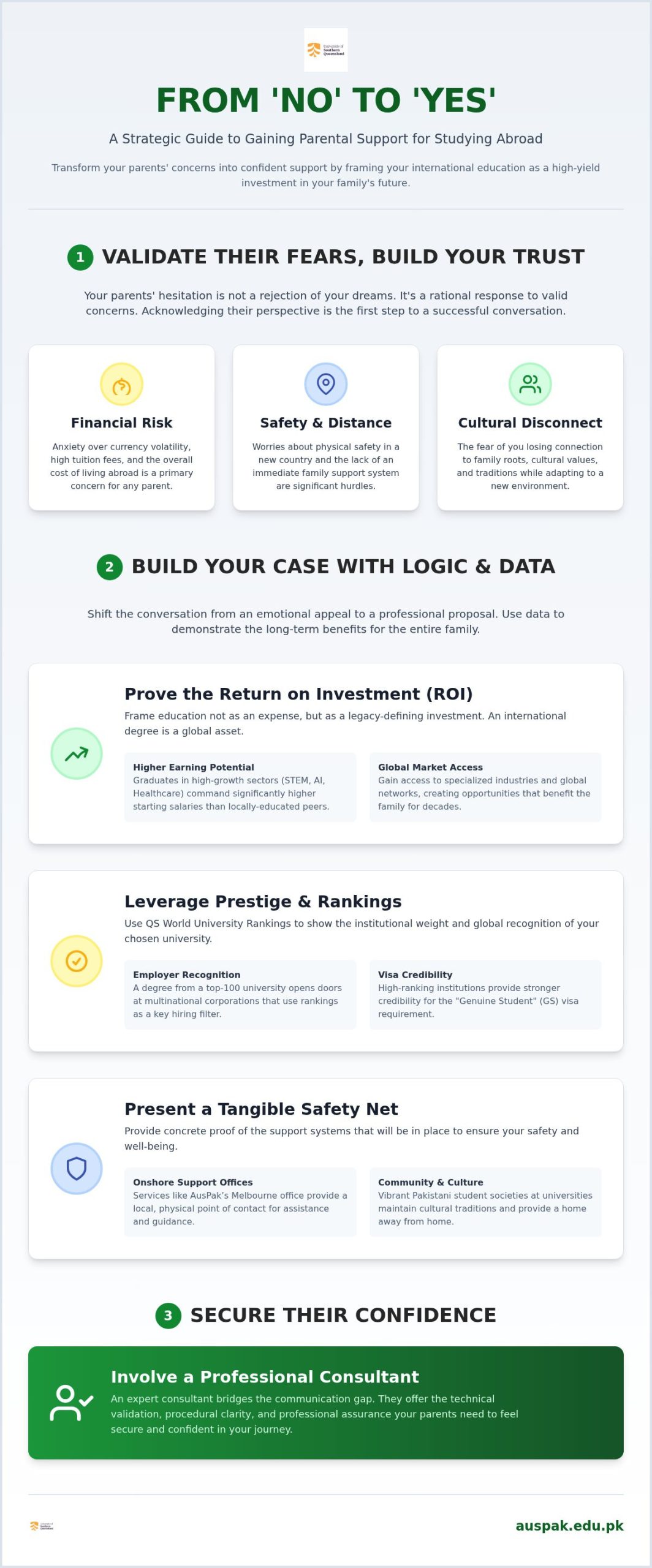
To master how to convince parents to study abroad, you must first dissect the layers of their resistance. In Pakistan, a parental “no” is rarely about stifling your ambition; it’s usually a protective mechanism triggered by the volatility of the global economy and the fear of distance. Instead of viewing their hesitation as an obstacle, treat it as a checklist of risks you need to mitigate together. Their concerns typically center on three pillars: financial sustainability, physical safety, and the preservation of cultural values. Validating these fears instead of dismissing them as “old-fashioned” is the first step toward a successful negotiation.
Strategy is everything. Don’t bring up your plans during a family crisis or a rushed morning. Choose a quiet evening when both parents are present and relaxed. Frame the conversation as a collaborative family project rather than a solo rebellion. By positioning yourself as a partner in the family’s long-term advancement, you shift the dynamic from a child asking for a favor to a future professional proposing a strategic move. Your parents need to see that you’ve thought about the family’s legacy, not just your own adventure.
The ROI Gap: Education as an Investment
Pakistani parents naturally prioritize stability and future security. With the current saturation of the local job market, a local degree often fails to provide the competitive edge needed for high-level leadership roles. In contrast, an international education offers a clear Return on Investment (ROI) by providing access to global markets and specialized industries that aren’t yet fully developed at home. You’re pitching a “global networking” asset that benefits the family for decades. Show them that you aren’t just spending money; you’re buying a seat at a global table. When you explain how to convince parents to study abroad, focus on how this degree will eventually allow you to provide better for the family in the long run.
Safety and Cultural Connection
The fear of cultural “drift” or physical isolation is a significant hurdle. Many parents worry that their children will lose their roots or face safety risks without a local support system. It’s helpful to research what is an international student in the 2026 context to understand the massive scale of global mobility and the support structures now in place. Modern universities in Australia, the UK, and Canada host vibrant Pakistani student societies that maintain cultural traditions and provide a sense of home. Choosing a destination with an established community ensures that you aren’t alone. This isn’t about leaving your culture behind; it’s about representing it on a global stage while remaining under the wing of institutional and community safety nets.
Building Your Case: Highlighting Career ROI and Global Rankings
When you analyze how to convince parents to study abroad, data is your most persuasive ally. Emotional appeals often fail where logical, financial evidence succeeds. 2026 salary benchmarks indicate that Pakistani graduates with international degrees in high-growth sectors like STEM, Healthcare, and Artificial Intelligence often command starting salaries significantly higher than their locally educated peers. This isn’t just about a degree; it’s about acquiring a specialized skill set that the local market currently underserves. International education fosters critical transferable skills including radical independence, cross-cultural problem-solving, and professional bilingualism, all of which are highly prized by global recruiters.
Prestige is a powerful motivator for Pakistani families who value long-term security. You must explain the QS World University Rankings and what they represent to top-tier employers. A degree from a university ranked in the global top 100 carries an institutional weight that opens doors at multinational corporations (MNCs) that local alternatives simply cannot match. This academic prestige also serves a dual purpose during the visa process. High-ranking institutions provide stronger credibility for the “Genuine Student” (GS) requirement, which has recently replaced the GTE criterion in Australia to ensure applicants are focused on high-quality academic outcomes.
The Prestige Factor: Why Rankings Matter to Employers
Global MNCs use university rankings as a primary filter for recruitment. By choosing a top-tier Australian or UK institution, you’re signaling to the market that your training meets rigorous international standards. This recognition is vital for long-term career mobility. Even government-sponsored scholarships often prioritize these high-ranking schools because they offer the best return on human capital. If you want to secure a future in specialized fields like AI or advanced surgical medicine, an international pedigree is often the mandatory entry price for leadership roles.
Long-term Career Trajectories
The journey doesn’t end at graduation. You should present a detailed analysis of career opportunities after studying abroad to show your parents the full timeline. Discuss the Post-Study Work Visa options, such as the UK’s Graduate Route or Australia’s revised work rights, which allow you to gain invaluable international work experience before returning home. This global exposure transforms you into a high-value asset for the Pakistani economy. To ensure your plan is airtight, consulting with a specialist can help you map out a 5-year trajectory that addresses every parental concern regarding employment and visa compliance.
Addressing the Financial Elephant: Scholarships and Budgeting
Financial transparency is the cornerstone of how to convince parents to study abroad. They need to see a rigorous balance sheet, not just an aspirational dream. As of late 2026, the financial capacity requirement for an Australian student visa has risen to AUD 29,710 for annual living costs, while the visa application fee itself is AUD 2,500. In the UK, the required funds for living costs are £10,224 for nine months if you’re studying outside London. Presenting these figures alongside a curated list of affordable Australian universities proves that you’ve done the necessary groundwork to find cost-effective pathways that don’t compromise on academic prestige.
Scholarship Opportunities for 2026
Securing merit-based funding is the most effective way to lower the financial barrier to entry and gain parental approval. High-achieving Pakistani students should target prestigious programs like the Chevening Scholarships, which close in November 2026, or the Commonwealth Master’s and PhD Scholarships with a deadline of October 20, 2026. For those looking toward the UK, the Gates Cambridge Scholarship deadlines fall on October 14, 2026, and in early January 2027. Many universities also offer internal bursaries based on your GPA and IELTS scores. Professional consultants play a vital role here, as they can often identify “hidden” institutional grants and fee waivers that aren’t always widely advertised on public portals.
The Reality of Self-Funding and Work-Study
Parents often worry about the ongoing burden of monthly living expenses in a foreign currency. You can ease this anxiety by explaining modern work-study regulations that encourage student independence. In Australia, for instance, you’re permitted to work 48 hours per fortnight, which allows you to cover a significant portion of your rent and groceries. While the initial bank statement requirement is a strict visa formality, the actual “net cost” of your degree decreases once you begin earning. You should also factor in mandatory costs like the UK’s Immigration Health Surcharge, currently £776 per year, to show your parents that your budget is exhaustive and realistic. This level of detail demonstrates maturity and a commitment to shared financial responsibility.
The Safety Solution: Onshore Support and Guardian Figures
Safety is often the silent dealbreaker in a Pakistani household. While financial spreadsheets and career data address the logic of the investment, the fear of a child being alone in a foreign land 10,000 miles away is an emotional hurdle that requires a different strategy. When you are researching how to convince parents to study abroad, the existence of a local, physical support network is your most powerful argument. You aren’t just going to a university; you’re entering a managed ecosystem designed to protect international students. Modern institutions provide 24/7 campus security, dedicated mental health support, and international student offices that act as a primary point of contact for any emergency. To understand how professional guidance can foster the resilience needed for this transition, you might explore High School Assemblies that provide students with the motivational tools to face global challenges confidently.
The most significant safety net you can offer your parents is the concept of “Onshore Support.” Unlike generic agencies that disappear once the visa is granted, an established consultancy like AusPak International maintains a physical presence in major destinations. Our Melbourne office serves as a local anchor for students in Australia, providing a familiar face and immediate assistance for everything from opening a bank account to navigating local laws. This local presence transforms the experience from an isolated journey into a supported transition, giving your parents the peace of mind that a trusted authority is nearby to intervene if needed.
Applying for a degree independently carries risks that many parents find unacceptable. Professional consultants vet universities not just for rankings, but for student satisfaction and campus safety records. With over 30 years of experience since 1995, we’ve seen how critical the first 48 hours are for a student’s confidence. This is why “Arrival Support” is a mandatory part of a secure plan. Services such as airport pickups and pre-arranged initial housing ensure that you never find yourself stranded in an unfamiliar city. This level of professional oversight eliminates the “fear of the unknown” that often leads parents to say no.
Staying Connected in 2026
Technology has fundamentally changed the “distance” of international education. In 2026, real-time location sharing and daily video calls make the physical gap feel much smaller. Beyond technology, the presence of a massive Pakistani diaspora in countries like the UK, Canada, and Australia provides a cultural safety net. You’ll likely find established communities and student societies that celebrate the same holidays and share the same values as your family at home. To build a customized safety plan that addresses your family’s specific concerns, you can book an onshore arrival support briefing to show your parents the exact steps we take to ensure your security from day one.
The Final Step: Bringing Your Parents to a Consultation
Even with a mountain of data, the final hurdle in how to convince parents to study abroad is often a matter of institutional trust. Pakistani parents frequently respect the word of a seasoned authority over the enthusiastic pitch of their own child. This isn’t a lack of faith in your judgment; it’s a desire for professional validation from a specialist who has successfully navigated the system thousands of times. A best study abroad consultant in Pakistan acts as an impartial mediator, bridging the communication gap by translating your academic goals into the language of parental security and legal compliance.
One of the most complex areas to explain is the recent shift from the “Genuine Temporary Entrant” (GTE) requirement to the “Genuine Student” (GS) criterion for Australia. Parents often find the technicalities of visa documentation overwhelming and fear that a single mistake could lead to a “wasted” investment. When you are learning how to convince parents to study abroad, showing them a structured success template is vital. We invite parents to see success stories and testimonials from other Pakistani families who have already completed this journey. This social proof provides the emotional and professional reassurance that your plan is both attainable and secure.
Demystifying the Visa Process
The technical side of a visa application is where most parental anxiety resides. Our documentation experts provide specific Australia student visa tips that ensure every bank statement and Statement of Purpose (SOP) meets the rigorous 2026 standards. We show parents that the process is a structured, legal, and transparent progression rather than a gamble. By addressing the fear of visa rejection with a professional methodology, we replace their anxiety with a sense of organized momentum. They need to see that the process is being handled by a navigator with over 30 years of experience.
Booking a Family Counseling Session
The most effective way to finalize your international education plan is to bring both parents into the conversation. We encourage students to attend a face-to-face or virtual session where the focus is on listening to parental concerns first. Our role is to provide the technical answers that only an expert can offer, from health insurance details to post-graduation work rights. Don’t let unanswered questions stall your future. Book a free counseling session with AusPak International today and let us help you turn your education goals into a shared family victory.
Secure Your Global Future Together
Mastering how to convince parents to study abroad is fundamentally about transforming their anxiety into shared confidence. By presenting a strategy backed by 2026 career ROI data and institutional safety nets, you demonstrate the maturity required for this international transition. You’ve learned that validating their concerns regarding financial risk and cultural preservation is far more effective than dismissing them. Now, it’s time to bring in the experts who can provide the technical validation your family deserves.
With 30 years of trusted service in Pakistan, we act as your family’s navigator through every complex visa regulation. Our onshore office in Melbourne provides a unique safety net, ensuring your parents have peace of mind long after you’ve arrived. We maintain direct partnerships with top-tier global universities to ensure your academic path is both prestigious and secure. Don’t let hesitation stall your advancement. Take the final step toward your international degree by involving a professional mentor who understands the Pakistani family perspective.
Start Your Journey: Book a Free Family Counseling Session
Your global career is an attainable milestone, and we’re here to help your family embrace it with absolute certainty.
Frequently Asked Questions
What is the best age for a Pakistani student to study abroad?
There is no single “best” age, but most students transition after completing their A-Levels or a local Bachelor’s degree. Studying abroad at 18 or 21 demonstrates a level of maturity that aligns with international university expectations. Starting earlier allows for better cultural integration, while post-graduate studies offer a more direct path to specialized global careers. We recommend choosing a time when you have a clear academic goal and the emotional readiness to handle independence.
How can I show my parents that I am responsible enough to live alone?
You can demonstrate responsibility by taking the lead on every logistical detail of your application. Presenting a comprehensive monthly budget and managing your own documentation proves you are prepared for adult life. Showing your parents how to convince parents to study abroad through organized planning, such as handling your own IELTS preparation and researching university safety ratings, provides them with the emotional security they need to trust your independence.
Are there specific countries that are ‘parent-approved’ for safety?
Australia, the UK, and Canada are consistently ranked among the safest destinations for international students due to their strict campus security and legal protections. These countries host established Pakistani communities and dedicated student support offices. Destinations with onshore support, such as Australia where we maintain a Melbourne office, offer an extra layer of protection. This physical presence provides a safety net that often eases parental anxiety regarding physical security and local guidance.
What if my parents are worried about the high dollar/pound exchange rate?
While the exchange rate is a valid concern, it’s essential to view the expense as a long-term investment rather than a cost. High-growth sectors like AI and Healthcare offer global salaries that quickly offset the initial tuition. Additionally, student work rights in Australia allow for 48 hours of work per fortnight, which helps you cover living expenses. This self-sufficiency reduces the financial pressure on your family and builds your professional character simultaneously.
Can a consultant really help convince my parents?
A consultant acts as a professional intermediary who provides the technical validation parents often require. With over 30 years of experience since 1995, we address the specific legal and financial questions that students might not be able to answer alone. When you are learning how to convince parents to study abroad, having a specialist explain the “Genuine Student” requirements and institutional rankings often carries more weight with parents than a personal appeal or emotional request.
What happens if my visa gets rejected after my parents have paid the fee?
Visa application fees paid to the government are typically non-refundable regardless of the outcome. This is why professional guidance is critical to ensure your documentation is airtight before submission. While we don’t provide a guarantee of approval, our expertise in GTE and GS requirements significantly reduces the risk of rejection. We focus on preparing a robust Statement of Purpose that clearly articulates your academic intent to the visa officer to protect your investment.
How often can I visit home while studying in Australia or the UK?
Most students visit home during the primary semester breaks in the summer and winter. International student visas for the UK and Australia allow for multiple entries, meaning you can travel home as long as it doesn’t interfere with your mandatory class attendance. Planning these visits in advance helps manage costs and ensures you maintain a strong connection with your family while pursuing your global education. Modern travel links make these trips manageable and predictable.
Do I need a high IELTS score to convince my parents of my academic seriousness?
A high IELTS score is a powerful tool to prove your academic commitment and focus to your parents. It isn’t just a visa requirement; it’s a reflection of your ability to succeed in an English-speaking academic environment. A strong score also opens doors to merit-based scholarships, which can significantly lower the financial burden on your family. Achieving a top score shows your parents that you are serious about your studies and ready for the challenge.