
A document buried in checked luggage can be difficult to retrieve when you need it at check-in or on arrival. The pre-departure checklist for students going to Australia brings your paperwork, visa conditions, travel arrangements and first-day plans into a clear sequence. Organising these details before you leave Pakistan can make the transition easier to manage.
Start by checking your admission and visa documents, reviewing your Student visa conditions and reading current Australian entry and biosecurity guidance. Then confirm your accommodation, plan how you’ll access money and decide how you’ll get to your first destination after landing. Requirements can change, so use official Australian government information for current rules.
This guide takes you through the key tasks, from documents and packing to arrival arrangements and your first few days. AusPak International supports students with Australian university applications, visa documentation guidance and arrival support. Work through the steps in order, and keep your plan and documents easy to access.
Key Takeaways
- Use the pre-departure checklist for students going to Australia to organise tasks from accepting an offer through to departure.
- Compare names, dates and validity across your passport, visa evidence, university correspondence and travel details.
- Pack according to your airline’s baggage rules and review Australia’s current biosecurity declaration instructions.
- Plan your first day: confirm accommodation and check-in, arrange onward transport and prepare access to funds.
- Before departure, review airline notices, university messages, visa conditions and official travel guidance for updates.
Australia Pre-departure Checklist: Where to Start
An Australian university offer is an important milestone. It also signals the start of practical preparation: organising documents, understanding your visa conditions and planning your travel from Pakistan. Breaking the work into stages makes it easier to spot gaps before departure.
Requirements can depend on your visa, course, airline and personal circumstances, and they may change. Use current Australian government guidance for visa and border requirements, and follow your university’s latest instructions for enrolment, arrival and orientation. Australia’s Visa Policy offers a broad overview, but Wikipedia is not an official source for current requirements. Check relevant government information before acting.
Use this practical summary to organise the main tasks:
Pre-departure checklist for students going to Australia
- Documents: Check your passport, visa evidence, university correspondence and personal records. Compare names and dates across documents.
- Travel: Review your flight details, airline baggage rules and instructions for items you plan to carry.
- Arrival arrangements: Confirm accommodation, check-in details, onward transport and how you’ll access funds after landing.
- Final checks: Revisit visa conditions, university messages, airline notices and current Australian border guidance before departure.
Your destination and campus arrangements affect practical details such as accommodation access, transport and orientation schedules. Use your institution’s information and your confirmed arrangements rather than assuming another student’s plan will suit you.
When should students begin preparing to travel?
Begin once your course dates and university deadlines are clear. Schedule tasks around your visa application and decision timing, and start gathering documents and planning accommodation early. Set aside time in the final week to review your arrangements. Your institution’s latest arrival and orientation messages can help you decide when to travel and what to do after reaching campus.
Work in stages instead of leaving everything to the last minute. Early tasks can include organising records and understanding your airline’s baggage allowance. In the final week, make sure key details still match your bookings and university instructions. On travel day, keep important documents and contact details accessible, and follow airport and airline directions.
How to use this Australia departure checklist
Treat the pre-departure checklist for students going to Australia as a working document. Mark tasks complete, note deadlines and store digital copies securely. Visa, health and travel requirements can differ by personal circumstances, so check the official guidance relevant to you. Keep original documents you may need during travel within easy reach.
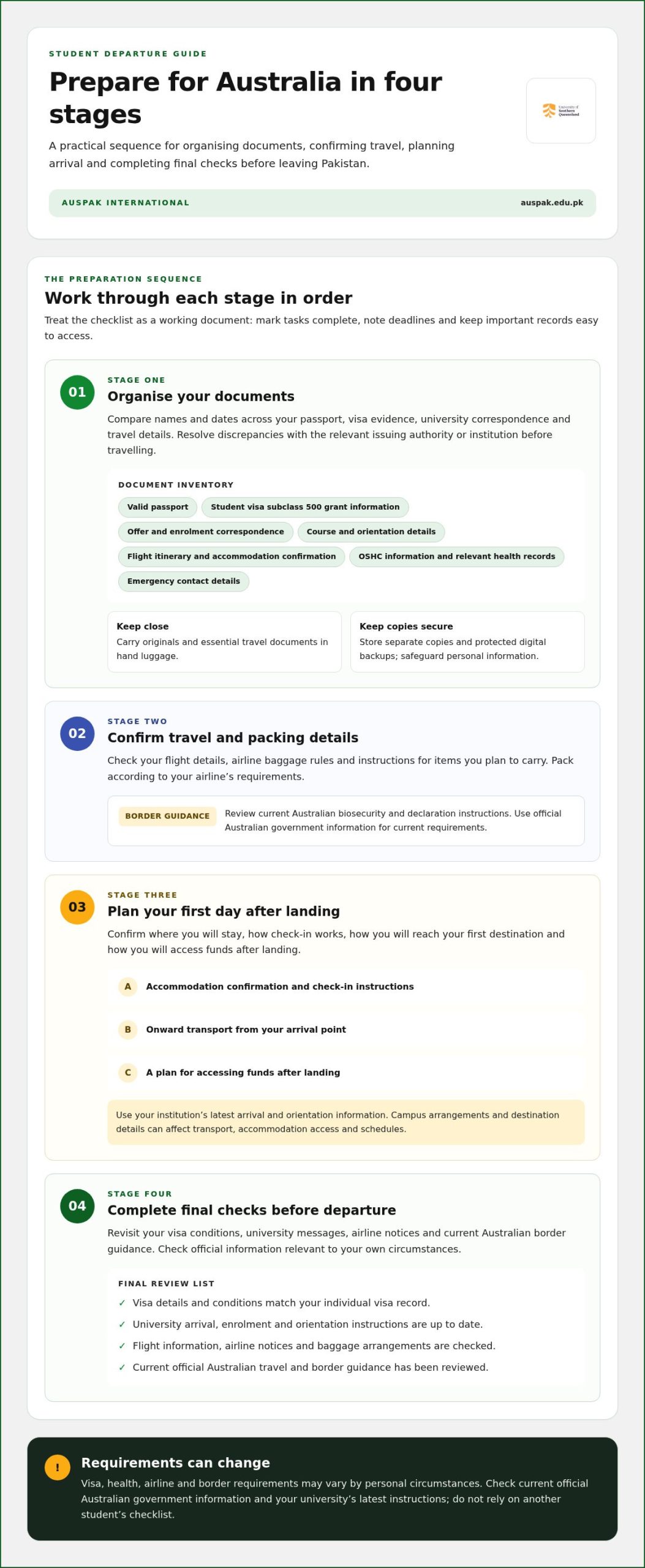
Prepare in four stages: organise documents, confirm travel, plan arrival, then complete final checks. This order makes unfinished tasks easier to identify and helps you adjust if a university message, visa update or airline notice changes your plans.
Check your passport, student visa, enrolment, and health documents
An organised document set helps you find information at check-in and respond to requests from your university. Before departure from Pakistan, compare your passport, visa evidence, enrolment records and travel arrangements. If names or dates do not match, resolve the discrepancy with the relevant issuing authority or institution before you travel.
Make an inventory of documents you may need during the journey and after arrival:
- Identity: Your valid passport and relevant personal records, such as documents supporting a name change if details differ across records.
- Visa: Your Student visa subclass 500 grant information and the conditions shown in your individual visa record.
- University: Offer and enrolment correspondence, course details, orientation information and any records your institution has asked you to bring.
- Travel and arrival: Flight itinerary, accommodation confirmation, check-in instructions and useful emergency contact details.
- Health: Your Overseas Student Health Cover (OSHC) information and health records or prescriptions you may need to refer to.
Keep originals and essential travel documents in your hand luggage, where you can reach them during check-in and arrival. Store copies separately, and keep secure digital backups in a protected account or on a device. Protect sensitive personal information, especially when using shared devices.
What student and travel documents should go in your hand luggage?
Keep documents you may need to show or consult during your journey together: your passport, visa grant information, university correspondence, accommodation details, itinerary and emergency contacts. An organised folder makes it easier to retrieve a particular record without unpacking. Store a separate copy set securely because it contains personal information.
How to check visa, university, and health requirements
Use your individual visa grant information to review your Student visa subclass 500 conditions, and compare it with current guidance from Australia’s Department of Home Affairs. Do not rely on old terminology or another student’s checklist. Requirements can change, so review official information during your preparation and close to departure.
Then read your university’s latest messages for enrolment steps, orientation dates, health cover details and any records requested for arrival. Check that your name and course details match across your documents, and note deadlines that require action before travel. For background on choosing a course and institution, AusPak’s Australia university guide for Pakistani students provides useful admission context.
AusPak provides guidance with Australian university applications and visa documentation to help you organise the paperwork relevant to your student journey. Visit AusPak International to learn more.
Packing for Australia and Biosecurity Checks
Packing for a move from Pakistan is easier when you sort items by purpose instead of filling bags at random. Your course, personal needs and destination will shape what to bring. Before packing, check your airline’s current baggage allowance, cabin-bag rules and restrictions. Allowances can differ by carrier, route and ticket.
Sort your belongings into four practical groups:
- Travel essentials: Keep documents you may need in transit accessible, along with essential contact details.
- Study materials: Pack items you know you’ll need for your course, and check university guidance before carrying bulky supplies.
- Personal items: Choose clothing and everyday necessities based on your plans, expected conditions and what you can reasonably carry.
- Restricted or uncertain items: Set aside food, medicines, plant or animal products and other items whose import conditions you have not checked.
Keep items needed during the journey or soon after arrival in your hand luggage, including necessary medication and immediate-arrival essentials. Pack other permitted belongings in checked baggage, within the airline’s size, weight and item restrictions. Do not assume an item is allowed just because it is common in Pakistan or has travelled internationally before.
What belongs in hand luggage and checked baggage?
Keep essential travel documents, necessary medication and items you’ll need soon after landing within easy reach. Pack medication with its identifying labels and any supporting information you may need, then check current official guidance for the specific medicine. Before closing your bags, review your airline’s latest cabin and checked-baggage instructions, including limits on particular items. Let your course, health needs and personal circumstances guide what you pack.
How to prepare for Australian customs and biosecurity
Australia has strict biosecurity controls. Before packing, read current Australian Border Force and biosecurity guidance for food, medicines, plant and animal products, and other restricted or controlled goods. Rules depend on the item and its circumstances. Check the current official instructions for anything you are unsure about rather than relying on informal advice or an old packing list.
Declaring an item is safer than guessing whether it’s admissible. A declaration is a disclosure process, not proof that an item is prohibited. Officials can assess it under the applicable requirements. Follow the instructions on your arrival card, declare items as directed and answer every question accurately. Do not leave out an item because you believe it will be permitted. Read the declaration wording carefully and ask an officer if you are unsure how to respond.
Include this step in your pre-departure checklist for students going to Australia: review your planned packing, check current rules for uncertain items and revisit airline instructions close to departure. Official guidance is more reliable than a generic packing list for deciding what to carry.
Plan your money, accommodation, and first journey after landing
Your first hours in Australia will be easier to manage if you know where you’re staying, how you’ll get there and how you’ll pay for immediate needs. Transport options, check-in arrangements and university arrival guidance vary, so base your plan on your confirmed accommodation and destination. Add the details to your pre-departure checklist for students going to Australia before leaving Pakistan.
Work through your arrival plan in order:
- Confirm your first accommodation. Save the full address, booking confirmation and contact details. Check that your stay covers your expected arrival date.
- Review check-in instructions. Note the check-in time, entry process and what to do if your arrival is delayed. Keep these details available offline as well as on your phone.
- Plan onward transport. Decide how you’ll travel from the airport to your accommodation, considering your arrival time, luggage and destination directions. Keep relevant booking or transport information easy to access.
- Share your arrival details. Give your itinerary and expected arrival time to a trusted person, and save contact information for your accommodation and university.
How to prepare accommodation and airport transport
Before departure, make sure the accommodation address and check-in instructions are clear, and that you can contact the accommodation after landing. Compare your arrival time with the stated check-in arrangements so you can address any gap in your plan. Review your university’s latest messages for orientation dates, campus arrival guidance or other information relevant to you. Keep the route and key contact details somewhere you can access without an internet connection.
Check the details for your own booking rather than assuming every campus or accommodation provider follows the same process. Your first stay may have specific entry instructions or a set check-in time. Plan transport around the actual address, not a generic guide.
How to organise access to money and essential contacts
Plan for initial expenses such as transport, food and immediate necessities, and avoid relying on one payment method alone. Before leaving Pakistan, check that your bank cards can be used overseas, review transaction settings that could affect access and save your bank’s contact method for use from abroad. Decide how you’ll access funds after landing, and keep essential contact details both on your phone and on paper.
Save your university’s international student or arrival contact, accommodation contact, a trusted person and relevant emergency information. Add orientation dates and arrival instructions to your calendar, noting the time zone where needed. If plans change during travel, these details can help you work out whom to contact and what to do next.
Organising your arrival is part of the transition from admission to study. AusPak International provides arrival support for students, alongside guidance with Australian university applications and visa documentation. Explore student arrival support as you prepare for your move.
Complete your final pre-flight checks and get student support
Use the final 24 to 72 hours before departure for a focused review rather than last-minute repacking. Airline notices, university messages and official guidance may change, so review the latest information and keep essential details close at hand. This final pass completes your pre-departure checklist for students going to Australia.
What should students recheck before leaving for the airport?
Review each item against your current bookings and instructions. If something has changed, update your notes and tell anyone who needs your arrival details.
- Flight: Check departure time, terminal information, itinerary and airline notices. Confirm current baggage allowances and restrictions with your carrier.
- Passport and documents: Keep your passport and essential documents accessible, and make sure secure backups are stored separately.
- Accommodation: Recheck the address, check-in time, entry instructions and contact details. Confirm how you’ll get there after landing.
- University: Review new messages, orientation dates, enrolment instructions and the appropriate contact for arrival questions.
- Requirements: Revisit your visa conditions and current official Australian travel and border guidance. Follow the latest instructions that apply to your circumstances.
Keep your itinerary and essential contact details accessible during the journey, including if your phone battery runs low or you cannot connect to the internet. If flight or arrival plans change, use your saved contacts to update your accommodation and university as needed. Check for newer notices instead of relying on an old email or screenshot.
How AusPak supports students preparing for Australia
Preparing to leave involves more than reaching the airport. AusPak International supports Pakistani students with Australian university applications and visa documentation guidance, helping them organise key stages of the transition. AusPak also provides arrival support to help students prepare for their next steps in Australia.
If you’re still organising your application or visa documents, get guidance early so you have time to address questions. Keep your own records of instructions and decisions, and use official sources for current visa and travel requirements.
As you prepare to move from planning to arrival, get guidance for your Australian study journey.
Take your next step towards studying in Australia
Your preparation doesn’t end when the bags are packed. Keep your plans current as departure approaches, and review any new university message, travel notice or official update that affects you. A pre-departure checklist for students going to Australia is most useful when it guides decisions as well as packing.
If parts of your study journey still feel unsettled, seek guidance early and turn outstanding questions into clear next steps. AusPak International has supported students since 1995 and works with more than 40 Australian university partners. Its team can guide you through application and visa-documentation steps and help you prepare for arrival.
Get support with your Australian study journey. Move forward with a plan and keep checking current requirements as you prepare for Australia.
Frequently Asked Questions
How early should I arrive in Australia before my course starts?
Plan to arrive with enough time to settle in and complete any required enrolment or orientation activities before classes begin. There’s no single arrival window that suits every course. Check your university’s dates, accommodation check-in arrangements and travel plans together. For example, if orientation is scheduled before teaching starts, arriving after orientation could mean missing important course information. Follow your institution’s latest guidance when choosing your travel date.
Can I enter Australia before my student course begins?
You may be able to travel before your course begins if your Student visa is in effect and permits travel and entry on your intended dates. Check your visa grant details for validity and conditions, and make sure your travel plans align with your enrolment. A useful pre-departure checklist for students going to Australia includes checking both your visa dates and your course start date, rather than assuming one confirms the other.
How much cash should I take when travelling to Australia as a student?
There’s no universal cash amount to carry. Plan access to funds for your own first expenses, such as transport, food and essential purchases, and avoid relying entirely on cash. Before leaving Pakistan, check whether your bank card works overseas, review its transaction settings and know how to contact your bank from abroad. Check current Australian Border Force rules for declaring cash or other monetary instruments if you plan to carry them.
Can I bring prescription medicines into Australia?
You may be able to bring certain prescription medicines for personal use, but conditions depend on the medicine and its ingredients. Before packing, check current Australian government guidance, including Therapeutic Goods Administration and border information, for your specific medication. Keep it in its original packaging and carry a copy of your prescription or a letter from your doctor where appropriate. Don’t assume a medicine permitted in Pakistan has identical entry conditions in Australia.
What happens if I arrive in Australia without confirmed accommodation?
Without confirmed accommodation, you may have nowhere arranged to rest or store your belongings after arrival, and last-minute options may not fit your budget or check-in time. Arrange at least an initial place to stay before travelling, and save its address, booking details and contact method offline. If plans change, contact your university’s international student team for information about relevant arrival guidance, but don’t assume it can provide a room.
Do I need to declare food or personal items when arriving in Australia?
Declare items as instructed on your passenger arrival card and follow current Australian biosecurity guidance. Food, plant and animal products can be subject to specific controls, while ordinary personal belongings may be treated differently depending on the item. A declaration doesn’t automatically mean an item is prohibited; it allows officials to assess it. If you’re unsure whether something needs to be declared, disclose it and answer officers’ questions accurately.
Can I work in Australia immediately after arriving on a student visa?
Not necessarily. Student visa work rights are subject to conditions, including limits on work while your course is in session, and you generally can’t begin working before your course starts unless an applicable exception applies. Check your visa grant and current Department of Home Affairs guidance before accepting work. Don’t treat arrival in Australia or holding a student visa as automatic permission to start a job on your first day.