
The right destination can matter as much as the major you choose. To decide how to choose a major for studying abroad, connect your interests and strengths with your career direction, then compare how each programme and destination supports that path. Don’t choose a field or country just because it is popular.
It’s natural to start with the subject you want to study. But a programme’s curriculum, specialisations, teaching language, and practical learning opportunities shape what you gain from studying overseas. The destination can also bring your field to life in a distinctive way. For example, environmental studies may offer a different perspective depending on the region’s sustainability challenges.
This guide shows how to connect career goals with programme content, weigh language and cultural immersion, and learn from professionals and students. It also covers ways to explore a field through courses, volunteering, or projects, and how to assess destinations in relation to your intended subject.
Key Takeaways
- Match a programme’s curriculum and specialisations to your strengths, career direction, and degree requirements.
- Compare the language of instruction with the kind of cultural and language immersion you want from your destination.
- Talk with professionals and university students to understand the field’s daily work, challenges, and useful skills.
- Use short courses, volunteering, or projects to explore a subject before committing to it as a major.
- Choose a destination for the perspectives and learning opportunities it can bring to your intended field.
1. Matching study-abroad programs to a major and career goals
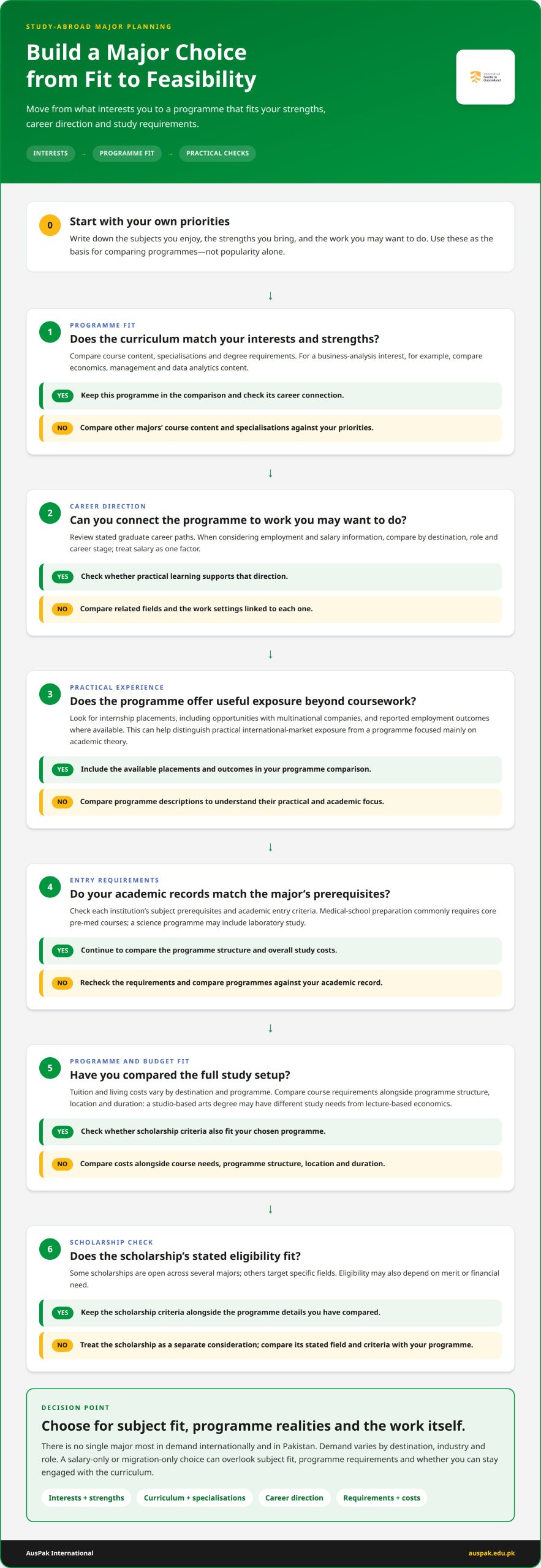
Start with three factors: your interests, strengths, and the work you may want to do. An education consultant can compare these priorities with degree curricula, specialisations, and stated graduate career paths. For example, someone interested in business analysis could compare economics, management, and data analytics course content before choosing a major. This comparison links personal fit with the realities of each programme.
When comparing job prospects and average salaries across popular majors abroad, look at available employment and salary information by destination, role, and career stage. Treat salary as one factor: graduates and experienced professionals may earn differently.
Internships and graduate outcomes add useful context. A consultant can compare programme descriptions for internship placements, including opportunities with multinational companies, and examine reported employment outcomes where available. This helps distinguish a business degree with practical international-market exposure from one focused mainly on academic theory.
Admission requirements depend on the major and institution. A consultant compares each programme’s subject prerequisites and academic entry criteria with the student’s records. For example, medical-school preparation commonly requires core pre-med courses, while a science programme may include laboratory study.
Tuition and living costs vary by destination and programme, and course requirements can affect your overall budget. A studio-based arts degree, for example, may have different study needs from a lecture-based economics programme. Compare programme structure alongside location and duration.
A practical way to decide how to choose a major for studying abroad is to discuss your preferred subjects, academic performance, and possible work settings with an education consultant. They can compare these priorities with programme curricula and specialisations, rather than steering you toward a subject just because it seems popular.
There is no single major most in demand internationally and in Pakistan. Demand varies by destination, industry, and role, so compare the career paths linked to fields such as communication, economics, and biology across your intended markets.
Scholarships may be open across several majors, while some target specific fields. Eligibility may also depend on merit or financial need. A consultant can compare each scholarship’s stated field and criteria with the student’s chosen programme.
Choosing a major only for salary or migration prospects can mean overlooking subject fit, programme requirements, and the work itself. If you dislike the curriculum, it may be difficult to stay engaged, even if the field seems financially attractive.
Arts and humanities deserve the same careful curriculum review. An arts programme may include an artist residency or partnership with a local creative institution, while International Relations may examine intercultural dynamics and global issues in context. These opportunities connect academic study with the destination’s professional and cultural environment.
If a college lacks study-abroad programmes, external providers offer another route to international study. A consultant can compare those programmes with the student’s degree plan, course content, teaching mode, duration, and available internships or research, then identify options that fit academic goals.
2. Language of instruction and cultural immersion
Language affects both classroom learning and daily life, so assess each separately. Some programmes in non-English-speaking countries are taught entirely in English, while opportunities to use the local language may come outside class. You don’t need fluency in a second language to study abroad, but your comfort speaking it can affect how readily you participate and connect with others.
Compare a programme’s teaching language, language-support options, and opportunities to use the host country’s language. For example, you may study in an English-taught course in France while encountering French in shops, museums, and community activities. This distinction can help you decide whether to prioritise academic access or greater everyday language immersion.
Housing changes the experience, too. A host family can create regular opportunities to practise conversation and learn local routines; an apartment can offer greater independence. An advisor can discuss which arrangement better suits a student’s confidence, study habits, and preferred level of cultural contact. The choice matters for someone who wants structured interaction as much as for someone who prefers to explore independently.
Consider climate and lifestyle before choosing a destination. Compare the weather with the clothing and activities you’re comfortable with, then think about local food, transport, social customs, and the pace of daily life. Someone who enjoys outdoor activities may value a destination where these fit naturally into local routines, while another student may prioritise museums or public transport.
Culture shock can involve unfamiliar communication styles, meals, classroom expectations, or daily schedules. Prepare for the situations you’re likely to encounter: learn common greetings, read about local etiquette, and discuss classroom differences with an education consultant. For example, if you’re used to speaking only when invited, seminar discussions that encourage active participation may take some adjustment.
Build cultural learning into the academic plan. A language student can practise during café visits, museum trips, and weekend outings; an international studies student can connect classroom topics with local events and perspectives. These activities make immersion purposeful, rather than leaving it to chance. An advisor can help weigh the expected learning experience against language comfort and lifestyle preferences.
For students considering the UK, visa planning is another part of preparing for study abroad. UK Student Visa Consultancy can support the visa process alongside decisions about language, programme, and destination.
Living with a host family can offer cultural immersion and opportunities to practise a language, while an apartment can provide more independence. If you’re studying a foreign language, everyday activities such as visiting cafés, museums, and local attractions can become opportunities to practise.
3. Speaking with professionals and university students
Conversations with working professionals and current university students can reveal what course descriptions leave out. A professional can explain typical work routines, field challenges, and skills used toward a career. A student can describe coursework, group projects, and how academic expectations differ from their previous school. An education consultant can use these perspectives to test whether a major matches the student’s interests and preferred working style.
Make each conversation specific. For a student considering economics, ask a professional about the balance between analysis, communication, and team work. Ask a current university student which assignments build those skills and how they connect with later studies. These answers help distinguish an appealing subject title from the actual learning experience, while showing what students value about their programme.
Support and safety deserve their own discussion. An education consultant can compare what each study-abroad programme says about student support, orientation, and emergency contacts. Programmes with 24/7 emergency contacts give students a clear route to urgent assistance. Discuss who students contact for academic concerns, accommodation issues, or personal difficulties, and how those support routes fit the destination.
Work permissions vary by country, so students should consider them alongside course demands, not as a promise of employment. Canada allows international students up to 24 hours of off-campus work per week. Australia allows 48 hours per fortnight during term time and unlimited work during study breaks. New Zealand allows international students up to 25 hours per week. These rules can shape how students plan study and work commitments.
Student visa requirements also vary by country. A consultant can help students understand how the intended destination’s visa process relates to their study plans, while keeping career expectations separate from permission to work. For example, a student should compare a programme’s timetable with the relevant work limits before assuming a job can fit around classes.
Housing availability affects daily routines and the choice of university. A consultant can compare accommodation types and explain how location, travel to campus, and programme arrangements shape a student’s options. Ask current students about their experience of university housing or local rentals, including how far they travel and what daily access to campus services looks like.
Bring these conversations together before settling on a major and destination. Compare professional insight, student experience, support arrangements, visa work permissions, and housing considerations against your academic priorities. This gives you a clearer picture of how study, daily life, and future career plans may fit together.
4. Using short courses, volunteering, and projects to explore fields
A short course can test a subject before a student commits to a full degree. Programming, business, design, psychology, and engineering courses introduce different ways of thinking and working. An education consultant can match an exploratory course with the student’s academic goals, then use the student’s response to its assignments and content as evidence of subject fit.
Volunteering and independent projects add practical context. A student curious about environmental studies might contribute to a community sustainability project, while an aspiring designer could create a small portfolio. A consultant can help connect these experiences to relevant programmes and present them clearly in an application. The work can reveal whether the student enjoys a field’s everyday tasks, not just its subject matter.
STEM students need to look beyond course titles. An education consultant can compare course descriptions, learning outcomes, and available laboratory research to identify useful academic matches abroad. Some universities offer equivalent STEM courses, and some programmes include lab research opportunities. A student considering a semester overseas should also look for direct course-equivalency agreements, which can support credit transfer.
Course sequencing affects whether an international term fits your degree plan. A science programme, for example, may require one course before you can take an advanced laboratory class. Map prerequisites, required courses, lab or clinical components, and planned internships against the proposed study period. Reviewing these details early can reveal scheduling conflicts that might affect your graduation timeline.
To assess transfer policies, an education consultant reviews potential courses and compares their content with the student’s degree requirements. The student’s academic advisor and study abroad office can clarify how coursework may count toward the home degree. Students should contact both 4 to 6 months before the planned study-abroad term to discuss credit transfer and whether courses fulfil major requirements.
If you’re considering a regulated profession, compare the foreign programme’s qualification, curriculum, and accreditation information with the licensing criteria for your intended profession. This can help identify requirements that may affect eligibility before enrolment. In Pakistan, international degree accreditation and recognition can influence how a qualification is assessed for employment or professional licensing, so understand the relevant recognition requirements for your career path.
Shorter experiences can help protect a demanding academic schedule. Summer or faculty-led study-abroad programmes may let students take part without missing required coursework. A consultant can weigh those formats against the student’s course sequence, research interests, and graduation plan, then help identify a practical way to gain global experience while continuing progress toward the degree.
5. Choosing a destination based on field of study
A destination can become part of the classroom when its environment connects with your subject. Environmental Studies students, for example, can examine sustainability approaches and environmental issues in different parts of the world. The strongest fit is not simply a country with a relevant reputation. Look for a programme that connects local context with classes, research, or practical learning tied to your academic goals.
For Art History, location can bring works and architecture into closer focus. Florence, Beijing, Paris, and Cape Town each offer distinct settings for examining art and built environments. Compare course content with the works you’ll study, then consider whether the destination supports the skills you want to develop. A city’s name alone does not show how much its local context shapes the degree.
Business students can assess destinations through the international markets and industries their programmes cover. Compare course topics, case studies, and internship opportunities with your intended career direction. A programme offering exposure to multinational companies may connect classroom concepts with cross-border business practice. Match the destination’s learning opportunities to the work you hope to pursue.
For International Relations, studying global issues in context can make a destination especially relevant. Compare how programme classes address intercultural dynamics, then consider whether local perspectives deepen those subjects. The destination should add substance to your academic experience, not serve only as a backdrop for travel.
Build a destination comparison around four criteria: relevant classes, field-based learning, career connections, and personal fit. If you’re interested in environmental work, you might prioritise sustainability-related study; if you’re an aspiring art historian, access to architecture and collections may matter more. Compare programme details and available research or internships to see what each destination adds to your major.
Scholarships can also shape your shortlist. Some are open to students across different majors, while others target particular fields. Awards may be need-based or merit-based and can come through universities or third-party providers. Compare eligibility with your academic profile and chosen field, and weigh funding alongside curriculum and destination fit.
Pakistani students can consider study pathways to the UK, Canada, Australia, and other countries, depending on their plans. Assess each option against your intended major, programme structure, and future career direction. A clear comparison can show whether a destination strengthens your degree experience or simply makes the application seem attractive.
Choose the destination that gives the student’s field a meaningful setting and supports the skills they want to gain. Get guidance on choosing a study destination that aligns with your academic direction.
AusPak International: Canada Study Permit Assistance
AusPak International offers Canada Study Permit Assistance for students who have chosen a Canadian programme and need support with the permit process. Turn to this service as you move from choosing a major and university toward preparing a study permit application. Let your programme and destination guide the next steps.
Students considering other study pathways can also access Australian University Admission Support or UK Student Visa Consultancy. Onshore Arrival Support can help you prepare for the transition after reaching your destination. These services connect education planning with admission, visa, or arrival support without replacing your own academic decisions.
Have your intended destination and study plans in mind for the next step. Contact AusPak International to discuss the support that fits your plans.
Turn your academic direction into a practical plan
Understanding how to choose a major for studying abroad is the start of a larger decision: shaping an international education around the person you want to become. Let your chosen field guide the next steps, from selecting suitable programmes to preparing for study in another country. Keep your goals clear, while allowing room to refine them as you learn more about your chosen work and academic environment.
Your next step is to connect your academic direction with a realistic application plan. AusPak International supports students pursuing international education through admission and visa services. Choose support that matches your destination and stage in the process, then move forward with a clearer study plan.
Contact AusPak International today to discuss your study-abroad plans. Your next academic chapter can start with a focused decision and a confident step forward.
Frequently Asked Questions
How do work visa and post-study work rules vary by country and major?
Work permissions depend on the destination, visa conditions, and, for some post-study options, the field. Canada permits international students up to 24 hours of off-campus work per week, while Australia allows 48 hours per fortnight during term time and unlimited work during study breaks. New Zealand permits up to 25 hours per week. In the United States, eligible STEM graduates can receive up to three years through standard F-1 OPT plus the STEM OPT extension.
What steps should Pakistani students take to select a major and shortlist study-abroad programs?
Start by identifying the subjects you enjoy, the areas where you do well, and the kind of work you hope to pursue. Shortlist majors whose curricula and entry prerequisites fit your academic background. Compare programmes by destination, course structure, teaching language, and practical learning opportunities. Consider how each qualification connects with your intended career, whether further licensing may matter, and how the programme fits your study plans before applying.
Which majors are most in demand internationally and in Pakistan?
There is no single major most in demand internationally and in Pakistan; demand varies by destination, industry, and role. Communication, Economics, and Biology can lead to opportunities across multiple industries.