
What if the nursing course that seems like the obvious next step doesn’t match your education or long-term goals? If you plan to study nursing in Australia from Pakistan, choosing a qualification is only one part of the decision. You’ll also need to understand university entry criteria, student visa requirements, English-language expectations, clinical learning, and the separate process for professional registration.
These requirements can be difficult to untangle because university admission, a student visa, and nursing registration serve different purposes. Meeting one set of criteria doesn’t automatically satisfy the others. Start with your previous education and career aims, then compare them with suitable courses and the requirements for each next step.
This 2026 guide explains the main nursing study pathways, what to check with universities and official authorities, and how to organise your application from Pakistan. It also covers why clinical placements and English preparation deserve early attention, and how AusPak International’s university counselling, application processing, and document review can help you approach the process with greater clarity.
Key Takeaways
- To study nursing in Australia from Pakistan, match your previous education and career goals to a suitable course pathway before you apply.
- Compare nursing qualifications by applicant fit, clinical learning, and the outcomes each course is designed to support.
- Check academic, English-language, document, and visa requirements separately. They can vary by university, course, and applicant profile.
- Plan your application in sequence, from comparing course criteria and preparing records to submitting your university application and preparing for a student visa.
- University counselling, application processing, and document review can help you organise your next steps while keeping study and professional registration requirements distinct.
Study nursing in Australia from Pakistan: understand your pathway first
Choosing to study nursing in Australia can be an ambitious and rewarding step. For applicants in Pakistan, the right starting point is to understand how previous education, career plans, and course entry criteria fit together. Enrolling in a course is not a shortcut to professional registration or a guaranteed career outcome.
Nursing education is a course of study; professional registration is a separate process that determines whether someone may practise as a nurse under Australian requirements. Completing a qualification doesn’t automatically mean you’re registered. The course, its accreditation, and your individual circumstances all matter. The overview of Nursing in Australia can help you familiarise yourself with different qualification levels and the wider context of nursing practice.
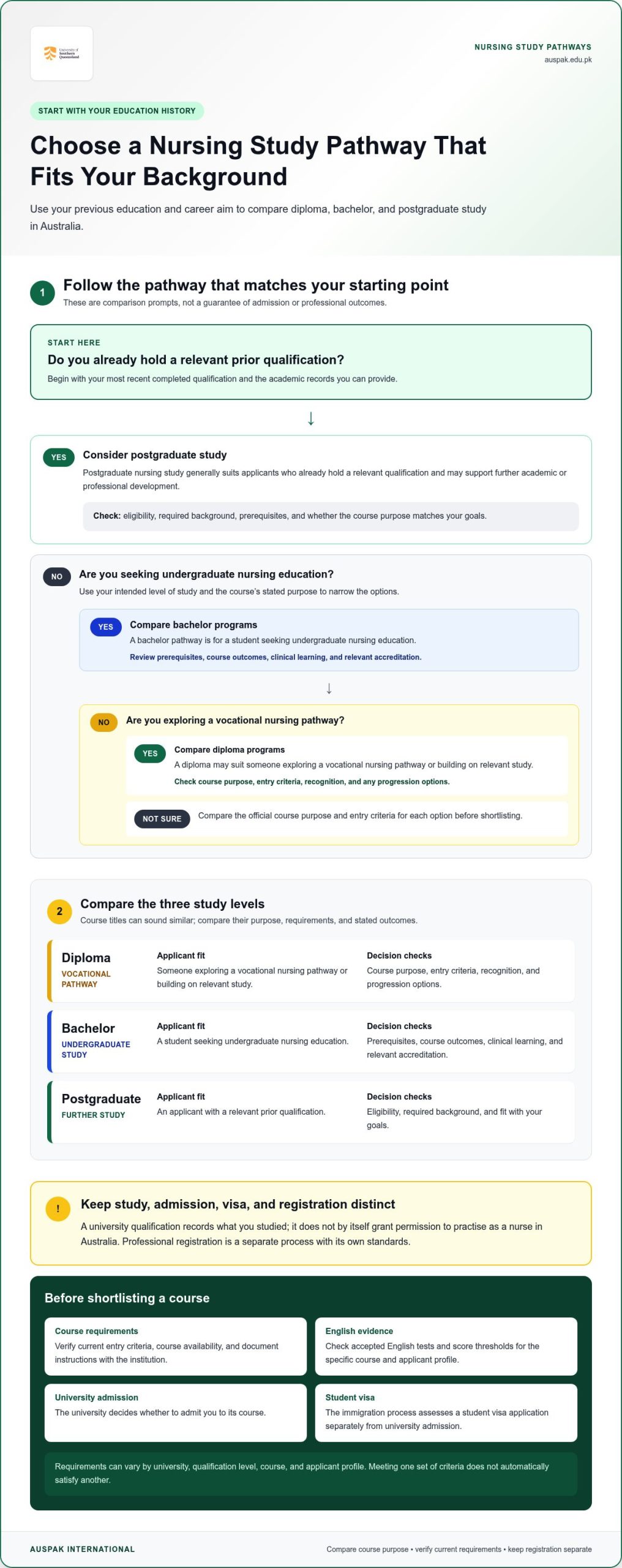
Which nursing qualification could fit your background?
Start with your most recent completed qualification and the role you hope to pursue. Diploma and bachelor pathways differ in level, course structure, entry criteria, and potential outcomes, so they aren’t interchangeable. A diploma may suit one learner’s starting point, while a bachelor’s degree may be more relevant for another. Compare each course’s stated outcomes and registration relevance rather than relying on its title alone.
Postgraduate nursing study generally suits applicants who already hold a relevant qualification. It may support further academic or professional development, but its prerequisites and purpose need to match your existing education. Before shortlisting courses, ask yourself:
- What nursing or other qualifications have I completed, and what academic records can I provide?
- Am I entering nursing study for the first time, or building on relevant prior education?
- What career aim is this course intended to support?
- What entry criteria and professional outcomes does the university specify?
Use your answers to guide your research, then verify current entry requirements and course availability with each institution. Requirements vary by university and qualification level.
What is different for applicants applying from Pakistan?
Plan university admission and the student visa as separate stages. First, identify courses that align with your background, then prepare an application that meets the chosen institution’s criteria. A university decides whether to admit you to its course; Australia’s immigration process assesses a student visa application. Meeting admission requirements doesn’t decide the visa outcome.
Your academic records may be assessed against the university’s requirements, while English-language evidence must meet the criteria for your course and applicant profile. Standards can differ between institutions and programs, so don’t assume one test result or document set will satisfy every requirement. Check accepted English tests, score thresholds, academic prerequisites, and document instructions in the university’s current course information.
If your longer-term goal is to practise as a nurse, research registration requirements alongside course selection, not after making an enrolment decision. Keep education, admission, visa preparation, and professional registration distinct in your plan. This helps you build a realistic pathway from Pakistan, with each decision based on the requirements that apply to you.
Nursing courses in Australia: compare study levels, clinical learning, and outcomes
Course titles can sound similar while preparing students for different academic and professional outcomes. If you plan to study nursing in Australia from Pakistan, compare each qualification with your education history, intended career direction, and the university’s current course information. Don’t choose on the award title alone.
A university qualification records what you studied; it doesn’t, by itself, grant permission to practise as a nurse in Australia. Registration is a separate process with its own standards.
| Study level | Typical applicant | Decision checks |
|---|---|---|
| Diploma | Someone exploring a vocational nursing pathway or building on relevant study | Check course purpose, entry criteria, recognition, and any progression options |
| Bachelor | A student seeking undergraduate nursing education | Review prerequisites, course outcomes, clinical learning, and relevant accreditation |
| Postgraduate | An applicant with a relevant prior qualification | Confirm eligibility, required background, and whether the course matches your goals |
This is a broad guide, not a promise that qualifications lead to identical roles or outcomes. Universities set their own admission criteria and progression arrangements, and course availability can change. Compare the official course page and current entry requirements for each option on your shortlist.
Diploma, bachelor, or postgraduate nursing study?
Use your previous education as the first filter. A diploma and a bachelor’s degree differ in level and course purpose, so check what each program teaches and what further study it may allow. Postgraduate options generally require relevant prior qualifications; exact prerequisites depend on the institution and course. Build a shortlist around the fit between your existing studies and your intended next step, rather than assuming one level is automatically best.
How clinical learning and accreditation affect course choice
Clinical learning is a core part of course planning because it connects academic study with supervised practice. Before applying, review how the university describes placements, how they fit into the course, and what requirements students must meet. Placement arrangements differ, so use the institution’s current information rather than assuming every program offers the same experience.
Accreditation and registration are related, but they aren’t interchangeable. Check the program’s current accreditation status through the relevant nursing authorities, including ANMAC’s role in nursing program accreditation. The Nursing and Midwifery Board of Australia (NMBA) publishes registration standards and guidance. The university decides admission; professional registration has its own requirements.
For a more considered shortlist, AusPak International’s Australian university counselling can help align course research with your education history and goals.
Nursing entry requirements for Pakistani students: what to check before applying
Before applying, separate four types of requirements: academic eligibility, English-language evidence, supporting documents, and student visa criteria. They’re assessed for different purposes, and exact requirements can differ by institution, course level, and applicant profile. Use the checklist below to build a course-specific plan rather than assuming one university’s criteria apply everywhere.
Academic records, English evidence, and supporting documents
Start by comparing your completed Pakistani qualifications with the chosen course’s published prerequisites. Check required subjects, academic results, and any rules for applicants with previous tertiary study. If a requirement isn’t clear, use the university’s current admissions guidance to understand how to present your records.
Prepare documents according to the institution’s instructions. A useful starting checklist includes:
- Academic transcripts and certificates for completed qualifications
- Evidence of identity, such as the documents specified by the university
- English-language test results from a test accepted for your course
- Any additional records requested for your qualifications or applicant profile
- Documents related to clinical placement checks, if required by the institution
English thresholds aren’t universal. Confirm which tests the university accepts, the required scores, and any section-score minimums for your chosen course. Nursing registration has a separate English standard: as of 23 April 2026, the NMBA standard for IELTS Academic requires an overall 7.0, with at least 7.0 in listening, reading, and speaking and 6.5 in writing. This is a registration benchmark, not a substitute for checking course admission criteria.
2026 verification note: English standards, entry criteria, document instructions, and placement conditions can change. Recheck current university requirements before submitting your application, including whether clinical placements require additional checks or evidence.
Student visa and nursing registration are separate processes
University admission does not itself grant permission to travel or study in Australia. After considering course admission, review the student visa application process separately through the Australian Department of Home Affairs. The relevant visa is Student visa (subclass 500); verify current application requirements and terminology against official guidance before preparing your application. The Genuine Student (GS) requirement is the current terminology for 2026, but applicants should confirm the latest rules when they apply.
Keep professional registration on a separate track, too. Completing a nursing course doesn’t automatically guarantee registration, employment, or permission to practise. Check the relevant registration standards with the Nursing and Midwifery Board of Australia, and use the Australian Nursing and Midwifery Accreditation Council (ANMAC) to understand its role in nursing education program accreditation. Accreditation, university admission, visa eligibility, and registration are distinct checks.
If you plan to study nursing in Australia from Pakistan, maintain a simple record for each shortlisted course: academic criteria, accepted English evidence, required documents, placement checks, and separate visa and registration actions. Revisit it before each application stage.
How to apply for nursing study in Australia from Pakistan: a practical sequence
A well-organised application starts with the course, not the visa form. Work through each stage in order, keeping university admission and visa preparation distinct. This helps you identify missing documents early and base decisions on current course and official requirements.
From course shortlist to university application
- Set your study direction. Note your previous education, the nursing qualification level you’re considering, your learning preferences, and your career aims. Use these to focus your research rather than applying to courses that may not fit your background.
- Compare current course details. Review each university’s course availability, entry criteria, English-language requirements, course structure, and published information about clinical placements. Save the official course pages and note when you checked them, as details can change.
- Prepare your application records. Follow the university’s instructions for academic transcripts, certificates, identity documents, English evidence, and any other requested records. Make sure names and details match across documents, and arrange verification or translations if the institution requires them.
- Submit to the university. Complete the application using the chosen institution’s process and provide the requested supporting material. AusPak International supports Pakistani students with profile assessment, document verification, and university application processing, helping keep submissions organised.
At this stage, an education counsellor can help relate your academic history and goals to your course research. AusPak partners with over 40 Australian universities. Compare each nursing program using its own current course details and entry criteria.
From an offer to visa preparation
- Review the university’s decision. Read the offer and its conditions carefully. Follow the institution’s instructions for responding and completing any outstanding admission requirements.
- Organise visa documents separately. When preparing for the visa stage, use current Department of Home Affairs guidance for the Student visa (subclass 500). Check the documents and information that apply to your circumstances, and make sure they are consistent with your course and application records.
- Prepare with care. Visa documentation guidance can help you organise materials and understand the application process, but no admission or support process guarantees a visa decision. The relevant Australian authority makes the final assessment.
Keep a simple tracker with course deadlines, document status, university instructions, and visa preparation tasks. For a wider overview as you organise your research, use AusPak’s Australian university application guidance. AusPak also provides profile assessment, document review, and application processing to help organise your submission. Get help with your Australian university application.
Plan your nursing study journey with informed application support
Once you understand the differences between courses, admission criteria, visa preparation, and nursing registration, turn that information into a plan that fits your background. Applicants from Pakistan can make better-informed choices by comparing current course requirements with their academic history and career aims before preparing applications.
What structured application support can help you organise
AusPak International’s Australian university counselling can help you assess your profile and relate your previous education and goals to course research. This gives you a clearer basis for deciding which qualification levels and university options to investigate. AusPak partners with over 40 Australian universities, and each program’s current course information and entry criteria should guide your shortlist.
Application processing and document verification can help you organise the materials a university requests, such as academic records and identity documents. A careful review can help identify missing or inconsistent information before submission. Application support also helps keep the steps and institutional instructions organised. The university makes its own admission decision.
Visa guidance is a separate part of preparation. It can help you organise visa documentation and understand the process, but it doesn’t determine the outcome. Australian authorities assess visa applications under the requirements in force when you apply. Likewise, admission to a nursing course doesn’t itself grant professional registration or permission to practise.
Your next steps before starting an application
Begin with a short preparation exercise. Write down your preferred qualification level, the education you’ve completed, and the career direction you’re considering. Then gather your transcripts and certificates, along with any other records you may need to demonstrate your academic background. This makes it easier to compare your profile with course criteria and identify gaps to address.
Before deciding, revisit the current information that governs each stage. Check university course availability, entry criteria, English evidence, and placement information directly with the institution. Review student visa requirements through the Australian Department of Home Affairs, and consult the relevant Australian nursing authorities for current accreditation and registration standards. Keep these as separate checks; satisfying one doesn’t automatically satisfy the others.
A simple planning sheet can keep your research manageable. For each course, record its level, prerequisites, required documents, application instructions, and questions you still need to resolve. Add separate notes for visa preparation and registration research. Update the sheet whenever you verify a detail, so your decisions rely on current information rather than assumptions.
With a clearer profile and organised records, you’re better prepared to take the next step. AusPak International supports course research, document review, university application processing, and visa preparation, without promising an admission or visa outcome. Start a profile discussion with AusPak and begin shaping your nursing study plan.
Turn your nursing study plans into a clear next step
Your next move doesn’t have to be a complete application. Begin with one focused decision: identify the qualification level that best matches your education and career direction. Then turn unanswered questions about course fit, requirements, and timing into a short list to resolve before you commit.
This preparation gives your application a clear purpose. AusPak International can help you develop that plan through Australian university counselling and application support, while visa guidance helps you prepare documentation for the relevant process. Universities and Australian authorities assess applications under their own requirements.
If you’re ready to move from research to a practical plan, take the next step with support tailored to your study goals. Start planning your Australian nursing study application with AusPak. With a considered pathway and organised preparation, your goal to study nursing in Australia from Pakistan can begin with confidence.
Frequently Asked Questions
Can Pakistani students study nursing in Australia?
Yes, Pakistani students can apply to Australian nursing courses if they meet the chosen institution’s admission requirements and satisfy the relevant student visa requirements. Eligibility depends on factors such as prior education, English evidence, and the course’s entry criteria. Start by comparing your academic background with current university requirements, then treat admission, visa assessment, and any future professional registration as separate decisions.
What qualifications can I study for nursing in Australia?
Options may include diploma, bachelor’s, and postgraduate nursing courses. The suitable level depends on your completed education and goals. Postgraduate study generally requires relevant prior qualifications, while diploma and bachelor pathways have different purposes and entry criteria. For example, an applicant with relevant tertiary study should check postgraduate prerequisites rather than assume direct entry. Confirm the course’s current structure and outcomes with the institution.
Do I need IELTS to study nursing in Australia?
Not necessarily IELTS specifically, but you’ll generally need to provide English-language evidence that meets the chosen university’s requirements. Accepted tests and score thresholds vary by institution and course, so check current admissions information before booking a test. Nursing registration has its own English standard, which may differ from course entry requirements. AusPak’s free IELTS mock test can help you practise if IELTS is part of your preparation.
How do I apply to study nursing in Australia from Pakistan?
To study nursing in Australia from Pakistan, shortlist courses that fit your education and goals, then compare current entry criteria, English requirements, and application instructions. Prepare academic records, identity documents, and any other materials the university requests. Submit through the institution’s application process and review any offer conditions carefully. After admission, prepare a separate student visa application using current Department of Home Affairs guidance.
Does studying nursing in Australia guarantee registration as a nurse?
No. Completing a nursing course does not automatically grant professional registration. Registration is assessed separately under the applicable requirements of the Nursing and Midwifery Board of Australia. Before enrolling, review whether the course’s accreditation and intended outcomes align with your professional plans. After graduation, check the registration authority’s current standards and application process for your circumstances rather than assuming the qualification alone is sufficient.
Can I work as a nurse in Australia after graduating?
Possibly, but graduating alone doesn’t establish permission to practise or a right to work. You’ll need to meet relevant professional registration requirements, and your visa must allow the work you intend to do. Student visa holders may work up to 48 hours per fortnight while their course is in session. Check current visa conditions and registration rules before making employment plans.
How much does it cost to study nursing in Australia?
Total costs depend on the university, course, study duration, and personal circumstances. Build a budget that includes tuition, living expenses, travel, and Overseas Student Health Cover, which is required for a student visa. For planning in Pakistan, record university charges in a worksheet and convert them to USD using a current exchange rate. Recheck published fees and official visa-related financial requirements before applying, as amounts can change.
What is the difference between a nursing course and nursing registration in Australia?
A nursing course is an education program delivered by a university or other institution; registration is a separate professional approval process. Admission confirms a place to study, while graduation confirms completion of the course. Neither automatically provides registration or permission to practise. If your goal is a nursing career, research the course’s recognition alongside current registration standards, and plan to meet the applicable requirements after study.