
What if your biggest challenge in planning to study in Sweden for Pakistani students isn’t finding a university, but making sure your programme choice, funding plan, and residence-permit application all line up? It’s understandable to have questions about eligibility, academic records, English-language evidence, and how admission connects to permission to live in Sweden. For courses lasting more than three months, the process involves a residence permit for studies, not a study visa.
A clear sequence makes the journey easier to plan. This 2026 guide explains how to identify programmes that match your academic background, understand application and English-language requirements, and prepare for tuition and living costs using current information. It also outlines scholarship options and the key evidence students need to consider for a residence-permit application.
Follow the main steps from choosing a programme and preparing documents to applying for admission, arranging funds, submitting a permit application, and getting ready for arrival. With a realistic plan, you can assess your options with greater confidence and know what to prepare next.
Key Takeaways
- Explore how English-taught programmes, research opportunities, and teaching approaches may fit your goals when you study in Sweden for Pakistani students.
- Compare your previous education, subject background, grades, and English-language evidence with each programme’s specific entry criteria.
- Build a realistic budget by accounting for tuition, housing, food, transport, insurance, study materials, and application expenses.
- Understand why university admission and a Swedish residence permit are separate processes, each with its own requirements.
- Follow a practical application sequence, from clarifying your study goals and preparing documents to planning funds and coordinating admission and permit steps.
Why Pakistani Students Consider Studying in Sweden
A European degree can represent an exciting academic step, but the right destination depends on more than its reputation. For Pakistani students considering study in Sweden for Pakistani students, a practical decision starts with the actual programme: its language of instruction, academic expectations, learning format, and relevance to future plans. This overview weighs Sweden’s potential attractions alongside the details each applicant needs to assess for themselves.
English-taught programmes can make Swedish higher education accessible to international applicants, while research and practical learning may appeal to students who want to connect theory with real questions or applications. These are possibilities to investigate, not promises that every course offers the same experience. University, programme, and personal circumstances all matter. The broad structure of the system is outlined in Education in Sweden, but programme pages are essential for course-level decisions.
What makes Swedish higher education distinctive?
Student-centred learning generally means students are expected to take an active role: preparing for classes, contributing to discussions, and managing independent study, rather than relying only on lectures. Some programmes may also include research projects, laboratory work, case studies, or other practical activities, but the format varies. Compare the teaching language, course structure, assessment methods, and stated learning outcomes to see what studying there would involve day to day.
Which study goals might Sweden suit?
Sweden may suit applicants whose subject interests align with available programmes and who are comfortable with the teaching and independent-study approach. Start with your goals: the expertise you want to develop, the subjects you want to explore, and the kind of learning environment in which you can do your best. Then compare course content and entry criteria, rather than assuming a subject is a good fit because it is often associated with Sweden.
- Review modules and learning outcomes to check whether the programme matches your academic interests.
- Consider whether its teaching format fits your preference for discussion, independent work, or practical study.
- Compare the stated entry criteria with your previous education and subject preparation.
Career plans deserve the same close attention. A programme’s content can help you assess how it supports your intended direction, but a degree alone doesn’t guarantee a particular job or outcome. For a broader perspective on planning beyond graduation, explore career opportunities after studying abroad.
Programme fit matters more than a country’s reputation: choose Sweden when a specific course matches your preparation, learning preferences, and goals. That comparison gives you a stronger basis for deciding whether Sweden belongs on your shortlist and what to investigate next.
How to Match Swedish Programmes with Your Pakistani Academic Background
For study in Sweden for Pakistani students, the strongest starting point is not a general list of popular subjects. It’s a careful match between your Pakistani education and the requirements of a specific programme. Swedish universities set their own entry criteria, and requirements can differ between institutions and even between courses at the same university.
How should applicants compare programme entry requirements?
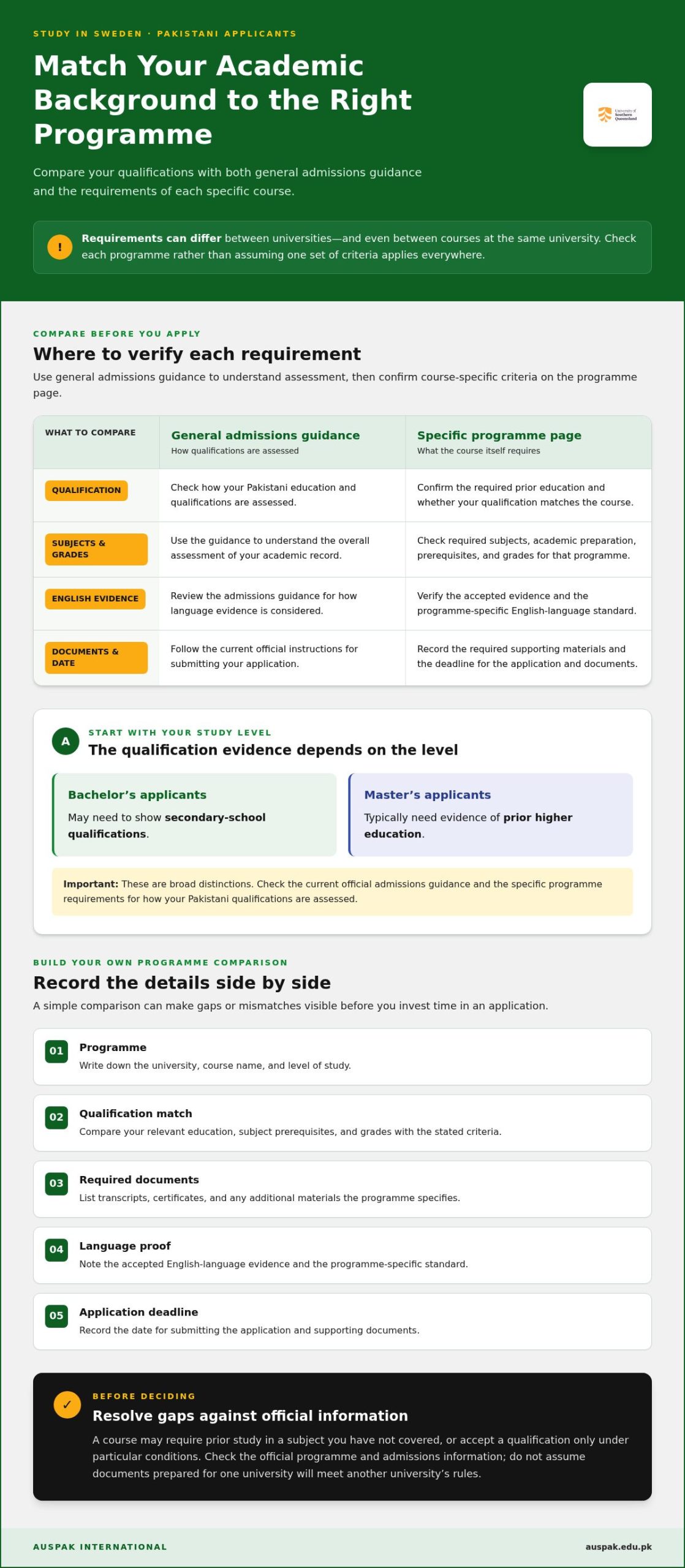
Read the general admissions guidance separately from each programme’s prerequisites. General guidance explains how qualifications are assessed; programme pages identify required subjects, academic preparation, grades, and English-language evidence. Bachelor’s applicants may need to show secondary-school qualifications, while master’s applicants typically need evidence of prior higher education. Use current official admissions guidance to understand how your Pakistani qualifications are assessed, and don’t assume one programme’s criteria apply to another.
Build a comparison table before deciding where to apply. Record the details for each option, then note any gaps you need to resolve:
- Programme: university, course name, and level of study.
- Qualification match: your relevant education, subject prerequisites, and grades.
- Required documents: transcripts, certificates, and any additional materials.
- Language proof: the accepted evidence and programme-specific standard.
- Application deadline: the date for submitting the application and supporting documents.
This simple comparison makes mismatches visible early. A course may sound relevant but require prior study in a subject you haven’t covered, or accept a qualification only under particular conditions. Resolve those questions against the official programme and admissions information before investing time in an application.
Which application documents should students prepare?
Start with academic records and identity documents, then add any supporting materials required by the programme, such as a statement or portfolio if specified. The exact list depends on the course and applicant. Check official instructions for translation, certification, file format, and submission method; don’t assume that documents prepared for another university will meet the same rules. Guidance on international university document verification can help you understand why accuracy and consistency matter.
Keep admission evidence distinct from residence-permit preparation. An offer from a university and permission to reside in Sweden are separate decisions, with separate requirements. As your plans progress, consult the Swedish Migration Agency’s guidance for higher education students for current permit information. This helps you plan ahead without treating university admission as a permit decision.
Meeting general eligibility doesn’t guarantee admission to a particular programme. Your application still needs to satisfy that course’s specific criteria. If you’d benefit from help aligning your education and study goals, counselling and profile assessment can help you organise the comparison and identify the next steps.
How to Assess Sweden Study Costs, Funding, and Scholarships
A sound budget for study in Sweden for Pakistani students should cover the full study period, not just the first tuition payment or the amount needed to submit an application. Separate tuition from living expenses and one-time preparation costs, then check each figure against an up-to-date, relevant source. Fees and expenses vary by programme, university, housing choice, and personal circumstances, so a general estimate is only a starting point.
What belongs in a realistic study budget?
List costs under clear categories: tuition, housing, food, local transport, insurance, study materials, and application-related expenses. Add one-time preparation items where relevant, such as document preparation or travel for required administrative steps. Distinguish recurring costs from one-off payments so you can see when funds may be needed, not only how much you may need overall.
For each amount, record its source and the date you checked it. A simple comparison table can use these columns:
- Cost item: tuition, housing, food, transport, insurance, materials, or application expense.
- Amount: enter the current figure in USD, noting the original currency and exchange-rate date if the source uses another currency.
- Source: the relevant university fee page or official Swedish information source.
- Date checked: the day you reviewed the figure, so you know when to verify it again.
Compare the same categories across programmes and living arrangements. A tuition figure alone won’t tell you whether your plan is workable; housing, payment schedules, and recurring expenses shape the total. For Pakistani applicants, also allow room in the plan for currency conversion and the timing of international payments, without treating an exchange rate as fixed for the entire course.
How can students assess scholarships and funding evidence?
Scholarships are not interchangeable. An award may have its own eligible programmes, applicant criteria, coverage, and deadline, and its value may apply to tuition only or follow other conditions. Read the awarding organisation’s current rules to determine what costs are covered, whether funding is renewed, and what obligations or application documents apply. The Official Guide to Study in Sweden is a useful starting point for researching study options and funding information, but verify each award with the organisation that administers it.
Record scholarship details beside each programme in your budget: award name, eligibility, coverage, deadline, and source date. Don’t count a possible award as confirmed funding before you understand its decision process and conditions. Scholarship planning is also separate from the financial evidence required for a residence-permit application. Check the Swedish Migration Agency’s current rules directly, and plan to meet its evidence requirements independently of any university admission decision.
Finally, total your expected costs across the full study period and identify which funds are confirmed, conditional, or still needed. This gives you a more dependable funding plan and makes gaps easier to address before application and permit steps advance.
What Pakistani Students Need to Know About Sweden’s Residence Permit
University admission and permission to live in Sweden are separate decisions. Pakistani students planning to study in Sweden for more than three months generally apply for a residence permit for studies, not a study visa. An offer confirms an academic place; it does not decide whether the Swedish Migration Agency will grant permission to reside.
How does admission connect to a residence-permit application?
Think of the process as two connected but distinct tracks. First, meet the university’s admission requirements and secure a place on an eligible programme. Then prepare a separate permit application using the Migration Agency’s current instructions. For higher education, the research available for this 2026 guide states that applicants must be admitted to full-time studies and pay the first tuition instalment before applying. Recheck the sequence with the Swedish Migration Agency’s higher education permit guidance before acting, as requirements can change.
Organise permit evidence independently from your university application. The Agency’s instructions determine what financial documents, identity records, admission details, and other supporting material are required. The current research brief states that 2026 financial evidence must show funds in the student’s own name and come from a bank statement issued no more than four months before the application. Treat this as a time-sensitive detail: verify the latest rules and required amount on the official source before submitting.
Timing matters. Coordinate the university’s tuition-payment schedule with your permit preparation, and allow time to gather records in the requested format. The research brief also notes that applicants may need to travel outside Pakistan for biometrics. Confirm the current arrangements and instructions before making plans.
A university offer confirms admission, not approval of a Swedish residence-permit application. Each decision has its own assessment, and no application support can guarantee the outcome.
Can students work or stay after graduation?
Work rights during study and post-study residence are separate policy questions. Don’t assume that permission to study automatically answers what work is permitted, or that the rules will remain unchanged throughout your course. Check current conditions directly with the Swedish Migration Agency and consider how they apply to your specific permit.
Post-study options also have eligibility requirements and defined conditions. The 2026 research brief reports that graduates may apply for a residence permit for up to 12 months to look for work or start a business, but applicants should verify the current criteria and permitted duration before relying on this route. It isn’t a promise of employment or a longer-term immigration outcome.
For help organising admission documents and understanding the separate permit-documentation steps, get guidance on your Sweden study application.
A Practical Sweden Study Plan for Pakistani Applicants
Turn your Sweden plans into a sequence of manageable decisions. For study in Sweden for Pakistani students, programme choice, funding, university admission, and residence-permit preparation connect, but each has its own requirements and timeline. Keep them coordinated without treating an offer of admission as permit approval.
Work through the pathway in order:
- Clarify your goals: identify the subject, qualification level, learning preferences, and career direction you want your studies to support.
- Compare programmes: shortlist courses by subject fit, academic eligibility, language requirements, and application deadlines.
- Prepare documents: use each university’s current instructions to check required records, document format, and submission method.
- Plan funding: map tuition, living expenses, possible scholarship support, and the evidence required for a separate permit application.
- Manage applications: submit university applications first, then coordinate permit preparation according to current Swedish Migration Agency instructions.
For the Autumn 2027 main application round, the research brief gives 15 January 2027 as the application deadline and 1 February 2027 as the supporting-document and fee deadline. Use the dates that apply to your intended intake, and verify them on official admissions pages before planning submissions. Build time into your schedule for university decisions, tuition steps, and permit preparation rather than leaving each task until the preceding one is complete.
What should applicants organise before submitting applications?
Create one shortlist and one checklist for every programme. Record its subject fit, entry criteria, language evidence, deadline, required documents, and submission instructions. Mark what’s ready, what needs translation or verification, and what must come directly from an issuing institution. If you’re also comparing another destination, the study in Germany guide for Pakistani students can help you consider a different study pathway.
How can applicants keep the process manageable?
Use a dated tracker with separate sections for admission, funding, and residence-permit tasks. Add the source and date whenever you record a requirement, then revisit official guidance before submitting. This helps you spot approaching deadlines, missing records, and changes without confusing university requirements with immigration instructions.
Structured support can make preparation easier to manage. AusPak International supports counselling, profile assessment, document verification, university application processing, and visa documentation guidance. Profile assessment can help connect your academic background with suitable study plans, while a checked document set can help keep application materials organised. These steps support preparation, not a guaranteed university decision or permit outcome.
Begin with one action: choose a study goal and identify programmes to assess against it. Explore study guidance from AusPak International as you organise your next steps. A clear plan puts you in a stronger position to prepare carefully and move forward with confidence.
Take the First Step Toward Your Sweden Study Plan
Your next step doesn’t need to be a complete application. Start by choosing one programme that interests you, then set aside time to check its current entry requirements and application dates. This focused first move can turn a broad ambition into a practical decision, helping you identify what you know, what you still need to verify, and what deserves attention next.
For study in Sweden for Pakistani students, a thoughtful plan is more valuable than rushing into choices based only on a destination’s reputation. Give yourself room to assess your fit, organise your priorities, and make each decision with reliable information. Progress comes from taking the next clear step, then the one after it.
Plan your study abroad journey with AusPak International and move forward with guidance as you shape your study plans. Your Sweden goal can begin with one well-considered decision.
Frequently Asked Questions
Is IELTS compulsory for every Pakistani student applying to a Swedish university?
No. IELTS isn’t a universal requirement, but you must meet the English-language requirement set for your chosen programme. A university may accept other evidence, such as a different recognised test or qualifying previous education, depending on its current rules. Check the programme’s accepted proof and minimum scores before booking a test. For study in Sweden for Pakistani students, don’t assume an English-medium certificate automatically qualifies as proof.
Can Pakistani students apply to a Swedish programme while awaiting final academic results?
Sometimes, but it depends on the programme, your qualification level, and the application instructions for that intake. Some routes may allow an application using interim records, while others require completed qualifications by a stated document deadline. Check whether predicted or provisional results are accepted and how final records must be submitted. If results will arrive late, contact the university’s admissions office through its official channel before relying on an exception.
Do documents from Pakistan need translation or certification for Swedish university applications?
It depends on the document’s language and the university’s instructions. Documents issued in English may not need translation, but don’t assume every Pakistani record follows the same rule. If a document isn’t in an accepted language, check whether an authorised translation is required and whether the original must also be submitted. Confirm certification and file-format requirements, and make sure your name and personal details match your passport and application.
Can a Pakistani student bring family members to Sweden on a study-related residence permit?
Possibly. Eligible family members may be able to apply for residence permits linked to a student’s stay, but eligibility, relationship definitions, financial requirements, and application procedures apply. The student’s permit doesn’t automatically grant permission to relatives. Check the Swedish Migration Agency’s current family-member guidance for the student’s permit category, and determine whether family applications should be submitted together or separately. Plan for each applicant’s documents and evidence requirements.
What happens if a student’s Swedish residence-permit application is delayed?
A delay means you’ll need to keep following the application status and respond promptly if the Swedish Migration Agency requests more information. Don’t treat a submitted application or university offer as permission to travel or reside in Sweden. Review official guidance for what to do in your circumstances, and contact the Agency through its designated channels if you need case-specific information. Keep your university informed if the delay may affect enrolment or arrival arrangements.
Are scholarships in Sweden guaranteed for Pakistani students who meet admission requirements?
No. Admission eligibility doesn’t guarantee a scholarship. Awards can have separate selection criteria, limited funding, eligible-programme rules, deadlines, and application materials. Some awards reduce tuition, while others may have different coverage or conditions. Read the current terms from the organisation offering the scholarship, and distinguish an application from a confirmed award. Build a funding plan that remains workable if you don’t receive the scholarship.
Is Swedish language knowledge necessary for an English-taught degree programme?
Usually, Swedish isn’t an admission requirement for a programme taught entirely in English, but the university’s published entry criteria are decisive. Check the language of instruction for every course, including any placement, clinical, or practical component, and look for Swedish-language prerequisites. Learning some Swedish can also help with everyday communication and social participation. Treat that as a useful preparation choice, not a substitute for meeting the programme’s academic and English-language requirements.