
A single headline figure can make Sydney seem either affordable or out of reach, but neither tells the full story. The cost of living in Sydney for Pakistani students 2026 depends on where you live, whether you share accommodation, how you travel, and how carefully you plan everyday spending. For families in Pakistan, exchange-rate changes can add another layer of uncertainty.
Before committing to an Australian study plan, build a monthly estimate around your own circumstances. This guide breaks down the main expenses, compares accommodation choices, and explains how transport and everyday costs can vary. It also shows why part-time work should be extra support, not the foundation of your financial plan.
Use these practical comparisons to assess what your preferred lifestyle may require and weigh study plans with greater confidence. AusPak International supports Pakistani students with university applications, visa documentation guidance, and arrival support as they prepare to study in Australia.
Key Takeaways
- Separate recurring living expenses from tuition and application charges to see what your monthly budget needs to cover.
- Compare accommodation by rent, included bills, and commute, not price alone.
- Plan for upfront accommodation and household setup costs alongside regular spending on utilities, phone, study materials, and health needs.
- Use a five-step budgeting process to estimate the cost of living in Sydney for Pakistani students 2026, and review how currency conversion may affect your family’s plan.
- Once your budget assumptions are clear, connect them with your study plans through AusPak’s Australian university application, documentation, visa guidance, and arrival support.
What does the cost of living in Sydney for Pakistani students include?
Student living costs are the regular and occasional expenses of daily life in Sydney, excluding tuition fees and visa application charges. A published cost estimate may describe typical living expenses, but it is not a personal budget or a complete calculation of the money needed to study. To estimate the cost of living in Sydney for Pakistani students 2026, first check what each figure includes, then adapt the categories to your accommodation, routine, and circumstances.
Sydney’s wider economy provides context, but it doesn’t determine what an individual student will spend. The Economy of Sydney overview offers a general picture. Your budget, however, should reflect your day-to-day choices and study arrangements.
Which expenses belong in a student living budget?
Group expenses by category, then separate predictable monthly payments from costs that arise only at certain times. This makes it easier to identify both your regular spending and the funds you’ll need to get settled.
- Housing: Rent and household bills not included in the accommodation agreement.
- Food: Groceries, meals out, and other routine food purchases.
- Household bills: Utilities and internet, if paid separately or shared among housemates.
- Transport: Local trips between home, campus, work, and essential services.
- Study: Course materials, printing, and other study-related purchases.
- Personal spending: Phone service, clothing, personal care, health-related needs, and recreation.
Rent, phone service, and regular groceries are recurring expenses. A rental deposit, household setup, or occasional replacement purchase is different: it may be due before or during your first months, but it is not a regular monthly payment. Track these costs separately so a low estimate of routine spending doesn’t hide the funds needed to get settled.
Tuition is also a separate category, even if you pay it in instalments. Visa application charges and the financial evidence required for a student visa are different again. Check current Australian Government guidance for visa requirements and use your course information to plan tuition. Don’t assume one figure covers all three.
Why can two Sydney student budgets look very different?
Housing can shape the rest of your budget. A student renting a room in shared housing may divide some household bills, while someone living alone may cover them independently. Location can also affect commute length and transport costs. Household size and access to a shared kitchen influence how costs are divided and whether meals are mostly prepared at home or bought out.
Family planning adds another consideration. Your expenses may be charged in Australian dollars, while relatives in Pakistan assess support in Pakistani rupees. Exchange-rate movements can change how the same Australian-dollar budget looks to your family. When converting planned expenses into PKR, record the rate and date. No single lifestyle or budget suits every Pakistani student, so build your estimate around your own study and housing choices.
How do Sydney housing, food, and transport shape monthly costs?
Accommodation and commute choices can substantially reshape a student’s budget because rent, included bills, and travel needs vary with where and how you live. When estimating the cost of living in Sydney for Pakistani students 2026, compare the whole arrangement rather than choosing by rent alone. The 2026 rental and transport estimates for this section are quoted in Australian dollars, so they aren’t reproduced as USD figures without a dated, reliable conversion rate. Treat any estimate as a snapshot, and record its publication date, location coverage, and inclusions.
How should students compare Sydney accommodation options?
Shared housing, student accommodation, and a private studio suit different budgets and routines. The table outlines what to compare. Actual inclusions and commute times depend on the property and address, so check each listing or agreement for bills, furnishings, and internet instead of assuming they’re covered.
| Accommodation type | Bills and setup | Commute implications | Likely trade-offs |
|---|---|---|---|
| Shared off-campus housing | Utilities and internet may be divided or charged separately; furnishings vary. | Route and travel time depend on the suburb and campus location. | Sharing can spread household costs, but means coordinating with housemates and checking what the rent excludes. |
| Student accommodation | Some arrangements bundle selected bills or furnishings; inclusions differ by property. | Convenience depends on the location relative to campus and regular destinations. | A clearer package may simplify planning, while the room type and contract terms affect flexibility. |
| Private studio or apartment | Plan for household bills, internet, and setup separately unless the agreement includes them. | Living closer to campus may change travel needs, but address and timetable still matter. | Greater privacy can come with more costs managed by one person. |
Compare weekly rents on the same basis. Note whether each figure is for a room, an entire property, or a particular area. Keep any upfront deposit or household setup separate from recurring rent. This prevents a low monthly estimate from disguising the cash needed before move-in.
What should students budget for food and getting around?
Build your food estimate from groceries, meals away from home, and household purchases such as cleaning supplies. Cooking at home may help control spending, while occasional takeaway can suit a busy schedule. Base the estimate on your own meal routine and how often you’ll restock shared essentials.
For transport, count the days you expect to travel and map the journeys you’ll actually make, including campus, work, and essential errands. A student travelling most weekdays has different needs from someone with a shorter commute or fewer campus days. Check current fares, fare caps, eligible travel products, and payment rules directly with Transport for NSW and Opal before finalising your plan. Don’t assume an adult fare or concession applies without checking current eligibility guidance.
After comparing housing and commute scenarios, connect those assumptions to your wider study plan. Australian university application support can help you plan the next steps alongside your budget.
Which Sydney student expenses are easy to overlook?
A monthly estimate can look manageable and still miss the cash needed before your first class. The gap often comes down to timing: accommodation payments and household setup may be due upfront, while utility bills, study purchases, and personal costs arrive later or vary from month to month. For a clearer estimate of the cost of living in Sydney for Pakistani students 2026, list these items separately instead of treating every expense as a fixed monthly payment.
What one-off costs should students plan for before settling in?
Before committing to a room or property, check the payment schedule and what you’ll need to make the space usable. Furnished accommodation may reduce setup needs; an unfurnished room could mean sourcing basic furniture and kitchen items. Initial household purchases may include bedding, cookware, cleaning products, and other essentials. Record each expected payment, its due date, and whether it recurs.
A rental bond or other refundable payment isn’t automatically a living expense, but it can tie up funds during your tenancy. Whether and how it’s returned depends on the arrangement and applicable conditions. Review current NSW Government tenancy guidance, read the agreement carefully, and keep payment records. Don’t assume every upfront charge is refundable or that all accommodation arrangements follow identical terms.
Use this checklist before agreeing to accommodation:
- Payments: Note rent timing, any bond or other upfront amount, and the conditions attached to each.
- Inclusions: Confirm in writing whether utilities, internet, and furnishings are included or arranged separately.
- Move-in setup: List essential household items you’ll need to buy, borrow, or share.
- Household arrangements: Understand how bills are divided, who pays them, and when your share is due.
- Records: Keep copies of the agreement, receipts, and communications about payments or included items.
How can students prepare for changing or irregular costs?
Some costs don’t arrive neatly every month. Utility bills may vary with seasonal use, the number of people sharing a home, and how charges are divided. Internet or phone plans may have different billing cycles, while course requirements can bring occasional spending on books, supplies, printing, or equipment. Add a flexible buffer, then adjust it once you know your actual bills and study needs.
Give health-related spending its own line. Review the terms and costs of your health cover, and use current Australian Government guidance for relevant student requirements rather than relying on old estimates. Don’t assume a particular service is covered. Include a separate allowance for personal care or other health needs that may arise, without treating it as a guaranteed monthly charge.
Occasional travel can also catch students off guard, whether it’s an extra journey across Sydney or a trip beyond the city. Keep these costs separate from routine commuting. In your overall plan, distinguish money paid upfront, regular bills, and irregular purchases. This makes it easier to see what must be ready before arrival and what you can review as your routine becomes clearer.
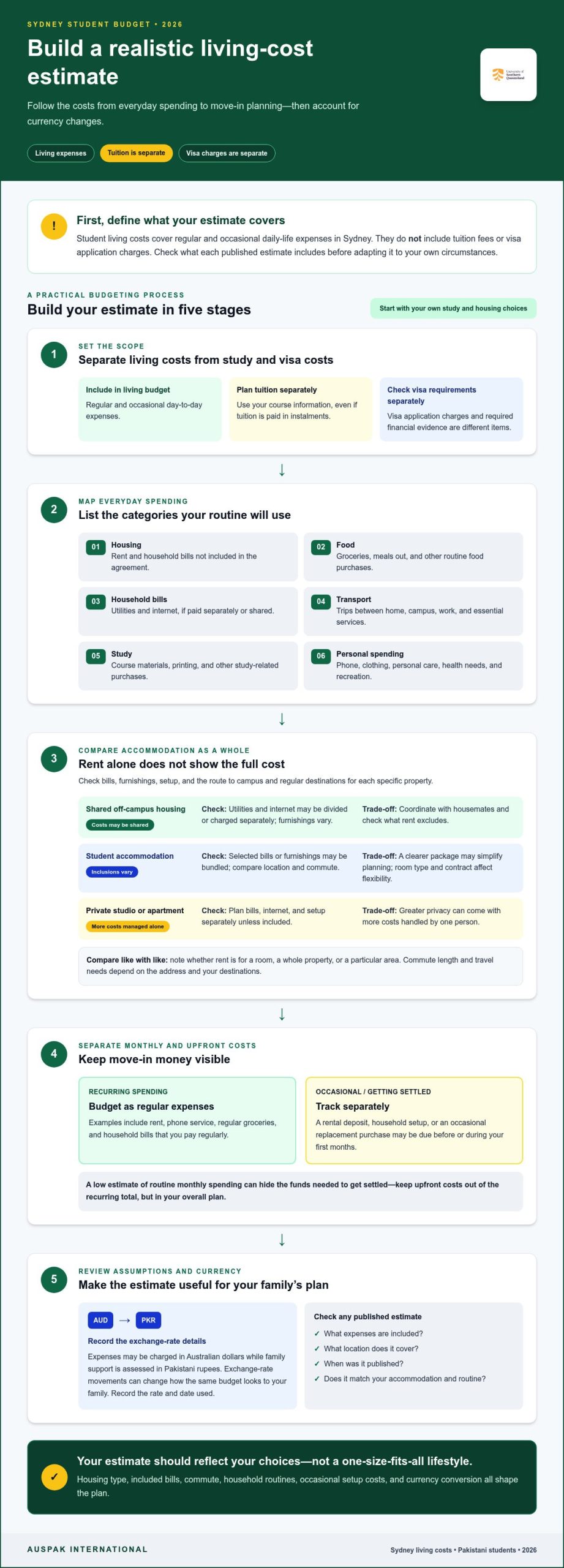
How can Pakistani students build a realistic Sydney budget for 2026?
A useful budget is based on your own choices, not copied from a general estimate. To work out the cost of living in Sydney for Pakistani students 2026, follow these five steps and keep monthly spending separate from one-off payments and study-related costs.
- Choose your housing plan. Record the expected rent, which bills are included, and how your address affects regular journeys.
- Estimate recurring costs. Add groceries, household bills, phone, transport, study needs, and personal spending using current estimates that match your circumstances.
- Add irregular costs. List expected setup purchases, occasional travel, and a flexible buffer for bills or personal needs that may change.
- Convert the total. Use a dated exchange rate and note the source, date, and currencies used.
- Review the plan. Compare expected funds with planned spending, then revise the figures when housing, expenses, or exchange rates change.
Use a simple worksheet rather than forcing uncertain numbers into a sample budget:
- Monthly recurring costs: rent ___; groceries ___; bills and internet ___; phone ___; transport ___; study and personal spending ___.
- Irregular or upfront costs: accommodation payments ___; household setup ___; occasional travel ___; flexible buffer ___.
- Separate study costs: tuition ___; visa application charges ___; travel to Australia ___.
- Funding plan: family support ___; savings ___; other planned funds ___; review date ___.
Keep the units consistent in each line and state whether an amount is weekly, monthly, or one-off. Don’t add a one-time payment to monthly spending without accounting for when it is due. Track consultancy service charges separately from living costs.
How should students convert an Australian-dollar budget to Pakistani rupees?
For a family-facing estimate, use an AUD-to-PKR rate from a named bank or currency-rate provider, then record the date you accessed it. Calculate: planned AUD amount × dated AUD-to-PKR rate = estimated PKR amount. Label the result as an estimate, not a fixed obligation. Rates can move, so recalculate when you review expenses or share an updated plan with family.
How can students check whether their plan is financially ready?
Compare dependable funds with recurring costs and irregular payments, and identify any gap before making commitments. Check the current Department of Home Affairs financial-capacity rules separately from your personal budget: visa evidence requirements are not the same as an estimate of what you’ll spend. Keep living expenses, tuition, travel, and application charges in separate lines, and verify each using current official or provider information.
Once you’ve written down your assumptions, compare them with your intended course and destination using this Australian university guide for Pakistani students. For another part of study preparation, explore Australian student visa IELTS guidance. For help connecting your budget with Australian university applications and wider study planning, plan your Australian study journey with AusPak.
How can AusPak support your Australia study planning beyond the budget?
Once you’ve estimated what living in Sydney may involve, connect your financial assumptions with a suitable study plan. The cost of living in Sydney for Pakistani students 2026 is one part of the decision; course selection, university applications, documentation, and arrival preparation also shape the move. AusPak International supports Pakistani students through these stages, helping organise the application journey.
What study-planning support can help clarify next steps?
Application counselling can help you consider your academic background and study goals as you explore Australian university options. AusPak supports Australian university applications and application processing, working with over 40 Australian universities. This support can help you focus your research on relevant study pathways and understand the steps involved in preparing an application.
Document preparation is another important part of planning. Guidance on reviewing application documents and preparing visa documentation can help you organise the information required for your next steps. Keep academic application requirements and visa documentation distinct: they serve different purposes, and current requirements should be checked through the relevant university and Australian Government sources. Preparation support does not guarantee admission, a visa, employment, or a particular financial outcome.
A useful discussion with a counsellor connects your preferred course and destination with practical assumptions you’ve already considered, such as your likely accommodation and how you expect to manage initial expenses. That context can help identify unanswered planning questions before you move further into the application process. It also keeps educational guidance separate from personal financial, migration, and employment advice.
How does arrival support connect with a prepared budget?
Getting ready to study doesn’t end with an application. Arrival support can be part of preparing for the transition to Australia, alongside your arrangements for accommodation, travel, and initial spending. Before departure, bring those plans together: know where you expect to stay, what you’ll need to organise after arriving, and which expenses may fall due early. Keep arrival costs separate from regular living expenses in your budget.
Preparing in stages can make a complex move feel more manageable. First, clarify your academic direction; then organise application and visa documentation; finally, connect arrival plans with your budget assumptions. AusPak’s onshore arrival support helps with the transition, while university application and documentation guidance supports the earlier planning stages.
When your budget and study goals are taking shape, discuss the next steps with AusPak. Plan your Australian study journey with AusPak.
Turn your Sydney budget into a confident study decision
A budget is more than a list of expenses. It can help you and your family decide whether your preferred course, location, and living arrangements fit your wider goals. Use your estimate of the cost of living in Sydney for Pakistani students 2026 as a starting point, then revisit it as your study options and personal circumstances become clearer.
Discuss the assumptions behind your plan together. Consider which choices are flexible, which need more research, and what information would help you feel ready to move forward. A clearer picture of your priorities can make conversations about studying in Australia more focused.
AusPak can support you as you move from budget research to planning your Australia study pathway. Discuss your Australian study plans with AusPak, and take your next step with purpose.
Frequently Asked Questions
How much does it cost to live in Sydney as a student in 2026?
There’s no single reliable total for every student. The cost of living in Sydney for Pakistani students 2026 depends on accommodation, household bills, transport, and personal spending. Build your estimate using dated 2026 sources, and note whether each figure covers a room or an entire property, includes bills, or reflects a particular area. Keep tuition separate, and check current visa financial-capacity requirements independently rather than using them as a personal spending estimate.
Is Sydney affordable for Pakistani students?
It depends on your available funding and study choices, so a universal yes-or-no answer won’t help you plan. Compare a source-backed monthly estimate with expected family support, savings, tuition, and other study costs. Your housing arrangement and commute can change the picture substantially. Converting Australian-dollar expenses to Pakistani rupees can help your family assess the plan, but the result is an estimate that can shift as exchange rates change.
What is the biggest living expense for students in Sydney?
Accommodation is commonly a major budget category, but its share varies with the room or property, household arrangements, and what the rent includes. A low rent estimate may not account for separate household charges or the cost of getting to campus. Compare current rental evidence with the agreement’s bill inclusions and your likely commute. Check the estimate’s date and area coverage before using it in your plan.
Can Pakistani students work while studying in Australia to cover living costs?
Student visa holders can generally work up to 48 hours per fortnight while their course is in session, with unlimited hours during scheduled course breaks, based on the rules provided for October 2026. Work conditions can change, so verify current Department of Home Affairs guidance before relying on this limit. Don’t count on finding a job or receiving a particular income; uncertain employment shouldn’t be your sole source of planned living-cost funding.
Does the Australian student visa financial requirement equal the actual cost of living in Sydney?
No. A visa financial-capacity requirement is an immigration evidence threshold, while an individual budget estimates what a student expects to spend. The current official requirement can change, so verify it through the Australian Department of Home Affairs. Build your own estimate around your accommodation, transport, food, bills, and other needs. Meeting a visa threshold doesn’t mean your personal expenses will match that amount.
How can Pakistani students convert Sydney living costs from AUD to PKR?
Choose a clearly dated exchange-rate source, keep the original Australian-dollar figure visible, and apply the rate to each planned amount. Record the source and date beside your calculation so family members can see how you reached the estimate. The PKR result is a snapshot, not a fixed future cost, because exchange rates can move. Recalculate before making financial arrangements or updating your study plan.
Is shared accommodation a good way to reduce student living costs in Sydney?
It can change how rent and household expenses are divided, but it doesn’t guarantee lower total spending. Compare the actual room cost with included bills, shared household charges, and travel from the property to your regular destinations. Consider how costs are split among housemates and whether the arrangement suits your routine. Use current evidence for the specific property rather than assuming sharing always makes a budget cheaper.