
Tuition is only one part of the budget. Your actual total depends on the university, programme, accommodation and day-to-day choices.
It’s natural to focus first on tuition, but fees vary substantially by institution and course. Additional expenses can also affect your budget. Scholarships may reduce tuition, while your university and housing choices shape your overall spending.
This guide explains how to assess tuition, administrative charges and living expenses, and how scholarships and university choices affect the total. Use it to compare study plans and set a realistic budget from Pakistan.
Key Takeaways
- Tuition can be charged by credit hour or as an annual programme fee, so compare the full course structure when estimating your budget.
- Administrative and visa-related charges are separate from tuition; include them when planning your initial expenses.
- Accommodation, food, transport, insurance and personal spending all shape your living-cost estimate in Dubai.
- Scholarship eligibility and award conditions can affect what you pay, so consider available financial aid alongside the programme’s total cost.
- Compare universities by programme, fee structure and study options to find a choice that fits both your academic goals and budget.
How much are the tuition fees?
Tuition varies by university, course and study level.
Tuition by Credit Hour
Some universities calculate tuition by credit hour. Multiply the rate by the course’s required credit hours to estimate tuition. Compare the total credit-hour cost, not just the rate.
With credit-hour pricing, programme length and course load matter. A programme with more credits can cost more overall, even if its rate per credit is lower. This total is not the same as an annual fee, so check the fee basis before comparing universities.
Undergraduate Tuition by Programme
Undergraduate fees vary by institution and programme. These examples illustrate why one figure cannot represent every Dubai study option.
The programme and school matter, too. Compare the specific course and academic year, as fees can vary by programme and fee schedule.
Foundation study has a separate tuition figure from an undergraduate degree. The figures apply to different academic years, so use the fee schedule for your intended start date.
Postgraduate Tuition Fees
Postgraduate tuition depends on the qualification and subject. These are programme fees, not annual rates unless the fee schedule identifies them as such.
Compare the full qualification, rather than assuming all master’s courses cost the same. A programme’s subject, structure and stated fee period affect the total tuition budget. Middlesex’s listed 2026/27 figures illustrate the difference between an MBA and a specialist MSc. Studying costs also include accommodation, so keep that budget separate from tuition.
Application and other administrative fees
Tuition is only one part of a Dubai study budget. Consider application processing, programme-specific charges and visa-related costs separately.
Programme-Specific Fees
A Doctor of Business Administration (DBA) may have a different fee structure from an undergraduate or standard graduate programme. The available fee examples do not establish a DBA price, so don’t use another qualification’s tuition as a substitute. For an accurate budget, separate DBA tuition from any application or academic charges listed for that programme.
English language programmes also have their own fee schedules. Treat them as a separate course cost rather than assuming they’re included in degree tuition. If you take an English programme before undergraduate study, budget for each programme as a distinct stage. Check the fee schedule for the tuition period and course charges.
Visa and Application Costs
UAE visit visa charges are not student visa prices. Treat them as separate costs, not tuition.
The UAE also applies 5% VAT to the listed visit visa fee. That rate is not a student visa fee estimate. Keep visit visa charges distinct from student visa and university application expenses when preparing a budget. For student visa planning, account separately for the visa process and any university application charges, without treating a visit visa price as a proxy.
What proof of funds is required for an international student visa in Dubai? Prepare evidence of funds for tuition and your planned stay, including accommodation and day-to-day expenses. Make sure the evidence matches your study period and the costs in your application.
Incidental expenses can also affect an undergraduate’s first-year budget. For example, programmes such as the American University in Dubai’s B.Arch. may require additional fees for specialized materials, studio equipment, or software licenses. These are programme-specific examples, not charges for every undergraduate course. Check whether your course requires equipment or materials before setting aside funds.
For students still comparing destinations, AusPak International Australian university admission support can help with a separate study pathway. The key budgeting step remains clear: list each application, programme, visa and course-specific expense separately.
Living costs and additional expenses
Living expenses are separate from tuition and vary with housing, transport and personal routines. UAE-wide estimates provide a planning range, but your chosen city and accommodation determine your actual monthly budget when evaluating the cost of university in Dubai for international students.
How do tuition and living costs in Dubai compare with Abu Dhabi and other study destinations? UAE-wide estimates alone can’t show which city is cheaper. Compare the same programme and study period, then assess accommodation, transport, insurance and daily expenses in each destination with guidance from experts like AusPak International.
Monthly Student Living Costs
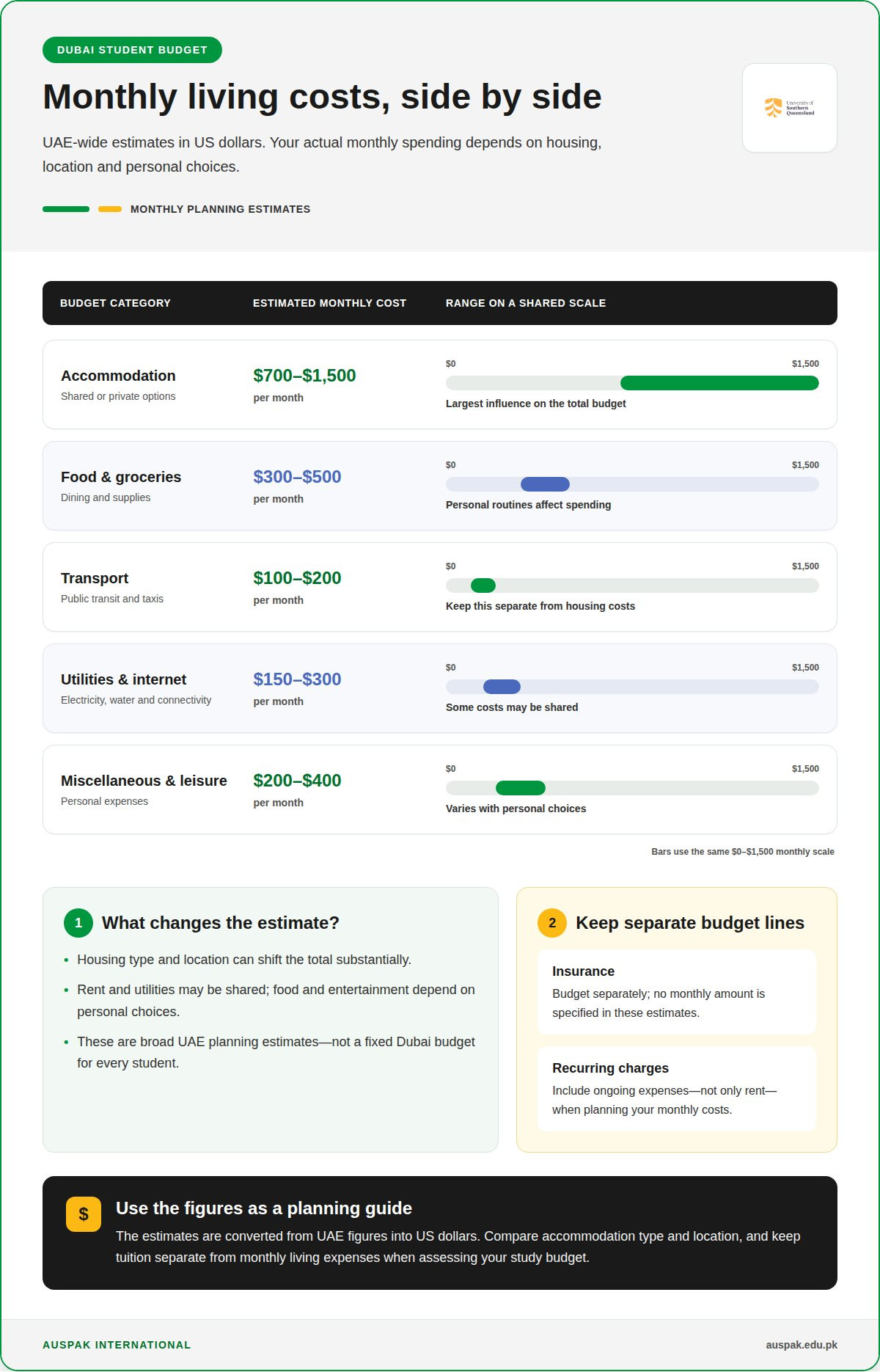
It provides a broad planning range, not a fixed Dubai budget. Housing often has the greatest effect on the total, especially when comparing a private flat with shared accommodation.
Use these monthly estimates to shape a practical budget:
- Accommodation: $700 to $1,500 per month depending on shared or private options
- Food and Groceries: $300 to $500 per month for standard dining and supplies
- Transport: $100 to $200 per month for public transit and taxis
- Utilities and Internet: $150 to $300 per month for electricity, water and connectivity
- Miscellaneous and Leisure: $200 to $400 per month for personal expenses
These estimates use UAE figures converted into US dollars, but they won’t apply identically to every student. Rent and utilities may be shared, while food and entertainment depend on personal choices. For students planning weekend trips and leisure activities on a student allowance, resources like Budgettravelplaces.com offer useful advice on keeping travel affordable. Include recurring charges, not just rent. Keep insurance and transport as separate budget lines so changes in housing don’t obscure other monthly costs.
Housing examples also vary by institution. They cover different locations and periods, so compare the accommodation type and dates covered before treating them as equivalent.
Cost Comparisons
To compare Dubai, Abu Dhabi and another destination, match the study level, programme length and housing arrangement. Compare tuition separately from monthly living expenses. University fees affect the education budget, while rent and transport shape day-to-day costs.
For example, when comparing a Dubai campus with an Abu Dhabi option, prepare monthly budgets using the same categories: rent, utilities, food, transport, insurance and entertainment. UAE-wide living estimates provide context, but don’t prove that one city costs less. Compare actual accommodation options and commute needs alongside tuition.
Scholarships and financial aid
Scholarships and financial aid can change how much you need to fund yourself. Base your budget on the award’s terms, not an assumed discount.
Scholarship Opportunities
Start by identifying scholarships offered by your chosen university for your course. Read each award’s eligibility, selection criteria, value and renewal conditions. A scholarship may reduce tuition, support another study expense or apply only under specific conditions. Treat these as distinct possibilities, not interchangeable benefits.
Match the award criteria to your academic record and intended qualification. For example, if you’re applying for a master’s in science, look for awards whose subject criteria include your course. Engineering applicants can use the same approach. The university and specific programme determine which published opportunities are relevant.
Check how the award is applied to your student account. If it offsets tuition, calculate the remaining tuition separately from accommodation, insurance and daily costs. If the award can continue beyond the first academic year, check the renewal requirements and timing. Registration status, academic progress and course changes may affect eligibility under the award’s terms.
Financial Aid Support
Financial aid planning involves more than scholarship eligibility. Separate confirmed tuition support from the funds needed for accommodation and other expenses. This makes the remaining study budget easier to assess, even if an award covers only one category.
Before accepting an offer, organize the figures in a simple budget: total tuition, any award, remaining tuition, living expenses and initial charges. Keep the scholarship decision separate from the university’s fee schedule. A credit-hour rate can help estimate tuition, but it doesn’t show how much financial aid applies.
Ask the university’s financial aid office about its award process and terms. Focus on application deadlines, required documents, award decisions and renewal conditions. These details determine when support is assessed and whether it continues. Don’t count a scholarship as funding until the university has awarded it.
For a practical comparison, assess the same course at each shortlisted campus. Record its tuition basis, eligible scholarship options and renewal conditions, then compare the remaining amount with your available funds. This method works for undergraduate and graduate programmes, including master’s courses in science or engineering.
Keep award records with your registration and fee documents. If a scholarship changes after you select a course, update your budget before committing to related expenses. Clear records help distinguish tuition support from personal costs and show how much funding remains for the study period.
Universities in Dubai for international students
Dubai offers a range of university options, from international campuses to locally based institutions. Compare the course, fee structure, study duration and campus location together.
Are international students in Dubai allowed to work while studying, and what rules apply? Work eligibility depends on applicable UAE permissions and your circumstances. Don’t include expected employment income in your study budget until you know it’s available to you.
University names can refer to campuses in different parts of the UAE. American University of Sharjah and Abu Dhabi University are UAE examples, but neither is in Dubai. Keep the city and campus location in mind when estimating accommodation, transport and total study costs.
Rankings can help you explore institutions, but they answer only one part of the decision. American University of Sharjah ranked #332 in the QS World University Rankings 2025, while Abu Dhabi University ranked #=501 in the same edition. These are UAE comparisons, not Dubai campus rankings.
For Dubai institutions, Amity University Dubai ranked #1001-1200 in the QS World University Rankings 2025. The British University in Dubai ranked #70 in the Arab Region Rankings 2025. These rankings use different systems, so don’t compare the figures as if they were one scale.
Shortlist universities by your intended course and qualification. Then compare the tuition basis, programme duration and campus location. Undergraduate and postgraduate qualifications can have different fee schedules, even at the same institution. Course-specific charges and requirements also affect the final budget.
Programme length matters because it changes how many academic years you’ll fund. University of Wollongong in Dubai lists bachelor’s degrees with advanced entry as three-year programmes. Its degrees with an integrated freshman year are listed as four-year programmes. Its engineering honours degrees are listed as 32-subject programmes. Compare the entry route and total course structure, not just the annual tuition.
Review each institution’s academic year fee schedule for your intended start. For example, Middlesex University Dubai publishes separate schedules for 2025/26 and 2026/27. Murdoch University Dubai states that tuition fees are subject to annual increases. A current fee therefore shouldn’t automatically be treated as the total cost across a multi-year degree.
Use the same comparison sheet for each Dubai option: programme, qualification, duration, tuition period, campus and accommodation plan. Record scholarships separately, then calculate the remaining amount for each academic year. Add transport and other living costs based on the location you’re considering.
If your shortlist includes Australia as another global study destination, explore Australian university admission support as part of your comparison.
AusPak International: Australian University Admission Support
AusPak International supports students considering destinations beyond Dubai, including Australian university applications. Its Australian University Admission Support helps Pakistani students move from comparing destinations to preparing an application. This can be a useful next step if your budget review has prompted you to consider Australia alongside Dubai.
AusPak International also provides UK Student Visa Consultancy and Canada Study Permit Assistance. Its Onshore Arrival Support helps students transition after reaching their study destination. Choose support that matches your destination and stage, whether you’re preparing an application or planning for arrival.
Ready to discuss your study plans? Contact AusPak International.
Choose your next study step with confidence
Planning for the cost of university in Dubai for international students is one part of a wider decision: choosing a destination, course and application pathway that fit your academic goals. Compare your options carefully, then move forward with a clear plan for the next stage.
If Australia is part of your plans, AusPak International provides Australian University Admission Support. Students considering other destinations can also use its UK Student Visa Consultancy and Canada Study Permit Assistance. These services support different destinations and stages, so focus on the pathway that matches your plans.
Ready to discuss your study options? Contact AusPak International to take the next step. Your international study journey can begin with a considered decision and a practical plan.
Frequently Asked Questions
How much does it cost to study in the UAE per year?
The cost of university in Dubai for international students depends on tuition, accommodation and personal spending. Treat this range as an initial planning guide, not a fixed amount for every university or city. For a more useful estimate, calculate tuition for your chosen programme, then add housing, transport, insurance and other regular expenses.
What is the average annual tuition fee for international students at universities in Dubai?
There’s no annual tuition figure that applies to every Dubai university and course. The cost of university in Dubai for international students varies by university, programme and fee structure. For a realistic comparison, use the fee schedule for your intended academic year and distinguish annual charges from total programme fees.
How much does tuition cost by degree level and field of study in Dubai?
Tuition depends on the qualification, subject and how the university calculates fees. Compare the same academic year and fee period, as programme totals and annual charges aren’t interchangeable.
What are the tuition fees at major Dubai universities for international students?
Examples illustrate how fees differ between institutions. These examples use different universities and schedules, so compare the specific course and academic year you plan to enter.
How much do accommodation, food, transport, and other living expenses cost in Dubai per month?
Your accommodation, commute and spending habits affect the total. Use these figures as separate budget categories, not as one fixed Dubai price.
What are the university application, registration, and student visa fees in Dubai?
University application and registration charges depend on the institution and programme. Don’t use those amounts as student visa prices. Keep university charges, student visa expenses and any visit visa costs in separate budget lines.
Are scholarships or tuition discounts available to international students in Dubai?
Scholarships and tuition reductions depend on each university’s published criteria and award terms. Check whether an award applies to your course, how it affects tuition and whether renewal conditions apply. Build your budget using the tuition remaining after an award is formally applied. Keep accommodation and other living expenses separate, as a tuition award doesn’t automatically cover them.
What additional costs should international students budget for, such as health insurance and textbooks?
Budget for medical insurance, textbooks, course materials, equipment and everyday expenses in addition to tuition. American University in Dubai’s B.Arch. is one programme-specific example. Such examples don’t apply to every course. Check your programme’s requirements and keep recurring insurance costs separate from one-time equipment purchases.