
Your funds must cover tuition and living costs, not just course fees. For Pakistani students, meeting the New Zealand student visa requirements for Pakistanis means preparing clear evidence of funding alongside an offer of place and other application documents. The amount depends on your course fees and how long you plan to study.
It’s reasonable to want a clear budget before committing to study overseas. This guide explains how to plan for tuition and living expenses, then outlines key visa, English-language, offer-of-place, and work-right requirements. You’ll also see how these elements fit together, so you can prepare your application in a structured way and understand what to consider before taking the next step.
Key Takeaways
- Plan funds for both tuition and living expenses, and organise evidence that clearly shows how your study costs will be covered.
- Visa processing time depends on submitting a complete application, so prepare your documents and allow time before your intended travel date.
- English test scores vary by course and education provider; confirm the requirement for your chosen programme before applying.
- An offer of place from a New Zealand education provider is a key step for students planning a longer course of study.
- Work rights depend on your visa conditions and study programme, while some graduates may qualify for a post-study work visa.
Student work rights
Student work rights can help cover living costs, but they depend on your visa conditions and study details. If you’re a Pakistani student, distinguish between working during your studies and working after graduation.
Part-Time Work During Study
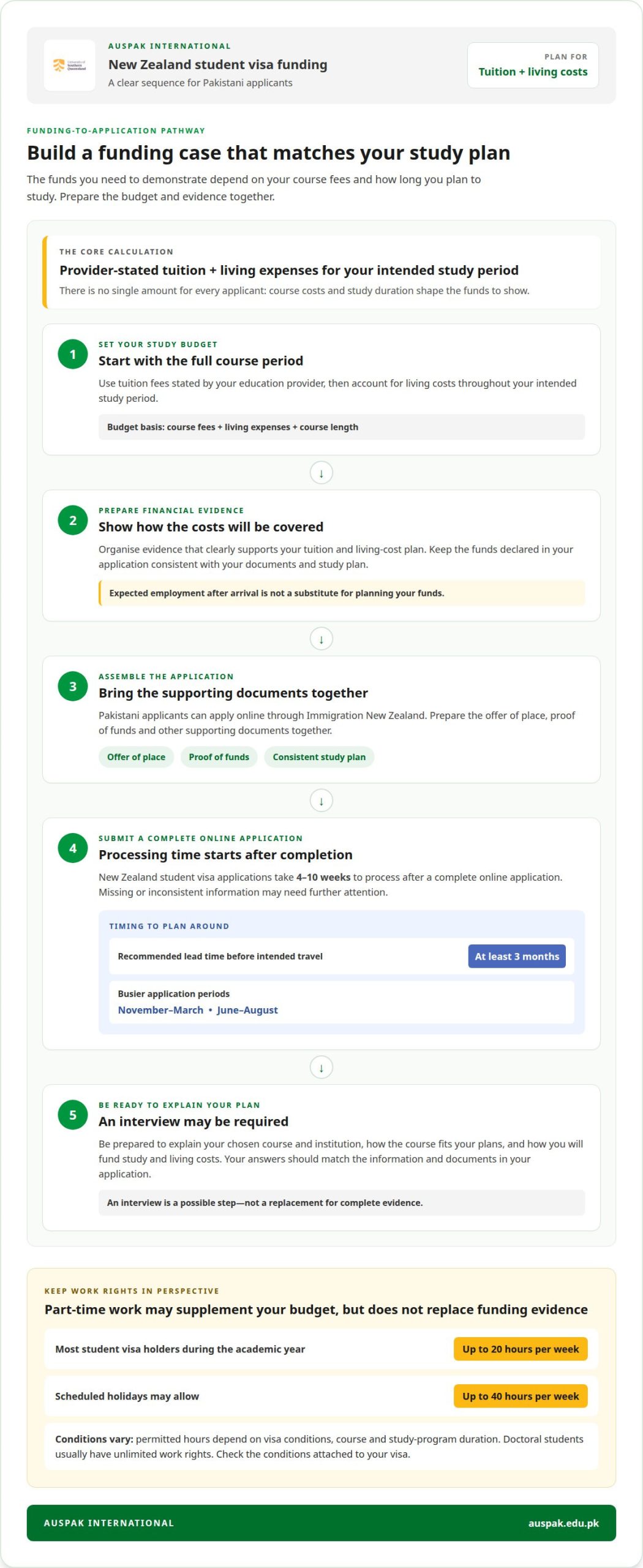
Most New Zealand student visa holders can work up to 20 hours per week during the academic year, depending on their course and study-program duration. Scheduled holidays can allow up to 40 hours per week. Check the work conditions attached to your visa before accepting a job, and plan study work around classes and course commitments.
These limits affect how much employment can contribute to living expenses, but they don’t replace the need to plan for tuition and living costs. Treat part-time work as a possible supplement, not the basis of your study budget. Use your visa conditions to guide your work plans, as permitted hours depend on those conditions.
Doctoral students usually have unlimited work rights. This differs from the limits that apply to most other student visa holders. If you’re pursuing doctoral study, understand which work conditions apply to your visa rather than assuming the general 20-hour limit covers your situation.
Post-Study Work Opportunities
After completing an eligible course, graduates may be able to apply for a New Zealand Post-Study Work Visa. This visa may allow full-time employment after study, giving graduates an opportunity to gain work experience in New Zealand. Its duration depends on the qualification, so consider your programme and post-study plans together.
This pathway is separate from student work during term. A student visa does not automatically allow you to remain and work after your course ends. A post-study visa is a distinct next step, with eligibility and duration linked to the qualification you complete.
Duration varies by qualification. A Post-Study Work Visa lasts 1 year for a qualification below Level 7. It lasts 2 years for a Level 7 Bachelor’s degree in a specified region. According to Immigration New Zealand, it lasts 3 years for Level 8, 9 or 10 qualifications.
These differences make qualification level an important part of long-term planning. For example, a Level 9 programme falls within the three-year duration category. A lower-level qualification may lead to a shorter visa period, so don’t assume every graduate receives the same post-study work time.
Post-study employment may form part of a longer residency pathway, but it isn’t permanent residency by itself. The pathway generally involves completing a course, gaining a qualification in an in-demand field, securing a relevant job, and applying for a work visa. Each step has its own requirements.
New Zealand Study Visa Funds for Pakistani Students
Plan your study budget around tuition, living expenses, and course length. Your financial evidence should show how you’ll meet these costs in New Zealand, rather than relying on expected employment after arrival. Processing begins after you submit a complete online application.
Calculate your tuition total using the fees stated by your education provider. Then account for living costs throughout your intended study period. The funds you need to demonstrate depend on those expenses and your course duration. Keep your financial evidence consistent with your study plan and the funds declared in your application.
Pakistani applicants can apply online through Immigration New Zealand. Prepare your application and supporting documents together, including your offer of place and proof of funds. Submit a complete application, as the stated processing period begins once the online application is complete. Missing or inconsistent information may require further attention and affect how smoothly your application progresses.
Allow time for processing before your intended travel date. New Zealand student visa applications take 4-10 weeks to process after a complete online application. International students are strongly encouraged to apply at least 3 months before intended travel. Applications are busiest from November to March and from June to August, so include those periods in your planning.
Immigration New Zealand may require you to attend an interview. Be ready to explain your chosen course and institution, how the course fits your plans, and how you’ll fund your studies and living costs. Your answers should match the information and documents in your application. An interview is a possible step, not a substitute for complete evidence.
There isn’t a single approval-rate figure that can predict an applicant’s outcome. Each application is assessed on its own information, including study plans and financial evidence. Focus on presenting a coherent application rather than treating an overall rate as a prediction for your case.
Can Pakistani students bring family members to New Zealand on a student visa? A student’s spouse or partner may be eligible for a full-time work visa when the student pursues a postgraduate qualification, such as a Master’s degree or PhD. A dependent child aged 19 or younger may study at a primary or secondary school as a domestic student under a Dependent Child Student Visa, subject to the sponsor holding an appropriate work or student visa.
Before submitting, compare your course dates, tuition information, living-cost plan, and financial documents for consistency. Apply early enough to account for processing time and busier application seasons. A clear, organised file brings the details of your study plan together in one coherent application.
English language proficiency
English-language requirements can affect both admission and visa preparation. For Pakistani applicants, the required score depends on the chosen programme and education provider.
English-Language Test Requirements
IELTS is a common measure: many New Zealand universities require an overall score of 6.0, with no band below 5.5. Pakistani applicants may also need a minimum PTE score of 50. These are useful planning benchmarks, but the required test and score can vary by course and institution.
Check the English-language condition for your chosen programme before booking a test. Some institutions accept alternatives based on prior training, exemptions, or internal assessments. For example, an applicant whose previous training meets a provider’s criteria may be able to use an alternative to a standard test. The provider’s admission conditions determine which evidence applies.
Allow time to meet the requirement before your course begins. If your test result falls short of the stated score, you may need another attempt or an accepted alternative. Don’t assume a general IELTS benchmark automatically satisfies every course or visa condition. Check the exact score requirement for your programme.
Academic and English Requirements
Admission involves more than English ability. New Zealand universities assess applicants against the academic requirements for each programme, while the English-language condition measures readiness to study in an English-speaking setting. Review both requirements together, since meeting one doesn’t replace the other.
Start with the programme’s entry criteria, then identify its English score and accepted evidence. For example, a course requiring IELTS 6.0 overall and no band below 5.5 calls for attention to both the total score and individual bands. A strong overall result alone may not meet a minimum band condition.
Some undergraduate courses may require IELTS band scores between 5.5 and 6.0, while the stated general benchmark for many undergraduate and postgraduate courses is IELTS 6.0 overall, with no band below 5.5. Certain New Zealand universities require 6.5 overall. These differences make the selected course and institution central to your preparation.
If you don’t yet meet an English-language condition, consider whether your institution offers a pathway study option. English preparation may help you build the skills needed before academic study, but entry conditions depend on the provider and programme. Ask how a pathway connects to your intended course and whether it addresses both academic entry and English requirements.
For a practical sequence, select your course, record its academic and English-language criteria, then choose an accepted test or evidence route. IELTS and PTE results can support an application when they meet the institution’s stated requirements. Meeting those conditions is a concrete step towards studying abroad, but admission and visa requirements remain separate.
Pakistani applicants’ offer-of-place requirements
An offer of place connects your New Zealand study plan to a specific education provider and programme. People planning to study for more than 3 months need an offer from a New Zealand education provider and a student visa. An unconditional offer is needed for a student visa application.
Start by securing admission to the course you intend to study. Your offer should relate to your chosen programme, not a different degree or institution. Use it as a reference when preparing your visa application, so your study details and supporting documents present a consistent account.
Before submitting, organise your application around the offer and your study plan. Keep these steps in sequence:
- Confirm the programme. Identify the provider and course stated in your offer of place.
- Review the offer. Check whether it is unconditional and retain the document for your application.
- Prepare supporting documents. Include the offer alongside the required evidence for your visa application.
- Apply online. Pakistani applicants can submit a New Zealand student visa application online through Immigration New Zealand.
Tuition fees and visa application costs are separate budget items. Use the tuition amount stated in your offer when planning study expenses, and account for the visa application cost separately. Fees depend on the course and application route, so don’t treat a general estimate as the amount for your programme. Keep your financial plan aligned with the tuition information in your documents.
Careful preparation helps show a clear connection between your programme, provider, and intended studies. For example, an offer for a specific degree should match the course details in your visa application. Organise your documents so the same study information appears consistently. If your application includes a different course or institution, clearly explain the change.
A strong application starts with completeness and consistency, not promises of an outcome. Submit your unconditional offer and supporting documents as part of the online application, and make sure your study plan matches the admission details. Immigration New Zealand may ask you to attend an interview, so be prepared to explain your chosen programme and how it fits your plans. Your application is assessed on the information submitted, so clear records matter.
For Pakistani students, the offer of place is both an admission document and a foundation for visa preparation. Secure the right programme first, then build your application around its details. This sequence helps align course selection, tuition planning, and visa documents as you prepare to study in New Zealand.
Basic student visa requirements
For Pakistani citizens, key New Zealand student visa requirements include a valid passport, an offer of place, proof of sufficient funds, English-language evidence, and medical and character documents. Prepare these around your intended course and study period, then submit a complete application online.
Your passport should remain valid for at least 3 months beyond your intended stay in New Zealand. The offer of place identifies your education provider and course, while financial evidence shows how you’ll cover study and living expenses. English evidence should match the admission conditions for your chosen programme, rather than relying on a general score alone.
Do Pakistani students need a medical examination or police certificate for a New Zealand student visa? A chest X-ray may be required for a stay longer than six months, including for applicants from Pakistan, and medical results must come from a physician approved by Immigration New Zealand. Applicants aged 17 or older need a police certificate when their study period exceeds 24 months; Pakistani applicants should provide a police certificate as character evidence.
Use a document sequence to keep the application organised:
- Confirm the study details. Match the provider, course, and study period to your offer of place.
- Prepare identity and admission evidence. Include your passport information and offer of place.
- Organise financial and English evidence. Align these documents with your course and study plan.
- Address health and character requirements. Include relevant medical results and police evidence for your circumstances.
- Submit the application online. Review the information for consistency before sending it.
Comprehensive health insurance is required for the full duration of a student visa holder’s stay. Include insurance in your preparation alongside medical documents and course records. These items serve different purposes: insurance covers your stay, while medical evidence addresses health requirements for immigration processing.
A bank statement covering the last six months is advised for Pakistani applicants. Present your financial records so the available funds and their purpose are clear alongside tuition and living costs. Keep names, dates, and study details consistent across your passport, offer, financial evidence, and application forms.
Before submitting, review the application as one connected record. A course offer, English evidence, funds documents, and health or character records should support the same study plan. If you’re also planning to study in the UK, explore UK student visa consultancy support for that separate destination.
AusPak International: UK Student Visa Consultancy
AusPak International supports students considering study abroad through UK Student Visa Consultancy, Australian University Admission Support, and Canada Study Permit Assistance. After reviewing New Zealand’s requirements, you may also be considering another destination or comparing options for a future application.
Turn to AusPak International for guidance on these study pathways or for Onshore Arrival Support as part of your arrival planning. The right next step depends on your destination and where you are in the application process. Contact AusPak International to discuss support for your study plans.
Take the Next Step Toward Your Study Plans
Understanding the New Zealand student visa requirements for Pakistanis can help you turn a broad ambition into a considered study plan. Take time to weigh your academic goals, preferred destination, and readiness for the application process. If you’re also exploring study options in other countries, guidance can help clarify which direction best matches your priorities.
AusPak International can help you plan your next steps towards studying abroad. Start a conversation about your goals and the support that fits your plans.
Contact AusPak International for support, and move forward with greater clarity and confidence.
Frequently Asked Questions
What documents do Pakistani applicants need for a New Zealand student visa?
Prepare identity, admission, financial, English-language, health, and character evidence relevant to your circumstances. Organise digital copies by category and use clear filenames so each document is easy to identify during submission. Make sure course and provider details are consistent across your application materials. Health and character documents may depend on factors such as your stay length, age, and study period.
How much proof of funds is required for a New Zealand student visa, and what expenses are included?
Your financial plan needs to cover tuition and living expenses for the relevant study period. Treat money already paid to your education provider separately from funds available for upcoming costs, and keep records that explain the source and availability of your funds. Your budget should match the course dates and fees in your offer, rather than relying on estimated earnings after arrival.
What is the New Zealand student visa application fee for applicants in Pakistan?
The application fee depends on the submission method, so separate the visa charge from tuition and other study expenses in your budget. Check the amount shown for your chosen application route before paying, and keep the payment confirmation with your application records. This helps you track the transaction and distinguish the government application charge from education or consultancy costs.
How do Pakistani students apply for a New Zealand student visa, and where do they submit biometrics?
Pakistani students submit their visa applications online through Immigration New Zealand. Follow the application instructions for any biometrics request, as they specify the next steps required in your case. Keep your submission confirmation and application reference accessible. If you’re asked to book an appointment or provide additional evidence, follow the instructions given for your application rather than assuming every applicant follows the same process.
What English language and academic requirements apply to New Zealand student visa applicants?
Applicants must meet the academic entry criteria and English-language conditions for their chosen programme. These are separate admission requirements, so satisfying one doesn’t automatically satisfy the other. Before applying, match each condition to its supporting evidence, such as prior academic records for entry criteria and an accepted English test result where required. The applicable requirements depend on the programme and provider.
How long does New Zealand student visa processing take for applications from Pakistan?
A complete online application takes 4-10 weeks to process. Use that estimate as a planning window, not as a fixed decision date, and build flexibility into arrangements tied to your course start. An interview or a request for additional information can add steps. Keep your application reference and submitted records accessible, so you can respond consistently if Immigration New Zealand contacts you.
Can international students work in New Zealand on a student visa, and what are the current limits?
Most eligible student visa holders can work up to 20 hours per week during the academic year and up to 40 hours per week during scheduled holidays. The conditions attached to your visa determine your permitted work. Before accepting a role, compare its hours with those conditions and your study schedule. Don’t plan a job around holiday dates until your course calendar confirms them.
What are the visa conditions, health insurance requirements, and common refusal reasons for Pakistani students?
Student visa holders need comprehensive health insurance for their full stay and must follow the study and work conditions on their visa. Missing documents, inconsistent information, or financial evidence that doesn’t support the stated plan can weaken an application. Review your submission as a complete record, checking names, course details, dates, and funds evidence. Respond accurately to any request from Immigration New Zealand and follow its instructions.