
For Pakistani students comparing public vs private universities in Germany, public institutions are usually the lower-cost option because most charge no tuition, while private universities charge tuition. The lower fee alone doesn’t settle the choice: programme fit, admission requirements, class size and industry links can matter just as much.
Affordability is often the first concern when planning an overseas degree. A sound comparison also considers what you want to study, the language of instruction and the kind of learning environment that suits you.
This guide explains how tuition and other costs differ, what to expect from admissions, and how public and private universities compare in class size and industry connections. Use it to weigh your budget against your academic and career goals before choosing a university in Germany.
Key Takeaways
- Include Baden-Württemberg’s tuition rule for non-EU students in your cost comparison, alongside each university’s semester fees.
- Compare admission requirements and intake options with your academic profile and preferred start date.
- Weigh programme language and specialisation against your study and career goals.
- Consider whether smaller classes and closer industry links suit the way you want to learn.
- Before deciding, weigh budget, programme fit and state approval together, rather than choosing on one factor alone.
Cost of Public and Private Universities in Germany
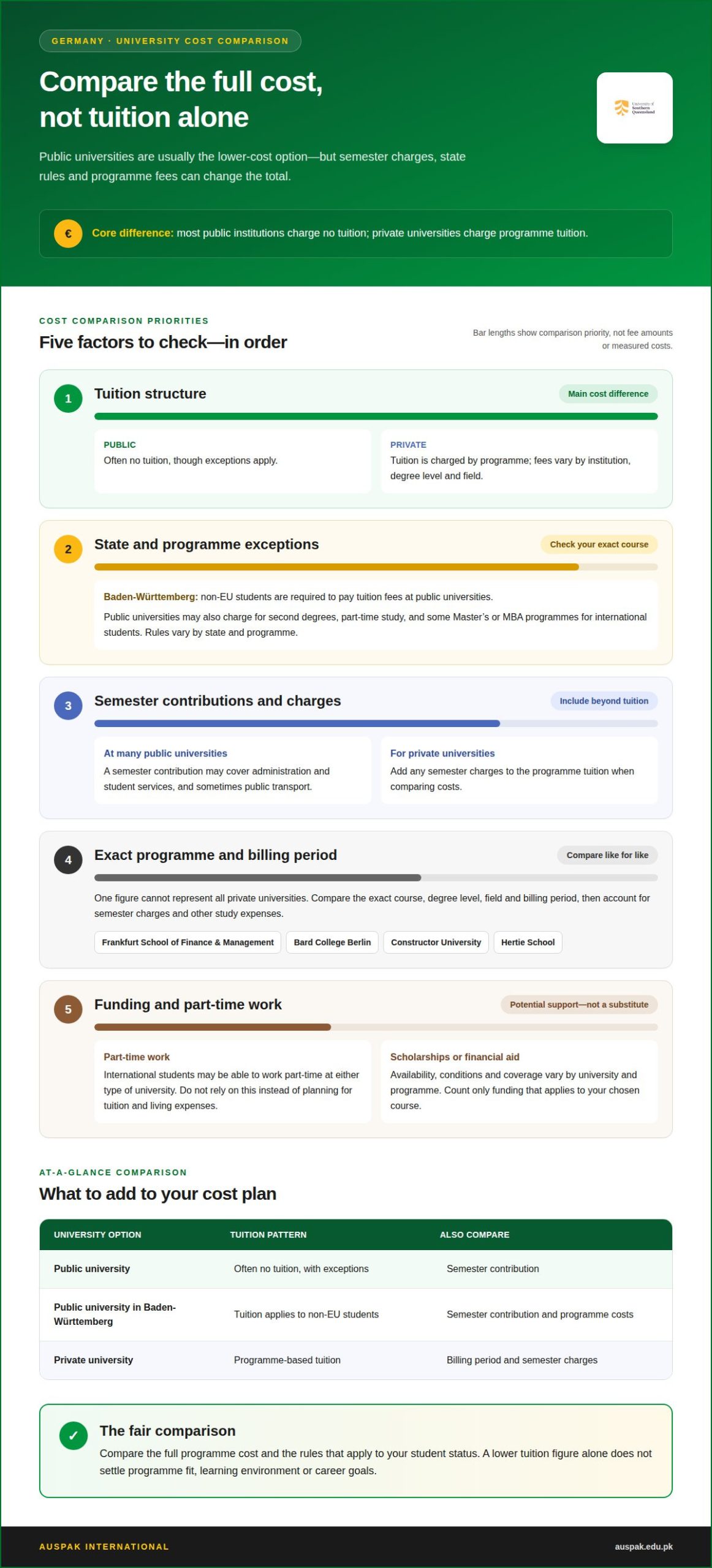
For Pakistani students, the main cost difference is tuition: most public institutions charge none, while private universities set programme fees. Compare tuition with semester contributions and any state-specific exceptions before judging affordability.
Public University Tuition and Semester Fees
At many public universities, students pay a semester contribution rather than tuition. It may cover administration and student services, and sometimes public transport. Private universities, by contrast, charge tuition as a central programme cost. Include the semester contribution in your budget even when the degree has no tuition.
Public Tuition Exceptions and Baden-Württemberg Fees
Public study is not tuition-free in every case. Baden-Württemberg requires students from non-EU countries to pay tuition fees. Public universities may also charge for second degrees, part-time study, and some Master’s or MBA programmes for international students. Rules vary by state and programme, so check how they apply to your intended course before comparing total costs.
Private University Tuition Costs
Private universities charge tuition, with fees varying by institution, degree level and field. Examples include Frankfurt School of Finance & Management, Bard College Berlin, Constructor University and Hertie School. Their costs show why one figure cannot represent all private universities: compare the exact programme and billing period, then add semester charges and other study expenses to your plan.
For a like-for-like comparison, use these cost features:
| Option | Tuition pattern | Additional cost to compare |
|---|---|---|
| Public university | Often no tuition, with exceptions | Semester contribution |
| Public university in Baden-Württemberg | Tuition fees apply to non-EU students | Semester contribution and programme costs |
| Private university | Programme-based tuition | Billing period and semester charges |
Compare the full programme cost and the rules that apply to your student status.
International students may be able to work part-time while studying in Germany, whether they attend a public or private university. This can support budgeting, but it should not replace a plan for tuition and living expenses.
Scholarships or financial aid may be available through individual universities and programmes. Conditions and coverage vary, so count only funding that applies to your chosen course in your cost plan.
Admission competitiveness and flexibility
Admission depends on the programme, your academic background and the institution’s selection process. Public and private universities can differ in competition, application timing and available start dates.
Admission Requirements and Competition
Popular degrees at public institutions may attract strong competition, so meeting the basic requirements does not always guarantee admission. Criteria vary by course and may include previous qualifications, subject preparation and language ability. English-taught programmes may assess English proficiency, while German-taught courses may require evidence of German-language ability.
Private universities may offer more flexible admission, but that does not mean every applicant qualifies automatically. Each institution sets its own requirements, which may include academic records, language skills and the fit between an applicant’s background and the subject. Compare requirements for the specific degree, not just the institution’s general admissions page.
For a practical comparison, list the entry criteria side by side:
- Academic fit: Identify the previous qualification and subjects each programme expects.
- Language: Match your English or German proficiency evidence to the programme’s teaching language.
- Selection: Note whether the institution uses additional assessments or evaluates applications competitively.
- Documents: Prepare the records and supporting materials each application requests.
This helps you distinguish minimum eligibility from competitive selection. A public university may suit you if your profile matches its academic criteria. A private institution may appeal if you want a more flexible route, provided you meet the programme-specific standards.
Application Deadlines and Admission Processes
Public universities generally follow semester-based application cycles. The general deadlines are July 15 for the winter semester and January 15 for the summer semester. Public applications are advised at least eight weeks in advance, giving time to prepare documents and complete the relevant steps.
These are general dates, not a substitute for the deadline for a particular degree. Institutions and programmes set their own application calendars and procedures. For a public course, identify the intake first, then work backward from the deadline to prepare academic records, language evidence and application materials.
Private universities may offer intakes outside the standard winter and summer cycles, giving applicants more flexibility. Each institution sets its own admission process and timeline, so its schedule may differ from a public university’s. Confirm the programme’s stated intake and submit all required documents within its application window.
In short, public applications usually align with semester deadlines, while some private institutions provide additional intake options. If you’re also considering Australia, Australian University Admission Support can help with planning an application there.
Choosing based on budget, programme fit, and career goals
Choose a university by weighing your study budget against programme content, teaching language and career direction. Public and private institutions in Germany can differ across all these factors.
Start with the degree itself. Public institutions offer around 90% of study programmes in Germany, while private universities may focus on specialist or niche subjects less widely available at public universities. An MBA, for example, may suit a career goal that requires advanced business education, while a broader public programme may offer a different academic route.
Next, consider how the programme connects with your intended career. Review its curriculum for subject coverage, practical learning and industry focus. A programme title alone may not show whether its modules build the expertise you want. Compare the courses on offer and consider how the skills they teach support your next professional step.
Use these criteria to narrow your options:
- Programme fit: Match required subjects and course content to your academic interests.
- Language: Confirm that the teaching language suits your current proficiency and learning plans.
- Specialisation: Look for a niche programme when its focus directly supports your career direction.
- Recognition: Include institutional approval and programme accreditation in your decision.
This keeps your decision focused on your goals, not simply on whether a university is public or private.
English-Taught Programme Availability
Teaching language can shape which options are accessible to international students. Public universities in Germany mainly teach in German, while private universities offer many programmes in English. An English-taught course may make a private institution worth considering, but compare specific programmes rather than assuming every degree follows the same language pattern.
Check the programme’s language of instruction alongside its curriculum and entry requirements. An English-taught degree may match your current language skills, while a German-taught option may suit you if you are prepared to study in German. The right choice depends on the course and your academic plan.
University and Programme Recognition
Recognition matters for future employment. A degree from a private or church-run higher education institution in Germany is valid on the international labour market only if the institution is state-approved. Accreditation also matters: since the Bologna higher education reform, degree programmes at private and state universities undergo the same accreditation process.
Use recognition as a decision filter, not a substitute for programme fit. Consider state approval and accreditation alongside the curriculum, teaching language and career relevance. This gives you a clearer basis for comparing German universities and choosing a pathway that supports your next step.
Private university class sizes and industry links
Private universities in Germany often offer smaller classes than public institutions. This can shape student interaction, individual attention and the learning environment.
Class Sizes and Individual Attention
Smaller classes can give students more chances to speak, ask questions and receive feedback. Public universities generally have larger classes, while private institutions may offer closer interaction with instructors and classmates. These are broad differences, not a guarantee that every course follows the same format.
Consider class size alongside teaching style. Check whether the programme relies on lectures, seminars, group discussions or practical sessions. A smaller seminar can encourage direct discussion, while a large lecture may suit students who prefer independent note-taking and broader classroom perspectives.
Public universities can also offer smaller student groups, so class size is not determined by institution type alone. This example shows that smaller groups are not exclusive to private universities. For each programme, consider how its teaching format supports your own participation, especially if you’re studying in Germany for the first time.
For students arriving from different countries, class interaction can also affect how quickly they build academic connections. Compare opportunities to contribute in class, collaborate with peers and receive feedback. Smaller classes at a private institution do not automatically mean better learning: course structure and your preferred learning style matter too.
Learning Environment and Student Interaction
Class size shapes the learning environment. In a smaller group, students may find it easier to join discussions and get to know classmates. Larger classes at public universities can bring a wider range of perspectives, though individual exchanges may be less frequent during lectures.
Industry links need separate assessment. Private universities may offer industry-focused or niche programmes that are less widely available at public institutions. A specialised curriculum can align with a defined career interest, but its focus alone does not establish the strength of its industry connections.
Compare evidence within the programme. Review whether the course content identifies an industry specialisation and how that focus supports your career direction. Then consider whether the teaching format gives you useful opportunities to discuss those subjects with instructors and classmates.
A practical comparison can use three steps:
- Class format: Compare lectures, seminars and group-based learning.
- Interaction: Consider how students participate and receive feedback.
- Industry focus: Match programme specialisation to your intended career path.
Private university tuition does not guarantee a particular classroom experience or career outcome. Judge the specific programme, not its public or private label. For Pakistani students, this helps establish whether smaller classes or a specialised focus genuinely support their goals.
Differences between public and private universities
The key differences involve funding, programme range, admissions and learning structure. Public universities offer around 90% of Germany’s study programmes, while private institutions may focus on more specialised fields.
Public universities are owned and funded by Germany’s federal states. That public structure supports a broad higher education offering, from large universities to universities of applied sciences. The Free University of Berlin, for example, offers about 150 academic programmes. Private institutions operate differently and can focus on particular subjects, professional fields or teaching models.
Admission can differ too. Private universities may offer more flexible entry, including intakes outside standard semester cycles. That does not mean every applicant is admitted: institutions set programme-specific requirements. Public university applications may be more competitive, particularly for sought-after degrees. Compare each course’s entry criteria, language requirements and application process rather than assuming one sector has a universal admissions standard.
Recognition matters in both sectors. Since the Bologna higher education reform, degree programmes at private and state universities undergo the same accreditation process. A degree from a private or church-run institution is valid on the international labour market only if the institution is state-approved. Public universities also face state oversight and must meet defined academic standards, including on-site teaching requirements, to be recognised.
Compare teaching quality and employment prospects at programme level rather than making assumptions based on public or private status. Review the curriculum, teaching format, accreditation and industry focus. Consider how the programme’s subjects and practical orientation align with your intended career; ownership alone cannot establish an outcome.
Rankings can offer context, but they measure only selected dimensions. Germany has 43 universities among the Times Higher Education top 500, and two are private. That places institutions from both sectors in the ranking, but it does not show that every listed programme suits every student. Treat ranking position as one consideration alongside course content, recognition and career fit.
- Public universities: Broad programme availability and state funding.
- Private universities: Potentially more specialised programmes and flexible admissions.
- Both sectors: Compare programme accreditation, teaching approach and career relevance.
Use those criteria to assess teaching quality and employment relevance for each specific degree. If your comparison also includes Australia, explore Australian University Admission Support for help with that application pathway.
AusPak International
AusPak International supports Pakistani students with education counselling and application processing for study abroad. If comparing German universities has prompted you to consider other destinations, its relevant services include Australian University Admission Support, UK Student Visa Consultancy and Canada Study Permit Assistance.
AusPak International also offers Onshore Arrival Support for students preparing to transition after admission. These services support plans for those destinations, rather than applications to German universities. Contact AusPak International to discuss your study-abroad plans and whether admission, visa preparation or arrival support is your next priority.
Turn your shortlist into a clear next step
Turn your choice into a practical plan. Decide which programme best supports your academic direction, then organise your next steps around its application requirements and intake. A focused shortlist can move you from comparing public vs private universities in Germany to preparing for the pathway that fits your goals.
If Germany is not your final destination, AusPak International can discuss study-abroad options within its education support. Keep the conversation focused on your goals, preferred destination and the stage you have reached. This helps you identify a useful next step while keeping sight of what matters most: choosing an education pathway that suits your plans.
Discuss your study plans with AusPak International, and take the next step with confidence.
Frequently Asked Questions
Is Studying in Germany a Good Idea for Pakistani Students?
Germany may suit Pakistani students whose academic background, language skills and budget align with a suitable programme. Public universities offer a broad range of courses, while private institutions may offer English-taught or specialised options. Before applying, compare each programme’s teaching language, admission criteria, recognition and total study costs. Let your academic goals and preferred learning environment guide the decision, rather than the institution’s public or private status alone.
What is the difference between public and private universities in Germany?
Germany’s federal states fund public universities, while private universities set tuition for their institutions and programmes. Public institutions offer most study programmes; private institutions may focus on specialist fields, flexible admission or smaller classes. Both sectors include recognised degree programmes, but assess the specific institution and course. Compare teaching language, curriculum, accreditation and learning format to identify which option fits your plans.
How much is tuition at public universities in Germany for international students?
Many international students at public universities pay no tuition, but still need to budget for a semester contribution. The amount and what it covers vary by institution. State and programme rules can affect the total: non-EU students pay tuition fees in Baden-Württemberg, and some second-degree, part-time, Master’s or MBA study may also carry tuition. Review the cost structure for your course and student status.
What are the tuition fees and additional costs at private universities in Germany?
Private university tuition depends on the institution, degree level and programme, so there is no single fee for all of Germany. Compare the tuition billing period with semester charges to understand your university costs. Also budget separately for living expenses such as accommodation, food and local transport. Published tuition is only one part of your study budget, particularly when fees continue over multiple semesters.
Which German states charge tuition fees to non-EU students at public universities?
Baden-Württemberg requires non-EU students to pay tuition fees at public universities. Rules can vary by state and study situation, so the same tuition policy does not apply throughout Germany. Before choosing a university, identify its federal state and review the fee conditions for your programme and student status. Distinguish tuition from the semester contribution, which may apply separately even when tuition is not charged.
What are the admission requirements for public versus private universities in Germany?
Requirements depend on the degree and institution, rather than applying uniformly to every public or private university. Admissions may consider your previous education, subject background and the programme’s teaching language. Public courses can be competitive, while some private institutions may offer more flexible entry routes. Before preparing your application, list the academic records, language evidence and additional selection steps required by each programme.
Are degrees from private universities in Germany accredited and recognized?
They can be recognised, but institutional approval matters. A degree from a private or church-run higher education institution is valid on the international labour market only if the institution is state-approved. Degree programmes at public and private universities undergo the same accreditation process. Assess both the institution’s approval status and the specific programme’s accreditation. This helps distinguish recognised study from a course whose name alone may sound relevant.