
Admission is an important milestone, but it does not guarantee a US student visa. If you’re researching how to apply to US universities from Pakistan, remember that university admission and the visa application are separate processes, each with its own requirements, documents, and timelines. A complete application can support your admission request, but it cannot guarantee a visa.
You can make the process easier to manage by tackling it in order. First, research programs and check eligibility. Then plan for any required tests, gather academic records and application materials, and track each university’s deadlines. After admission, follow the school’s instructions and prepare for the F-1 visa process using current official guidance. This guide explains each stage and shows how profile assessment, document verification, application processing, and visa-documentation guidance can help you stay organized.
Key Takeaways
- Follow the process in sequence, from choosing programs to preparing for the visa stage.
- Compare universities by program fit, admission criteria, location preferences, academic support, and overall study budget.
- Use each university’s own checklist to prepare accurate academic records and other application materials.
- Keep admission separate from the F-1 visa process, and follow official instructions for post-admission steps such as the I-20 and SEVIS.
- Plan backward from each institution’s deadlines, allowing time for tests, recommendations, essays, document collection, and review.
How the US university application journey works for students from Pakistan
University admission and an F-1 student visa are separate decisions. A university assesses whether you meet its academic and program requirements. Your visa application is considered separately under US immigration rules. An admission offer does not guarantee a visa or entry to the United States.
For students asking how to apply to US universities from Pakistan, a clear sequence helps: define your study goals, shortlist institutions, compare requirements and deadlines, submit complete applications, and then prepare for visa steps if admitted. Requirements and timelines vary by university, course, and intake, so use each institution’s current instructions rather than assuming there is one checklist or deadline for everyone.
What should Pakistani applicants decide before choosing universities?
Begin with your intended degree level and subject. Consider your academic goals, the kind of study environment you prefer, and the budget you need to plan for. Then review your previous education, grades, English-language evidence, and any relevant academic or professional experience. These details help you focus on programs that match your background and priorities.
Set your planning window around the intake you’re targeting. Allow time to research programs and gather records before applying, but don’t rely on a general calendar. Each university publishes its own deadlines, and different programs at the same institution may have different requirements or dates.
How is university admission different from an F-1 student visa?
The university reviews your application and decides whether to offer admission. The visa process is separate, and an offer alone does not establish that you qualify for an F-1 visa. If admitted, follow the university’s post-admission instructions and consult current US government guidance for the visa application steps. Review official instructions closely because procedures and requirements can change.
For general background, the F-1 student visa process overview explains the visa category and related concepts. Use it as supplementary reading, not as a substitute for current instructions from official US government sources.
Keep the distinction clear as you plan: admission is an academic decision, while visa eligibility is assessed through a separate process. AusPak International’s profile assessment and document verification support can help you organize accurate information as you move from university research to application preparation, without treating one decision as a guarantee of the other.
How to shortlist US universities and check admission requirements
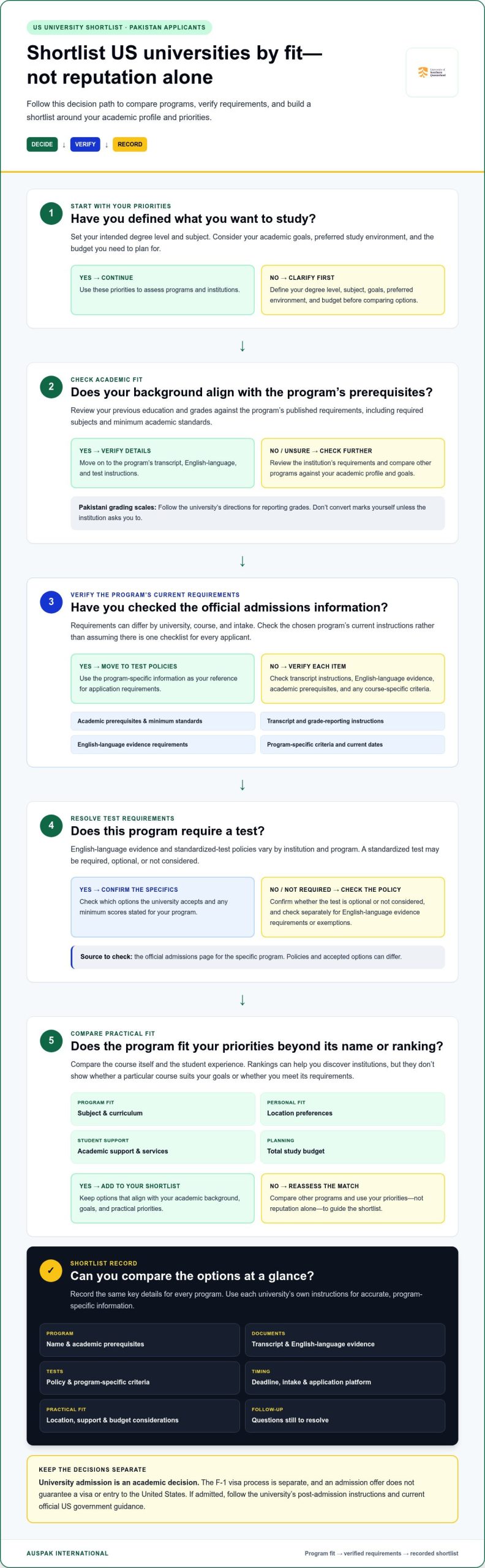
A useful shortlist balances academic fit with practical considerations. Compare programs by subject, curriculum, entry criteria, location preferences, academic support, and total study budget instead of relying on reputation alone. A suitable option should match your academic background and goals as well as your plans as a student from Pakistan.
Which admission requirements should applicants check first?
Start with the program’s published academic prerequisites. Check required subjects, minimum academic standards, transcript instructions, and any criteria specific to your intended course. If your grades use a Pakistani grading scale, follow the university’s directions for reporting them. Don’t convert marks yourself unless the institution asks you to.
Next, check English-language evidence requirements and the tests each university accepts. Accepted options, minimum scores, and exemptions can differ by institution or program. Standardized-test policies also vary: a test may be required, optional, or not considered. Confirm the current policy on the official admissions page for your chosen program before deciding whether to plan for a test.
How can applicants build a balanced university shortlist?
Group prospective programs by how closely they match your academic profile and entry requirements. Then compare curriculum, student services, location, and published information about academic support. Rankings can help you discover institutions, but they don’t show whether a particular course suits your goals or whether you meet its requirements. Use the guide to understanding QS World University Rankings 2026 as one reference point, not the deciding factor.
For Pakistan-specific guidance on researching US study options, EducationUSA Pakistan advising is an official source from the U.S. Department of State. Use it alongside each institution’s own admissions information, which is the authority for that university’s current requirements and deadlines.
Record your research in a comparison table so you can see differences at a glance. Include:
- Program name and academic prerequisites
- Transcript and English-language evidence requirements
- Standardized-test policy and any program-specific criteria
- Application deadline, intake, and application platform
- Location, student support, budget considerations, and questions to resolve
This framework makes how to apply to US universities from Pakistan more manageable: assess fit first, verify details institution by institution, then apply to programs with clear, recorded requirements. AusPak International’s university profile assessment support can help you organize your academic profile and application documents.
How to prepare a strong US university application from Pakistan
A strong application is complete, accurate, and tailored to the program. Requirements differ by institution and course, so use each university’s current checklist rather than relying on a generic document list. As you work through how to apply to US universities from Pakistan, keep a master record of the materials, submission instructions, and deadlines for every application.
Core application checklist: Prepare the academic records, identity details, English-language evidence, essays, recommendations, and program-specific documents requested by each university.
What documents may a US university application require?
Depending on the institution and program, you may need school or university transcripts, certificates, and identification details. Check whether records must come directly from your school or institution, and whether translations or a credential evaluation are required. Don’t assume every university uses the same process or accepts the same document format.
Some applications also request recommendation letters, a résumé or activities history, and supporting materials related to your chosen field. A program may ask for evidence of relevant experience or other work connected to your academic interests. Follow the university’s instructions for who submits each item, how it must be sent, and whether it needs to be uploaded through an application platform.
How should applicants prepare essays and submit applications?
Write essays that directly answer each prompt and are specific to the course. Use truthful examples to explain what sparked your academic interest, how your studies or experience have prepared you, and what you hope to gain from further study. Avoid broad claims that could apply to any applicant. A clear connection between your background and the program helps the reader understand your choices.
Before submitting, review the full application for consistency. Check names, dates, academic history, and details repeated across forms, essays, and supporting documents. Make sure transcripts and certificates are legible and every required section is complete. Profile assessment and document verification can help you organize records and identify inconsistencies before submission.
Use the official university admissions page and application platform to verify the current checklist, submission method, applicable fees, and deadline. After submitting, save the confirmation message and check the application portal for updates or requests for additional materials.
- Match every document to the institution’s instructions.
- Keep copies of submitted forms and supporting records.
- Track outstanding recommendations and documents until the application is marked complete.
Careful preparation can reduce avoidable errors, but it doesn’t guarantee admission. Each university makes its own decision based on its requirements and review process.
Post-Admission: I-20, SEVIS, and F-1 Visa Process
Admission starts a new stage; it doesn’t complete the process. Follow the university’s instructions for confirming your place and providing the information it needs to prepare your Form I-20. Then use current official guidance to complete the separate F-1 visa application steps. Each stage has its own requirements, and completing paperwork does not guarantee visa approval.
What should students do after receiving an admission decision?
Read the university’s post-admission instructions carefully. An eligible school issues Form I-20 for an admitted student planning to apply for F-1 status. The form records information about the student and their program and is used in the student visa process. Check that your name, date of birth, and other identifying details match your passport and application records. Ask the school to correct any discrepancies before proceeding.
The university creates the student record in SEVIS, the US government’s Student and Exchange Visitor Information System. Follow the current official SEVIS I-901 fee instructions, including directions on how and when to pay the required fee. The F-1 SEVIS fee is currently $350. Verify the amount and payment guidance before submitting because fees and procedures can change, and keep the payment confirmation with your records.
How can applicants prepare for an F-1 visa application?
After receiving the I-20 and completing the relevant SEVIS step, review the latest instructions from the US Department of State’s student visa guidance. It explains the current DS-160 application, visa fee, appointment process, interview requirements, and supporting documents. The F-1 visa application fee is currently $185. Check official instructions for the latest amount and payment process before applying.
Prepare to explain your study plans clearly and truthfully. Your answers should align with your selected program and the information in your university and visa documents. Organize relevant evidence about your funding and keep it consistent with the details you provide. Don’t guess, embellish, or submit information that conflicts across forms.
Follow this sequence: complete the university’s I-20 instructions, review current SEVIS payment guidance, complete the DS-160, and then follow official instructions for the appointment and interview. Requirements can change, so check government sources before each step. Visa-documentation guidance can help you organize your materials, but neither complete paperwork nor an admission offer guarantees approval. The visa decision is separate.
AusPak International’s F-1 visa documentation guidance can help you organize your post-admission documents and prepare for the next steps.
A practical application timeline and support for your next steps
Plan backward from each program’s published deadline and intake, rather than from an assumed annual schedule. Application calendars can differ by university, course, and application round. For Fall 2027, for example, some early-action and early-decision deadlines fall in October or November 2026, while regular-decision deadlines commonly fall in January or February 2027. Confirm dates directly with each institution. Use this how to apply to US universities from Pakistan timeline as a planning framework, not a substitute for official deadlines.
What should a month-by-month application plan include?
Count backward from the deadline for every program on your shortlist. Give each task enough lead time, especially if you need to arrange testing or request records from your school or previous institution.
- Research phase: Confirm the intake, official deadline, application platform, admission criteria, and test policies for each target program.
- Preparation phase: Arrange transcripts, certificates, identity details, and any required English-language testing. Request recommendations early and give recommenders time to submit them.
- Drafting phase: Write and revise essays to address each program’s prompts. Check that your examples and goals match the course you’re applying to.
- Submission phase: Review every form and document, submit before the stated deadline, and save confirmation messages and copies of your materials.
- Follow-up phase: Monitor each university’s application portal and email for status updates or requests for additional documents.
Keep the schedule in one tracker, with a separate row for every university. If you’re applying after intermediate studies, the study-abroad-after-intermediate guide can also help you think through your next education stage alongside your US program research.
How can structured application support help Pakistani students?
A profile assessment can help you organize your academic goals, previous education, and application priorities before submission. Document verification supports a careful review of records for completeness and consistency. Application processing can help you manage materials across institution-specific requirements. Consult the university application assistance guide as you work through your shortlist and deadline tracker.
Visa-documentation guidance is a separate preparation step after admission. It can help you organize materials and understand the sequence, but it cannot promise a visa decision. Keep following university and official government instructions as your application progresses.
Take the next step at your pace. Explore student application support from AusPak International for guidance with application preparation and documentation.
Take Your Next Step Toward US Study
A clear plan turns a complex process into manageable stages. Match your academic goals with suitable programs, verify each university’s current requirements and deadlines, and prepare a complete, consistent application package. Treat the F-1 visa process as a separate step after admission. An offer is an important milestone, but it doesn’t guarantee visa approval.
Understanding how to apply to US universities from Pakistan also means knowing where careful preparation can help. Profile assessment can clarify your academic priorities, document verification can help organize accurate records, and application processing can support you through submission. Visa-documentation guidance can help you prepare for the next stage without promising an outcome.
Move forward with an organized checklist and confirm requirements through official university and US government sources. For support with your application preparation, explore student application support. Each well-planned step brings your study goals into sharper focus.
Frequently Asked Questions
Can Pakistani students apply directly to US universities?
Yes. Pakistani students can apply directly to US universities through each institution’s admissions portal or an application platform it accepts. Review the university’s official instructions for eligibility, required materials, submission method, and deadlines. AusPak International’s application support can help organize documents and manage submissions, but the university makes its own admission decision. Applying directly does not remove the need to prepare separately for the student visa process after admission.
What documents do Pakistani students need to apply to US universities?
Requirements vary by university, degree level, and program. Common materials include academic transcripts and certificates, identity details, English-language evidence, essays, and recommendation letters. Some programs may also request a résumé, activities history, or other supporting documents. Check whether records need translations, evaluations, or direct submission from your school. Follow each institution’s instructions for accepted formats and submission channels, and keep your details consistent across forms and documents.
Do I need the SAT or ACT to apply to a US university?
Not always. SAT and ACT policies differ by university and sometimes by program. A test may be required, optional, or not considered, so don’t assume one rule applies across your shortlist. Check the current official admissions page for each program, including guidance for international applicants. If a score is required or you choose to submit one, plan ahead for registration, test availability, and score reporting.
How early should I apply to US universities from Pakistan?
Start by checking the intake and actual deadline for each program, then plan backward to leave time for tests, records, recommendations, essays, and review. For Fall 2027, most applications open in August 2026. Early-action or early-decision deadlines often fall in October or November 2026, while regular deadlines commonly fall in January or February 2027. Dates vary, so confirm them on each university’s official admissions page. Begin your research well before applications open.
Does admission to a US university guarantee an F-1 student visa?
No. Admission and the F-1 visa are separate decisions. A university offer is an important step, but it doesn’t guarantee visa approval or entry to the United States. After admission, follow the school’s instructions and review current US government guidance for visa application requirements, forms, appointments, and supporting documents. Prepare accurate, consistent information about your study plans and funding, and don’t treat application guidance as a promise of a visa outcome.
What is Form I-20, and when does a student receive it?
Form I-20 is a document issued by a US school to an eligible student planning to apply for F-1 student status. It contains information about the student and their program and is used in the student visa process. The school provides it after admission and completion of its required post-admission steps. Follow the institution’s instructions, check that your personal details match your passport, and use official government sources for subsequent SEVIS and visa procedures.
Can I apply to US universities after intermediate in Pakistan?
Yes. Students who have completed or are completing intermediate studies can apply to undergraduate programs, subject to each university’s admission criteria. Institutions set their own academic prerequisites, documentation rules, English-language evidence requirements, and deadlines. Review whether your subjects and academic records meet the requirements for your intended course, and follow the university’s instructions for submitting transcripts and certificates. A profile assessment can help you organize your academic background and identify suitable application priorities.