More documents do not automatically make a stronger Canadian study permit application. Consistency matters. For Pakistani students, understanding the Canada student visa requirements for Pakistani students means identifying which documents apply to their circumstances and showing how their chosen programme fits their academic background and plans.
It’s understandable to feel uncertain when online advice conflicts, especially about financial evidence, attestation letters, and application steps. The Student Direct Stream closed on November 8, 2024, so Pakistani applicants now apply through Canada’s regular study permit stream. Requirements can also vary by programme and institution.
This 2026 guide explains how to distinguish general requirements from case-specific documents, organise a practical checklist, and follow the process from Pakistan. It also covers how to make sure your evidence is accurate and consistent. Check current IRCC guidance before applying, since requirements can change.
Key Takeaways
- Learn how a Canadian study permit differs from a temporary resident visa and why approval depends on your individual circumstances.
- Use a case-aware checklist to identify the identity, admission, financial, academic, and additional evidence relevant to your application.
- Understand the Canada student visa requirements for Pakistani students and how to connect your programme choice with your academic history and future plans.
- Follow a practical sequence for preparing and submitting your application using the forms and route specified by current IRCC instructions.
- Find out when Canada study permit assistance with document organisation and application preparation may help you manage your next steps.
Canada Student Visa Requirements for Pakistani Students: Start with the Study Permit
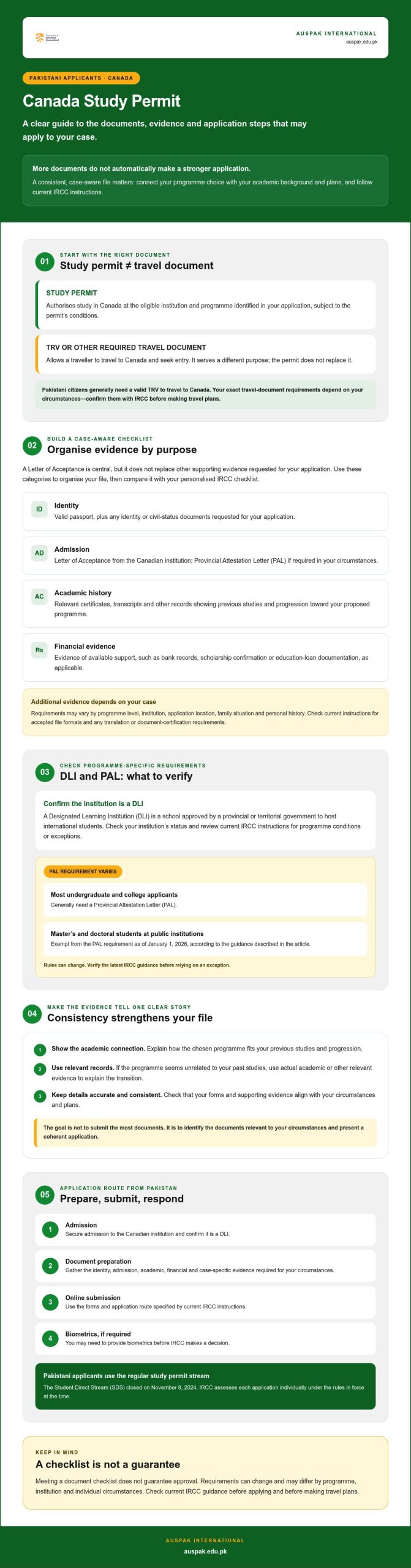
Before preparing forms and supporting evidence, clarify what you’re applying for. A Canadian study permit authorises you to study in Canada under conditions set by Immigration, Refugees and Citizenship Canada (IRCC). It is not, by itself, permission to travel to or enter Canada. Understanding this distinction is a practical first step in meeting the Canada student visa requirements for Pakistani students.
Study permit: Authorises study in Canada, subject to its conditions.
Temporary resident visa (TRV) or other required travel document: Allows a traveller to travel to Canada and seek entry. The permit and travel document serve different purposes, and one does not replace the other.
What does a Canadian study permit allow?
A study permit allows you to study at the eligible Canadian institution and programme identified in your application, subject to the permit’s conditions. It does not settle every travel requirement. Pakistani citizens generally need a valid TRV to travel to Canada, but your exact travel-document requirements depend on your circumstances. Confirm them directly with IRCC before making travel plans.
Which applicants and programmes may have different requirements?
Requirements can vary based on your programme level, institution, application location, family situation, and personal history. A Designated Learning Institution (DLI) is a school approved by a provincial or territorial government to host international students. Check that your institution is a DLI, then review current IRCC instructions for programme-specific conditions or exceptions.
For example, most undergraduate and college applicants need a Provincial Attestation Letter (PAL). As of January 1, 2026, master’s and doctoral students at public institutions are exempt from this requirement, according to the current guidance used in this article. Check the latest IRCC rules before relying on an exception in your own case.
The process starts with admission, followed by document preparation and online submission. You may then need to provide biometrics before IRCC makes a decision. Pakistani students apply through the regular study permit stream because the Student Direct Stream closed on November 8, 2024. IRCC assesses each application individually under the rules in force at the time. Meeting a checklist does not guarantee approval.
Canada’s international education system has a wider history and impact, explored in this overview of international students in Canada. For a step-by-step walkthrough, continue to the full Canada study permit guide and verify each requirement against current IRCC instructions before submitting.
Canada Study Permit Eligibility and Document Checklist for Pakistani Applicants
A useful checklist distinguishes documents commonly needed from evidence that depends on your programme, personal circumstances, or IRCC’s instructions. The Letter of Acceptance is central to a study permit application, but it does not replace other supporting evidence requested for your case. Use the categories below to organise your file, then compare it with your personalised IRCC document checklist before submitting.
Core identity, admission, and academic documents
Start with records that establish who you are, where you’ll study, and how the programme fits your education to date. Documents commonly relevant to the Canada student visa requirements for Pakistani students include:
- Identity: A valid passport and any identity or civil-status documents requested for your application.
- Admission: Your Letter of Acceptance from the Canadian institution, plus a Provincial Attestation Letter (PAL) if required in your circumstances.
- Academic history: Relevant certificates, transcripts, and other records showing your previous studies and progression toward the proposed programme.
- Financial evidence: Documents demonstrating available support, such as bank records, scholarship confirmation, or education-loan documentation, as applicable.
Check the current application guide for accepted file formats and instructions on translations or document certification. If your proposed programme seems unrelated to your previous studies, use your actual academic or other relevant records to explain the transition. Make the connection clear rather than leaving the officer to infer it.
Financial evidence and programme-specific requirements
Required funds and acceptable ways to prove them can change. Do not rely on an old checklist or another applicant’s documents. Review the official study permit requirements and follow the instructions generated for your application. PAL rules also depend on the applicant category and programme. Current guidance states that most undergraduate and college applicants need a PAL, while master’s and doctoral students at public institutions are exempt as of January 1, 2026. Verify the rule for your own programme before applying.
Other evidence is conditional. An English-language test result may support admission or be requested in your case. A medical examination or police certificate may also be required, depending on IRCC instructions. Biometrics are a separate step when requested. Do not submit documents just because they appear on a generic online list. For a broader Pakistan-to-Canada application journey, refer to the Canada study permit guide. You can also consider Canada study permit assistance if you want help organising and reviewing your documents.
How to Make Your Study Plan and Supporting Evidence Consistent
A complete file can still be unclear if its documents tell different stories. Your study plan should connect your reason for studying in Canada, the programme you selected, your academic history, and the evidence you submit. Treat your statement as a guide to the documents, not a substitute for them. This matters as much as collecting the right items when preparing the Canada student visa requirements for Pakistani students.
Connect your chosen programme to your academic background
Explain your progression in plain terms: what you’ve studied, what you plan to study next, and how the selected programme fits that path. If you’re changing fields or have a gap in your education, address it truthfully and refer to relevant records where available. For example, moving from business studies to a technology programme may need an explanation supported by your actual experience or preparation. Do not invent employment, motivations, or career plans to make the transition sound more persuasive.
| Study-plan point | What to explain | Evidence to cross-check |
|---|---|---|
| Study rationale | Why further study is relevant to your goals | Statement and supporting academic or work records |
| Programme choice | Why this course and level fit your plan | Letter of Acceptance and programme details |
| Academic history | How previous study connects, or why your direction changed | Transcripts, certificates, and any relevant explanation |
| Funding plan | Where the funds for your studies come from | Financial records and scholarship or loan documents, if applicable |
Check financial and personal documents for consistency
Review the application as one connected record. Names should match across identity and academic documents. Dates, programme details, and stated funding sources should also align wherever they appear. If a discrepancy has a legitimate explanation, describe it accurately and provide supporting context when IRCC instructions call for it. Do not alter or omit information to make documents appear consistent.
Use this final review before submission:
| Check | What to flag |
|---|---|
| Missing | A document requested in your personalised checklist isn’t included. |
| Conflicting | Names, dates, study details, or funding information don’t match. |
| Expired | A document is no longer valid for the purpose or timeframe specified. |
| Unreadable | A scan is cropped, blurred, incomplete, or difficult to read. |
No writing style or career plan guarantees approval. Aim for a clear, specific account supported by your actual records, and follow current IRCC instructions.
How Pakistani Students Can Prepare and Submit a Canada Study Permit Application
A clear sequence can help you move from admission to submission without relying on outdated forms or generic instructions. For applicants in Pakistan, follow the application route and personalised checklist in current IRCC guidance. Use these steps to organise your work, then confirm each requirement before submitting.
Prepare the application before submitting
- Confirm your admission. Check that your Letter of Acceptance is accurate and reflects the programme and institution you intend to attend.
- Review your personalised checklist. Follow current IRCC instructions for your application, including any programme-specific documents or forms. Requirements can differ by applicant.
- Prepare the evidence. Organise identity, academic, financial, and other requested records. Follow current IRCC instructions for file formats, translations, and certification.
- Complete the forms carefully. Check names, passport details, dates, education history, and programme information against your supporting documents. Resolve discrepancies honestly and explain them where appropriate.
- Check fees and submit. Confirm the applicable application and biometrics fees through IRCC before payment. Submit using the route specified in your current instructions, and save your confirmation and copies of the application.
Before submitting, check for missing uploads, unclear scans, and answers that conflict with other parts of your file. The Canada student visa requirements for Pakistani students are a general guide, not a replacement for the instructions generated for your application.
After submission: biometrics, requests, and status checks
- Follow biometrics instructions. If IRCC asks you to provide biometrics, follow the letter’s directions and deadline. Another applicant’s requirements or timing may not be the same as yours.
- Monitor your official account. Check for messages, additional-document requests, or medical examination instructions. Respond by the stated deadline and use the method specified by IRCC.
- Check processing information. Timelines can change and vary by application. Use IRCC’s current processing-time tool for the latest estimate, and keep monitoring your account for updates specific to your case.
Keep your records together after submission. If you want support organising documents and preparing an application from Pakistan, explore Canada study permit assistance. Professional guidance can help you review your file, but IRCC makes the decision.
Canada Study Permit Document Support and Its Benefits
Some applicants are comfortable managing every form and document themselves. Others may find it useful to get help organising academic and financial records, checking for gaps, and preparing the application. The right choice depends on your case, your confidence with the instructions, and the time you can give to a careful review. Support is optional, and current IRCC requirements remain the authority.
What professional application support can and cannot provide
Consultancy can help you review whether documents appear complete, consistent, and organised for your application. For example, academic records can be checked against your study plan, and financial documents can be reviewed for consistency with the funding information you provide. AusPak International offers Canada Study Permit Assistance, including guidance with visa documentation and application preparation.
You remain responsible for the accuracy of your information, the documents you submit, and your final application decisions. No consultant can guarantee approval, provide privileged access to IRCC, or promise an immigration outcome. IRCC assesses each application and makes the decision. For admission-document preparation, use the relevant university application assistance guide where available, and check its advice against the institution’s own requirements.
A final readiness check before you apply
Before submitting, confirm the essentials. A complete file is more than a collection of documents: its details should align with your admission and study plan.
- Admission: Confirm that your Letter of Acceptance and programme details are accurate.
- Current instructions: Check the personalised IRCC checklist and any programme-specific requirements.
- Consistency: Compare names, dates, academic history, and funding details across forms and supporting documents.
- Completeness: Make sure each requested document is included, readable, and prepared in the required format.
- Questions: Resolve uncertainties about a requirement before submitting rather than risk an avoidable omission.
Use this review to decide whether you’re ready to apply independently or would benefit from case-specific help. The Canada student visa requirements for Pakistani students can depend on individual circumstances, so do not treat another applicant’s document set as your final guide.
If you’d like help organising and reviewing your documents or preparing your application, discuss Canada study permit assistance with AusPak International. Contact the team to discuss your document preparation needs. The final decision remains with IRCC.
Prepare Your Application with Confidence
A strong Canadian study permit application is more than a collection of documents. It connects your admission, academic history, study plan, and financial evidence in a clear, consistent account. As you review the Canada student visa requirements for Pakistani students, use your personalised IRCC checklist and confirm current instructions for your circumstances.
Before submitting, check that your records are complete, legible, and consistent. Follow any individual instructions about biometrics or additional evidence. Careful preparation can help you identify questions or gaps early, but only IRCC makes the decision on your application.
AusPak International offers Canada Study Permit Assistance, including visa consultancy guidance on preparing academic and financial documentation. If you’d like support reviewing and organising your documents, discuss your Canada study permit documents with AusPak International.
Take the process one step at a time. Accurate evidence and a clear study plan can help you move forward with greater confidence.
Frequently Asked Questions
What are the main Canada student visa requirements for Pakistani students in 2026?
A typical application includes identity documents, a Letter of Acceptance from an eligible institution, evidence of financial support, and relevant academic records. Depending on your circumstances, IRCC may also require a Provincial Attestation Letter, biometrics, a medical examination, or other supporting documents. Requirements can change, so use your personalised IRCC document checklist and current instructions rather than treating an online summary as definitive.
Is a study permit the same as a Canadian student visa?
No. A study permit authorises you to study in Canada under its conditions, while a separate travel document may be required to travel to Canada and seek entry. The documents serve different purposes, and receiving one does not automatically provide the other. As a Pakistani citizen, check current IRCC guidance for the travel documents required in your circumstances before making plans. Confirm that you understand both study authorisation and entry requirements.
Can Pakistani students apply for a Canada study permit without a Provincial Attestation Letter?
Some applicants are exempt from the Provincial Attestation Letter (PAL) requirement, but eligibility depends on the programme and institution. Under current guidance, most undergraduate and college applicants need a PAL, while master’s and doctoral students at public institutions are exempt as of January 1, 2026. Check the latest IRCC instructions and confirm the requirement with your institution. If a PAL applies to your case, include it as directed in your application.
How much proof of funds is required for a Canadian study permit?
The amount depends on current IRCC rules and factors such as tuition, living expenses, accompanying family members, and where you’ll study. Requirements can change, so check the current financial-support instructions for your application date instead of relying on figures in older articles. Prepare evidence showing that the funds are available and explaining their source, such as relevant bank records, scholarship information, or education-loan documents. Keep the figures consistent across your application and supporting evidence.
Do Pakistani students need IELTS for a Canada study permit?
IELTS is not automatically a universal study permit document requirement. Your Canadian institution and programme set admission language requirements, and your IRCC checklist may identify additional evidence relevant to your case. Check the conditions in your Letter of Acceptance and confirm whether a test result is required for admission. If you include IELTS results, make sure the information is accurate and the result meets the institution’s current requirements.
What happens if a Canada study permit application is refused?
Read the refusal letter carefully and identify the reasons IRCC gives. Then review your submitted forms and evidence against current instructions to see whether accurate additional information or clearer explanations could address the concerns. Do not simply resubmit the same application unchanged, and do not assume a new application will be approved. If you’re unsure how to respond to the stated reasons, consider seeking case-specific guidance before deciding what to do next.
Are biometrics required for Pakistani students applying for a Canada study permit?
Biometrics requirements depend on your circumstances and the instructions issued during your application. Follow any personalised IRCC request, including its deadline and directions for completing the step. Do not assume you’re exempt because another applicant did not need to provide biometrics. Keep the confirmation with your application records, and continue checking your official account for other requests, such as additional documents or a medical examination.