
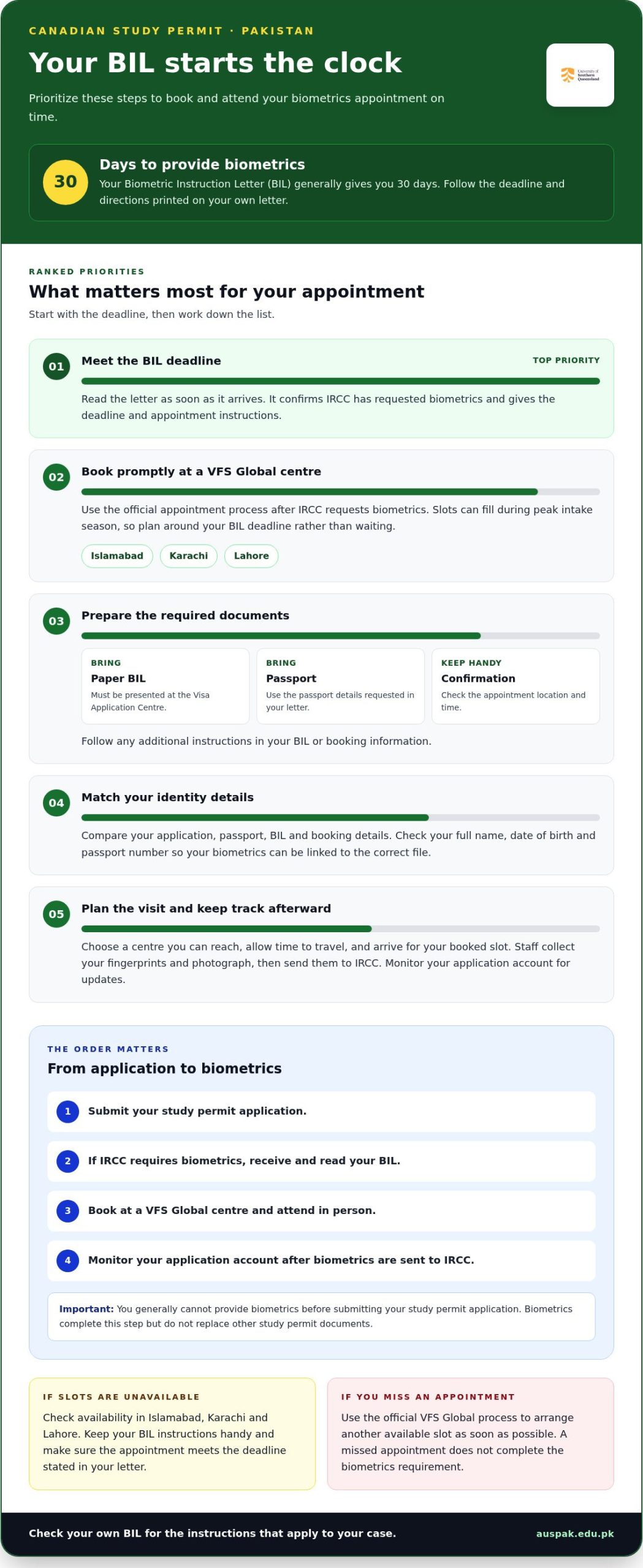
The BIL starts a deadline, not just a booking step. If you receive a Canadian Biometric Instruction Letter for your student visa application from Pakistan, you generally have 30 days to provide your biometrics, subject to the instructions on your letter. For biometrics for a Canadian student visa in Pakistan, you’ll attend a VFS Global centre after IRCC requests them.
It’s easy to focus on the visa application and overlook how quickly the biometrics deadline can arrive. Acting promptly gives you time to book an appointment and prepare the required documents. Understanding the biometric requirements for a Canadian student visa in Pakistan helps you plan this step without leaving it until the last moment.
This guide explains when to book biometrics in Pakistan, what to bring to your appointment, and how long biometrics may remain valid for temporary-residence applications. It also explains which students generally need to provide them and why the instructions in your BIL matter. Follow the steps in order to navigate this part of your Canadian study permit application more clearly.
Key Takeaways
- Your Biometric Instruction Letter generally gives you 30 days to provide biometrics; follow the deadline and directions printed on your own letter.
- In Pakistan, book an appointment at a VFS Global centre in Islamabad, Karachi, or Lahore, and bring a paper copy of your letter.
- Biometrics for Canadian temporary-residence applications may remain valid for up to 10 years, depending on the applicant’s case.
- Age affects whether biometrics are required: applicants aged 14 to 79 generally need to provide them.
- Learn which other study permit steps may apply to Pakistani students, including the Provincial Attestation Letter requirement for many undergraduate and college applicants.
Canadian study permit requirements for Pakistani students
A Canadian study permit application involves admission, supporting documents, and biometrics when requested. As a Pakistani student, prepare each step in sequence and keep your details consistent across your application, letter, and passport.
Biometric Instruction Letter and Applicant Details
Submit your study permit application first. If IRCC requires biometrics, it sends a Biometric Instruction Letter, or BIL, with directions for completing them. Read the letter carefully, especially the deadline and appointment instructions. Bring a paper copy to your Visa Application Centre in Pakistan.
Before your appointment, compare your application details with your passport. Check that your full name, date of birth, and passport number match across the documents. Use the same identity details throughout the application process so your biometrics can be linked to the correct file. After your appointment, the Visa Application Centre sends your biometrics to IRCC. Monitor the account you used to apply for updates.
Identity, Health, and Age Requirements
Your passport is an important identity document for your study permit application. Bring the passport details requested in your BIL and the paper letter itself. Keep your name and other personal details consistent with your application. These checks help ensure your biometrics are associated with the correct study permit file.
Medical requirements are separate from biometric collection. Applicants must complete a required immigration medical examination with an IRCC-approved panel physician. Follow the medical instructions for your application and keep its records with your supporting documents. Age also affects biometrics: applicants under 14 are usually exempt, while applicants aged 14 to 79 generally provide them when requested.
Biometric Exemptions and Fee Details
Age-based exemptions matter for Pakistani study permit applicants. Children under 14 applying for Canadian biometrics are usually exempt. Adults over 79 are usually exempt, and Visa Application Centres cannot collect biometrics from applicants aged 80 or over. If you are close to an age threshold, use the age and instructions relevant to your application and appointment.
The amount in Pakistani rupees depends on the exchange rate used for payment, so there is no single fixed PKR equivalent. Keep the biometric fee separate from other study permit costs. Follow the payment instructions associated with your application and appointment.
Biometrics Before Application Submission
You generally cannot provide biometrics before submitting your Canadian study permit application. Apply first, then follow IRCC’s request and the instructions in your BIL. Pakistani study permit applicants provide biometrics at a VFS Global centre after IRCC requests them. The letter explains what to bring and how to proceed.
At the appointment, staff collect your fingerprints and photograph, then send the biometrics to IRCC. Bring your paper BIL and passport, and make sure your details match your application. Afterward, monitor your application account for correspondence or status updates. Biometrics complete this required step, but do not replace the other documents needed for a study permit application.
Booking a biometric appointment in Pakistan
After IRCC requests your biometrics, arrange an in-person appointment at a VFS Global centre in Pakistan. Book promptly, as appointment slots can fill during peak intake season.
Appointment Booking Process
Start with your Biometric Instruction Letter (BIL). It confirms that IRCC has requested your biometrics and explains the next step. Use the official VFS Global appointment process to select a centre in Islamabad, Karachi, or Lahore. Choose a location you can reach and an available appointment that meets the deadline in your letter.
Before booking, make sure you have the details needed to identify your application. Follow the appointment process carefully and use the same personal and passport information as in your study permit application. Review the booking confirmation for the appointment location and time. Keep it accessible while preparing for your visit.
Prepare the required documents before travelling. Bring a paper copy of your BIL, which applicants must present at the Visa Application Centre. Bring your passport and appointment confirmation too, and follow any additional instructions in the letter or booking information. Check that the name and passport details on these documents match your application.
Plan your booking around the BIL deadline rather than waiting until the end of the available period. During busy intake periods, your preferred date or city may not have an appointment immediately available. Consider the three listed centres and allow enough time to travel and arrive for your booked slot.
Missed or Unavailable Appointments
If you miss an appointment, use the official VFS Global process to arrange another available slot as soon as possible. If you cannot find an appointment, review availability in Islamabad, Karachi, and Lahore, and keep your BIL instructions handy. Your appointment must meet the deadline stated in the letter.
A missed appointment does not mean your biometrics requirement is complete. You still need to attend a Visa Application Centre and provide them in person. Keep your BIL and any booking confirmation handy while arranging a new appointment. If the letter’s deadline is approaching, follow the instructions provided in your BIL for your situation.
Before travelling, compare your appointment confirmation, BIL, and passport. Confirm the centre and appointment time, then carry the paper letter required for collection. These checks help prevent avoidable problems at the centre, especially when your appointment is close to the deadline.
If you need support organizing the wider study permit process alongside this appointment, explore Canada study permit assistance.
Deadline for providing biometrics
After IRCC issues your Biometric Instruction Letter (BIL), the usual deadline is 30 days. You must provide biometrics within the period stated on your own letter, because its instructions govern your application. Treat the BIL’s deadline as a required completion date, not simply a target for booking an appointment.
Start counting from your letter
As soon as the BIL arrives, note its issue date and stated deadline. Then compare the remaining time with appointment availability at VFS Global centres in Islamabad, Karachi, and Lahore. The general 30-day period does not replace the deadline printed on your individual letter.
Plan to attend the appointment, not just secure a booking. Biometrics are provided in person after IRCC requests them. A reserved slot does not complete the requirement: you still need to attend and have your fingerprints and photograph collected.
Plan around appointment availability
Book promptly after receiving the BIL. Appointment slots can fill during peak intake season, so delaying your search may leave fewer suitable dates. Consider all three Pakistani locations, especially if your nearest centre has no convenient slot. Choose a date that leaves time to prepare and travel.
For example, if your letter gives a deadline and your preferred centre has no early opening, check the other listed cities instead of waiting. Make realistic travel plans and ensure your appointment falls within the time allowed by your BIL.
Keep the deadline and documents together
Save the BIL where you can access it while booking, and note the deadline in your calendar. Keep the paper letter ready for your Visa Application Centre visit, as applicants must bring a paper copy. Prepare one document set by pairing it with your appointment confirmation and passport.
Before leaving for your appointment, compare the centre, date, and time with your booking confirmation. Check that you have your paper BIL and passport. These checks help you avoid arriving at the wrong location or without a required document, which could disrupt your visit.
If the deadline is close
If available appointments are close to your BIL deadline, promptly review openings in Islamabad, Karachi, and Lahore. Follow the instructions in your letter for your specific case. Do not assume that booking automatically changes or pauses the deadline: the BIL states the instructions that apply.
After biometrics are collected, keep any appointment or visit records with your study permit documents. The centre sends your biometrics to IRCC, but your application remains subject to its other requirements. Acting soon after the letter arrives gives you more time to arrange an appointment and complete this step within the stated period.
Temporary-residence biometric validity
For Canadian temporary-residence applications, biometrics may remain valid for up to 10 years, depending on the applicant’s case. Pakistani students should distinguish this validity period from the separate deadline in a new Biometric Instruction Letter (BIL).
What the 10-year validity period means
The 10-year period describes how long previously provided biometrics may remain valid for temporary-residence applications. It does not mean every student’s biometrics remain valid for the full period. The applicable validity depends on the applicant’s case, so avoid treating 10 years as a guaranteed reuse period.
Biometric validity is separate from your passport’s validity and your study permit’s duration. A valid passport does not establish that your biometrics are still valid. Likewise, a study permit application has its own requirements, even if you have previously provided fingerprints and a photograph.
How to review your biometric history
If you previously applied to visit, study, or work in Canada, locate records from that application. Note when you gave biometrics and keep related IRCC correspondence with your current study permit documents. These details help you understand whether your earlier collection may still fall within the 10-year period.
Read the instructions for your current application. If IRCC issues a new BIL, follow its directions and deadline instead of relying only on an older appointment record. A past collection does not automatically cancel a new request. Treat the current letter as the guide for your present file.
Do not confuse validity with the BIL deadline
Biometric validity and the time allowed to complete a new request answer different questions. Validity concerns whether previously collected biometrics may still be used. The BIL deadline tells an applicant when to provide biometrics after IRCC requests them. The usual BIL period is 30 days, subject to the letter’s instructions.
For example, a student may have provided biometrics during an earlier Canadian temporary-residence application. If a new BIL arrives, check its instructions rather than assuming the earlier collection settles the new request. Keep the letter, passport details, and previous application records together as you review the next step.
Keep records for future applications
After providing biometrics, save the date and any related correspondence in a secure place. If you apply again within the possible 10-year validity period, those records can help you review your history alongside the new application instructions. Keep the information accurate, especially when your passport or personal details change.
For a Canadian study permit application from Pakistan, use the current IRCC correspondence as your guide. A previous biometric appointment is useful context, but it does not replace reading a new letter. Check the dates, request, and stated deadline before deciding what action your current application requires.
Biometrics for international students applying in Canada
Applying for a study permit from inside Canada follows a different location path from applying in Pakistan. Foreign nationals aged 14 to 79 applying in Canada for an international student permit, including an extension, must submit biometrics. This applies to students extending their stay as well as those making an initial in-Canada application.
Who must provide biometrics in Canada?
Start by identifying where you’ll submit your application. The in-Canada rule applies to foreign nationals aged 14 to 79 seeking an international student permit or extension. Age matters: applicants under 14 and over 79 fall outside this stated age group. If you’re within the range, prepare to follow the biometric instructions issued for your application.
An extension is still an application that may require biometrics. Don’t assume your original study permit or an earlier collection automatically covers a later request. Read the instructions for the extension file and follow the steps stated for that application. This distinction helps you plan for biometrics before your current permit ends.
How collection fits the in-Canada process
Biometrics are collected in person, not by uploading a photograph or document online. A Visa Application Centre or Application Support Center can collect them, according to the applicant’s instructions. The collection includes fingerprints and a photograph. Follow the location and appointment directions in your biometric request.
After a visit to a Canadian Visa Application Centre, your biometrics are sent to IRCC. This connects the collection to your application record. Keep your appointment details and application correspondence together so you can track what is complete and respond to any later request related to your file.
What students should do after receiving instructions
When IRCC requests biometrics, read the letter before arranging collection. Match the applicant details in it to your study permit or extension application, then follow the stated appointment process. If you’re applying from Pakistan, provide biometrics at a VFS Global centre after IRCC requests them. The country where you apply determines the applicable instructions and location.
For example, a student already in Canada who is seeking an extension should follow the in-Canada directions, rather than assume Pakistan’s VFS process applies. A student applying from Pakistan should use the instructions for that application location. In either case, treat the request letter as your guide to completing collection.
Keep the application and biometrics aligned
Use consistent identity details across your application, passport, and biometric appointment records. If you’re applying for an extension, keep your current permit information with the new application correspondence. These records make it easier to track the right file and distinguish a new request from a previous study permit application.
Students preparing an application from Pakistan can get support with the broader permit process through Canada study permit assistance. Keep the biometric request and appointment instructions central to your next steps.
AusPak International: Australian University Admission Support
AusPak International supports students planning to study abroad, including Pakistani applicants preparing for a Canadian study permit. Its Canada Study Permit Assistance can help you organize the wider application process alongside biometric steps, including understanding application requirements and preparing supporting documents. Turn to this support if you need guidance beyond booking an appointment or have questions about how biometrics fit into your study plans.
If your plans change, AusPak International also offers Australian University Admission Support, UK Student Visa Consultancy, and Onshore Arrival Support. Choose the support that fits your next step, whether you’re preparing an application or planning for arrival after completing your study arrangements.
Contact AusPak International or visit auspak.edu.pk to discuss your study plans.
Move Your Study Plans Forward
Biometrics are one part of a broader education plan. Use this stage to keep your next decisions aligned, from preparing your study permit application to planning what comes after admission. If you’re arranging biometrics for a Canadian student visa in Pakistan, coordinated support can help you manage the wider application journey.
AusPak International offers Canada Study Permit Assistance for students preparing to study in Canada. It also provides UK Student Visa Consultancy and Australian University Admission Support for students considering those destinations. Choose support that fits your intended study pathway and current stage.
Take the next step by discussing your plans with AusPak International. Contact AusPak International for help and move forward with clarity and confidence.
Frequently Asked Questions
How long do I have after receiving the BIL?
You generally have 30 days after receiving your Biometric Instruction Letter (BIL) to provide biometrics. The deadline and instructions on your individual letter apply to your application. Arrange your appointment promptly, especially during busy student intake periods, and plan for the time needed to travel to a Visa Application Centre. For example, if your preferred appointment date falls outside the letter’s deadline, consider another available centre.
Need Help With Your Canada Study Visa?
AusPak International offers Canada Study Permit Assistance for Pakistani students preparing their study plans and applications. Support with the wider permit process can help you organize application documents alongside biometric steps. AusPak International also offers UK Student Visa Consultancy and Australian University Admission Support for students considering those destinations. To discuss support for your Canadian study permit application, contact AusPak International and explain which stage you’re working on.
What is a Canada Biometric Instruction Letter?
A Biometric Instruction Letter is IRCC’s notice asking an applicant to provide biometrics for a Canadian application. It explains how to complete the requested step and states the applicant’s deadline. Keep the letter with your study permit records so you can refer to it while arranging your appointment. For example, use the applicant details in the letter to check that your appointment information matches your application.
What should I bring to my biometrics appointment?
Bring a paper copy of your BIL and your passport to the appointment. Keep your appointment confirmation accessible so you can refer to the booked location and time. Before leaving, compare the name and passport details across your letter, passport, and application records. This quick review can help you spot a spelling or number mismatch before arriving at the Visa Application Centre.
Do Pakistani applicants need to give biometrics for a Canadian study permit?
Pakistani study permit applicants generally provide biometrics after IRCC requests them. Applicants aged 14 to 79 usually need to give biometrics, while children under 14 and adults over 79 are usually exempt. For example, a student aged 16 who receives a BIL should follow its instructions and arrange collection. Age exemptions and the request in your letter both matter when deciding your next step.
Where can students in Pakistan give Canadian visa biometrics?
After IRCC requests them, students in Pakistan can provide Canadian visa biometrics at VFS Global centres in Islamabad, Karachi, or Lahore. Choose a centre you can reach, then check the location and time on your booking confirmation before travelling. If your preferred city has no suitable appointment, consider the other listed centres while keeping your BIL deadline in view.
What documents should I bring to my Canada biometrics appointment?
Bring the paper BIL and passport, along with your appointment confirmation. The BIL is essential because the Visa Application Centre uses it to identify the biometric request linked to your application. Before your appointment, check that your passport details and personal information match across the documents. Keep other study permit papers organized separately so you can quickly present the items required for biometric collection.
When do I receive the biometrics instruction letter and how long do I have to submit biometrics?
IRCC generally issues a BIL after you submit your study permit application and requests biometrics. Applicants usually have 30 days to provide them, subject to the deadline and instructions on the individual letter. Check your application correspondence for the BIL, then note its deadline immediately. If you’re planning your biometric for a Canada student visa in Pakistan, make the appointment the next practical step after receiving the request.