IELTS isn’t the only possible route to Swedish university admission for Pakistanis. Depending on the programme, some universities accept alternatives such as TOEFL, PTE Academic, Cambridge English Qualifications, the Duolingo English Test, or a Medium of Instruction certificate. Pakistani students planning to study in Sweden for more than three months need a residence permit. The accepted English-language evidence and immigration process depend on the course and its requirements.
It’s understandable to want clear requirements before investing time in applications, preparing documents, or paying tuition. This guide covers English-test options, Pakistani qualifications, required documents, admission offers, tuition-payment steps, and when a residence permit is needed.
You’ll also see how the application process fits together, from meeting academic entry criteria to preparing for the move. Use these details to plan your next steps with greater confidence.
Key Takeaways
- Understand when your Swedish study plans call for a residence permit rather than a short-stay visa.
- Explore English-language evidence accepted by some universities, including alternatives to IELTS.
- Prepare Pakistani academic and identity documents in the form required for admission review.
- See how your previous qualifications can affect eligibility for a bachelor’s or master’s programme.
- Follow the key steps connecting an admission offer and tuition payment with your permit application.
Do Pakistani students need a study visa or a residence permit for Sweden?
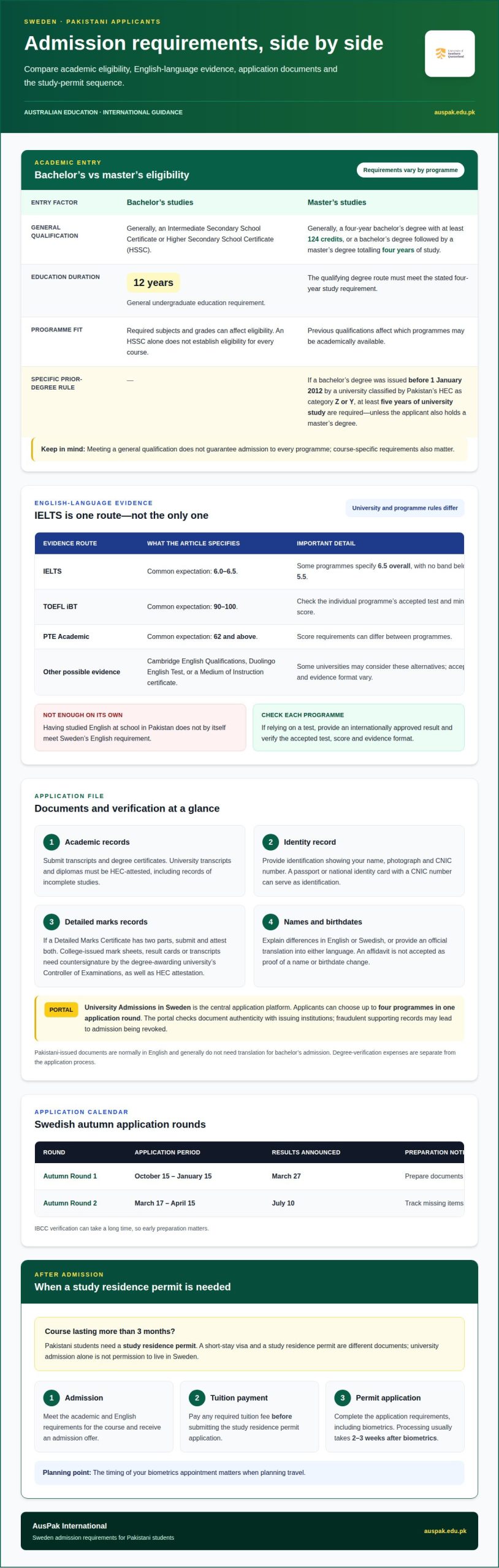
A residence permit for studies is the authorization Pakistani students need when their Swedish course lasts more than three months. In that situation, plan for a study residence permit, rather than treating university admission as permission to live in Sweden. A short-stay visa and a study residence permit are different documents, so the course duration matters when identifying the route.
Academic entry requirements are the qualifications and subject preparation a university expects before admitting a student. For bachelor’s studies, Pakistani applicants generally need an Intermediate Secondary School Certificate or Higher Secondary School Certificate. The general undergraduate requirement is 12 years of education. Programme-specific subjects and grades can also affect eligibility, so an HSSC alone does not establish that every applicant meets every course requirement.
For master’s studies, Pakistani applicants generally need a four-year bachelor’s degree with at least 124 credits, or a bachelor’s degree followed by a master’s degree totalling four years of study. Applicants with a bachelor’s degree issued before 1 January 2012 from a university classified by Pakistan’s Higher Education Commission as category Z or Y need at least five years of university study, unless they also hold a master’s degree. These distinctions can change which programmes are academically available.
English-language proof is evidence that an applicant can study in English at the level required by the university and programme. Studying English at school in Pakistan does not, by itself, meet Sweden’s English requirement. If relying on a test, Pakistani applicants must provide an internationally approved English test result. Common expectations include IELTS 6.0 to 6.5, TOEFL iBT 90 to 100, or PTE Academic 62 and above. Some programmes list IELTS 6.5 overall, with no band below 5.5.
IELTS is not the only possible test route. Accepted English-language evidence may vary between Swedish universities and programmes. Some universities may also consider a Medium of Instruction certificate. Check the rules for each programme: accepted tests, minimum scores, and evidence formats can differ between institutions.
After admission, the permit process follows a practical sequence. Pay any required tuition fee before submitting the study residence permit application. Then complete the application requirements, including biometrics. Processing usually takes 2-3 weeks after biometrics, so the timing of that appointment matters when planning travel. Swedish university admission for Pakistanis therefore involves two separate checks: academic and English eligibility for the course, followed by the residence permit requirement for studies lasting more than three months.
Application documents
Application documents are academic and identity records used to assess admission eligibility and confirm an applicant’s details. Pakistani applicants to Swedish universities generally submit academic transcripts and degree certificates, along with identification showing their name, photograph, and CNIC number. A passport or national identity card with a CNIC number can serve as identification.
Attestation is official confirmation of Pakistani university records by the Higher Education Commission (HEC). All university transcripts and diplomas submitted for Swedish admission must be HEC-attested, including records of incomplete studies. If a Detailed Marks Certificate has two parts, submit and attest both. College-issued mark sheets, result cards, or transcripts require countersignature by the degree-awarding university’s Controller of Examinations, as well as HEC attestation.
The national admissions portal is the central platform where most students submit Swedish university applications. Called University Admissions in Sweden, it allows applicants to choose up to four programmes in one application round. A professional coordinator can organize programme choices, prepare document uploads, track the submission, and monitor requests for additional records. Degree-verification expenses are separate from the application process.
Pakistani-issued documents are normally in English and generally do not need translation for bachelor’s admission. If names or birthdates differ between records, explain the discrepancy in English or Swedish, or provide an official translation into either language. An affidavit is not accepted as proof of a name or birthdate change. University Admissions in Sweden checks document authenticity with issuing institutions, and fraudulent supporting records may lead to admission being revoked.
Swedish application rounds determine when a complete file must be submitted. The listed Autumn Round 1 period is October 15 to January 15, with results announced March 27. Autumn Round 2 runs March 17 to April 15, with results announced July 10. A professional managing the portal process can align document preparation with the selected round and follow up on missing items. IBCC verification can take a long time, so early preparation matters.
Application fees are charges attached to specific application processes, not a substitute for document preparation. A professional can help keep portal submissions, payment records, and residence-permit paperwork organized as distinct steps. Adults applying for a Swedish study residence permit pay an application fee; the permit application follows the admission and required tuition-payment stages. Scholarships are separate funding opportunities, and applying for one does not replace required admission documents.
Swedish university or residence-permit applications from Pakistan can be rejected if academic requirements are not met, required records are missing or improperly attested, or documents are fraudulent. Differences in names or birthdates without acceptable supporting documentation can also cause problems. Organize your application around the programme requirements, official records, and correct application round.
Is it possible for Pakistani students to study in Sweden without taking the IELTS?
IELTS-free admission means meeting a university’s English-language requirement through evidence other than IELTS. Pakistani students may apply without IELTS if their chosen Swedish university accepts an alternative, but skipping the test does not mean skipping English proof. The university and programme set the accepted evidence and required level. Check those criteria before choosing a course or submitting an application.
Alternative English proof is a test result or other evidence a university accepts instead of IELTS. Options may include TOEFL, PTE Academic, Cambridge English Qualifications, or the Duolingo English Test. Requirements vary by programme: a university may accept one option but not another, or set different minimum scores. Treat the programme’s English-language rules as a separate admission requirement, not an automatic benefit of applying to Sweden.
A Medium of Instruction certificate records the language used in a student’s previous education. Some Swedish universities may accept this certificate from Pakistani applicants instead of IELTS. Acceptance depends on the institution and programme, so it does not automatically exempt every applicant. If the university requires an approved English test, a school certificate showing English study alone will not meet that requirement.
An English-taught programme delivers teaching and coursework in English rather than Swedish. Swedish universities offer programmes taught entirely in English, including options in business, technology, and social sciences. This can make higher education in Sweden accessible to international students who are still learning Swedish. Confirm the language of instruction and English-evidence rules for your chosen programme before applying.
Work while studying means taking employment during an active study programme. International students in Sweden are generally allowed to work while studying, and the stated limit is up to 20 hours per week. Employment can provide experience alongside academic studies, but it should not replace the study plan or the financial preparation required for a residence permit. Balance work commitments with course attendance and assessment deadlines.
Post-study work time is a period available after graduation to seek employment. International students graduating in Sweden may stay for up to 12 months to look for work. That creates time to explore employment opportunities after completing a degree, rather than needing to secure a role before graduation. Business, technology, and social-science graduates can consider relevant roles, while planning their transition before the study period ends.
For Pakistani applicants, a practical approach is to shortlist English-taught courses, review each programme’s accepted proof, and match your evidence to its rules. If IELTS is not your preferred option, check whether a test such as TOEFL or PTE Academic, or a Medium of Instruction certificate, meets the requirements for that specific application. Keep the course deadline in view so your language evidence is ready in time.
Admission offers and tuition payment
An admission offer is a university’s decision to offer a place on a selected programme. For Pakistani applicants, it marks the transition from meeting academic requirements to arranging tuition and residence-permit steps. Review the programme, degree level, and any conditions attached to the offer. These details guide your next decisions, including payment planning and preparation of the study-permit application.
Tuition fees are charges for an academic programme. In Sweden, annual tuition differs between bachelor’s and master’s studies, and the programme determines the amount. Compare the specific fee shown for each offer rather than assuming that degrees at the same level cost the same. Other expenses also matter: accommodation, food, transport, and personal spending all shape a student’s living budget.
Tuition payment is the required payment to the university for a programme. Students who need a Swedish study residence permit must pay any required tuition fee before submitting the permit application. Keep payment separate from receiving an offer: the offer identifies your place, while payment is a distinct step before the permit application can proceed. Organize the payment record with your admission documents.
Living expenses are the everyday costs of living in Sweden while studying. Budget categories include accommodation, food, transport, and personal expenses, which can vary with living arrangements and location. Residence-permit applicants must show sufficient funds for one year of living expenses. The Swedish Migration Agency sets the required amount. Plan for tuition and living costs as separate parts of your budget.
Scholarships are funding opportunities that may help eligible students cover study costs. Options identified for Pakistani students include Swedish Institute Scholarships, Erasmus+ Scholarships, university-specific scholarships, tuition-fee waivers, and merit-based awards. Named university opportunities include the Lund University Global Scholarship, Uppsala University Global Scholarship, and Stockholm University Scholarship. Each has its own eligibility rules and application process, so note relevant deadlines alongside admission requirements.
Treat a scholarship as a possible funding route, not a substitute for completing university or permit steps. Keep award decisions, tuition-payment requirements, and living-fund evidence organized separately. If an award changes the amount you must pay, follow the university’s current payment instructions for the next stage. This helps connect the offer, financial plan, and residence-permit application without confusing their separate requirements.
A practical sequence is to review the offer’s programme and fee details first. Next, identify suitable scholarships and account for everyday living expenses. Then make any required tuition payment before submitting the study residence-permit application. A Swedish student visa does not replace the residence permit required for studies lasting more than three months. Keeping these decisions in order helps Pakistani students plan study costs and immigration steps together.
Pakistani degree qualifications for Swedish master’s admission
A master’s qualification is the prior university education required for entry to a postgraduate programme. Pakistani applicants generally need a four-year bachelor’s degree with at least 124 credits, or a bachelor’s degree followed by a master’s degree totalling four years of study. The degree must meet the programme’s academic entry requirements, so applicants should match their qualification and subject background to the chosen course.
An older Pakistani bachelor’s qualification is a degree issued before 1 January 2012 by a university classified as category Z or Y by Pakistan’s Higher Education Commission. For Swedish master’s admission, applicants in this group need at least five years of university study, unless they hold both a bachelor’s degree and a master’s degree. A Bachelor of Ayurvedic Medicine and Surgery does not satisfy Sweden’s master’s entry requirements.
Bachelor’s admission eligibility is the combination of school-level education and subject preparation required for undergraduate study. Pakistani applicants generally need an Intermediate Secondary School Certificate or Higher Secondary School Certificate, representing 12 years of education. Intermediate, FSc, or A-Level qualifications may qualify when the required subjects and grades are met. Previous university results do not replace upper-secondary qualifications, though they may help meet course-specific requirements.
Mathematics equivalency describes how Pakistani school studies correspond to Swedish mathematics requirements. For applicants completing Intermediate or Higher Secondary School after 2010, SSC mathematics will usually meet the specific Matematik 2a requirement. Pakistani SSC mathematics may correspond to Swedish Matematik 1b or Matematik 2a, depending on the year studies were completed. Applicants seeking bachelor’s admission who graduated after 2009 need a passing Mathematics grade in ISSC or HSSC for Sweden’s general entry requirements.
PhD study is advanced research conducted after earlier higher education. In Sweden, PhD positions are usually paid jobs rather than standard tuition-based student places. Pakistani applicants considering this route should distinguish advertised research positions from bachelor’s or master’s programmes because the application route and selection criteria differ. A research topic, relevant academic background, and the position’s stated criteria shape the application.
For international students, “taught” describes a course’s language and format, while degree eligibility concerns prior qualifications. Studying in Sweden therefore involves two distinct questions: whether Pakistani school or university credentials meet academic entry requirements, and whether the selected programme fits the applicant’s education. For bachelor’s applications, include upper-secondary qualifications and identification. For master’s applications, focus on university degrees and transcripts.
Use the qualification route that matches your intended degree, then organize the corresponding academic records for the application. To discuss how your academic pathway fits your international study plans, explore your study pathway.
AusPak International: Australian University Admission Support
AusPak International supports students considering Australia through Australian University Admission Support. If researching Sweden has prompted you to consider another destination, this service can help you work through the Australian university application process.
AusPak International also offers support for students comparing study routes across countries, including UK Student Visa Consultancy and Canada Study Permit Assistance. Onshore Arrival Support is available for students preparing for life after arrival. Choose the pathway that matches your destination and the support you need.
To discuss your study plans, contact AusPak International.
Choose the study pathway that fits your next step
Your next decision is not only where to study, but which academic environment aligns with your goals, qualifications, and plans for the future. Use the Swedish university application process to assess whether Sweden suits your plans. If you’re also considering other destinations, compare the routes by programme fit and the application support you need. A clear destination choice helps focus your preparation and keep your next steps purposeful.
For students exploring alternatives, AusPak International offers Australian University Admission Support, UK Student Visa Consultancy, and Canada Study Permit Assistance. These services support applicants pursuing those destinations. The best next step depends on where you intend to study and the application support relevant to that choice. Swedish university admission for Pakistanis requires a pathway grounded in your academic and destination goals.
Contact AusPak International for guidance on the study pathways it supports. Take the next step with a clear destination in mind and confidence in your plan.
Frequently Asked Questions
What about university records?
University records should present a consistent, verifiable history of your studies. Include completed and incomplete study records when relevant to your application, and ensure Pakistani university transcripts and diplomas carry Higher Education Commission attestation. University Admissions in Sweden may verify documents with the issuing institution, so accurate records matter. If an academic document contains a discrepancy, provide acceptable official supporting documentation rather than relying on an affidavit.
What documents do you need?
Required documents depend on your study level and programme. A bachelor’s applicant typically needs upper-secondary qualifications and identification, while a master’s applicant needs university transcripts and degree certificates. Pakistani university records require Higher Education Commission attestation. Prepare English-language evidence if required. A passport’s personal-data and photograph page can identify you; a national identity card showing your photograph and CNIC number is another accepted identification option.
Why choose Sweden for higher education?
Sweden offers English-taught programmes and international study environments, with options across fields such as business, technology, and social sciences. University communities also vary: Malmö University welcomes students from more than 80 countries, offering a distinctly international setting. Students may also work while studying, and graduates may have time to seek employment after completing their studies. The best fit depends on your subject, language preference, and future plans.
What are the admission requirements for Pakistani students applying to Swedish universities?
Requirements depend on the degree level and selected programme. Bachelor’s applicants need qualifying upper-secondary education, while master’s applicants need an acceptable university qualification. Programme-specific subjects, grades, and English proficiency can affect eligibility. Submit official academic records and identification in the required format. Applicants can select up to four programmes in one application round, so arrange choices by academic fit and entry criteria.
Which Pakistani qualifications are accepted for undergraduate admission in Sweden?
Pakistani applicants may use an Intermediate Secondary School Certificate or Higher Secondary School Certificate for bachelor’s admission, provided they meet subject and grade criteria. Intermediate, FSc, and A-Level qualifications may also be considered. Applicants generally need 12 years of education. Mathematics preparation can matter for course eligibility: Pakistani SSC mathematics may correspond to Swedish Matematik 1b or Matematik 2a, depending on when studies were completed.
What English language tests and scores are required for Swedish university admission?
English evidence and minimum scores are set by each university and programme. Commonly listed thresholds include IELTS 6.0 to 6.5, TOEFL iBT 90 to 100, and PTE Academic 62 and above. Some programmes require IELTS 6.5 overall, with no band below 5.5. Universities may accept Cambridge English Qualifications or the Duolingo English Test as alternatives, while some may consider a Medium of Instruction certificate.
What are the application deadlines and intake periods for Swedish universities?
The main autumn intake begins in August or September, with applications generally taking place from October through January. A spring intake begins in January, with applications commonly running from June through August. Autumn Round 1 and Round 2 have separate dates and result announcements, so identify the relevant round before preparing your submission. Early preparation is especially useful when Pakistani records require verification.
How do professionals manage Pakistani students’ applications through University Admissions in Sweden, and what documents are required?
A professional application process organizes programme choices, document preparation, portal submission, and follow-up as connected stages. For Pakistani students, the file may include academic transcripts, certificates, HEC-attested university records, and identification showing a name, photograph, and CNIC number. Add English-language evidence where required. The applicant supplies accurate records, while professional coordination helps keep the submission aligned with the chosen programmes and application round.