
The tuition bill is only one part of planning your studies in Sweden. What it covers depends on the course or programme you enter, so understand the fee’s scope before setting your budget.
It’s reasonable to want a clear figure and know whether tuition also covers other study costs. Living expenses usually need a separate budget, and a scholarship can affect how much tuition you ultimately pay. Timing matters too: a university may require the first semester’s fee before issuing documents needed for a residence permit.
This guide explains who pays tuition, what the fee covers, how it varies by subject and university, and which Swedish rules apply. You’ll also learn what to consider while waiting for a scholarship decision, so you can plan your next steps with greater clarity.
Key Takeaways
- Find out whether your citizenship or residency status affects your obligation to pay application and tuition fees.
- Understand what tuition pays for, and which study and living costs need separate budgeting.
- Learn how programme subject and university influence tuition, so you can compare options with a clearer budget in mind.
- See how Swedish fee rules apply to international students, including important exemptions.
- Know what to consider if you’re awaiting a scholarship decision and a tuition payment deadline is approaching.
Who needs to pay tuition fees in Sweden?
Citizens of countries outside the EU, EEA and Switzerland normally pay application and tuition fees for Swedish university studies. Tuition fees apply to first- and second-cycle education, including bachelor’s and master’s programmes. EU/EEA students do not pay tuition fees, and Swedish citizens are exempt from both application and tuition fees. Your citizenship and any qualifying exemption therefore affect the costs of applying.
The application fee is 900 SEK per semester. It is separate from tuition, so paying it does not cover the course or programme fee. Non-EU/EEA applicants generally pay this fee when submitting an application to a Swedish university. An exception applies to students already registered for a course or programme at a Swedish university when applying for future semesters: they do not pay another application fee. Non-EU students at Stockholm University’s business school pay an application fee in addition to tuition fees.
Some applicants are exempt based on their status or family relationship. For applications for the fall semester 2026 or spring semester 2027, family members of students of any cycle are exempt from application and tuition fees in Sweden. British citizens who started living in Sweden on or before 31 December 2020 may also qualify for exemption, as may qualifying family members included under Article 10 of the UK-EU Withdrawal Agreement. These exemptions depend on meeting the stated conditions; British citizenship alone is not the full test.
When and how must non-EU students pay tuition fees in Sweden? Payment timing depends on the university and semester. Stockholm University collects tuition in instalments by a set deadline before each semester begins. Newly admitted fee-paying students at the University of Gothenburg must pay autumn-semester tuition by 1 May. At Gothenburg, continuing students pay spring-semester tuition by 15 December and autumn-semester tuition by 15 August.
How much do tuition fees vary by subject, such as engineering, business and medicine? These subject ranges help explain why two applicants from the same country can face very different bills. The programme, not citizenship alone, determines the amount payable.
For a Pakistani applicant, separate the application fee from the programme’s tuition, then note the university’s payment deadline. A scholarship decision may change the amount ultimately due, but applying for one does not establish an exemption. Confirm which fee rules apply to your citizenship and circumstances before planning payment. This distinction helps prevent treating the application charge as a tuition deposit or assuming every student follows the same payment schedule.
I have applied for a scholarship, should I pay my tuition fee now?
A scholarship application and a scholarship award are different stages. For a Swedish master’s programme, plan around the university’s tuition deadline unless an award changes the amount you owe.
Scholarships and Tuition Waivers
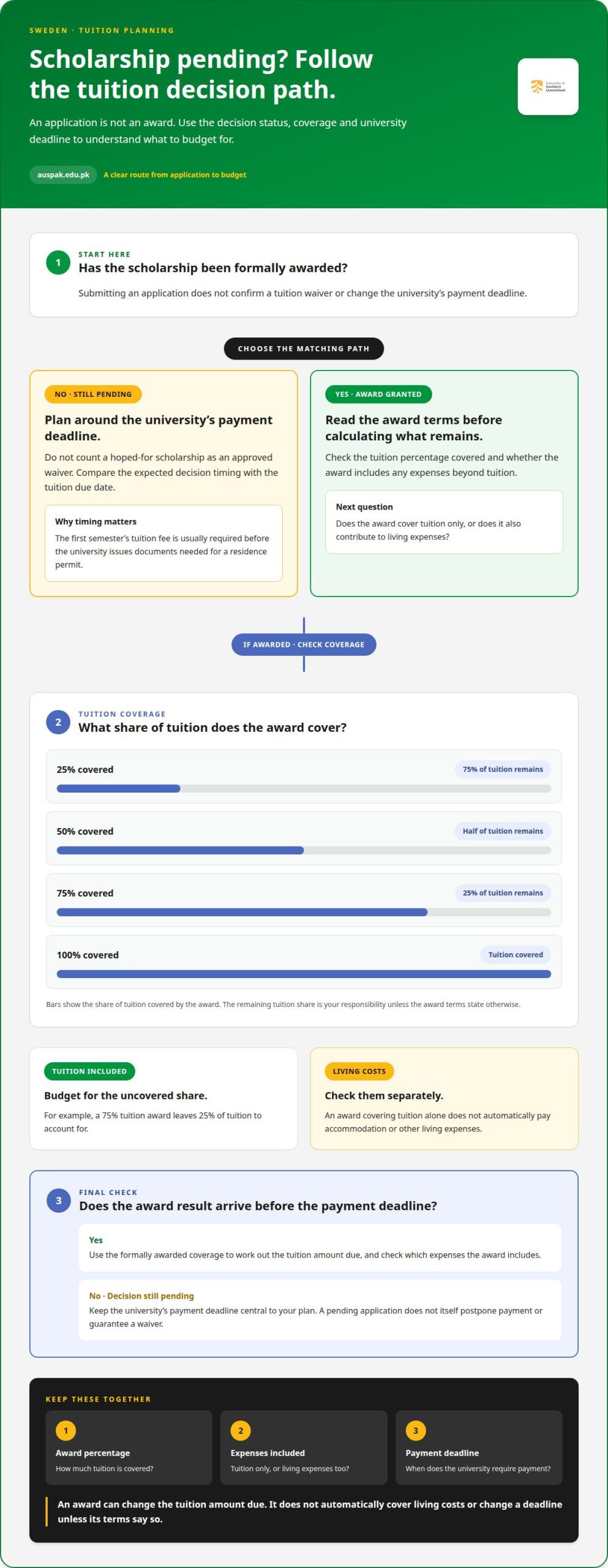
A scholarship or tuition waiver reduces or covers tuition, while some scholarships also contribute to living expenses. For international applicants, the award’s coverage determines how much of the programme cost remains their responsibility. Scholarships for studying in Sweden may cover 25%, 50%, 75%, or 100% of tuition fees. An award covering tuition alone does not automatically pay accommodation or other living costs.
Options include scholarships from Stockholm University and the Swedish Institute for tuition-fee-paying master’s students from outside the EU, EEA and Switzerland. These named opportunities are relevant to applicants planning a master’s degree, but their coverage can differ. Read an award decision for its percentage and what expenses it includes. For example, a 50% tuition scholarship reduces the tuition amount by half; it doesn’t mean living expenses are also covered.
Scholarship Applications and Tuition Payment
Submitting a scholarship application does not confirm a tuition waiver or change the university’s payment deadline. This matters because the first semester’s tuition fee is usually required before a Swedish university issues documents needed for a residence permit. A pending decision and an approved award therefore have different effects on your financial plan.
Use the university’s payment deadline as the key date while your scholarship application is under review. Compare the decision timeline with the due date, then check whether the award has been formally granted and what portion of tuition it covers. If the decision arrives before payment, its stated coverage can help determine the amount due. If it is still pending, don’t treat a hoped-for award as an approved waiver.
For example, an international student offered a 75% tuition scholarship still needs to account for the remaining 25% of tuition. If the award covers tuition only, living expenses remain a separate budget item. A 100% tuition award can cover the tuition charge, but it should not be read as covering living costs unless the scholarship terms say so.
When you receive the result, consider three details together: the award percentage, the expenses covered and your programme’s payment deadline. Stockholm University and the Swedish Institute are examples of scholarship providers relevant to eligible master’s students. Since first-semester payment is tied to residence-permit documentation, timing matters. Align the scholarship outcome with your tuition plan rather than assuming an application postpones payment or guarantees a waiver.
Average tuition fees in Sweden
For international students from outside the EU, EEA and Switzerland, average tuition is a starting point, not a fixed price for every course. The variation reflects different estimates, so use the figure for your chosen programme when planning.
These ranges show why a single average can’t predict an individual student’s bill. The university, course and study level all matter when assessing the actual fee.
These figures help applicants compare study levels, but they don’t replace the fee for a specific programme. For example, a bachelor’s applicant can use the bachelor’s range as an initial guide, then budget using the selected course’s annual fee.
Budget tuition separately from living costs. These figures cover different periods: one is monthly living expenditure, while the other combines annual tuition and living costs.
For a practical comparison, record each programme’s annual fee and study level, then calculate the full cost of study using its stated fee structure. A course lasting more than one academic year requires planning beyond the first tuition payment. A scholarship may reduce tuition, but its award terms determine how much it covers.
Studying in Sweden also means budgeting for costs beyond tuition. A student who plans only for the annual university fee may underestimate the funds needed for accommodation, food and other living expenses. Keep monthly living costs separate from tuition when comparing universities; combining different time periods can distort the comparison.
Use averages to narrow your shortlist, not to assume every university charges the same amount. For instance, a master’s course near the lower end of its general range requires a different tuition budget from one near the upper end. Compare the annual fee, programme duration and scholarship coverage before deciding whether the overall study plan is workable.
Swedish tuition fee regulations
Swedish tuition rules distinguish between first- and second-cycle higher education, doctoral studies, and students’ citizenship. Under Ordinance 2010:543, non-EEA and non-Swiss citizens are subject to tuition fees for first- or second-cycle education at Swedish higher education institutions. This covers bachelor’s and master’s studies. For Pakistani applicants, the key distinction is whether the intended programme falls within those study cycles and whether an exemption applies.
Sweden does not apply the same tuition rules to every international student. PhD courses are free for international students, regardless of their country of origin. Study cycle is therefore crucial: a non-EU applicant considering a master’s programme faces a different tuition rule from an international student pursuing doctoral studies. Check the course level before applying, because the degree cycle determines which rule applies.
Tuition regulations also leave room for universities to set programme fees. The amount can depend on the institution and subject, rather than following one nationwide flat rate. Stockholm University, for example, distinguishes between subject areas: Humanities, Social Sciences and Law have one listed annual fee, while Sciences have another. This subject-based approach means applicants should compare the exact programme, not rely only on a national average.
Tuition relates to the course or programme for which a student is admitted and pays. At Stockholm University, a bachelor’s or master’s programme normally covers 30 credits per semester. At the University of Gothenburg, programme tuition normally covers 60 credits per academic year, equivalent to 30 credits per semester. These credit rules help clarify the study workload covered by programme tuition.
How do Swedish tuition fees compare with those in other European countries? One figure cannot show whether Sweden is cheaper or more expensive overall: fees vary by subject, university and degree cycle. For a useful comparison, match the study level and subject, then consider how each country treats applicants with the same citizenship.
For anyone studying abroad, regulations and budgeting go hand in hand. First identify whether the intended course is a bachelor’s, master’s or PhD. Then establish whether the citizenship-based tuition rule applies and compare the fee for that specific programme. For example, a Pakistani applicant to a Swedish master’s programme should assess the stated programme fee, while a doctoral applicant falls under the separate PhD tuition rule.
Ordinance 2010:543 provides the framework for fee liability, while the university and programme determine the relevant tuition amount. Keep those roles distinct: the regulation indicates who is subject to fees, and the institution’s programme information explains the fee attached to a course of study. This is the clearest basis for understanding Swedish tuition rules before choosing a programme.
Tuition fees for non-EU students in Sweden
The tuition fees in Sweden for non-EU students depend on the programme and university, while payment also affects admissions and residence-permit planning. For Pakistani students, treat admission, tuition payment, refund terms and permission to travel as separate matters. Paying tuition is important, but it does not itself grant permission to reside in Sweden.
Are tuition fees refundable if a student visa is denied or a student withdraws? Neither visa refusal nor withdrawal automatically determines a refund; the university’s refund rules govern the application. At the University of Gothenburg, a refund application must be made within one year of the tuition payment date, and cases can take up to four months to complete.
The University of Gothenburg’s rules offer concrete timing, but they do not mean every visa refusal or withdrawal qualifies for a refund. Keep proof of payment and the university’s decision, and follow its refund process if your circumstances change. The payment date matters because the one-year application period starts then. For another university, its own refund procedure applies.
What residence permit rules apply to non-EU students who have paid tuition fees? Non-EU/EEA students must apply for a student residence permit before arriving in Sweden, and the Swedish Migration Agency handles applications. The first semester’s tuition fee is usually required before a Swedish university issues documents needed for a residence permit. Payment supports the admissions process but does not replace the permit application.
Treat these steps as connected but not interchangeable. First, secure admission to the programme. Then follow the university’s instructions for tuition payment and required documents. Separately, apply for a residence permit before travelling. A Pakistani student admitted to a Swedish master’s programme still needs to meet the permit requirement after paying tuition; payment alone does not authorise arrival or residence.
Costs can feel high when tuition is considered without the wider study budget. Keep tuition, living expenses and possible refund exposure separate in your planning. The university’s payment schedule and refund rules determine when funds are due and how a later change is handled. This matters especially if a residence-permit decision or personal circumstances disrupt the original study plan.
If Sweden is one of several study destinations under consideration, compare the admissions and payment process for each country before committing. For applicants also considering Australia, explore Australian university admission support as a separate study-abroad pathway.
AusPak International: UK Student Visa Consultancy
If comparing study destinations leads you to consider the UK instead of Sweden, AusPak International can support your next step. Its UK Student Visa Consultancy is relevant once you have chosen a UK study pathway and need help with the student visa process. If you’re still weighing options, decide on your destination and programme before moving to the visa application stage.
For a different direction, AusPak International also offers Australian University Admission Support and Canada Study Permit Assistance. Onshore Arrival Support helps students preparing for arrival. Each service addresses a different part of studying abroad, so choose the pathway that matches your destination and immediate need.
If you’re ready to discuss a UK study visa pathway, contact AusPak International.
Turn your study plan into a clear next step
Choosing a university is also a decision about how your education fits your longer-term goals. Use your funding plan to assess whether a programme is workable for its full duration, rather than focusing only on the first payment. For Pakistani applicants, tuition fees in Sweden for non-EU students are one part of a wider study-abroad decision that also involves choosing a destination, programme and application pathway.
Before moving forward, bring these choices together: identify the subject you want to study, consider how you’ll fund it and decide which destination best supports your plans. This gives you a practical basis for moving from research to action without treating one fee figure as the whole decision.
AusPak International can help you consider your next study step and the support that fits your plans. Discuss your study plans with AusPak International, and move forward with greater clarity and confidence.
Frequently Asked Questions
What does the tuition fee cover?
Tuition pays for the course or programme you’re admitted to, not your general living expenses. At Stockholm University, a programme fee normally covers 30 credits per semester, while an individual-course fee relates to that course’s credits. Use the credit load to understand the academic study covered by the charge. Accommodation, food and other personal costs need separate budgeting.
What does it cost to study a bachelor’s or master’s programme in Sweden?
The exact amount depends on the programme and university. For example, when comparing two master’s degrees, use each programme’s stated annual fee, then budget separately for living expenses and the full duration of study.
What are tuition fees in Sweden for non-EU/EEA students by degree level?
Annual tuition generally varies by programme rather than following one price for every degree. PhD courses are free for international students, regardless of their country of origin. Confirm the study cycle first: doctoral courses follow different fee rules from first- or second-cycle education.
What is the average tuition fee for bachelor’s and master’s programs in Sweden?
Treat averages as planning references, not as a quote for a particular course.
Which Swedish universities charge the lowest and highest tuition fees for international students?
Compare fees for specific programmes, since university-wide ranges can include courses with different costs.
Are there application fees for non-EU students applying to Swedish universities?
Yes. The application fee is 900 SEK per semester, separate from tuition. Applicants already registered for a course or programme at a Swedish university don’t pay an application fee when applying for future semesters. Some applicants may also qualify for exemptions based on citizenship or family status. Check which exemption applies to your circumstances before including the fee in your application budget.
What scholarships or tuition waivers are available for students from Pakistan?
Scholarships may cover 25%, 50%, 75% or 100% of tuition, and some awards also contribute to living expenses. Stockholm University and the Swedish Institute offer scholarships to eligible tuition-fee-paying master’s students from outside the EU, EEA and Switzerland. A Pakistani applicant should assess each scholarship’s eligibility conditions and coverage. Don’t assume a tuition award also pays living costs unless its terms include them.
What is the total cost of studying in Sweden, including living expenses and required financial proof?
These are planning figures, not a stated residence-permit proof threshold. Non-EU/EEA students must apply for a residence permit before arriving, and the Swedish Migration Agency handles applications.