
Applying independently can be a strong fit when you’re targeting just 1-2 universities and feel confident managing research, documents and deadlines. The study abroad consultant vs DIY application choice shifts when you’re considering competitive universities or need guidance across several parts of the process. The right approach depends on how much support you need, not on a single rule that suits every student.
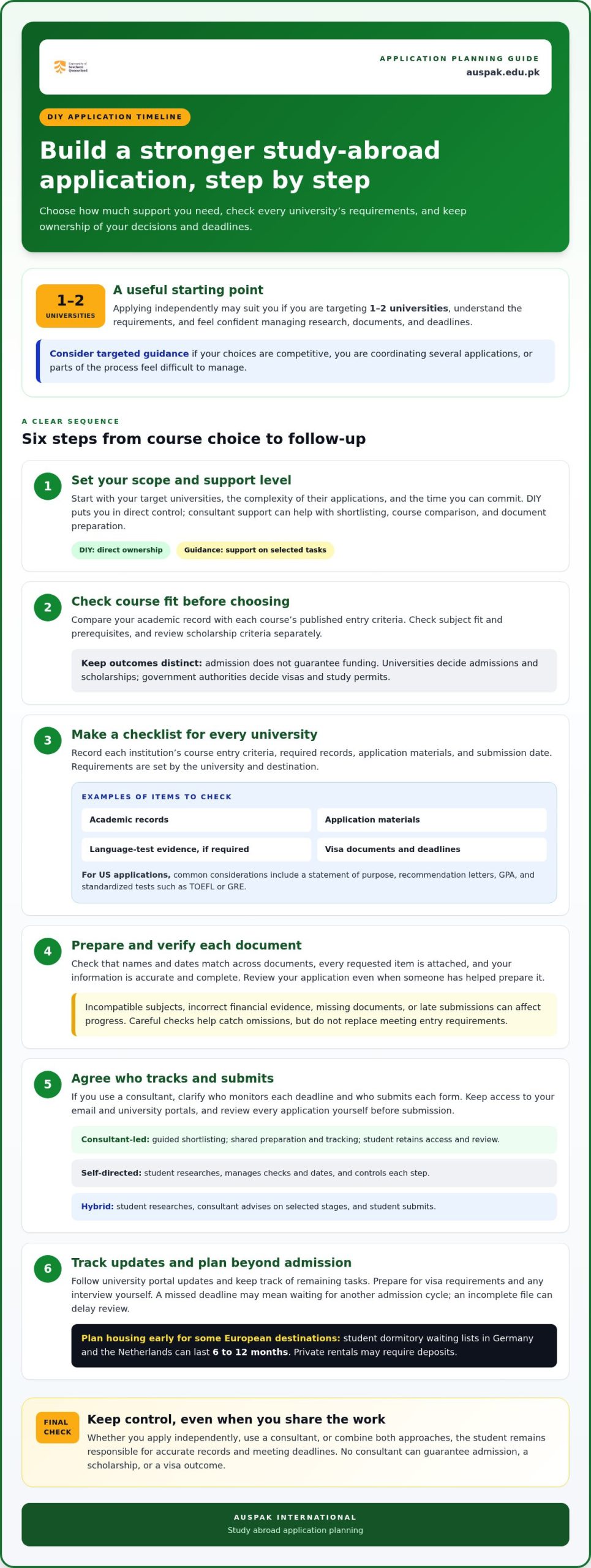
It’s understandable to want control over your application while avoiding preventable errors. Both routes can work: a DIY application gives you direct ownership of each step, while a consultant can guide tasks such as shortlisting, application preparation and visa documentation.
This guide helps Pakistani students decide when to apply independently, when professional guidance may be useful and how to combine both approaches. It compares the choices across the USA, UK, Canada and Australia so you can weigh practical differences and choose a route that fits your plans, time and experience.
Key Takeaways
- Applying independently may suit you if you’re targeting 1-2 universities and can manage research, documents and deadlines yourself.
- Consider professional guidance when your options are competitive or the application process feels difficult to coordinate; admission and visa decisions remain with the relevant authorities.
- Reduce the risk of avoidable delays by organizing requirements and deadlines for each destination, and keeping access to your email and university portals.
- You can combine independent university research with targeted support for shortlisting, application preparation or visa documentation.
- Compare the application pathways for the USA, UK, Canada and Australia before choosing how much support to use.
Study Abroad Consultant vs Self Application: Which Is Better?
The right route depends on your target universities, the complexity of your applications and the time you can commit to each step. For Pakistani students, the decision may differ by destination because admission and visa processes vary.
Can a study abroad consultant improve your chances of admission or a visa? A consultant can help you prepare, but cannot guarantee either outcome. Universities decide admissions and scholarships; government authorities decide visas and study permits.
Consultant-Led Applications
A consultant-supported application adds guidance on steps such as university selection, course comparison and document preparation. This may help if you’re targeting competitive universities or coordinating several applications, but the consultant does not control admission decisions. Before submitting, review each application yourself, confirm your chosen course and keep access to your email and university portals.
The key difference is shared oversight: a consultant may help spot omissions, but you remain responsible for providing accurate records and meeting deadlines. Errors can delay an application or affect its outcome, so agree on who tracks each deadline and who submits each form.
Self-Directed Applications
With a self-directed application, you research universities, prepare documents and submit through each institution’s process. This can suit a student applying to 1-2 universities with clear requirements and enough time to manage each task. You retain direct control, but must notice missing documents, follow portal updates and track deadlines without a second reviewer.
Build a checklist for every university: course entry criteria, required records, application materials and submission date. A missed deadline may mean waiting for another admission cycle, while an incomplete file can delay review. Your own planning and careful document checks become the main safeguards.
The competitiveness of your course also matters. Applicants to highly selective courses may need to compare academic fit, prerequisites and scholarship criteria across universities. A consultant can help with shortlisting and application preparation, but no adviser can promise admission or a scholarship. Choose based on course requirements, not just a country’s appeal.
European admissions can involve country-specific steps. In Germany, universities may assess whether your subjects and credits match the intended course. Finland has multiple application rounds and processes. Across Europe, accepted financial-proof formats and visa processes vary, so identify the requirements for your destination before setting a submission plan.
Application mistakes go beyond missing forms. Incompatible subjects, incorrect financial evidence or late submissions can affect your progress. For each university, compare your academic record with the course requirements, then check that every requested document is accurate and complete. Treat scholarships separately: admission does not guarantee funding.
| Option | University selection | Error and deadline management | Decision control |
|---|---|---|---|
| Consultant-led | Guided shortlisting | Shared preparation and tracking | Student retains access and review |
| Self-directed | Student researches independently | Student manages checks and dates | Student controls each step |
| Hybrid | Student researches, consultant advises | Support focused on selected stages | Shared input, student submits |
Choose between a study abroad consultant vs DIY application by matching your experience and available time to the complexity of your target universities and countries.
When independent applications may suit students
Applying independently may suit Pakistani students who can research requirements, organize documents and manage deadlines themselves. Consider whether you can confidently handle each task, from comparing courses to preparing for a visa interview.
What documents and tests do Pakistani students need to apply abroad? Prepare academic records, application materials, any required language-test evidence and visa documents. Universities and destinations set the exact requirements. For US applications, common considerations include a statement of purpose, recommendation letters, GPA and standardized tests such as TOEFL or GRE.
Students applying independently are responsible for researching programs, scholarships and visa processes. They also prepare their application materials and attend visa interviews themselves. This route may suit applicants who understand their course choices, can follow university instructions and have time to track deadlines. Strong organization helps, but it cannot replace meeting a university’s entry requirements.
Review every application before submitting. Compare your chosen course with its published requirements, check that names and dates match across documents, and confirm that each requested item is attached. Keep a checklist for every university, including its deadline and any outstanding tasks. This final review can catch omissions, but you remain responsible for the accuracy of all information.
Planning must extend beyond admission. Student dormitory waiting lists in some European countries, including Germany and the Netherlands, can last 6 to 12 months. Research housing options early and understand the practical steps involved in securing accommodation. Private rentals may require deposits and local documentation, while online listings can carry fraud risks. Treat housing research as a parallel task, not something to begin after receiving an offer.
Visa preparation is another distinct stage. US student visa applicants apply for an F-1 student visa, so organize the visa process separately from university admission. For Canada, study permit preparation calls for careful attention to the relevant stream’s documentation and financial requirements. Across destinations, assemble evidence according to the applicable instructions, keep copies of submissions and prepare clear, consistent answers for any interview. The university application and visa application are related, but they are not the same task.
Independent research can help you identify where support would add value without handing over every decision. If Canada is your destination and permit preparation is the difficult step, explore Canada study permit assistance as a focused support option.
Choosing between consultant support and DIY
Choose your route by matching your academic profile, timeline and available support to each destination’s process. A competitive course, several applications or complex documents may call for more guidance; a clear plan may be manageable independently.
What does a study abroad consultant do compared with applying independently? A consultant may provide education counseling, help with country selection, university shortlisting, course comparison, applications and visa preparation. When applying independently, you research and complete each step yourself, while retaining direct control over decisions and submissions.
Which universities or countries offer free applications or direct application support? Most universities accept applications through their official websites, and UK applicants can often apply directly or through UCAS for undergraduate courses where applicable. Direct access does not mean an application is free; check the fee details on the university’s application page.
Use these decision points before choosing:
- Academic fit: Compare your subjects, grades and experience with the course’s published entry criteria.
- Timeline: List each university deadline, document task and visa stage, then assess whether you can manage them.
- Competitive options: For selective universities, structured shortlisting can help you compare course fit and entry requirements.
- Career direction: If your course choice is unclear, career counselling may help connect study options with your longer-term goals.
- Control: Keep access to your email and university portals, and review every document before submission.
For UK applicants, separate the university application from the visa process. The usual sequence moves from an offer to a Confirmation of Acceptance for Studies (CAS), then a visa application. UK Student Route applications rely on a CAS and accurate financial evidence. A student visa adviser can help you understand documentation and preparation, but the applicant remains responsible for truthful information and final review.
Support can also connect you with other students and provide networking opportunities during your study journey. This may be useful when adjusting to an unfamiliar destination or learning from peers preparing for a similar transition. It complements academic planning, but does not replace your own research into universities, courses or career outcomes.
Consider a hybrid approach if you want independence without managing every task alone. Research universities and courses yourself, then seek focused guidance on shortlisting, application materials or visa preparation. You retain control of your decisions and portal access while directing support to the parts of your timeline that need more attention.
Combining independent research with professional guidance
Pakistani students can assess an agency by reviewing its status, references and conduct commitments. ICEF’s agency-status process includes vetting, references and a commitment to its code of conduct.
Consultant Expertise and Guidance
An education consultant can help organize your international application without taking every decision away from you. Start by researching courses and countries, then use guidance to review your shortlist, application materials or visa preparation. This keeps your goals central while adding another perspective on requirements, especially when unfamiliar visa rules or several destinations complicate your plans.
Keep responsibilities clear. You provide accurate academic records and approve documents before submission; guidance can help identify gaps and coordinate tasks. For example, compare a course’s entry criteria with your transcript before preparing supporting materials. Consultants may also offer opportunities to connect with other students and hear their perspectives.
Verifying Consultant Credentials
Credential checks focus on an adviser’s conduct and claims, rather than the application process itself. Review documented agency status, references and written service terms. ICEF’s process is one example of agency vetting, including references and a commitment to a code of conduct. Treat promises of guaranteed admission, scholarships or visas as warning signs.
Ask how recommendations are made and whether a university relationship could influence them. Education consultants may receive university commissions, so understand whether that relationship affects the options they suggest. Keep access to your email and portals, retain copies of submitted documents, and approve every statement made in your name.
A practical hybrid plan starts with your own research, then adds guidance at specific checkpoints. This lets you retain control of your application while creating opportunities to catch mistakes before submission. Use a shared task list, but make your own decisions about course fit and final documents.
- Define your goal: Record your intended subject, career direction and preferred countries.
- Research options: Compare university course pages, academic entry criteria and scholarship information.
- Choose support areas: Identify specific tasks, such as shortlisting, application review or visa preparation.
- Review documents: Check names, dates and academic details against your original records before submission.
- Retain control: Keep access to university portals and email, and save copies of correspondence.
For visa preparation, treat each destination’s requirements separately rather than assuming international applications follow the same process. A UK application, for example, involves a CAS and accurate financial evidence. Use professional guidance to clarify the process, while checking that each document reflects your circumstances and that you understand every submission. This approach combines your oversight with focused help where the process feels unfamiliar.
DIY applications in the USA, UK, Canada, and Australia
Applying independently to universities in the USA, UK, Canada and Australia means following distinct admission and visa processes. Start by matching your academic profile to course requirements, then shortlist institutions and record each application stage.
What are the steps to apply to universities abroad without a consultant? Research courses and entry criteria, prepare each institution’s requested documents, submit through its application route, and track decisions and deadlines. Then prepare the relevant visa application using the destination’s instructions.
In the USA, universities commonly consider your statement of purpose, recommendation letters and GPA. Some programs also consider standardized tests such as TOEFL or GRE. Check each university’s requirements before applying, as materials vary by institution and course. Keep a separate record of your application status and any follow-up requests.
For UK undergraduate courses, students can often apply directly to universities or through UCAS where applicable. After an offer, the process moves to a Confirmation of Acceptance for Studies (CAS), followed by a visa application. According to the UK Home Office, Student Route applications rely on a CAS and accurate financial evidence. Keep your offer details and financial documents organized together.
Canada has distinct study permit streams, including the Student Direct Stream (SDS) and the regular stream, with different financial and documentation requirements. Identify the stream relevant to your application and prepare materials against its criteria. Don’t assume that a document list used for another destination will satisfy Canadian requirements.
For Australia, separate university admission tasks from student visa preparation. Use the Department of Home Affairs’ Student visa information to understand the visa process, and organize university records and visa documents separately. A clear file structure helps distinguish admission correspondence from visa evidence as your application progresses.
Use this destination-by-destination sequence to keep your overseas applications manageable:
- Shortlist: Select courses that match your academic background and goals.
- Compare: Record each university’s entry criteria, application route and required documents.
- Prepare: Gather records and supporting materials, checking names and details for consistency.
- Submit: Use the institution’s designated application channel and save confirmation messages.
- Track: Monitor university correspondence, outstanding tasks and visa preparation separately.
Applying directly gives you control over each submission, but destination-specific details matter. In the UK, the CAS links the university offer to the visa stage; in Canada, stream requirements shape document preparation. Build your checklist around each destination, not a single generic application template.
If Australia is your preferred destination and you want support with university applications, explore Australian university admission support as part of your application plan.
AusPak International: Australian University Admission Support
AusPak International supports Pakistani students with Australian university applications and guidance for other application stages. Its Australian University Admission Support can help when you’re comparing courses and preparing admission applications. If your next challenge is the visa process, UK Student Visa Consultancy and Canada Study Permit Assistance address those destination-specific needs.
Support can continue after arrival through Onshore Arrival Support. Choose assistance that fits your plans while keeping your own goals and application decisions in view. Contact AusPak International to discuss the support that suits your study plans.
Take the Next Step With Confidence
Your study abroad consultant vs DIY application decision becomes clearer when you identify the next task that needs attention. Start with a practical plan: choose your destination, outline what you can manage independently and note where specialist guidance could help. You don’t have to hand over every decision to get useful support.
For Pakistani students planning to study abroad, AusPak International can connect your next step with relevant application or visa support. Choose the assistance that matches your plans, while keeping your academic goals and final decisions in view.
Contact AusPak International to discuss your study plans and the support that fits. Take the next step with purpose, and keep your international education goal moving forward.
Frequently Asked Questions
So, Which Path Should You Choose?
Choose the approach that matches the work you can confidently manage. If you can explain your course choice, organize evidence and track updates from each institution, independent applications may suit you. If you’re unsure how your academic background fits your target course, seek guidance for that stage. Before deciding, list the tasks you can complete alone and where an experienced adviser could add clarity.
Final Verdict: Which Path Is Right for You?
The right choice keeps you informed and responsible for your application. For example, research programs independently, then get help reviewing your shortlist or preparing visa documents. Keep control of your email, portal accounts and final submissions. This helps you decide where support is useful while staying actively involved in the details that affect your plans.
Study Abroad: DIY for USA, UK, Canada & Australia vs Europe: What Really Works?
Use destination requirements, not a single global checklist, to guide your approach. US applicants pursue an F-1 student visa; UK Student Route applications rely on a CAS and accurate financial evidence, according to the UK Home Office. Canada has different study permit streams. In Europe, processes also vary: Finland has multiple application rounds, while German universities may assess subject and credit relevance. Compare the specific steps for each destination.
When Should You Consider a Consultant?
Consider focused guidance when a part of the process is difficult to assess, such as choosing between courses with different academic prerequisites or organizing visa documentation. You may also value support when scholarship options affect your university shortlist. Ask how recommendations are shaped, since consultants may receive university commissions. Keep your records and make sure you understand the application decisions made in your name.
Who Should Consider the DIY Path?
DIY may suit students with a clear course goal who can interpret university instructions and manage their own correspondence. For example, a student applying to a short list of universities can create a task tracker for requirements, submission confirmations and follow-up messages. This route also suits applicants who want direct control over every statement and document. Set aside time to review each form carefully before submitting.
What are the advantages and disadvantages of using a consultant versus DIY applications?
Consultant support can provide structured guidance, application assistance and connections with other students, but it doesn’t replace your judgment or guarantee an outcome. DIY gives you direct control and firsthand understanding of each process, while requiring you to manage research, paperwork and deadlines yourself. Whichever route you choose, retain access to your accounts and write your own statement of purpose. Relying on someone else to write it entirely may risk rejection.