Malaysia offers Pakistani students an English-medium study option, with a clear route from admission to a Student Pass. The benefits of studying in Malaysia from Pakistan include access to degree programmes taught in English and the opportunity to study in a multicultural setting. Your course choice, academic record, and ability to meet entry requirements matter just as much as the destination.
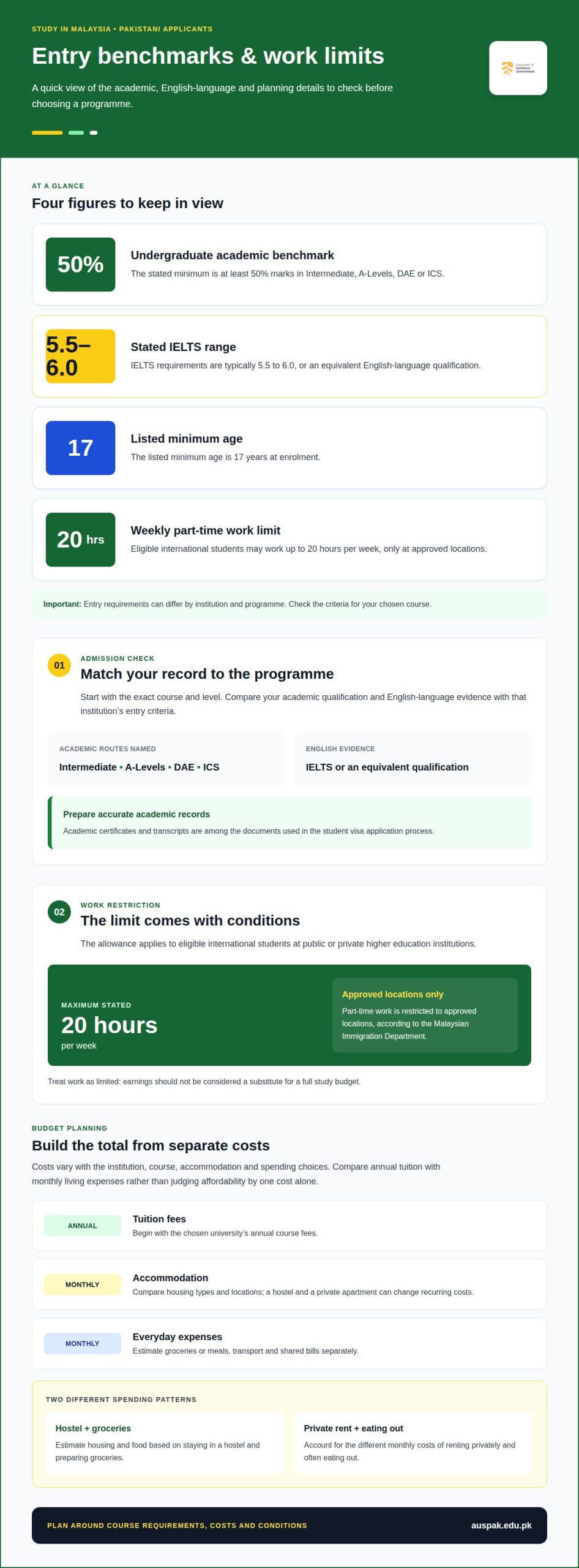
It’s reasonable to want a straightforward picture of what comes next. Undergraduate applicants commonly need Intermediate, A-Levels, DAE or ICS with at least 50% marks, while stated IELTS requirements are typically 5.5 to 6.0 or an equivalent qualification. Requirements can differ by institution and programme, so understanding the sequence early can help you prepare a stronger application.
This guide explains the practical advantages for students from Pakistan, the admission and English-language requirements to expect, and the key restriction on part-time work: eligible international students at public or private higher education institutions may work up to 20 hours per week only at approved locations, according to the Malaysian Immigration Department. You’ll also learn what to consider before choosing a course and planning your study journey.
Key Takeaways
- Build a realistic study budget by comparing tuition and everyday expenses across Malaysian institutions and accommodation options.
- Understand why Malaysia appeals to Pakistani students, including its English-medium study environment and multicultural setting.
- Prepare for admission by identifying the academic and English-language criteria that apply to your chosen programme.
- Learn the limits on international students’ part-time work and why earnings shouldn’t be treated as a substitute for a full study budget.
- See how Malaysian institutions’ international links and recognition can inform your choice of qualification and future study plans.
Why study in Malaysia from Pakistan?
Malaysia gives Pakistani students another option for pursuing internationally oriented courses and experiencing a different culture. Tuition and monthly living expenses vary by institution, accommodation, and spending choices, so compare these costs before choosing a programme.
Tuition Fees and Living Costs
Plan tuition fees and living costs together. Separating annual course fees from monthly expenses gives Pakistani students a clearer budget. Actual totals depend on the course, university, and housing arrangement.
Accommodation choices can significantly affect monthly expenses. Compare housing types and locations when estimating living costs, since both shape recurring expenses.
Everyday spending adds to rent. Consider food choices when estimating recurring costs, rather than assuming every meal costs the same.
For example, a student staying in a hostel and preparing groceries will have different monthly costs from someone renting privately and often eating out. Add housing, food, transport, and shared bills separately, then compare the total with available funding.
Study Destination Comparisons
Compare destinations by weighing study costs and daily life against your priorities. Studying in Malaysia instead of staying in Pakistan means planning for tuition, accommodation, and other expenses abroad. One advantage is access to Malaysian universities and courses in a different cultural setting. One challenge is managing housing and daily costs away from home. Consider these differences when deciding whether the experience fits your budget and goals.
That flexibility does not remove the need to fund tuition and living costs. Compare annual tuition with monthly estimates for accommodation, groceries, and transport, rather than judging affordability by one expense alone.
Use these as planning categories, not as a single budget figure. Start with the chosen university’s annual tuition, then add estimated monthly costs for housing, groceries, transport, and shared utilities. A hostel and a private apartment have different accommodation costs, so location and housing choice can substantially change your calculation.
Why study in Malaysia from Pakistan?
Malaysia gives Pakistani students another option for pursuing internationally oriented courses and experiencing a different culture. Tuition and monthly living expenses vary by institution, accommodation, and spending choices, so compare these costs before choosing a programme.
Tuition Fees and Living Costs
Plan tuition fees and living costs together. Separating annual course fees from monthly expenses gives Pakistani students a clearer budget. Actual totals depend on the course, university, and housing arrangement.
Accommodation choices can significantly affect monthly expenses. Compare housing types and locations when estimating living costs, since both shape recurring expenses.
Everyday spending adds to rent. Consider food choices when estimating recurring costs, rather than assuming every meal costs the same.
For example, a student staying in a hostel and preparing groceries will have different monthly costs from someone renting privately and often eating out. Add housing, food, transport, and shared bills separately, then compare the total with available funding.
Study Destination Comparisons
Compare destinations by weighing study costs and daily life against your priorities. Studying in Malaysia instead of staying in Pakistan means planning for tuition, accommodation, and other expenses abroad. For applicants comparing options, the benefits of studying in Malaysia from Pakistan include access to Malaysian universities and courses in a different cultural setting. A challenge is managing housing and daily costs away from home.
The benefits of studying in Malaysia from Pakistan also depend on whether the destination fits your budget and goals. Flexibility does not remove the need to fund tuition and living costs. Compare annual tuition with monthly expenses rather than judging affordability by one cost alone.
Use these as planning categories, not as a single budget figure. Start with the chosen university’s annual tuition, then add estimated monthly costs for housing, groceries, transport, and shared utilities. A hostel and a private apartment have different accommodation costs, so location and housing choice can substantially change your calculation.
Admission requirements and English proficiency
For Pakistani applicants, admission to a Malaysian university depends on academic qualifications and the chosen programme’s entry criteria. English proficiency is another key requirement, especially for courses taught and assessed in English.
Academic Entry Requirements
For undergraduate admission, the stated minimum is Intermediate, A-Levels, DAE or ICS with at least 50% marks. The listed minimum age is 17 years at enrolment. These benchmarks provide a starting point, but the programme and institution determine which qualifications match a particular course.
Before applying, identify the exact course and level, then compare your education record with its entry criteria. A student with ICS may have different degree options from someone with A-Levels or a DAE. Academic certificates and transcripts are also part of the student visa application documents, so accurate, complete records support both admission and the subsequent process.
Choose a course before planning tuition. Foundation programmes, undergraduate degrees, and postgraduate courses can have different academic requirements and English expectations. For example, applicants considering a foundation programme should distinguish its entry criteria from those for direct undergraduate admission. The offer letter identifies the course and institution linked to the application.
English Proficiency and Medium of Instruction
With English-medium instruction, lectures, course materials, and assessments use English. This shapes daily study, from understanding a lecturer’s explanations to contributing to group work. English is also useful for practical interactions, such as communicating with university offices or asking for directions on local transport.
The stated IELTS requirement for Malaysian undergraduate admission is 5.5 to 6.0, or an equivalent qualification. Foundation programmes typically require IELTS 6.0 or an equivalent English proficiency test. These figures are useful planning benchmarks, while the selected programme’s stated requirement is the relevant one for an applicant.
Universities may accept TOEFL, IELTS, or a similar English proficiency test for entry to bachelor’s, master’s, or doctoral programmes. The Malaysian University English Test, or MUET, may also meet university English requirements. Check which assessment applies to your course before booking a test, since an equivalent score must satisfy the institution’s criteria.
English preparation is not only about meeting an admission threshold. Students need to follow course instructions, write assignments, and discuss ideas clearly. Malaysian universities offer English-language courses for students seeking to improve spoken English. For Pakistani applicants, planning academic documents and the required language assessment together creates a more coherent application for admission and a student visa.
Part-time work opportunities and restrictions
Part-time work can give international students experience and some income while studying abroad. In Malaysia, permission depends on Student Pass conditions, work location, and the timing of academic commitments. Treat employment as a limited opportunity, not the foundation of a study budget or a replacement for scholarships and other funding.
According to the Malaysian Immigration Department, Student Pass holders at public or private higher education institutions may work part-time for up to 20 hours per week, but only at approved locations. The location restriction matters as much as the hourly limit. A job in an unapproved setting does not fit this rule, even if its duties seem suitable for a student.
Malaysia’s stated rules also restrict work during active study weeks unless special permission is granted. Distinguish teaching periods from eligible breaks before accepting shifts. For example, a student offered restaurant work during an active semester should not assume the same permission applies during a holiday. Academic commitments remain central to the Student Pass purpose.
Permitted sectors listed for international students include restaurants and cafes, hotels and hospitality, retail shops and malls, petrol stations, and mini markets. These examples clarify the types of workplaces involved, but do not remove the approved-location condition. A role’s sector alone does not establish permission; the work setting and applicable approval matter too.
Part-time roles may help students practise communication, teamwork, customer service, and workplace routines. A hospitality role, for instance, may involve serving customers and coordinating with colleagues. These experiences can complement academic study, but duties and schedules should leave room for classes, assignments, and examinations. Employment should support the student experience, not disrupt progress toward a qualification.
Do not rely on part-time earnings to cover all study and living costs. Earnings depend on available shifts, the permitted work period, and the role. Budget for tuition and essential expenses independently, and treat any employment income as supplementary. This approach reduces pressure to accept excessive hours or work outside permitted conditions.
Post-study employment options may depend on individual circumstances and available pathways. Career prospects therefore depend on qualifications, relevant experience, and available employment pathways, not an assumed graduate work entitlement. Students can use course projects and any permitted work experience to build skills while planning their next step before their studies conclude.
Keep the distinction clear: part-time work during study is restricted, while post-study employment is a separate matter. Before accepting a role, understand whether the location is approved and whether the timing meets applicable conditions. This practical planning helps Pakistani students protect their academic progress while making realistic use of work opportunities in Malaysia.
Why Choose Malaysia for Higher Education?
Malaysia offers international study options across universities and colleges, including institutions featured in global rankings. For Pakistani applicants, recognition, course structure, and practical learning all matter when choosing a degree.
Recognition of Malaysian Qualifications
International recognition means a qualification can be assessed by employers or institutions outside its country of award. It matters if you plan to pursue further education or work internationally after graduation. Student Pass holders at public or private higher education institutions may work part-time for up to 20 hours per week, but only at approved locations. These listings provide context about institutions, but don’t by themselves establish how every qualification will be assessed.
Education Standards
Education standards describe how institutions structure teaching, assessment, and academic programmes. Comparing these features helps applicants judge whether a course fits their goals. Malaysia has over 500 universities and colleges, offering a broad institutional landscape. Review the course curriculum, assessment methods, and academic support alongside the institution’s profile when deciding where to apply.
Rankings can add another comparison point. Monash University Malaysia is listed at =36, the University of Southampton Malaysia at 87, and the University of Nottingham Malaysia at 97 in the QS Global World University Rankings provided for this topic. These examples show why applicants should assess the institution and chosen course separately, rather than relying on a country-level impression.
For Pakistani students, the practical question is how a degree will support their next step. Further study applications may assess the qualification, subject, and academic record. Employers may consider course content and skills relevant to a role. Recognition is not a guarantee attached to every Malaysian degree; it depends on the receiving institution’s or employer’s criteria.
Internships and industry placements can connect academic learning with workplace experience, but their structure varies by course. A placement may be built into a programme, offered as an elective, or absent from the curriculum. Before choosing a course, review its published structure for practical projects, placement components, and industry links. These details help distinguish classroom-focused study from programmes that include applied learning.
Quality education also means looking beyond a university’s name. Compare learning outcomes, teaching language, assessment format, and how well the course fits your intended career. For example, a business student may prioritise applied projects, while a science applicant may focus on laboratory learning. Start by comparing degrees, then consider each institution’s wider standing.
If you’re comparing Malaysia with Australia as a study destination, explore Australian University Admission Support as a separate pathway.
AusPak International: Canada Study Permit Assistance
AusPak International supports students considering a different destination through Canada Study Permit Assistance. If Malaysia isn’t the right fit for your academic plans, this support can help you work through the Canadian study permit process. AusPak International also provides Australian University Admission Support and UK Student Visa Consultancy, offering options for students weighing those pathways.
Choose the destination and course that match your goals, then seek guidance for that route. AusPak International also provides Onshore Arrival Support for students preparing to settle into a new study environment. These services address different destinations and stages, so focus on the one that matches your next decision.
Discuss your study plans and contact AusPak International to explore the relevant support.
Turn Your Study Plans Into a Clear Next Step
The benefits of studying in Malaysia from Pakistan matter most when the course fits your academic direction and future plans. Make your next move deliberately: identify the qualification you want, the destination that supports your goals, and the application pathway that follows. If another destination better matches your plans, choose guidance for that route.
AusPak International offers Australian University Admission Support, UK Student Visa Consultancy, and Canada Study Permit Assistance. These services provide relevant guidance for students pursuing those destinations. Choose the pathway that aligns with your plans, then prepare for the next stage.
Contact AusPak International today to discuss your study plans. Your international education journey can start with one clear decision.
Frequently Asked Questions
What are the main benefits of studying in Malaysia for Pakistani students?
Malaysia gives Pakistani students access to English-taught higher education in a culturally diverse setting. More than 160 higher education institutions apply learning in English, giving applicants a range of possible academic environments. The value depends on how well a specific course fits your goals. For example, compare the programme’s subjects and practical learning opportunities with the skills you want to develop after graduation.
What are the admission requirements and application steps for Pakistani students?
Start by selecting a programme and submitting an application to its Malaysian institution. Undergraduate applicants commonly need Intermediate, A-Levels, DAE or ICS with at least 50% marks; requirements can differ by course. Once admitted, use the institution’s offer letter as the basis for the Student Pass process. Keep academic records and financial documents organised, since these support the application stages that follow.
How do Pakistani students apply for a Malaysian student visa, and what are the fees and processing times?
After receiving an offer from a recognized Malaysian institution, the student-pass application is submitted through the university to EMGS and Immigration. Typical processing takes around 4 to 6 weeks. Visa-related charges include processing components, so distinguish these from tuition and living expenses when planning funds. Allow time for document preparation before the intended course start, rather than arranging travel around an unsubmitted application.
Can international students work part-time in Malaysia, and what are the current rules?
Yes, but work is restricted by location and permitted conditions. According to the Malaysian Immigration Department, Student Pass holders at public or private higher education institutions may work part-time for up to 20 hours per week, but only at approved locations. Listed sectors include restaurants and cafes, hotels and hospitality, retail shops and malls, petrol stations, and mini markets. Do not treat part-time earnings as guaranteed income.
How are Malaysian universities and degrees recognized in Pakistan and internationally?
Recognition depends on the qualification and the institution or employer assessing it for a particular purpose. Student Pass holders at public or private higher education institutions may work part-time for up to 20 hours per week, but only at approved locations. Before committing, identify how the degree supports your next step, such as applying for further study or presenting your qualification to an employer.
What English-language requirements do Malaysian universities have for Pakistani applicants?
English requirements depend on the programme and institution. The stated IELTS range for undergraduate admission is 5.5 to 6.0, or an equivalent qualification; foundation programmes typically require IELTS 6.0 or an equivalent test. Some universities accept TOEFL or similar assessments, and MUET may also meet English requirements. Match your test choice to the course’s stated criteria before arranging an exam.
How safe and culturally welcoming is Malaysia for Pakistani students, including halal food and prayer facilities?
Malaysia may feel culturally familiar to some Pakistani students: Muslims make up over 60% of its population. That context can be relevant when considering daily routines, food, and religious practice. Halal food options and prayer facilities vary by campus and location, so consider them alongside accommodation and transport when comparing institutions. Malaysia’s national culture alone cannot describe every student’s experience or campus environment.