
An F-1 visa refusal can reflect gaps across an application, not just one imperfect interview answer. For students in Pakistan, funding evidence, academic history, study plans, and interview responses should tell a clear, consistent story. Understanding the common F1 visa rejection reasons can help you review that story before your interview.
It’s natural to feel unsure about what a consular officer will focus on, especially if you’re not certain whether your financial documents support your plans or why you chose a particular programme. This guide explains common concerns, including nonimmigrant intent, financial support, and inconsistencies between application details and interview answers. It does not rely on rumours or promise an outcome.
You’ll learn how to compare documents and explanations, prepare to discuss your school and study plans in your own words, and distinguish a visa refusal from further administrative processing. If you receive a refusal, read the stated reason and address relevant gaps before deciding whether to reapply. Careful document and application preparation can help you present your circumstances clearly.
Key Takeaways
- The common F1 visa rejection reasons often involve unclear funding, study purpose, or inconsistencies across application materials. Review how the parts of your case fit together.
- A university admission decision and a visa decision are separate. Be ready to explain why your chosen programme and institution suit your plans.
- Prepare truthful, direct interview answers that align with your DS-160 and supporting records instead of relying on memorised scripts.
- After a refusal, read the notice, identify the stated concerns, and compare them with your documents before deciding whether to reapply.
- Use a final checklist for admission records, Form I-20, funding evidence, application consistency, and interview readiness. Check current official instructions too.
Common F1 Visa Rejection Reasons: What a Refusal Actually Means
An F-1 visa refusal means a consular officer has decided not to issue a visa based on the information available at that time. A university’s admission decision is separate: acceptance and a Form I-20 don’t guarantee visa issuance, and a visa decision doesn’t determine whether a school has admitted you. The common F1 visa rejection reasons relate to the visa application and eligibility, not simply to whether you have been accepted.
In brief: a refusal means the visa has not been issued. Further administrative processing means the application needs additional review or information before a decision can be completed. The U.S. Department of State distinguishes refusal grounds under sections 214(b) and 221(g) of the Immigration and Nationality Act. Its visa denial guidance explains these terms. The next steps depend on the notice you receive.
How does a 214(b) refusal relate to F-1 applications?
Section 214(b) applies to nonimmigrant visa applicants. In plain language, you must satisfy the consular officer that you qualify for the visa you seek and meet its requirements. For an F-1 applicant, the officer considers the circumstances presented, including the stated purpose of studying temporarily in the United States. This is an individual assessment, not a prediction based on one detail or a formula that guarantees a result.
A credible study plan should make sense alongside your academic background, chosen programme, funding, and stated plans. The F-1 student visa is part of the F visa category for academic study, but a general overview cannot replace current instructions or an individual decision. Admission to a school is relevant evidence, not a substitute for meeting visa requirements.
Is administrative processing the same as a visa rejection?
A 221(g) notice is also recorded as a refusal under U.S. visa terminology. It may mean the officer needs additional documents or that the case requires administrative processing. By itself, it does not indicate the eventual outcome. Read the notice carefully for any requested information or action. Follow its instructions and any deadline, and rely on the notice rather than assuming a standard timeline.
Identify the exact section cited and respond accordingly. A 214(b) refusal and a 221(g) notice call for different kinds of review. Check the latest Department of State guidance and the instructions relevant to your application before taking action.
The Most Common F1 Visa Rejection Reasons: Funding, Study Purpose, and Consistency
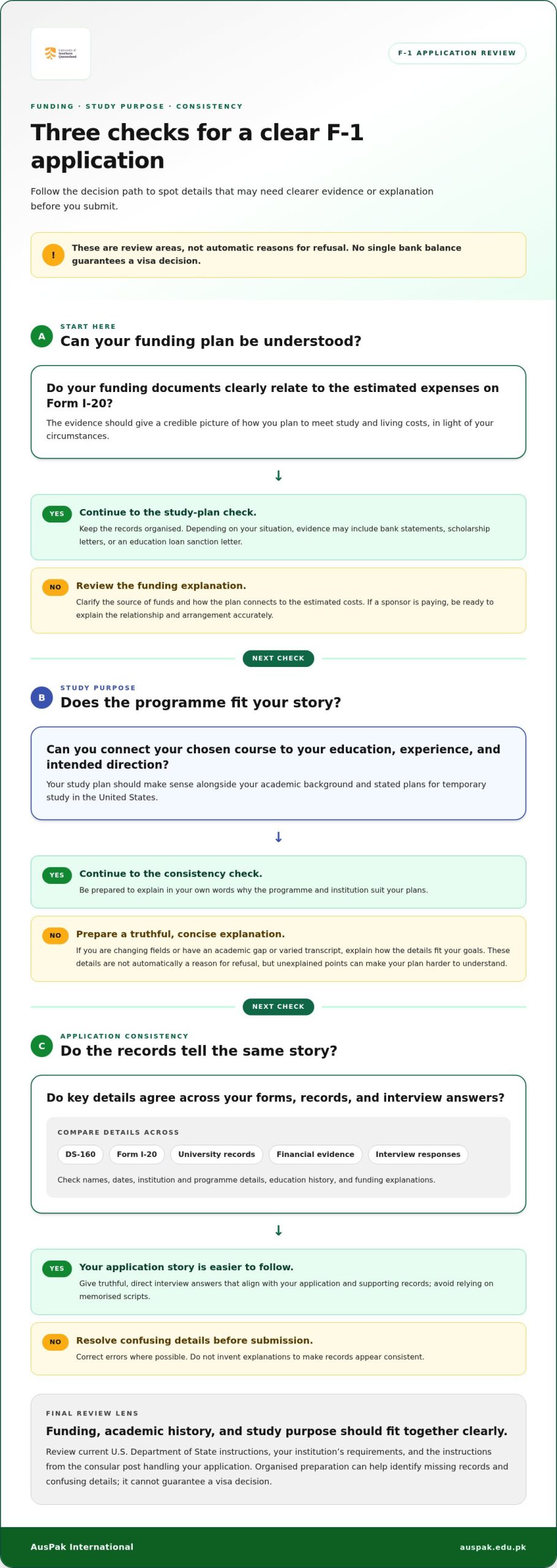
Once you understand what a refusal means, focus on the evidence behind your application. Common F1 visa rejection reasons often involve questions about whether you can fund your planned study, whether the programme fits your background and goals, and whether details match across forms, records, and interview answers. These are areas to review, not automatic reasons for refusal.
Why can financial evidence raise concerns?
Your funding documents should give a clear, credible picture of how you plan to meet the costs of study and living. Form I-20 states the institution’s estimated expenses. Be prepared to show credible evidence of funds that relates to those costs and your circumstances. Depending on your situation, supporting records may include bank statements, scholarship letters, or an education loan sanction letter.
There is no single bank balance that guarantees a visa decision. A large figure without a clear source or explanation may raise questions. Organised evidence can help show how your study plan will be funded. Before submitting, compare your documents with current U.S. Department of State instructions and the requirements provided by your institution and the consular post handling your application.
How can study plans and documents appear inconsistent?
Your chosen course should connect logically with your previous education, experience, and intended direction. If you’re changing fields or pursuing a programme that seems different from your earlier studies, prepare a concise, truthful explanation of how it fits your goals. An academic gap, change in direction, or varied transcript is not automatically a reason for refusal, but unexplained details can make your plan harder to understand.
Review the application as a complete record rather than treating each document separately. Check that names, dates, institution and programme details, education history, and funding explanations agree across your DS-160, Form I-20, university records, financial evidence, and interview responses. If a sponsor is paying, understand and explain the relationship and funding arrangement accurately. Correct errors where possible, and don’t invent explanations to make records appear consistent.
Consistent, credible evidence helps the officer understand how your funding, academic history, and study purpose fit together. A practical review can help flag missing records and confusing details before submission. AusPak International provides application processing, document verification, and visa documentation guidance to support organised preparation. Its visa documentation guidance can help you review your records carefully. The final decision remains with the consular officer.
F1 Visa Interview Concerns: What Applicants Often Misunderstand
An F-1 interview matters, but it is not a performance where polished English or a memorised speech guarantees a particular result. A consular officer considers the application as a whole. Your answers can explain information in your records, but nervousness, a brief response, or one imperfect moment should not be treated as an automatic reason for refusal. The common F1 visa rejection reasons cannot be reduced to a single speaking style.
Can a weak interview answer lead to an F-1 refusal?
An unclear answer may leave a relevant question unresolved, especially if it doesn’t explain information already in your application. If asked why you chose a university, give the specific academic reasons that fit your plans. For funding questions, explain who will pay and how the arrangement matches your submitted evidence. Keep answers direct, truthful, and consistent with your forms and records.
You don’t need a long speech to sound prepared. Answer the question asked, then add context if it helps explain your circumstances. If you don’t understand a question, ask for it to be repeated instead of guessing. If you don’t know a detail, don’t invent one. Clear communication means making your actual study plan understandable, not trying to say what you think the officer wants to hear.
Why is memorising sample answers a risky strategy?
Sample responses can suggest topics to think through, but copying a script can make your answer sound detached from your plans. It may also conflict with your DS-160, Form I-20, funding evidence, or academic history. A rehearsed answer about a career goal, for example, could create confusion if it does not match the programme or your real intentions.
Prepare the facts, not exact wording. Before the interview, practise explaining:
- Why you selected the institution and programme.
- How you’ll fund your planned study and living costs.
- How the programme connects with your education or career direction.
- Any change in your study plans or relevant background that you may need to clarify.
Practising aloud can help you organise your thoughts, especially if you’re anxious. But preparation should not become coaching to conceal information or deliver inaccurate answers. Your own words are more useful than a polished script when they accurately reflect your plans and submitted records.
Interview readiness is one part of preparation, alongside a careful review of your application and supporting documents. Focus on understanding your own case. Stay factual, listen closely, and answer calmly. No interview technique or practice can guarantee a visa decision.
How to Review an F1 Visa Refusal and Prepare a Stronger Application
A refusal can be discouraging, but a structured review is more useful than a rushed repeat application. Focus on what the notice says and whether your records clearly address the concern. Don’t assume a specific reason that the notice does not state.
What should you review after an F-1 visa refusal?
Work through these steps before deciding what to do next:
- Read the refusal notice. Note the section or reason given and any instructions. Don’t treat a guess about the interview as an official explanation.
- Compare the relevant records. Review your DS-160, Form I-20, financial evidence, academic documents, and interview explanations together. Look for missing information or mismatched names, dates, programme details, or funding descriptions.
- Identify what has genuinely changed. Record any new evidence or material change that directly responds to the stated concern. If funding was unclear, for example, consider whether updated documentation explains the source and availability of support.
- Separate correctable gaps from unchanged circumstances. A missing or confusing document may be addressable. Repeating an explanation without new facts may not resolve the underlying concern.
Organised records make it easier to see whether your application tells a coherent story. AusPak International’s university application assistance guide offers practical context for preparing clear application materials. A university application and a visa application serve different purposes, so review each for its own requirements.
When should an applicant consider reapplying?
Consider a new application only after reviewing the refusal and deciding whether you can address the stated concern accurately. Repeating an application with the same information may not resolve an issue that remains unchanged. If you reapply, follow current U.S. Department of State and consular instructions, complete the required application steps, and make sure every answer reflects your present circumstances.
Timing and requirements depend on your case and the instructions in effect when you apply. Don’t rely on a general rule about waiting a particular period or assume that new documents alone will change the decision. For complex circumstances, qualified guidance may help you understand records and procedures, but no adviser can determine or influence the consular outcome.
AusPak’s document verification and visa documentation guidance can help you organise relevant records and review application details carefully. Use that support to prepare a clear, consistent file, then make your decision based on the refusal notice and current official instructions.
Preparing for an F1 Visa Application: Clear Next Steps and Support
A final review can help catch avoidable gaps before you submit documents or attend an interview. The common F1 visa rejection reasons discussed here point to practical priorities: make sure your records are accurate, your funding evidence is understandable, and you can explain your study plans truthfully. Use this checklist, then confirm the latest requirements for your application.
Which F-1 application details should you check before the interview?
- Admission records: Check that the institution and programme details match the information you provide elsewhere.
- Form I-20: Confirm that your personal details and programme information are accurate.
- Funding evidence: Organise relevant documents and be prepared to explain how your study and living costs will be supported.
- Application consistency: Compare names, dates, education history, programme details, and funding explanations across forms and supporting records. Resolve errors before submitting where possible.
- Interview readiness: Practise explaining why you chose the programme, how you’ll fund it, and how it fits your plans. Use your own words and keep answers honest and direct.
Keep documents easy to locate and follow the appointment-specific instructions issued to you. Before submitting anything, check current U.S. Department of State guidance and the requirements provided by your institution. Instructions can change, so rely on current official information rather than old checklists or advice intended for another applicant.
How can professional guidance help without promising an outcome?
Profile review and document organisation can help you spot missing details, correct inconsistencies, and present your study plans clearly. AusPak International provides student application processing, document verification, and visa documentation guidance to support preparation. This guidance cannot determine the result. Visa decisions belong to the relevant U.S. authorities.
For broader study planning, explore this study-abroad consultancy guide. Prepare carefully, keep your explanations grounded in your circumstances, and use official instructions as your final reference. Plan your study-abroad application with AusPak.
Prepare Your F-1 Application with Clarity
The common F1 visa rejection reasons often point to areas that need a clearer explanation: funding, study purpose, and consistency across documents and interview answers. Admission to a U.S. institution is separate from visa issuance. Review your records carefully, and if you receive a refusal, rely on the notice and current official instructions to decide how to respond.
Preparation cannot guarantee a visa decision, but an organised application can help you present your circumstances accurately. AusPak International provides student counselling, application processing, document verification, and visa documentation guidance to support thoughtful preparation.
Plan your study-abroad application with AusPak. Prepare a clear study plan, consistent records, and explanations that reflect your circumstances.
Frequently Asked Questions
What are the most common reasons for an F-1 visa rejection?
Common F1 visa rejection reasons can include an unclear study purpose, funding evidence that doesn’t explain how the study plan will be supported, inconsistencies across application records, or answers that leave important questions unresolved. These are areas to review, not a definitive checklist or automatic refusal triggers. Each application is assessed individually under current rules. Check official U.S. guidance and read your refusal notice for the reason given in your case.
Is an F-1 visa refusal under section 214(b) permanent?
No. A refusal under section 214(b) is not generally a permanent lifetime bar, but a later application is not guaranteed to succeed. Start by reviewing the stated refusal basis and current U.S. Department of State instructions. Before applying again, consider whether you can provide relevant new information or show changed circumstances that address the concern. Follow the procedures in effect when you reapply rather than relying on assumptions about timing or outcome.
Can insufficient financial evidence cause an F-1 visa rejection?
Yes. Unclear or insufficiently documented funding may raise questions about how you’ll support your study plan. Evidence should fit your circumstances and explain the source and availability of funds. There is no universal balance that guarantees approval. Keep your funding explanation consistent with the records you submit. Check your institution’s current document guidance and the applicable U.S. visa instructions, since financial evidence is considered in the wider context of your individual application.
How much money should I show for an F-1 visa?
There isn’t one amount that applies to every F-1 applicant. Relevant costs and supporting evidence depend on your programme, institution, and individual circumstances. Review the expense information on your current Form I-20, then follow your school’s guidance and official visa instructions for the documents to provide. Don’t treat a generic online threshold as a guarantee or a substitute for current requirements. Your evidence should credibly explain how the planned study costs will be covered.
What happens if my F-1 application receives a 221(g) notice?
A 221(g) notice may request additional information or indicate that further administrative processing is needed. It is recorded as a refusal under U.S. visa terminology, but the notice’s specific instructions explain what applies to your case. Read it carefully, provide requested documents in the stated manner, and monitor official communication. Don’t assume a universal timeline or outcome. Check current U.S. Department of State guidance if you need clarification about the terminology or next steps.
Can I reapply for an F-1 visa after a rejection?
You may be able to submit a new application, depending on your circumstances and the procedures in effect. First, review the refusal notice and identify what information or circumstances have genuinely changed. Repeating an application with unchanged details may not address the concern behind the refusal. If you decide to apply again, provide accurate information, follow current U.S. Department of State instructions, and remember that reapplying doesn’t guarantee approval.
Does a university admission guarantee an F-1 visa?
No. University admission and visa issuance are separate decisions made through different processes. A Form I-20 supports an F-1 visa application, but it doesn’t guarantee that a visa will be issued. Applicants must still provide accurate information and meet the applicable requirements. Follow current instructions from the institution and U.S. authorities, and be cautious of anyone promising a guaranteed outcome. Admission is an important step, not a substitute for the visa decision.