
Would the highest-ranked Malaysian university still be the right choice if another campus better suits your subject, budget, or preferred study environment? The top universities in Malaysia for international students have different strengths, and a ranking alone cannot tell you which programme fits your goals. QS World University Rankings 2026 places Universiti Malaya at #58 globally, but that position is only one part of a well-informed decision.
Comparing public universities, private institutions, and international branch campuses can feel complicated. This guide highlights options by academic interest and study environment, then explains what to verify, including programme recognition, entry requirements, and current student-pass guidance. If you’re applying from Pakistan, checking official university and immigration information early can help you organize the process. Use the comparisons to build a shortlist, assess how each programme fits your plans, and map out the next steps.
Key Takeaways
- Use the top universities in Malaysia for international students as a starting point, then narrow your shortlist to programmes that match your subject and goals.
- Compare public institutions, private universities, and international branch campuses by their learning environment and programme options.
- Assess each course’s recognition, entry criteria, and student support using official university information.
- Separate verified programme facts from ranking signals and personal preferences before deciding which options deserve a closer look.
- Turn your shortlist into an application plan: check eligibility, prepare documents, submit your application, and follow current official student-pass guidance.
How to identify the top universities in Malaysia for international students
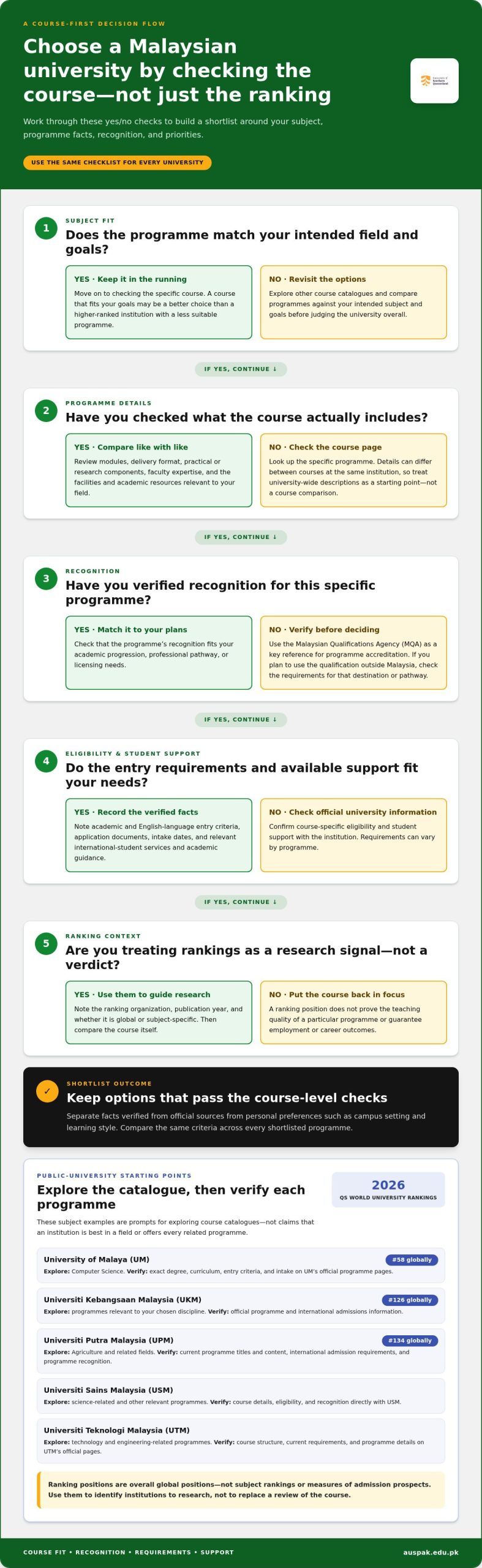
The top universities in Malaysia for international students aren’t necessarily the institutions with the highest overall rankings. The right choice depends on your intended field, the content and structure of the programme, its recognition, available student support, and your priorities, such as campus setting or learning style.
Compare programmes, not just university rankings. A course that fits your goals may be a better choice than a higher-ranked institution with a less suitable programme.
Use the same checklist for every university on your shortlist. Compare subject relevance, programme structure and learning resources, recognition, entry requirements, and international-student support. Record facts you can verify from official sources, then list your preferences separately. This makes it easier to see where options differ and prevents a strong overall ranking from overshadowing a better course fit.
What makes a Malaysian university a strong choice?
Start with the course. Review its modules, delivery format, practical or research components, and the expertise of the faculty involved. Check whether the campus offers relevant facilities and academic resources for your field. These details can vary between programmes at the same institution, so treat a university-wide description as a starting point, not a course comparison.
Next, verify recognition and accreditation for the specific programme. The Malaysian Qualifications Agency (MQA) is a key reference for checking programme accreditation in Malaysia. If you plan to use your qualification outside Malaysia, investigate the recognition requirements for your intended destination or professional pathway. Also review the support that could affect your day-to-day studies, such as international-student services, academic guidance, and access to campus resources.
To broaden your initial search, use this comprehensive list of Malaysian universities as a directory, then verify current programmes and details on each institution’s official pages. A directory can help you find options, but it cannot establish whether a particular course meets your needs.
How should international applicants use university rankings?
Read rankings in context. Note the ranking organization, publication year, and whether it compares universities globally or by subject. A global ranking can help you identify institutions to research, while a subject-specific table may be more relevant to your field. Neither replaces a review of the course itself.
A ranking position does not prove the teaching quality of a particular programme or guarantee employment or career outcomes. For a clearer explanation of what ranking tables measure, read our guide to understanding QS World University Rankings 2026. Use the same course-level checks for every university in the sections below.
Leading Malaysian public universities to consider for international study
Malaysia’s public universities offer a range of academic options, but each programme needs to be assessed on its own. Five institutions to include in an initial search of the top universities in Malaysia for international students are University of Malaya (UM), Universiti Putra Malaysia (UPM), Universiti Kebangsaan Malaysia (UKM), Universiti Sains Malaysia (USM), and Universiti Teknologi Malaysia (UTM). The subject examples below are prompts for exploring course catalogues, not claims that an institution is best in a field or offers every related programme.
Which public universities may suit different academic interests?
Use the examples to guide your catalogue search, then compare the degree content, facilities, and entry requirements. QS World University Rankings 2026 places UM at #58, UKM at #126, and UPM at #134 globally. These are overall positions, not subject rankings or measures of your admission prospects.
| Institution | Subject examples to explore | Official programme check |
|---|---|---|
| University of Malaya (UM) | Computer Science, an example of a degree programme referenced in the current research material. | Confirm the exact degree, curriculum, entry criteria, and intake on UM’s official programme pages. |
| Universiti Putra Malaysia (UPM) | Agriculture and related fields; check the current catalogue for programme titles and content. | Verify international admission requirements and programme recognition through UPM. |
| Universiti Kebangsaan Malaysia (UKM) | Explore the catalogue for programmes relevant to your chosen discipline. | Check UKM’s official programme and international admissions information. |
| Universiti Sains Malaysia (USM) | Explore science-related and other relevant programmes in the current catalogue. | Confirm course details, eligibility, and recognition directly with USM. |
| Universiti Teknologi Malaysia (UTM) | Explore technology and engineering-related programmes, then review their course structure. | Use UTM’s official pages to verify current requirements and programme details. |
What should applicants verify before adding a public university to a shortlist?
For each course, check the exact degree title, academic and English-language entry requirements, application documents, and available intake dates. Confirm that the programme meets any professional licensing, academic progression, or recognition needs relevant to your plans. Requirements can differ by course and applicant background, so a university’s ranking cannot tell you whether you are eligible.
For current information about studying in Malaysia and student-pass guidance, consult Education Malaysia Global Services alongside the institution’s international admissions pages. If you’re applying from Pakistan, profile-aware counselling can help you organize your shortlist and application steps. Plan your study-abroad options with AusPak International.
Private universities and international campuses in Malaysia: compare the right fit
Malaysia’s private sector includes locally established institutions and international branch campuses. Neither model is automatically better. Compare the programme, entry route, teaching environment, recognition, and student support relevant to your course. These checks help you judge the top universities in Malaysia for international students by fit, rather than by institutional label alone.
How do private universities differ from public universities?
Ownership can shape how an institution is organized, but it does not determine the quality or suitability of an individual degree. Private universities may differ from public institutions in course portfolios, admissions processes, campus facilities, and student support. These features also vary among private providers. Review the programme itself, including its curriculum, teaching approach, assessment, entry criteria, and services for international students.
| Institution | How to begin your comparison | What to verify |
|---|---|---|
| Asia Pacific University of Technology & Innovation (APU) | If you’re considering technology or computing, search the current catalogue for programmes aligned with your goals. | Check the exact course, entry requirements, accreditation, and campus arrangements on official pages. |
| International Medical University (IMU) | Applicants exploring health-related study can review IMU’s current programme catalogue. | Confirm programme recognition and any professional requirements relevant to your intended pathway. |
| Sunway University | Compare its current course options against your subject interests and preferred learning environment. | Verify programme structure, international entry criteria, and available student support. |
| Taylor’s University | Use the current catalogue to identify courses that match your academic plans. | Check the exact degree details, recognition, and intake information directly with the university. |
| Monash University Malaysia | Consider it as an international branch-campus option and investigate the specific course and campus experience. | Verify the teaching location, awarding institution, degree details, and programme accreditation. |
What should students know about international branch campuses?
A branch campus is generally an overseas campus operated as part of a university based in another country. The label alone does not confirm that every course, campus arrangement, or degree is identical to what the institution offers elsewhere. For Monash University Malaysia, review the exact programme details and arrangements in official university information before comparing it with other options.
Rankings can provide context, but interpret them carefully. The QS World University Rankings 2026 lists Monash University at #36 and Taylor’s University at #253 globally. These are institutional positions, not evidence of a particular Malaysian programme’s quality or recognition. Check current programme accreditation through relevant official sources, including the Malaysian Qualifications Agency where applicable, and confirm international admission requirements with the university.
Compare Malaysian universities by subject, recognition, and student experience
A useful comparison turns a list of universities into a course-by-course decision. For each option, record what the official programme pages confirm, what depends on your preferences, and what still needs investigation. This approach helps you assess the top universities in Malaysia for international students without treating rankings or broad reputation as substitutes for evidence.
How can students compare universities for a specific subject?
Look beyond the course title. Compare modules, practical or research components, facilities, teaching format, and progression options using each university’s official programme information. For regulated professions, verify current programme accreditation and professional recognition against the requirements of the country where you intend to work or continue studying. Keep ranking position separate: it provides context, but does not establish course suitability.
| Comparison area | What to record | Evidence or preference? |
|---|---|---|
| Subject fit | Modules, practical elements, facilities, and progression routes | Verify on official programme pages; note personal interests separately. |
| Recognition | Programme accreditation and relevant professional or academic recognition | Confirm with the relevant official body and the institution. |
| Entry criteria | Required qualification, grades, documents, and English-language evidence | Check current international admissions requirements for the exact course. |
| Student support | Orientation, academic assistance, wellbeing resources, and accommodation information | Review official service descriptions; consider which support matters most to you. |
| Total study planning | Published tuition and living expenses, intake dates, and application preparation time | Use current university information and your own budget and timeline. |
How do student support and daily study arrangements affect fit?
Programmes in the same subject can differ in learning format, campus environment, and available services. Check whether the university describes international-student orientation, academic help, wellbeing support, and accommodation options. Then weigh those services against your needs and preferences. Treat student experience as something to investigate, not a promise: support resources do not guarantee a particular outcome or employment after graduation.
For applicants from Pakistan, your qualification level affects which courses may be open to you. If you’re applying after intermediate, use this guide to study abroad after intermediate from Pakistan as a starting point, then compare your completed studies with each Malaysian programme’s stated entry criteria. Organize academic certificates and transcripts, and check the course’s English-language requirements. Accepted evidence and thresholds can vary, so don’t assume one test applies everywhere.
Build your comparison from verified course details and your own priorities. Get profile-aware guidance for planning your study-abroad applications as you turn the shortlist into a clear next-step plan.
From shortlist to application: next steps for international students
Once you’ve identified the top universities in Malaysia for international students that fit your goals, turn your research into a documented application plan. Requirements can differ by institution, programme, and applicant, so follow the current official instructions at each stage.
- Shortlist programmes. Choose options that align with your academic background, subject interests, and study plans.
- Verify each programme. Confirm the exact degree, current accreditation or recognition, campus arrangements, intake, and international application deadline on official university pages.
- Check eligibility. Compare your qualifications and English-language evidence with the programme’s published entry criteria. Meeting one university’s requirements does not necessarily mean you’ll qualify for another.
- Prepare documents. Gather the academic and identity records, language evidence, and supporting materials requested by each institution.
- Submit the application. Follow the university’s instructions for application format, fees, certification, and submission. The institution makes admission decisions.
- Follow official student-pass guidance. After receiving an offer, check the latest process with the university and Education Malaysia Global Services (EMGS). Procedures and responsible authorities can change. Immigration decisions are made by the relevant Malaysian authorities, not by the university or an education counsellor.
What documents and details should applicants prepare?
Start with the target university’s current checklist. It may specify academic records, identity documents, English-language results, or other supporting material. Check that names, dates, and qualification details match across your records. Follow the institution’s instructions for certified copies, translations, file formats, and deadlines rather than relying on a general checklist.
How can Pakistani students plan the application and student-pass stages?
Keep admission and immigration requirements in separate checklists. According to the process described in current guidance, students first need an offer from a Malaysian institution; the institution then submits the Electronic Visa Approval Letter (eVAL) application through EMGS. Depending on visa requirements, a Single Entry Visa may also be needed before travel. Verify the latest instructions, authorities, and any arrival requirements through official channels before making plans.
For help organizing application steps, see our guide to university application assistance. AusPak International provides student counselling and university application processing support, along with visa-documentation guidance for international study planning. Plan your study-abroad application with AusPak International.
Turn your shortlist into a confident next step
The top universities in Malaysia for international students are those with programmes that match your academic goals, eligibility, recognition needs, and preferred study environment. Compare course-level details instead of relying on rankings alone, and verify admission requirements and student-pass guidance through official sources before applying.
Turn your research into an organized plan. AusPak International offers student counselling and university application processing support, as well as visa-documentation guidance for international study planning. This support can help you organize your research, documents, and application priorities.
Plan your study-abroad journey with AusPak International and take the next step with greater clarity.
Frequently Asked Questions
Which university is best in Malaysia for international students?
There isn’t one best university for every international student. The right choice depends on your subject, eligibility, programme recognition, and preferred study environment. The QS World University Rankings 2026 places Universiti Malaya (UM) at #58 globally, but that overall position doesn’t establish which course will suit you best. Compare the top universities in Malaysia for international students at programme level, using official course details and admissions requirements.
Is Malaysia a good destination for international students?
Malaysia may suit students looking at a range of public universities, private institutions, and international branch campuses. English is the medium of instruction for most private programmes and many public programmes, according to the available research. A research estimate puts international students’ monthly living costs at about $350 to $700, depending on lifestyle and location. Consider your course, living arrangements, student support needs, and current student-pass guidance before deciding.
What are the top public universities in Malaysia for international students?
Notable public universities include Universiti Malaya, Universiti Putra Malaysia, Universiti Kebangsaan Malaysia, Universiti Sains Malaysia, and Universiti Teknologi Malaysia. In the QS World University Rankings 2026, UM is #58 globally, UKM #126, and UPM #134. These overall rankings provide context, but do not measure course fit or admission chances. Check each university’s current programme catalogue, international entry criteria, and recognition information.
Can international students study at private universities in Malaysia?
Yes. International applicants can consider locally established private universities and international branch campuses in Malaysia. Options discussed in this guide include APU, IMU, Sunway University, Taylor’s University, and Monash University Malaysia. Their course offerings, admission routes, campus arrangements, and degree details differ. Review the exact programme on the institution’s official website and verify accreditation or recognition relevant to your academic or professional plans.
How much does it cost to study at a university in Malaysia?
Total costs depend on the university, programme, level of study, and living arrangements. A research estimate places monthly living expenses for international students at approximately $350 to $700, with lifestyle and location affecting the amount. Tuition and other charges vary, so use the current fee schedule for your specific course and intake. Build a full budget that accounts for both university charges and day-to-day expenses.
Are Malaysian university degrees recognised internationally?
Recognition depends on the specific programme and the requirements of the country, employer, or professional regulator where you plan to use the qualification. Check the programme’s accreditation through the Malaysian Qualifications Agency and confirm any additional recognition needed for your intended pathway. For regulated professions, verify requirements with the relevant professional authority. Don’t assume an institution’s ranking or international profile guarantees acceptance of every degree.
What should Pakistani students check before applying to a Malaysian university?
Pakistani applicants should compare their completed qualifications with the exact programme’s academic entry criteria, including requirements after intermediate study where relevant. Check English-language evidence, application documents, intake dates, and programme recognition using official university information. Keep names and dates consistent across academic and identity records. Treat admission and student-pass requirements as separate checklists, and verify current immigration guidance through official Malaysian sources before making arrangements.
Do Malaysian universities offer scholarships to international students?
Scholarship availability and eligibility depend on the institution, programme, and award conditions. Check each university’s official scholarship information to see whether international applicants can apply, which qualifications are considered, what costs an award covers, and when applications close. Also review renewal conditions, such as academic progress requirements. Don’t treat a scholarship as confirmed funding until the institution has formally communicated the award and its terms.