
The SDS vs non-SDS Canada study permit question has a clear answer in 2026: there is no longer an SDS route to choose. Canada discontinued the Student Direct Stream on November 8, 2024, so Pakistani students must apply through the standard study permit process. Advice that still presents SDS as an available option may send you preparing for a pathway that no longer exists.
It is understandable if the old comparison has caused confusion. SDS once offered eligible applicants a distinct process, and online guidance may not reflect current rules. The important question now is not which stream to select, but whether your application meets today’s requirements and presents a consistent account of your study plans, finances and supporting documents.
This guide explains what the end of SDS means, how the standard application process works and which documents Pakistani students should review carefully, including financial evidence and Provincial Attestation Letter requirements where applicable. You will also learn how to check for avoidable gaps and when Canada study permit assistance may help clarify document preparation. Plan with current requirements, not outdated comparisons.
Key Takeaways
- The SDS vs non-SDS Canada study permit comparison is now historical. Focus on the requirements that apply to your application today.
- Check IRCC’s personalized document instructions to confirm which acceptance, identity, financial and attestation documents you need.
- Make your application clear and consistent by checking that your forms and supporting documents align with your study plans.
- Follow the application steps in order, and respond to any instructions about biometrics, medical examinations or additional documents.
- If your documents or circumstances are complex, professional review may help you identify gaps and improve clarity before submission.
SDS vs non-SDS Canada study permit: what changed and what applies in 2026?
IRCC stopped accepting new Student Direct Stream (SDS) applications on November 8, 2024. In 2026, Pakistani students applying for a Canadian study permit must use the standard application process. SDS is not an active processing route. Check the current instructions from Immigration, Refugees and Citizenship Canada (IRCC) before applying, since official guidance, not an old article or saved checklist, determines what you need to submit.
SDS was a former application stream for eligible international students from participating countries. “Non-SDS” was commonly used for applications made outside that stream. The International Students in Canada overview offers broader context on changes to international student policy, but it is not an application checklist. For current requirements, follow IRCC’s instructions for your circumstances.
Historical SDS eligibility describes a discontinued stream; new applications are assessed under current standard study permit requirements. This distinction matters if online advice recommends selecting SDS or relies on its former criteria. Do not treat an older SDS checklist as evidence of what IRCC requires today.
Is SDS still available for Canadian study permit applications?
No. IRCC announced that SDS would end on November 8, 2024, and new applicants cannot select it as a current processing option. The application date matters: articles and personal checklists created before the closure may describe a process that was available then, not a route open to applicants now. Confirm the status against IRCC’s current guidance before preparing your forms.
If an old guide suggests you qualify for SDS, do not assume that former eligibility allows you to apply through the discontinued stream. Instead, identify the current instructions that apply to you and build your document set around those requirements. This helps you distinguish what the former stream requested from what a new standard application requires.
What did non-SDS mean before the SDS stream ended?
Before SDS ended, “non-SDS” generally referred to a study permit application processed outside the Student Direct Stream. It was a useful shorthand for contrasting the two routes at the time, but it is not the name of a second current option. Today, the practical comparison is between outdated SDS advice and the standard process applicants must follow.
For Pakistani students, focus on your current eligibility, the IRCC document checklist generated for your application and the consistency of the information you provide. Requirements can depend on individual circumstances, so verify them before submitting rather than relying on labels or documents copied from an older application.
SDS vs non-SDS requirements: compare historical rules with today’s process
The useful comparison in 2026 is not between two open application streams. It is between conditions that applied to SDS in the past and the current instructions for a standard study permit application. Historical SDS criteria are not today’s checklist, and meeting a former stream’s conditions does not establish eligibility under current requirements.
| Topic | Former SDS treatment | What applicants must verify today |
|---|---|---|
| Eligibility | Historical. SDS had stream-specific eligibility conditions for applicants. Do not assume these remain applicable. | Check current eligibility instructions for your situation and study plans. |
| Language evidence | Historical. Language evidence formed part of the former stream’s criteria. Verify old test scores or rules before relying on them. | Review the current IRCC instructions and any document checklist generated for your application. |
| Financial documentation | Historical. SDS used stream-specific financial evidence requirements. Former amounts or document formats may no longer apply. | Confirm current proof-of-funds requirements and provide clear, consistent evidence for your circumstances. |
| Application handling | Historical. SDS was presented as a separate stream with its own processing approach. | Apply through the standard process. A former stream’s advertised benefits do not guarantee processing times or decisions. |
Which SDS criteria are now historical rather than current?
Eligibility rules, language evidence, financial documentation and application handling must be read in their historical context when they refer to SDS. Repeat former thresholds or required documents only when they have been verified against reliable archived or official guidance. This comparison avoids presenting old figures or checklists as current rules. For new applications, use IRCC’s official study permit requirements as your baseline.
What should applicants compare instead of stream labels?
For the SDS vs non-SDS Canada study permit question, focus on the fit and clarity of your current application, not its old label. Compare your study plan with your chosen program, make sure your financial evidence is clear and verifiable, and check that your forms and supporting documents tell a consistent story. Requirements can vary with your circumstances and application details, so follow your personalized IRCC checklist rather than a copied SDS document list.
Use the Canada study permit application guide to review the preparation process for applicants from Pakistan. If your documents are complex or you are unsure how to present information consistently, Canada study permit assistance and document review can provide additional guidance. Professional support can help clarify an application, but it cannot guarantee a decision.
What documents and eligibility checks matter for a Canada study permit now?
Start with the document checklist and instructions IRCC provides for your application. Requirements can depend on your circumstances, chosen program and destination province or territory, so use the personalized instructions rather than a checklist saved from an old SDS application. As you prepare, confirm that you have the documents required for these core areas:
- Acceptance documentation: Proof of acceptance from your designated learning institution (DLI), with program details that match your application.
- Financial support: Evidence that supports your plan to pay tuition and living costs and explains the funding available for your studies.
- Identity records: Valid identity documents and any other records requested in your personalized checklist.
- Provincial or territorial attestation: A Provincial Attestation Letter (PAL) or Territorial Attestation Letter (TAL) if required for your applicant category.
Coherent, consistent evidence matters more than an obsolete stream label. Your documents should support the same study plan and funding story throughout the application.
How do acceptance documents and PAL or TAL requirements fit?
Your DLI acceptance documentation connects your application to a specific institution and program. Check that the names and program details match the forms you submit. PAL or TAL rules can depend on the type of application and may change. For example, IRCC’s current rules include an exemption for students admitted to master’s and doctoral programs at public DLIs, effective January 1, 2026. Confirm whether an exception applies to you before submitting. If you plan to study in Quebec, check the current provincial and federal instructions for any additional requirements.
How should students prepare financial and personal documents?
Financial evidence should support the costs associated with your study plan and the funding sources you identify. Organize records so the amounts, account holders and source of funds are clear, then check current IRCC instructions for accepted evidence. Do not rely on a former SDS financial checklist, as it may reflect requirements that no longer apply.
Before uploading, compare every document against your forms. Check that names are spelled consistently, dates and program details align, and translations or file formats follow the instructions for your application. This final review can help you catch avoidable inconsistencies before submission.
The former Student Direct Stream requirements page can provide historical context, but it should not be used as the current checklist for a new application. The SDS vs non-SDS Canada study permit distinction is no longer a choice between active routes. If you would like help checking document clarity and consistency, Canada study permit assistance is an optional source of guidance.
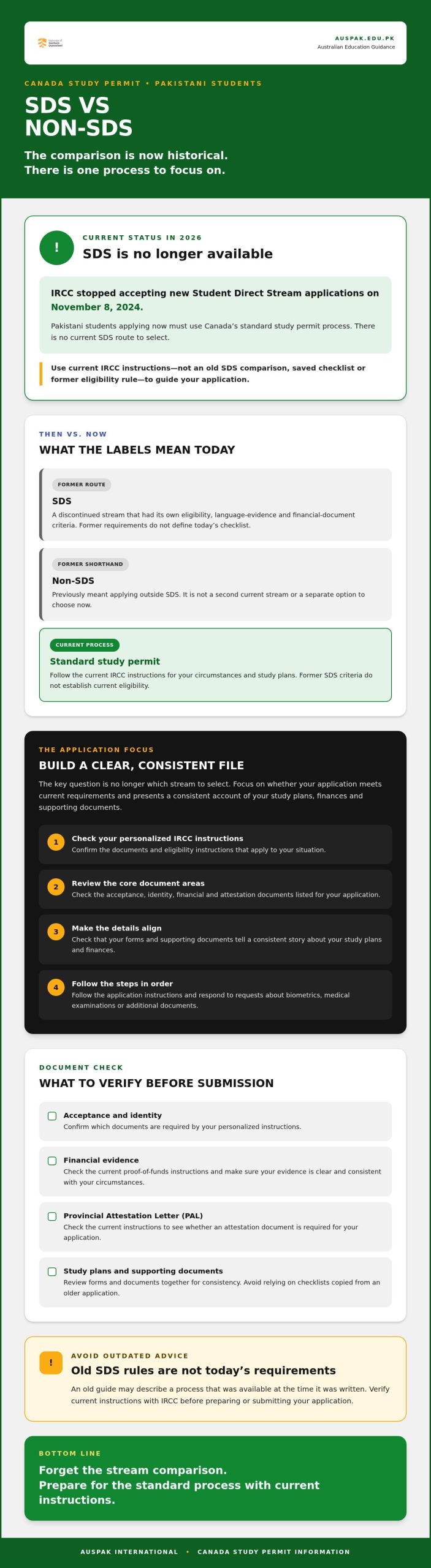
How to prepare and submit a study permit application from Pakistan
A clear sequence helps you move from admission documents to a complete submission without relying on outdated SDS instructions. For the SDS vs non-SDS Canada study permit question, the relevant task is to prepare under the current standard process and follow the requirements shown for your application.
- Confirm current rules. Check IRCC’s study permit instructions and the personalized document checklist for your circumstances. Verify the application route, required documents and any provincial or territorial attestation requirement before you begin.
- Gather your documents. Collect your acceptance documentation, identity records and financial evidence, along with any other items listed in your checklist. Check that names, dates and program details match across the documents.
- Complete the forms. Answer each question accurately and consistently. Review your forms against your supporting evidence before uploading, and follow current instructions for file formats and translations.
- Submit your application. Use the application method specified by IRCC. Save your submission confirmation and copies of every form and document you upload.
- Follow subsequent instructions. Monitor your application account and official correspondence. If IRCC requests biometrics, a medical examination or further evidence, follow the instructions and deadlines provided for your case.
What should applicants check before submitting online?
Do one final review before submission. Confirm that you are using the current application route, your checklist is complete and each document supports the information in your forms. For a fuller preparation overview, see this Canada study permit application support resource. Keep submission confirmations and document copies together so you can refer to them if IRCC contacts you.
What happens after submission?
Submission is not the end of the process. IRCC may send instructions for biometrics, a medical examination or additional evidence, depending on the applicant and application. Check your account and official messages regularly, and respond by the deadline stated in each request. Processing times vary, so consult current official processing information for an estimate rather than relying on older timelines or another applicant’s experience.
If you would like support checking your documents and application information for clarity and consistency, explore Canada study permit assistance. Guidance can help you prepare carefully, but it cannot guarantee an outcome.
When can study permit guidance help you move forward?
The choice in the SDS vs non-SDS Canada study permit discussion is settled: SDS is no longer an application route. Your next step is to meet current standard requirements and submit evidence that fits your study plans. Some students can manage the process independently, especially when their documents are straightforward and the IRCC checklist is clear. Others may benefit from a careful review before applying.
How can students assess whether they need application support?
Consider getting guidance if you are unsure how to explain a funding plan, reconcile differences across documents or present an academic history that includes gaps or changes in direction. If your checklist is clear and your records align, independent preparation may be manageable. Either way, check advice against current IRCC instructions. Before engaging a consultancy, ask what the service includes, which documents you need to provide and who is responsible for each step.
Useful questions to ask include:
- Will someone review my supporting documents for accuracy and consistency?
- Which parts of the application am I expected to complete or confirm?
- How will I be informed if additional information is needed from me?
What should students expect from a responsible consultancy?
Professional support should make the application clearer, not promise a particular decision. Depending on the service scope, assistance may include document verification, application preparation and visa documentation guidance. Ask how the advice relates to your circumstances, then compare it with official instructions. A consultant cannot guarantee a permit or replace an immigration officer’s assessment of your application.
AusPak International provides Canada study permit assistance, including application processing, document verification and visa documentation guidance. If reviewing your documents or preparing the application feels challenging, discuss your requirements and clarify what support is available for your case. The goal is a well-organized, consistent submission, not a promised result.
For more detail on documentation support, see professional student visa documentation guidance. Ready to discuss your next steps? Contact AusPak International about Canada study permit assistance.
Prepare your Canada study permit application with confidence
The key takeaway from the SDS vs non-SDS Canada study permit comparison is simple: SDS is no longer an application route, so Pakistani students should prepare under current standard requirements. Use IRCC’s personalized instructions, check which documents apply to your circumstances, and make sure your forms and supporting evidence are clear and consistent.
If your application is straightforward, you may feel comfortable preparing it independently. If your funding records, academic history or documents are difficult to reconcile, a professional review may help you identify gaps and improve clarity. Support can guide preparation, but no consultant can guarantee a permit decision.
AusPak International provides Canada study permit assistance, including application processing and document verification support. Discuss your Canada study permit application with AusPak International and clarify what guidance may suit your needs. With current information and careful preparation, you can take your next step toward studying in Canada with greater confidence.
Frequently Asked Questions
Is the Student Direct Stream still available for Canada study permits?
No. IRCC stopped accepting new Student Direct Stream applications on November 8, 2024. Pakistani students applying now cannot select SDS as a processing route and must follow the standard study permit process. Older online guides may still describe SDS eligibility or documents, but those details relate to a discontinued stream. Check current IRCC instructions for your application rather than relying on archived checklists or advice written before SDS ended.
What is the difference between SDS and non-SDS Canada applications now?
There is no current choice between SDS and non-SDS routes. SDS was a former stream, while “non-SDS” commonly described applications processed outside it. Since SDS ended, new applicants use the standard study permit process, and IRCC assesses applications against applicable current requirements. The phrase SDS vs non-SDS Canada study permit now describes a historical comparison, not two available ways to apply.
Can Pakistani students apply for a Canada study permit in 2026?
Yes, Pakistani students can apply through Canada’s standard study permit process in 2026. Eligibility and required documents depend on the applicant’s circumstances and study plans, and applying does not guarantee approval. Before starting, confirm your institution and program documentation, review the current IRCC checklist, and check whether provincial or territorial attestation requirements apply to your category. Submit a complete application that accurately supports your plans and funding.
Do I need a PAL or TAL for a Canadian study permit?
It depends on your applicant category and current rules. Most undergraduate and college program applicants need a Provincial Attestation Letter (PAL), while students admitted to master’s or doctoral programs at public designated learning institutions are exempt as of January 1, 2026. Territorial requirements may differ. If you plan to study in Quebec, check its current provincial instructions too. Confirm requirements with IRCC before submitting, since exemptions depend on your situation.
What financial documents should I provide for a Canada study permit?
Follow your personalized IRCC checklist, which identifies the evidence required for your application. Financial documents should clearly support how you will pay tuition and living expenses and align with the funding plan described in your forms. Depending on your circumstances and the instructions provided, this may involve records showing available funds and their source. Check current IRCC requirements for the applicable amount and accepted evidence. Do not rely on old SDS thresholds or lists.
Does applying through non-SDS reduce my chance of approval?
No. “Non-SDS” is not a separate current route that lowers or improves your chances. It is a historical label for applications made outside SDS, which IRCC discontinued. New applications are assessed under the standard process and the requirements that apply to each applicant. Focus on providing accurate forms, a credible study plan and consistent supporting documents. No application label, consultant or document format can guarantee a positive decision.
Can a study permit consultant guarantee approval?
No. A consultant cannot guarantee a Canadian study permit decision or replace the officer’s assessment. Professional assistance may help with application preparation, document verification and visa documentation guidance, but the applicant remains responsible for ensuring the information is accurate and following official instructions. Ask what the support includes and check advice against current IRCC requirements. Treat any promise of guaranteed approval as a warning sign, not evidence of a stronger application.