
With Canadian study permit approval rates for Pakistani applicants fluctuating around 30% in recent months, is your documentation truly resilient enough to withstand the scrutiny of the 2026 intake? It’s understandable to feel a weight of pressure after you’ve already committed significant time to IELTS testing and paid your initial university deposits. The fear of a rejection letter is a common hurdle. However, it’s one you can navigate successfully with a precise, evidence-based strategy that aligns with current IRCC standards.
This comprehensive guide explains exactly how to apply for Canada study permit from Pakistan under the revised 2026 landscape. We’ll navigate the permanent shift from the discontinued SDS route to the standard stream, ensuring you meet the updated proof of funds requirement of CAD $22,895 for living expenses. You’ll gain a clear, sequential roadmap covering the Provincial Attestation Letter (PAL) process, strategic Statement of Purpose drafting, and the critical documentation needed to prove your ties to Pakistan. By mastering these high-level requirements, you can transform a complex legal transition into a successful milestone for your international career.
Key Takeaways
- Learn exactly how to apply for Canada study permit from Pakistan following the 2026 standard stream requirements, ensuring every document meets IRCC’s updated scrutiny.
- Understand the critical shift in financial requirements, including the necessity of demonstrating CAD $22,895 in living expenses alongside your first year of tuition.
- Identify which programs require a Provincial Attestation Letter (PAL) and how to draft a high-impact Statement of Purpose that proves genuine academic intent.
- Navigate the current 2026 processing timelines and biometric procedures to plan your departure with precision and avoid common administrative delays.
- Gain expert insights on avoiding frequent rejection pitfalls by aligning your application with the specific “Big Three” approval criteria for Pakistani students.
Understanding the Canada Study Permit Landscape for Pakistanis
Canada continues to be the primary destination for Pakistani graduates seeking world-class education and professional advancement in 2026. The landscape for international students in Canada has become more structured, reflecting a national commitment to academic quality and sustainable growth. While the 2026 national cap of 408,000 study permits introduces a competitive layer, high-achieving students find that a well-prepared application remains a powerful gateway. A vital component of this journey is the concept of “dual intent.” This legal principle allows you to enter as a temporary resident with a genuine focus on your studies, while also maintaining the aspiration to transition toward permanent residency later. Understanding these nuances is essential when researching how to apply for Canada study permit from Pakistan effectively.
Study Permit vs. Student Visa: Clearing the Confusion
It’s vital to distinguish between your entry document and your status document. A student visa, or Temporary Resident Visa (TRV), is what appears in your passport to allow travel to a Canadian border. The study permit, however, is a separate document that authorizes your stay and outlines your specific conditions, such as your work eligibility and duration of study. You don’t receive this permit while still in Pakistan. Instead, you’re issued a Letter of Introduction after your online application is approved by the visa office. This Letter of Introduction is the precursor to the permit and must be presented to a border services officer upon arrival to receive your actual study permit at the Port of Entry.
The 2026 Regulatory Environment for International Students
The regulatory framework for 2026 emphasizes institutional integrity through the Designated Learning Institution (DLI) system. Every applicant must secure a place at a DLI, which is a school authorized by provincial governments to host international students. This system ensures that your chosen program meets the rigorous standards required for both quality education and future work permit eligibility. Additionally, the application process has shifted entirely toward a digital-first model via the IRCC secure account. This platform streamlines the submission of your biometric data and financial records. Mastering how to apply for Canada study permit from Pakistan in 2026 requires a focus on digital compliance and a thorough understanding of updated provincial attestation requirements for undergraduate programs. For a broader perspective on institutions, scholarships, and financial planning, the ultimate 2026 guide to study in Canada from Pakistan offers a comprehensive roundup of everything you need to know before submitting your application.
Student Direct Stream (SDS) vs. Regular Stream: Choosing Your Path
In previous years, the Student Direct Stream (SDS) was the gold standard for speed, offering 20-day processing for those meeting strict criteria. However, IRCC permanently discontinued the SDS route for Pakistan on November 8, 2024. This regulatory shift means that every student must now understand the nuances of the regular stream. While the regular stream involves a more comprehensive review of your financial history, it remains a viable and successful pathway for those who present a meticulous application. Learning how to apply for Canada study permit from Pakistan in this single-stream environment requires a focus on academic integrity and financial transparency.
The Transition to the Regular Stream
The primary difference between the old SDS and the current regular stream lies in the depth of documentation required. Historically, SDS offered a 20-day turnaround compared to the several months often seen in the regular stream; however, current 2026 processing for the standard stream has stabilized at approximately 7 weeks. Although the SDS is gone, maintaining its high standards remains a powerful strategy. Aiming for an IELTS score of 6.0 or higher in each band is still the best way to demonstrate your language proficiency to visa officers. High approval rates are no longer tied to an expedited stream but are instead earned through the clarity of your academic narrative and the strength of your ties to Pakistan.
Financial Readiness: The GIC and Tuition Requirements
Even without the mandatory SDS framework, many successful applicants still choose to utilize a Guaranteed Investment Certificate (GIC). Opening a Canadian bank account from Pakistan to deposit your living expenses shows the visa officer that you have immediate access to the required CAD $22,895. Additionally, paying your full first-year tuition fee upfront is a strong indicator of your financial stability and commitment to your studies. You must also be prepared to prove the source of these funds. Whether it’s through parental savings, property income, or business dividends, the IRCC requires a clear, logical trail of how your family accumulated the wealth. Securing professional Canada study permit assistance ensures your financial narrative is airtight and compliant with these strict 2026 standards.
The regular stream offers more flexibility for students whose financial structures don’t fit the rigid GIC model, but this flexibility requires even greater attention to detail. You must provide at least six months of bank statements and evidence of liquid assets that exceed the minimum requirements. By organizing your application into these digestible phases, you reduce the risk of administrative delays and position yourself as a high-value candidate for Canadian institutions. Working with experienced Canada study permit consultants in Pakistan can be particularly valuable at this stage, ensuring your financial documentation meets IRCC’s precise 2026 standards.
The Essential “Big Three” Requirements for Approval
While the administrative process involves various forms and digital uploads, your success depends on three primary pillars: a verified Letter of Acceptance, a robust financial profile, and a compelling Statement of Purpose. These elements provide the visa officer with the evidence needed to approve your stay. When learning how to apply for Canada study permit from Pakistan, you must treat these documents as a cohesive narrative of your academic intent. Missing a single detail in these “Big Three” can lead to unnecessary delays or a standard refusal based on a lack of clarity.
Securing a Valid Letter of Acceptance (LOA)
Your journey begins with a valid LOA from a Designated Learning Institution (DLI). This document must explicitly state your DLI number, the exact tuition fees for your first year, and your anticipated start and end dates. Ensuring your chosen course aligns with your previous academic background in Pakistan is not just a suggestion; it’s a requirement for proving your genuine student status. For FSc, ICS, and A-Level graduates navigating the transition from local colleges to international universities, understanding how to align your academic stream with the right global pathway is essential; our guide on study abroad after intermediate Pakistan provides a definitive roadmap covering Foundation Year versus Direct Entry options and entry requirements. While Canadian standards are rigorous, they offer a distinct pathway compared to other regions; you can explore our Australia University Guide 2026 to see how these admission standards differ globally. Always verify that your program is eligible for a Post-Graduation Work Permit (PGWP) before you commit.
Crafting a Persuasive Statement of Purpose (SOP)
The SOP is your only opportunity to “speak” directly to the visa officer and justify your choice of Canada over other global destinations. You must clearly address your “Ties to Home Country,” proving that you have significant family, economic, or professional reasons to return to Pakistan after your studies. Explain the logic behind your program choice and how it specifically enhances your career prospects within the Pakistani job market. The SOP acts as a bridge between your past achievements and your future goals. Be precise. Avoid generic templates. Focus on your unique story to demonstrate that your primary intent is academic advancement.
Medical and Security Clearances in Pakistan
Admissibility is the final hurdle in the application process. You should undergo an upfront medical exam with an IRCC-approved panel physician to speed up your processing time. Simultaneously, you must obtain a character certificate or police clearance from local Pakistani authorities to prove you have no criminal record. These documents typically have a limited validity period, so ensure they won’t expire during the seven-week processing window. By organizing these clearances early, you demonstrate a high level of readiness and professional compliance. This proactive approach is a hallmark of those who successfully master how to apply for Canada study permit from Pakistan on their first attempt.
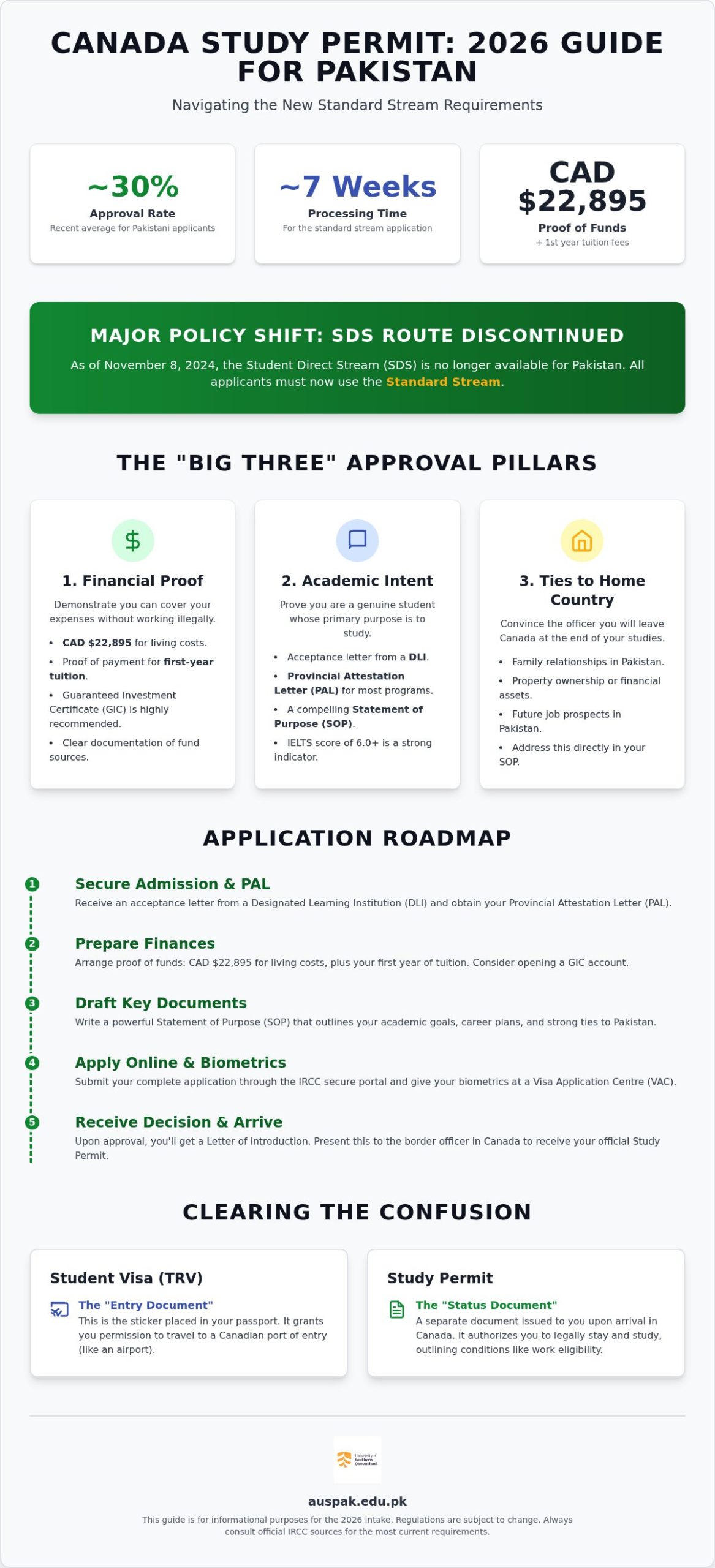
Step-by-Step Application Process: From Pakistan to Canada
Transforming your academic aspirations into reality requires a methodical approach to the IRCC digital infrastructure. Success begins with organization. Once you have consolidated your Letter of Acceptance and verified your financial standing, you must transition to the official portal to formalize your request. Understanding how to apply for Canada study permit from Pakistan involves mastering five critical phases that move your application from a digital draft to a final approval.
- Phase 1: Document Consolidation. Secure your Letter of Acceptance and ensure your financial proof, including your tuition receipts and liquid assets, is ready for upload.
- Phase 2: Digital Submission. Create your IRCC secure account and complete the mandatory IMM 1294 form with absolute precision.
- Phase 3: Financial Transaction. Pay the CAD $150 application fee and the CAD $85 biometrics fee online using a valid credit or debit card.
- Phase 4: Physical Verification. Visit a VFS Global center in Pakistan to provide your fingerprints and photo after receiving your Biometric Instruction Letter.
- Phase 5: Finalization. Submit your passport upon request and receive your Port of Entry (POE) Letter of Introduction, which you will present to the officer in Canada.
Managing the Digital Application (IRCC Portal)
Efficiency is paramount when navigating the IRCC secure account. You must ensure all scanned documents are clear and fall under the specific file size limits, typically 4MB per section. A common pitfall in the IMM 1294 form is failing to provide a complete, gap-free employment and education history; even one month of unaccounted time can trigger a request for more information. Utilize the “Client Information” section strategically. This is the designated space for your Statement of Purpose and any complex financial explanations that don’t fit into the standard form fields. If you require expert oversight to ensure your digital file is flawless, consider professional Canada study permit assistance to mitigate the risk of administrative refusal.
The Biometrics and Passport Process at VFS Global
Digital management eventually transitions to physical verification. After submitting your online application, you will receive a Biometric Instruction Letter (BIL) within 24 to 48 hours. You must then book an appointment at a VFS Global center in Pakistan immediately. On the day of your appointment, bring your original passport, a printed copy of your BIL, and your appointment confirmation. The IRCC has moved to a 100% digital tracking system, allowing you to monitor your application status in real-time through your secure account. Once the visa officer is satisfied, you will receive a Passport Submission Request. This is the final precursor to receiving your POE Letter, marking the successful conclusion of your application journey from Pakistan.
Navigating Visa Rejections and Ensuring Compliance with AusPak
Even with meticulous preparation, the Canadian study permit landscape remains one of the most rigorous in the world. Rejections often stem from a failure to meet the high burden of proof required by the IRCC. Understanding how to apply for Canada study permit from Pakistan is only half the battle; the other half is ensuring your profile is resilient enough to withstand intense scrutiny. A rejection doesn’t just delay your plans; it creates a permanent record that can complicate future applications. This is why a strategic, expert-led approach is essential for Pakistani students in 2026. You must present a narrative that is both legally compliant and academically logical.
Why Applications Fail: Lessons from 30 Years of Consultancy
Many Pakistani applicants face refusals because they fail to establish themselves as “Genuine Students” in the eyes of the visa officer. If your chosen program doesn’t show a clear, logical progression from your previous academic or professional history, your intent will be questioned. Another critical pitfall is “sudden money.” If your bank statements show large, unexplained deposits shortly before your application, it triggers red flags regarding your actual financial stability. While Canada’s intent requirements are strict, they differ significantly from other popular destinations; you can review our Study in UK Guide 2026 to understand how different nations assess student intent and financial ties. Ensuring your financial history is transparent is non-negotiable. Consulting a reputable team of Canada study permit consultants in Pakistan can help you identify and resolve these red flags before they reach the visa officer’s desk. For students exploring multiple international destinations simultaneously, partnering with the best study abroad consultants in Pakistan ensures you receive expert guidance tailored to each country’s unique documentation and visa requirements.
The AusPak International Advantage: Your Trusted Navigator
AusPak International acts as your seasoned mentor, leveraging over 30 years of expertise to simplify this multi-layered journey. We don’t just provide a checklist. We offer a sequential logic that reduces anxiety during the seven-week processing window. Our premium consultancy includes rigorous SOP reviews and mock interviews that prepare you for every possible scenario. We ensure your financial narrative is airtight, explaining the source of every fund to satisfy IRCC’s 2026 standards. This level of document verification is often the deciding factor between an approval and a refusal. We help you build a case that speaks the language of the visa officer.
Once you receive your Port of Entry (POE) Letter, your focus should shift to arrival support and physical preparation. This includes booking your flight, securing health insurance, and organizing your initial accommodation. Remember that your actual study permit is only issued at the border; you must carry all your original documents in your carry-on luggage for the final interview with the border officer. Your journey from Pakistan to Canada is a significant milestone. Don’t leave it to chance. Start your journey with a professional profile assessment today to ensure you master how to apply for Canada study permit from Pakistan with total confidence and precision.
Taking the Next Step Toward Your Canadian Education
Mastering the complexities of international transitions requires more than just filling out forms; it demands a strategic alignment with current IRCC standards. You now understand that while the SDS route has concluded, the path to success remains open through meticulous documentation and a clear academic narrative. By focusing on the “Big Three” requirements-a valid LOA, robust financial proof, and a compelling SOP-you position yourself as a high-value candidate for the 2026 intake. Knowing exactly how to apply for Canada study permit from Pakistan is your first step toward attaining an exciting milestone in your professional life.
With over 30 years of educational consultancy expertise, AusPak International serves as your trusted navigator in this high-stakes process. As official partners with leading Canadian institutions, we provide expert document verification to maximize your approval chances and eliminate the common pitfalls that lead to rejections. Don’t leave your investment to chance. Secure Your Future in Canada – Get Expert Visa Assistance from AusPak Today. Your journey toward a global degree is an attainable goal, and we are here to ensure you move forward with absolute confidence.
Frequently Asked Questions
Is IELTS mandatory for a Canada study permit from Pakistan?
IRCC doesn’t strictly mandate IELTS, but it’s the preferred proof of language proficiency for most institutions. Most Canadian universities require a 6.0 to 7.0 band score depending on the level of study. While you can use PTE or TOEFL, having a strong IELTS result remains the most reliable way to demonstrate your readiness for an English-speaking academic environment. It’s a critical component when learning how to apply for Canada study permit from Pakistan successfully.
How much bank balance is required for a Canada student visa from Pakistan in 2026?
For 2026, you must demonstrate a minimum bank balance of CAD $22,895 for living expenses plus the cost of your first year’s tuition. This requirement reflects the updated IRCC regulations that ensure students can support themselves without financial distress. If you’re bringing family members, this amount increases significantly. Providing clear, six-month bank statements is essential to prove that these funds are readily accessible and come from legitimate, documented sources.
Can I apply for a Canada study permit without an SDS-eligible IELTS score?
Yes, you can apply without the specific SDS scores because the Student Direct Stream was permanently discontinued for Pakistani applicants on November 8, 2024. All students now use the regular study permit stream. While you no longer need to meet the rigid SDS criteria, you still must prove your language ability to your chosen university. This shift allows for more flexibility in your application, provided your academic narrative and financial proofs remain exceptionally strong.
How long does it take to process a Canada study permit for Pakistani students?
Current processing times for Pakistani applicants average approximately 7 weeks as of August 19, 2026. It’s important to note that these timelines can fluctuate based on the volume of applications and the complexity of your specific case. You should monitor the live IRCC processing tool for the latest estimates. Beginning your application at least four to five months before your program start date is a strategic move to account for potential administrative delays.
What is the age limit for a Canada study permit for Pakistani applicants?
There’s no official age limit for a Canadian study permit, but older applicants must provide a more detailed justification for their return to education. Visa officers look for a logical progression between your past career and your chosen program. If you have a significant study gap, your Statement of Purpose must clearly explain how this degree will advance your professional goals in Pakistan. Success depends on the relevancy of the course, not your age.
Can I work in Canada while studying on a study permit?
Eligible international students can work up to 24 hours per week off-campus during regular academic sessions. During scheduled breaks, such as summer or winter holidays, you’re permitted to work full-time. This policy provides a valuable opportunity to gain Canadian work experience while offsetting some of your costs. However, your primary focus must remain on your studies to maintain your legal status and ensure you’re making satisfactory progress toward your degree requirements.
What happens if my Canada study permit is rejected?
If your application is refused, you’ll receive a letter outlining the specific grounds for the decision. Common reasons include doubts about your intent to return to Pakistan or insufficient financial proof. You can address these concerns and re-apply, but it’s often wise to request your GCMS notes first to see the officer’s detailed remarks. This is where professional guidance on how to apply for Canada study permit from Pakistan becomes invaluable to avoid repeating mistakes. Before re-applying, reviewing a comprehensive resource on how to study in Canada from Pakistan can help you identify gaps in your original application and build a stronger case for approval.
Do I need to pay the full tuition fee before applying for the visa?
While paying the full first-year tuition fee isn’t a strict legal requirement for the regular stream, it’s highly recommended to strengthen your application. Upfront payment serves as concrete evidence of your financial stability and your genuine commitment to the institution. If you choose not to pay in advance, you must provide even more robust evidence of liquid assets to cover these costs. Most successful Pakistani applicants find that paying tuition early reduces the risk of rejection. If you are still in the process of selecting the right institution and need guidance on navigating multiple study destinations, working with the best study abroad consultants in Pakistan can help you make a well-informed decision before committing to any upfront payments.