
Yes, Pakistani students can study engineering in the UK from Pakistan, with undergraduate and postgraduate routes available. A UK BEng usually takes 3 years, while an integrated MEng usually takes 4 years. Entry depends on your qualifications, chosen course and English-language results.
The opportunity is exciting, but choosing a course also means weighing academic entry requirements against tuition, living costs and visa preparation. For engineering applicants from Pakistan, IELTS requirements are commonly 6.5-7.0 overall, with no component below 6.0, although universities set their own course requirements.
This guide explains the main routes to study engineering in the UK from Pakistan, what to consider when comparing course costs, and how scholarships, student work, English requirements and visas fit into your plans. You’ll also learn how practical learning and different course structures can shape your future options.
Key Takeaways
- Compare undergraduate, foundation and postgraduate routes against your Pakistani qualifications to identify a suitable entry pathway.
- Assess scholarships by eligibility, award coverage and any post-study commitments before relying on them in your budget.
- Understand the student visa work limit during term time, and plan work around your course rather than treating it as a substitute for funding.
- Compare each engineering course’s English-language requirements, since accepted tests and score thresholds can vary by university.
- Explore how practical learning and post-study opportunities could support your engineering goals, then consider UK Student Visa Consultancy for application and visa guidance.
Can Pakistani Students Study Engineering in the UK?
Yes, Pakistani students can apply to UK engineering degrees at universities including Oxford, Cambridge, Imperial College London, Manchester, Surrey and Dundee. A BEng usually takes 3 years, while an integrated MEng usually takes 4 years.
Foundation-Year Routes
A foundation year is a preparatory course that can bridge the gap between 12 years of Pakistani schooling and a UK engineering degree. It matters because FSc or Intermediate certificates may not meet direct-entry requirements at many universities. Foundation entry usually requires 65% overall, including 70% or higher in relevant subjects. Several independent market sources indicate that Pakistani students generally need at least 75% in FSc for a UK International Year One (IY1) programme.
Compare foundation-year subjects with your intended engineering specialism. Preparation in mathematics and physics can help you build the academic foundation needed for degree study.
Engineering Application Steps
Undergraduate applications begin with choosing a course and checking its academic requirements, application route and deadline. For most undergraduate courses, students apply through UCAS; the main equal-consideration deadline for 2027 entry is 13 January 2027 at 6pm UK time. Oxford, Cambridge and most medicine, dentistry and veterinary courses have an earlier deadline, 15 October 2026 at 6pm UK time.
Postgraduate applicants usually apply through the university’s admissions system. Prepare academic transcripts, certificates, a personal statement and references, then submit your application and any requested documents. Some engineering courses may also consider relevant work or research experience.
Entry Qualifications for Pakistani Applicants
Entry depends on your qualification, grades and the university’s assessment of your school education. A limited number of universities may accept Pakistani FSc for direct undergraduate Year 1 entry, typically with at least 70% in Intermediate. Competitive courses may expect 70% in HSSC or FSc, or strong STEM A-Level grades.
For postgraduate study, universities generally expect a four-year Pakistani bachelor’s degree. A UK 2:1 equivalent is generally 65-70% overall, depending on the institution. Engineering master’s programmes typically require a recognised undergraduate degree equivalent to a UK 2:1 or above.
Student Visa Requirements and Timing
Pakistani nationals need a Student visa to study in the UK and submit their application at a local visa application centre. According to the UK Home Office, the fee to apply for a Student visa from outside the UK is £558. Student Route applicants must hold the required maintenance funds continuously for 28 consecutive days, according to the UK Home Office.
Applicants can apply three months before their course starts. The application requires evidence supporting the course and financial requirements. UK engineering applicants commonly need IELTS 6.5-7.0 overall, with no component below 6.0; universities set course-specific English requirements. Plan the visa application after receiving the university’s required course documentation, and allow time for biometrics and processing.
Scholarships for Pakistani students
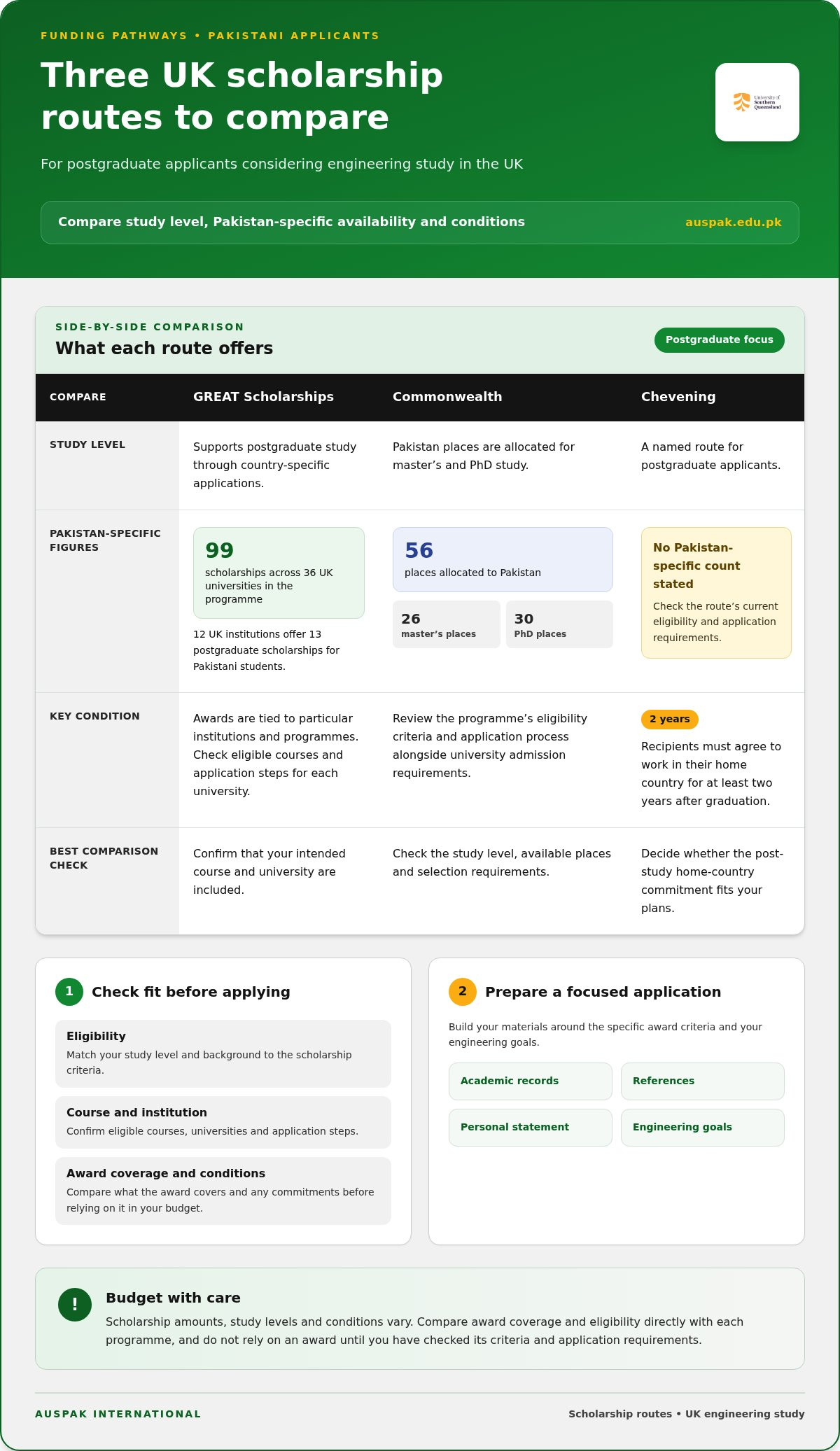
Scholarships can help bridge the funding gap, but award amounts, study levels and conditions vary. Match each opportunity to your intended degree, then review its eligibility criteria and application process alongside the university’s admission requirements.
Scholarship routes to explore
GREAT Scholarships support postgraduate study through country-specific applications. The programme lists 99 scholarships across 36 UK universities, while 12 UK institutions offer 13 postgraduate scholarships for Pakistani students. Compare each university’s eligible courses and application steps, because the award is tied to particular institutions and programmes.
The Commonwealth Scholarship programme allocates Pakistan 56 places: 26 for master’s study and 30 for PhD study. Chevening is another named route for postgraduate applicants. Recipients must agree to work in their home country for at least two years after graduation, so consider that commitment before applying.
Prepare a focused scholarship application with academic records, references, a personal statement and a clear explanation of your engineering goals. Match each document to the award criteria. A strong bachelor’s record may support your application, but selection requirements vary by scholarship and university.
Admission and English requirements
For undergraduate engineering, Pakistani applicants to competitive programmes are advised to aim for at least 70% in HSSC or FSc, or strong STEM A-Level grades. Universities assess the subjects behind the overall result, especially preparation relevant to the chosen engineering course. Check whether the course requires additional admissions tests, since some universities, including Oxford and Cambridge, use them.
English evidence is another part of the application. Engineering applicants are commonly given an IELTS range of 6.5-7.0 overall, with no component below 6.0. The listed alternatives are PTE Academic 61-67 or TOEFL iBT 90-100. Use the test accepted by your chosen university and compare its required score with your result before submitting.
Work alongside your studies
Work may help with everyday expenses, but it should not replace a funding plan for tuition and living costs. Most international students on a UK Student visa can work up to 20 hours per week during term time and full-time during holidays. Course demands, laboratory sessions and project deadlines can affect how practical part-time work is.
University international student teams can explain support services and course-specific guidance for overseas applicants. Ask about scholarship deadlines and document requirements as you compare institutions. Submit a separate scholarship application unless the award instructions specify that it is part of your university application.
For support with the visa stage after admission, UK Student Visa Consultancy can help Pakistani students prepare for the next part of their study plans.
Can international students work while studying in the UK?
Part-time work can contribute to a student budget, but it should sit alongside a realistic plan for tuition and living expenses. Most international students on a UK Student visa can work up to 20 hours per week during term time and full-time during holidays. Engineering students should weigh this limit against lectures, laboratory sessions and project deadlines.
Compare tuition by degree level
Undergraduate and postgraduate tuition varies by university, engineering subject and degree structure. International engineering tuition depends on the course and institution, so compare the published fee for each programme rather than assuming one rate applies across UK universities. A BEng, an integrated MEng and a specialist master’s course can each have different tuition arrangements.
For a useful comparison, shortlist courses at the same degree level and record tuition, course length and included components. Check whether the route includes a foundation year, as this adds a separate stage of study. Doctoral tuition also has its own structure and may differ from taught postgraduate fees.
Build a Pakistan-based budget in USD by converting each university’s published tuition and accommodation charges using the exchange rate available when planning payment. Keep tuition separate from housing and daily expenses. This makes it easier to see how course location and degree length affect the overall funding plan.
Plan for living costs
Budget for accommodation, food, transport, books and course materials, not just tuition. Housing costs can differ between London and other UK locations, while commuting expenses depend on campus access. Compare these costs alongside course fees before deciding where to apply.
Use the university’s stated course duration to estimate how many academic periods your budget must cover. For example, a three-year BEng has a different overall study period from a four-year integrated MEng. Include course-related expenses, such as equipment or materials, when the programme information identifies them.
Balance employment with engineering studies
The 20-hour term-time work limit applies to most international students on a UK Student visa; full-time work is permitted during holidays. Treat this as a limit, not a target. Timetables, assessment periods and practical coursework can restrict the hours available for employment.
Before taking a job, map your weekly schedule around lectures, laboratory classes and assignment deadlines. Part-time work may help cover some regular expenses, but engineering study requires sustained academic preparation. Plan tuition funding separately and consider scholarships, savings and family support in your overall budget.
English language requirements
Admission to UK engineering courses depends on academic qualifications and evidence of English ability. For Pakistani applicants, the required evidence varies by degree level, course and university entry criteria. Compare both requirements before applying, as meeting the academic standards alone may not satisfy the English-language condition.
Academic requirements for undergraduate courses
Undergraduate engineering applicants need suitable preparation in mathematics and other relevant STEM subjects. For competitive programmes, Pakistani students are advised to aim for at least 70% in HSSC or FSc, or strong STEM A-Level grades. Universities assess the subjects and grades behind each certificate, not only the overall result.
A limited number of universities may accept Pakistani FSc for direct Year 1 entry, typically with at least 70% in Intermediate. Foundation routes provide another option for applicants whose school qualification does not meet direct-entry criteria. Some universities, including Oxford and Cambridge, also require additional admissions tests for engineering.
English-language evidence
Pakistani applicants to UK engineering programmes are commonly given an IELTS requirement of 6.5-7.0 overall, with no component below 6.0. The listed PTE Academic range is 61-67, while the listed TOEFL iBT range is 90-100. These alternatives help students compare accepted tests with their current language skills.
Postgraduate applicants typically need IELTS 6.5-7.0 or an equivalent recognised English test score. Requirements can differ by course and institution, so use the exact threshold for your chosen programme. For example, Oxford’s listed undergraduate IELTS requirement is 7.5 overall, with a minimum band score of 7.0.
Plan your English test around application deadlines and allow time to receive the result. Check whether the course sets a minimum score for each component as well as an overall score. A strong academic profile does not replace the university’s English-language requirements.
Postgraduate entry with a Pakistani degree
UK universities generally require a four-year Pakistani degree for postgraduate admission. A three-year degree is generally not accepted without extra qualifications. Engineering master’s courses typically expect a recognised undergraduate degree equivalent to a UK 2:1 or above.
A Pakistani bachelor’s degree equivalent to a UK 2:1 generally requires 65-70% overall, depending on the university. The University of Manchester’s typical minimum for Pakistani postgraduate applicants is 70-85%, depending on their previous university and grading scale. Relevant work or research experience may also matter for some engineering courses.
Before applying, compare your transcript, degree duration and English test result with the course requirements. This can reveal gaps early and help you decide between direct admission, further preparation or a different course. Keep academic documents and test evidence ready for each application.
Reasons to study in the UK from Pakistan
Choosing to study engineering in the UK from Pakistan means considering more than a qualification. Your decision can shape your practical skills, career direction and future options. Look for a course that connects your engineering specialism with relevant teaching, a workable tuition plan and your professional goals.
Practical learning and specialist courses
UK universities use project-based, practical learning, giving students opportunities to apply engineering concepts to technical tasks. This approach can help connect classroom theory with design, testing and problem-solving. Compare course modules and project work before choosing a degree, especially if you’re interested in fields such as mechanical or civil engineering.
Course choice matters. The University of Surrey is ranked among the top 150 globally for Engineering in the THE World University Rankings 2026. The University of Dundee’s Mechanical Engineering programme is ranked in the UK top 10 by the Guardian University Guide 2026. These examples show why comparing subject-specific strengths can be more useful than relying on a university’s overall reputation alone.
An international academic environment
English is the language of instruction at UK universities, so engineering students develop technical vocabulary while completing academic work. Studying alongside international students can also bring different perspectives to group projects and discussions. For applicants educated in Pakistan, this provides experience communicating engineering ideas in English.
Research the academic environment as well as the course content. Compare programme structures, practical components and learning environments. A course with relevant project work may suit someone seeking applied experience, while another may better match research-focused ambitions.
Career planning and professional recognition
Eligible engineering graduates can use the UK Graduate Route to stay and work in the UK for 2 years after completing their degree. This can provide time to explore graduate roles and gain work experience. It is a post-study option, not a promise of employment, so connect course selection with the roles you intend to pursue.
If you plan to practise as an engineer in Pakistan, check whether the programme is recognised by the Pakistan Engineering Council. This connects your UK education with your intended professional pathway at home. Compare recognition alongside course content, tuition and career goals before committing to study abroad.
Make your shortlist based on subject fit, practical learning and post-study plans. If you need help preparing for the visa stage, explore UK student visa support as part of your study planning.
AusPak International: Australian University Admission Support
AusPak International helps Pakistani students prepare for the UK visa stage through its UK Student Visa Consultancy. Consider this support after choosing an engineering course and receiving the required university documents. The consultancy guides you through the visa process and helps you prepare the documentation for this part of your study plans.
If you’re comparing destinations too, AusPak International offers Australian University Admission Support and Canada Study Permit Assistance. Onshore Arrival Support is available to help students prepare for arrival. Choose the pathway that matches your destination and stage of planning, then discuss the relevant support with the team.
To explore your next step, visit auspak.edu.pk.
Turn your engineering plans into a clear next step
Choosing to study engineering in the UK from Pakistan is a major decision, but you can make the next steps manageable: define your preferred engineering field, identify courses that fit your academic background and organise your application documents. A focused plan helps you work through decisions in sequence rather than tackling everything at once.
For help with the visa stage, AusPak International offers UK Student Visa Consultancy. Students considering other destinations can explore Australian University Admission Support or Canada Study Permit Assistance. Choose support that matches your destination and the stage you’re preparing for.
Discuss your plans and the support relevant to your next step with AusPak International. Your engineering ambitions can become a well-planned path forward, starting with one clear decision.
Frequently Asked Questions
Why Study in the UK?
The UK may suit students looking for engineering courses with practical projects and an international academic environment. Compare course modules, project work and professional recognition rather than relying on reputation alone. For example, if you plan to practise in Pakistan, include Pakistan Engineering Council recognition in your comparison. Choose a course that supports your intended specialism and career direction.
Are Scholarships Available for Engineering Students in the UK?
Pakistani students can explore scholarships such as GREAT, Commonwealth and Chevening, though eligibility and award conditions vary. Identify awards open to your intended study level and engineering subject, then compare their deadlines with university admissions timelines. Prepare the required academic evidence and tailor your personal statement to each award. Treat scholarship funding as one part of your overall financial plan.
Can Pakistani Students Stay and Work in the UK After Graduation?
Eligible engineering graduates can use the UK Graduate Route to stay and work in the UK for 2 years after completing their degree. This period can help graduates gain experience and explore suitable roles, but it doesn’t guarantee employment. Before choosing a course, consider how its engineering focus connects with your career plans, and research the kinds of roles that match your skills.
How Much Does it Cost to Live in the UK?
Living expenses depend largely on location and accommodation, so London and smaller university cities may require different budgets. Include housing, food, transport, utilities, books and personal spending in your estimate. For a practical comparison, use the same expense categories for each location and convert expected costs into USD using the exchange rate relevant to your budget.
What Are the Eligibility Requirements for Engineering in the UK?
Eligibility depends on whether you’re applying for undergraduate or postgraduate study, your previous qualification and the course’s subject requirements. Undergraduate applicants need relevant preparation in mathematics and STEM subjects. Master’s applicants generally need a recognised bachelor’s degree comparable to a UK 2:1. Universities also assess English evidence, transcripts and, for some courses, additional admissions tests or relevant experience.
What Is the Admission Process for Engineering in the UK?
First, compare your academic record with course requirements. Apply through UCAS for undergraduate study or the university’s own system for postgraduate courses. Keep transcripts, certificates, references and personal statements consistent across applications. If you receive an offer with conditions, note each requirement and deadline so you can provide the evidence before enrolment.
What Is the Cost of Living in the UK for Pakistani Students?
There is no single living-cost total for every Pakistani student. Accommodation and location are major factors: shared housing, university accommodation and private rentals can lead to different monthly expenses. Add food, commuting, phone use and study materials, then assess the estimate against your course location. Set aside a separate amount for one-off arrival and setup costs.
What Is the Salary After Engineering in the UK?
Engineering salaries vary by specialism, employer, location and experience, so a graduate’s first role may pay differently from an experienced engineer’s position. Compare roles related to your degree, such as mechanical, civil or electrical engineering, and distinguish starting salaries from senior-level pay. Consider how each role supports your longer-term professional goals, not salary alone.