
A visa rejection in 2026 is rarely about bad luck or hidden quotas; it’s almost always a failure of narrative alignment between your academic history and your future goals. You likely feel the mounting pressure of non-refundable fees and the stress of meeting the rigorous Genuine Student (GS) requirements. It’s common to worry that the Australian student visa rejection reasons Pakistan applicants encounter are becoming more difficult to overcome. We recognize that your pursuit of an Australian degree is a major milestone that requires a significant financial investment, often totaling thousands of USD in tuition and living expenses.
This article promises to demystify the refusal process by debunking common myths and revealing the actual criteria used by visa officers. You’ll gain a high-level understanding of how to structure your profile to meet global standards. We’ll provide a comprehensive checklist of documents that satisfy verification protocols and a clear breakdown of the GS framework. Prepare to move forward with certainty. Build a high-probability application and secure your global future.
Key Takeaways
- Master the transition from GTE to the 2026 Genuine Student (GS) requirement by aligning your academic history with clear, professional objectives.
- Uncover the primary Australian student visa rejection reasons Pakistan students encounter and learn why a high GPA alone is insufficient without a cohesive narrative.
- Navigate the stringent 2026 financial capacity regulations to ensure your bank statements meet the Department of Home Affairs’ rigorous verification standards.
- Create a high-probability application by developing a custom Statement of Purpose that bridges your Pakistani education with Australia’s specialized job market.
- Utilize professional document auditing to identify potential red flags and mitigate the risk of fraud-based refusals through established consultancy expertise.
Understanding the Landscape: The Reality of Australian Student Visa Success in 2026
The Australian student visa landscape in 2026 has evolved into a precision-based system where only the most prepared applicants succeed. Pakistani students often find themselves navigating a complex web of regulations that have shifted significantly from previous years. The Department of Home Affairs (DHA) has implemented a quality-first approach, prioritizing applicants who demonstrate a clear, logical progression from their previous studies to their future career goals. This shift means that the Australian student visa rejection reasons Pakistan applicants face are no longer about generic quotas but about the granular details of their academic and financial narratives.
Current trends show that the DHA is utilizing advanced data analytics to assess risk. Applications from Pakistan are scrutinized with a focus on institutional integrity and the applicant’s genuine intent. While the overall volume of applications remains high, the approval rates are increasingly tied to the reputation of the chosen university and the transparency of the student’s documentation. Success in 2026 requires a proactive strategy that addresses potential red flags before the visa officer even opens the file. Preparation is your only safeguard.
What is the ‘Genuine Student’ (GS) Requirement?
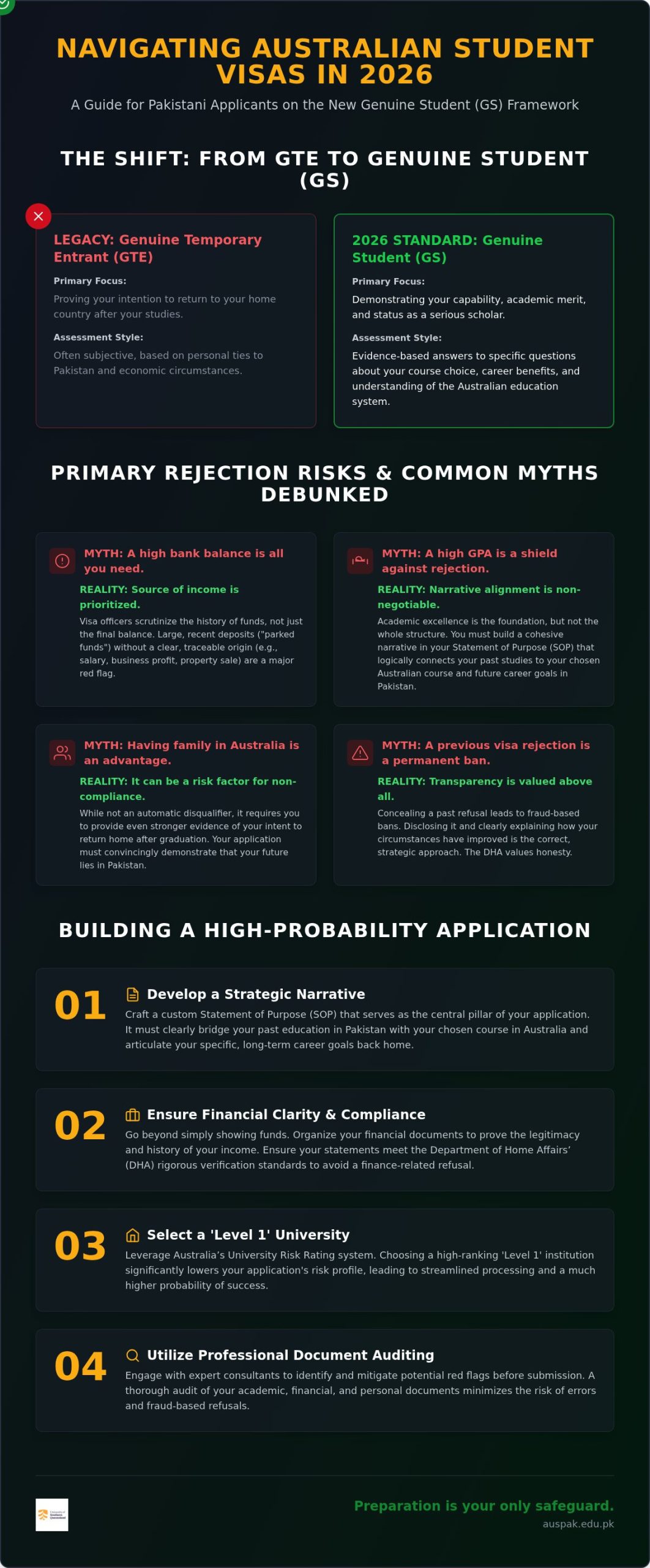
The transition from the Genuine Temporary Entrant (GTE) to the Genuine Student (GS) requirement represents a fundamental change in how your intent is measured. While the old system focused heavily on your intention to return home, the GS criteria for 2026 focus on your capability and academic merit. You’ll need to answer specific questions regarding your choice of course, how it benefits your career in Pakistan, and your understanding of the Australian education system. It’s a shift from being a temporary visitor to being a serious scholar. Failing to provide evidence-backed answers to these questions is one of the most common Australian student visa rejection reasons Pakistan students encounter today. To fully understand how this transition affects your application, review the updated GTE requirements for Australian student visa and what the new GS framework demands from Pakistani applicants.
Why ‘Level 1’ Universities Matter for Your Visa
Australia’s University Risk Rating system plays a decisive role in your application’s speed and outcome. Level 1 universities are high-ranking institutions with a proven track record of student compliance. This history grants their applicants a streamlined processing status. Choosing a Level 1 university significantly reduces the likelihood of a rejection because the DHA views these students as lower risk. Conversely, opting for lower-tier colleges often triggers a more rigorous manual review of your background. Reputation matters. Logic wins. At AusPak International, we leverage our partnerships with over 40 Australian universities to help you select institutions that maximize your chances of a swift approval.
Myth-Busting: 5 Common Misconceptions About Visa Rejections
Misinformation spreads quickly in Pakistani student forums, often leading to avoidable mistakes. Many applicants believe that a high GPA or a prestigious family background acts as a shield against scrutiny. In reality, the Australian student visa rejection reasons Pakistan applicants face often stem from a lack of narrative alignment rather than academic failure. A student with a 4.0 GPA can still be rejected if their Statement of Purpose fails to explain why they aren’t pursuing similar options within Pakistan. Your academic record is a foundation, but it isn’t the entire building.
Having family in Australia is another common point of confusion. While some believe it helps, it can actually signal a higher risk of non-compliance if you can’t prove your intent to return home after graduation. Similarly, a previous rejection from Canada or the UK isn’t a permanent barrier to your dreams. The Department of Home Affairs values transparency above all else. Disclosing a past refusal and explaining how your circumstances have changed since that decision is far better than concealment. Dishonesty leads to immediate fraud-based bans; clarity leads to opportunity.
Myth 1: A High Bank Balance is All You Need
Having a massive amount of liquidity in your account doesn’t guarantee success. In 2026, visa officers are specifically trained to identify “parked funds,” which are large deposits made shortly before an application without a clear history. The Department of Home Affairs prioritizes the Source of Income over the final balance. Whether your funds come from agricultural land sales, business profits, or salaried savings, every transaction must be traceable back to its origin. Third-party sponsorships are also under intense scrutiny. If a distant relative is sponsoring you, you must provide a compelling reason why they are making this financial commitment. For those feeling overwhelmed by financial documentation, seeking Australian University Admission Support can help clarify these complex requirements.
Myth 2: Study Gaps are Absolute Visa Killers
A gap in your education isn’t an automatic rejection if it’s filled with purpose. The DHA distinguishes between an unexplained gap and career progression. If you spent two years working in a relevant industry or completed professional certifications, these are viewed as enhancements to your profile. The key is to document this time with appointment letters, salary slips, and experience certificates. Using short courses to bridge academic pauses shows a commitment to continuous learning, which aligns perfectly with the Genuine Student criteria. Understanding these nuances helps you avoid the common Australian student visa rejection reasons Pakistan candidates often overlook. Evidence protects your future.
The Financial Trap: Why Bank Statements Lead to Most Refusals
Financial documentation remains the primary hurdle for most applicants in 2026. The Department of Home Affairs (DHA) has moved beyond simply checking for a specific figure in an account. They now analyze the entire financial ecosystem of the student and their sponsors. Inconsistent transaction histories, such as sudden large deposits or “parked funds,” trigger immediate suspicion. These anomalies are frequently cited among the Australian student visa rejection reasons Pakistan applicants face. Officers look for a logical flow of capital that matches your family’s reported lifestyle and professional background. If the money appears out of nowhere, the visa will likely be refused.
Errors in Federal Board of Revenue (FBR) tax returns are particularly damaging to your credibility. Discrepancies between the income declared to the Pakistani government and the funds shown for the visa application suggest financial non-disclosure or fraud. You must ensure that your annual income evidence supports the gradual accumulation of the liquid assets you’re presenting. If your sponsor’s tax returns show a modest income but their bank account holds millions of PKR, the visa officer will question the legitimacy of those savings. Transparency is your greatest asset.
Proving the ‘Source of Wealth’
Documenting agricultural income or business profits requires more than just a simple letter or a local certificate. You need to provide J-Forms, land ownership records, or audited business accounts that correlate exactly with the deposits in your bank statement. The DHA expects your reported income to reflect your actual economic standing within Pakistan. Genuine access to funds means the applicant can demonstrate not only the existence of the money but also a legitimate, legal pathway through which those funds are available for their exclusive use in Australia. Without this clear, documented link, your application is at high risk of a fraud-based rejection.
Currency Fluctuation and Buffer Zones
The volatility of the PKR against the Australian Dollar (AUD) presents a unique challenge for Pakistani students. Showing only the minimum required amount is a dangerous strategy that often leads to failure. If the exchange rate shifts negatively during the processing period, your application could fall short of the mandatory financial threshold at the moment of decision. We recommend maintaining a significant buffer zone, ideally 10% to 15% above the minimum, to account for these fluctuations. Additionally, using multiple sponsors can complicate your narrative. The more sponsors you have, the harder it becomes to prove that all those individuals will actually provide the funds once you’re onshore in Melbourne. Stick to immediate family members to maintain a clean, high-probability profile. Families managing tight budgets should also explore affordable Australian universities for Pakistani students to identify institutions with lower tuition fees that still meet DHA risk-level requirements.
Building a Strategic Narrative: The Statement of Purpose (SOP)
Your Statement of Purpose (SOP) is the primary document that defines your identity as a Genuine Student. In 2026, the Department of Home Affairs utilizes sophisticated plagiarism detection and AI-analysis tools to identify generic content. Submitting a “copy-paste” narrative is the fastest way to trigger a refusal. Your story must be uniquely yours, bridging the gap between your previous Pakistani education and your future professional aspirations. If you’ve completed a Bachelor’s in Engineering in Pakistan, your SOP must clearly articulate why an Australian Master’s is the essential next step that your local market cannot provide. Failing to articulate these points clearly is one of the most frequent Australian student visa rejection reasons Pakistan applicants encounter.
A successful narrative focuses on the logic of the journey. You must demonstrate a clear incentive to return to Pakistan by highlighting specific professional opportunities or family commitments that require your presence post-graduation. Officers look for concrete evidence of your research. This includes comparing tuition costs, curriculum depth, and post-study outcomes across various global destinations. If you can’t explain why Australia is a better investment than the UK or USA for your specific field, your application will likely be flagged. For personalized guidance on refining your narrative, consider seeking expert Australian University Admission Support to ensure your story aligns with DHA expectations.
Step-by-Step: Crafting Your GS Answers
The 2026 GS framework requires precise answers to a set of targeted questions. You must move beyond emotional statements and provide data-driven justifications for your choices. Understanding these narrative requirements is crucial, as a weak SOP remains one of the top Australian student visa rejection reasons Pakistan students face in 2026.
- Destination Research: Detail your comparison between Australian universities and similar programs in Pakistan or the UK. Mention specific modules that are unique to Australia.
- Why Australia? Focus on the quality of the Education Services for Overseas Students (ESOS) framework and the specific industrial links of your chosen city.
- Post-Graduation Path: Name specific industries or firms in Pakistan where your new skills will command a premium salary.
Common SOP Red Flags to Avoid
Small errors in your SOP can lead to significant setbacks. Avoid these common pitfalls to keep your application on track. Precision in your narrative is just as important as the accuracy of your bank statements.
- Unrealistic Salary Claims: Don’t claim you’ll earn a salary that is statistically impossible for a fresh graduate in Pakistan.
- Module Ignorance: If you can’t name at least three core subjects and explain their relevance, you don’t look like a genuine student.
- Weak Logical Link: If your chosen course has no connection to your past studies or work experience, you must provide a very strong explanation for the career change.
How AusPak Minimizes Your Risk of Visa Rejection
AusPak International has spent three decades refining the transition from Pakistan to Australia. We don’t just process papers; we engineer success. Our proprietary “Triple-Check” document verification process acts as a rigorous filter, ensuring every piece of evidence meets the highest standards of the Department of Home Affairs. By identifying the specific Australian student visa rejection reasons Pakistan applicants commonly face, we address potential red flags before your file ever reaches a visa officer. Our legacy since 1995 provides us with an unparalleled database of case studies, allowing us to predict and mitigate risks with surgical precision.
Mock interview sessions are a cornerstone of our preparation. We replicate the high-pressure environment of a DHA interview, forcing you to articulate your Genuine Student (GS) answers with clarity and confidence. This isn’t about memorizing scripts. It’s about understanding the logic behind your own application. We challenge your financial narratives and your career goals until they are bulletproof. This level of preparation transforms anxiety into authority. We ensure your story is consistent across every document you submit.
Expert Counseling and Profile Assessment
Success begins with a realistic assessment of your starting point. We meticulously analyze your academic background and financial capacity to match your profile with the appropriate University Risk Level. Choosing a university that aligns with your specific risk profile is essential for a streamlined experience. Our team identifies internal weaknesses, such as minor document discrepancies or weak logical links in your history, during the initial University Application Processing phase. We ensure that your application isn’t just complete; it’s competitive.
Onshore Support: A Complete Journey
The journey doesn’t end when your visa is granted. AusPak is one of the few consultancies with a dedicated onshore office in Melbourne, providing you with a trusted navigator the moment you land. This physical presence in Australia builds immense credibility with visa officers, as it demonstrates a continuous support network for the student. From arrival assistance to ongoing academic guidance, we remain your partner throughout your degree. To understand exactly what awaits you upon arrival and how to make the most of your first days in the city, explore our comprehensive guide to onshore student support Melbourne covering housing, legalities, and your 2026 essential arrival checklist. Don’t leave your future to chance. Book a free consultation to evaluate your visa chances and take the first step toward a successful Australian transition.
Take the Next Step Toward Your Australian Education
Mastering the 2026 Genuine Student (GS) criteria requires more than just submitting standardized documents; it demands a logical, evidence-backed narrative that connects your Pakistani academic history with specific Australian career outcomes. Transparent financial reporting, particularly regarding the verifiable source of wealth, remains the most critical factor in avoiding the common Australian student visa rejection reasons Pakistan applicants face today. By focusing on institutional risk ratings and precision-driven Statement of Purpose writing, you can transform a complex regulatory process into a clear path for personal and professional advancement.
With over 30 years of expertise in Pakistani student recruitment and direct partnerships with top-tier Australian Universities, AusPak International provides the rigorous document verification and onshore Melbourne support you need to succeed. Secure your future in Australia—get a professional profile assessment from AusPak today! Your global milestones are within reach. Take action today to ensure your application stands out for the right reasons and leads to a successful visa grant.
Frequently Asked Questions
What are the most common Australian student visa rejection reasons for Pakistani students in 2026?
The primary Australian student visa rejection reasons Pakistan applicants face in 2026 include a lack of logical progression in their academic history and an inability to verify the source of funds. Officers look for inconsistencies between your reported income and your actual financial transactions. If your Statement of Purpose (SOP) fails to demonstrate why an Australian degree is a necessary investment compared to local options, your application will likely be flagged for refusal.
Can I reapply for an Australian student visa after a rejection?
You can certainly reapply for an Australian student visa after a rejection, provided you address the specific grounds for refusal mentioned in your decision letter. It’s essential to disclose your previous rejection transparently. Simply resubmitting the same documents will lead to another refusal. You must provide fresh evidence or a clarified narrative that solves the officer’s initial concerns, such as improved financial documentation or a more detailed career plan.
How much bank balance is required for an Australian student visa from Pakistan?
You must demonstrate access to funds that cover at least 12 months of tuition fees, living expenses, and travel costs. For 2026, the Department of Home Affairs requires students to show a balance that reflects genuine financial capacity, often totaling around 20,000 USD for living costs alone, plus your specific tuition fees. The focus is less on the total amount and more on the source of wealth, ensuring the money is legitimately yours.
Does a low IELTS or PTE score increase the chance of visa refusal?
A low IELTS or PTE score significantly increases the chance of a visa refusal because it questions your academic capability. Each university level has specific English requirements; failing to meet these suggests you may struggle with the curriculum. If your score is borderline, it’s often better to retake the test or enroll in an English language bridging course (ELICOS) to prove your commitment to succeeding in an Australian academic environment.
How do I prove my intent to return to Pakistan after my studies?
Proving your intent to return to Pakistan requires showing strong economic and personal ties to your home country. You should document family assets, property ownership, or a standing job offer from a Pakistani firm that values an international degree. Your Statement of Purpose must clearly explain how the specific skills gained in Australia will lead to a high-paying career in the Pakistani market, making your return a logical and profitable decision.
Is it possible to get a visa with a 5-year study gap?
It is entirely possible to secure a visa with a 5-year study gap if you can provide documented evidence of professional growth during that period. The Department of Home Affairs accepts gaps that are filled with relevant work experience, internships, or professional certifications. You must include appointment letters and salary slips in your application. Unexplained gaps are a major red flag, but a gap used for career advancement is often viewed as a strength.
What is the ‘Genuine Student’ requirement for Australia?
The Genuine Student (GS) requirement is a 2026 assessment framework that focuses on your academic merit and the logic of your study plan. Unlike the previous GTE standard, the GS criteria prioritize your capability to complete the course and the value the degree adds to your future career. You must answer targeted questions about your research into other study destinations and explain why Australia is the most suitable choice for your professional development. For a detailed breakdown of how the old and new standards compare, consult our comprehensive guide on GTE requirements for Australian student visa applications and the 2026 GS transition.
How long does it take to process a student visa from Pakistan in 2026?
In 2026, processing times for Pakistani students typically range from four to eight weeks, depending on the risk level of your chosen university. Applications for Level 1 institutions are often prioritized and processed more quickly than those for lower-tier colleges. To avoid delays, ensure that all your documents are verified and complete at the time of submission. Incomplete files or requests for additional information can extend the timeline significantly beyond the standard window.