
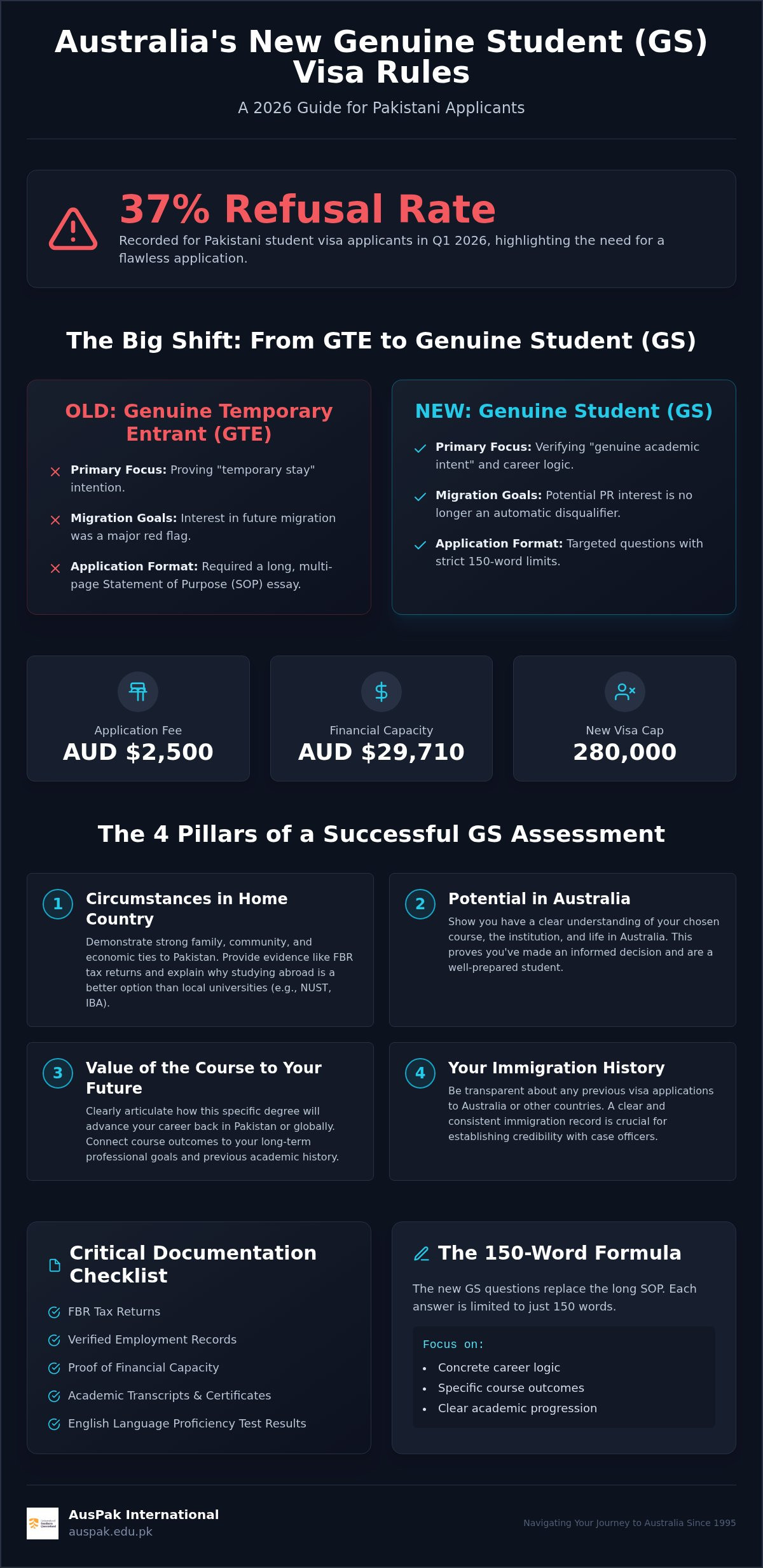
With a 37% refusal rate for Pakistani student visa applicants recorded in the first quarter of 2026, the margin for error in your documentation has never been slimmer. You’ve likely noticed that simply meeting the old GTE requirements for Australian student visa applications is no longer enough to guarantee success. The Australian government’s shift to the Genuine Student (GS) requirement means authorities are now scrutinizing your career logic and academic intent with unprecedented depth. It’s a high-stakes transition. This change can feel overwhelming when your international future is on the line.
We understand that explaining career gaps or proving family ties feels subjective and stressful. This guide transforms that uncertainty into a clear, actionable roadmap for your success. You’ll master the AUD $2,500 application fee requirements and the AUD $29,710 financial capacity threshold while learning to draft 150-word responses that satisfy the most rigorous assessments. We’re providing a comprehensive checklist designed specifically for the Pakistani market. This ensures your application stands out in a competitive landscape limited by the new 280,000 visa cap.
Key Takeaways
- Understand the mandatory shift from “temporary intent” to “academic purpose” as the Genuine Student (GS) requirement replaces the traditional framework for 2026.
- Master the updated GTE requirements for Australian student visa applications by aligning your career logic with specific university course outcomes and long-term professional goals.
- Learn the “150-Word Formula” to navigate the strict character limits of the ImmiAccount form while maintaining the high quality expected by Department of Home Affairs assessors.
- Identify critical documentation for Pakistani applicants, including FBR tax returns and verified employment records, to eliminate “red flags” before submission. For families with business interests in the UAE, you may also [explore Tax Consultancy](https://accouconsult.com/services/corporate-tax-consultant-dubai/) to ensure your corporate tax documentation is prepared to international standards.
- Leverage AusPak International’s 30 years of expertise and Melbourne-based onshore support to ensure a seamless transition from your visa grant to your arrival in Australia.
Understanding the Shift: From GTE to the Genuine Student (GS) Requirement
The transition from the Genuine Temporary Entrant (GTE) framework to the Genuine Student (GS) requirement represents the most significant overhaul of the Australian migration system in a decade. For years, the GTE requirements for Australian student visa applicants focused heavily on proving a "temporary stay" intention. If a case officer suspected you might want to stay in Australia long-term, your application faced immediate risk. In 2026, the priority has shifted entirely. The GS requirement is an integrity measure designed to verify your academic intent rather than just your return date. This means the Department of Home Affairs now assesses whether you’ve made an informed choice to study and if that study aligns with your professional trajectory.
One of the most encouraging changes in this new era is the government’s stance on migration pathways. Unlike the previous system, having a potential interest in future Permanent Residency (PR) no longer automatically disqualifies you. As long as your primary purpose for entering the country is to complete your degree, your application remains valid. This shift acknowledges that International Student Visas in Australia are often the first step toward a global career, making the process feel more transparent and less like a "trick" question about your future.
Why the Australian Government Changed the Criteria
The 2024 Migration Strategy laid the groundwork for these 2026 standards by identifying a need for high-skilled graduates who can contribute to specific sectors of the Australian economy. Authorities wanted to eliminate "visa hopping," a practice where individuals moved between unrelated, low-level courses just to maintain residency. By focusing on the GS requirement, the government ensures that students are genuinely committed to their chosen field. This logic-driven approach benefits Pakistani applicants who have a clear, documented plan for their advancement. It rewards those who view education as a milestone rather than just a means of entry.
GTE vs. GS: Key Differences for Pakistani Applicants
The most practical change for Pakistani applicants is the removal of the traditional, multi-page Statement of Purpose (SOP). You’re no longer required to write a sprawling essay that tries to cover every aspect of your life. Instead, you’ll answer targeted questions within the online ImmiAccount form. Each response is capped at a strict 150-word limit. This shift moves the focus from flowery language to concrete career logic. While the old GTE requirements for Australian student visa often felt like a test of your "intent to return," the GS assessment is a test of your "intent to learn." You must now prove that your previous academic history is relevant to your new course and that you understand the specific benefits of studying in Australia versus staying in Pakistan.
The 4 Pillars of a Successful GS Assessment
Your success in the 2026 visa landscape depends on a unified narrative. The Department of Home Affairs no longer looks at your application as a collection of isolated documents; they view it through four distinct analytical lenses. Consistency across these pillars is the secret to avoiding the high refusal rates currently affecting the region. If your financial documents suggest one story but your academic history tells another, you’ll trigger an immediate red flag. The Department of Home Affairs Genuine Student requirement is the definitive benchmark for this assessment, moving beyond the old GTE requirements for Australian student visa to focus on a holistic profile of the applicant.
Circumstances in Your Home Country
Case officers start by examining your roots in Pakistan. You must provide a compelling reason why you’re choosing to leave your current environment for international study. This involves documenting strong family ties, community involvement, and economic stability. If you’re involved in a family business in Lahore or Karachi, provide FBR tax returns and registration documents to prove your stake in the local economy. You also need to address why a similar course at a local institution like NUST or IBA isn’t a viable option. Clearly explaining the "push factors" in the local market ensures the assessor sees you as a student seeking advancement rather than an economic migrant.
Potential Situation in Australia
You need to demonstrate that you’ve done your homework. This means showing a deep understanding of your chosen university, its specific campus location, and the realities of living in Australia. You must prove you can meet the financial capacity requirement of AUD $29,710 for your first year of living costs without relying on part-time work. If you have family or friends in Australia, explain how their presence provides a support network for your academic goals rather than just a reason to stay. You don’t want to appear as if you’re choosing a city based on social ties alone; your focus must remain on the course structure and the commitment required for your degree.
Value of the Course to Your Future Career
This is the central pillar for 2026. You must map your degree to specific, high-level job roles in the global or Pakistani market. Quantify your expected salary increase by researching current job postings on platforms like LinkedIn or Rozee.pk. This Master of Business Analytics degree bridges the gap between my current project management experience and the technical data-driven leadership roles now required by Pakistan’s rapidly expanding tech sector. If you aren’t sure how to articulate this link, you can consult with an expert advisor to refine your career logic. Showing a clear professional trajectory proves that the investment in your education is a rational business decision for your future.
Comprehensive Documentation Checklist for Pakistani Students
Evidence is the bedrock of your application. While the shift to the GS model has streamlined the online application form, the underlying GTE requirements for Australian student visa protocols still dictate the level of documentation you must provide. You cannot rely on mere assertions. Every claim regarding your academic past and professional future must have a corresponding, verifiable document attached to your ImmiAccount. This rigorous approach is essential to navigate the increased scrutiny currently applied to South Asian applicants. Following the Official GS Requirements ensures your file is decision-ready from the moment of submission.
Your primary checklist must include the following high-priority items:
- Academic Records: Provide HEC-verified degrees, transcripts, and certificates. If you’re currently studying, include a "bonafide student" certificate from your institution.
- Employment Evidence: Submit the last three months of salary slips, formal experience letters on company letterhead, and FBR tax returns to validate your professional history.
- Financial Capacity: You must show proof of at least $19,550 (the equivalent of AUD $29,710) for living costs, plus the visa application fee of approximately $1,645 (the equivalent of AUD $2,500).
- English Proficiency: A valid IELTS score of 6.5, or an equivalent PTE or TOEFL result, is the standard threshold for most 2026 higher education commencements.
Proving Economic and Family Ties
Case officers need to see that you have a compelling reason to maintain your connection to Pakistan. For students with family assets, property documents or family business registration papers (such as Form C or partnership deeds) are vital. If your parents are sponsoring you, provide an affidavit of support alongside their income proof, such as bank statements and tax filings. Membership in professional bodies, like the Pakistan Engineering Council (PEC) or the Institute of Chartered Accountants of Pakistan (ICAP), further demonstrates your established social and professional standing in your home country.
Addressing Education Gaps and Immigration History
Honesty is the only policy when it comes to your immigration history. You must document every previous visa grant or refusal from any country, as failing to disclose a prior rejection is a leading cause of visa failure. Understanding the real Australian student visa rejection reasons Pakistan applicants face can help you proactively address weaknesses before submission. If you have gaps in your education or employment, don’t leave them unexplained. Provide a detailed CV and letters explaining these periods. Certificates for short courses, volunteer work with NGOs, or freelance projects completed during these gaps turn "dead time" into evidence of continuous personal development and academic curiosity.
How to Answer the GS Questions: The 150-Word Formula
Precision is your greatest asset in the 2026 visa cycle. The Department of Home Affairs has replaced the open-ended Statement of Purpose with targeted questions in the ImmiAccount portal. Each response is restricted to just 150 words. This shift from the traditional GTE requirements for Australian student visa means you can’t rely on long-winded introductions or flowery prose. You must be surgical. Case officers are trained to spot generic templates or AI-generated content within seconds. If your response sounds like a chatbot or a copy-pasted university brochure, it signals a lack of genuine research. Your goal is to pack maximum "career logic" into a very small space.
Quality over quantity is your new mantra. You don’t have the luxury of repeating information that is already visible in your transcripts. Instead, use these 150-word blocks to explain the "connective tissue" between your past achievements and your future goals. Every sentence must serve a purpose. If a word doesn’t add evidence of your genuine intent, delete it. This level of focus demonstrates that you’re a serious candidate who has carefully considered the investment of time and money required for Australian study.
Structuring Your Responses for Impact
To succeed within the character limit, follow a three-step logical progression for every answer. Start by stating your specific objective immediately. For example, "I’ve chosen the Master of Cyber Security to specialise in cloud infrastructure protection." This is your "Why." Next, provide evidence-based reasoning. Mention two or three specific modules or unique industry partnerships the university offers. Finally, connect the dots to your future. Name a specific job title or a sector in Pakistan, such as "Chief Information Security Officer in the growing fintech industry of Karachi," where this knowledge is in high demand.
Common Pitfalls to Avoid in the GS Statement
Generic praise is the fastest way to a rejection. Avoid phrases like "Australia is a beautiful country" or "I want a high-quality education." These are empty statements that apply to thousands of applicants. Case officers want to see that you understand your specific course better than anyone else. Do not copy-paste content directly from university websites. Assessors check for this. Use your own voice to explain how the curriculum fits your existing skills. Most importantly, ensure your written answers match the documents you’ve uploaded exactly. If you mention a specific salary increase, make sure it aligns with the local market data you provided in your financial evidence. Many applicants are surprised to learn that the most common Australian student visa rejection reasons Pakistan officers cite are rooted in narrative inconsistencies rather than outright document fraud.
Writing with such extreme brevity is difficult. If you’re struggling to condense your professional story, you should get your GS responses reviewed by a professional consultant to ensure they meet the 2026 integrity standards.
Navigating the Visa Journey with AusPak International
Securing your future requires a partner who understands the high-stakes nature of the 2026 migration landscape. With 30 years of experience since our founding in 1995, AusPak International acts as your "Trusted Navigator" through every phase of the application. We specialize in transforming the anxiety of the GTE requirements for Australian student visa into a structured, successful submission. Our team understands the nuance of the shift from the old GTE requirements for Australian student visa to the current GS model. We conduct a rigorous document verification process to ensure 100% compliance with current integrity standards. We identify potential "red flags," such as unexplained career gaps or insufficient financial evidence, before your file ever reaches a case officer.
Our personalized counseling focuses on more than just paperwork. We help you articulate your career logic so that your GS responses resonate with the Department of Home Affairs. By aligning your personal history with the specific outcomes of your chosen degree, we build a narrative that proves your genuine intent. You’ll gain the confidence to answer complex visa questions with precision and clarity. This proactive screening is vital in a market where refusal rates for Pakistani students remain high, and the industry often relies on platforms for Lead generation for migration professionals to connect applicants with verified experts.
Expert Profile Assessment and Guidance
Every successful journey begins with a detailed review of your academic and professional background. We don’t believe in one-size-fits-all solutions. Our consultants analyze your transcripts and work history to identify the most strategic path forward. With partnerships across 40+ Australian universities, we provide exclusive access to institutions that align with your long-term goals. We guide you through the entire documentation phase, from HEC verification of your degrees to the final submission of your ImmiAccount. This step-by-step support ensures that no detail is overlooked, maximizing your probability of a visa grant.
Onshore Support: We Are with You in Australia
Whether you need guidance on local regulations or support throughout your academic journey, we remain your primary gateway for success. We’re physically present in Australia to ensure your transition is as seamless and exciting as you imagined it would be, including the opportunity to experience the history of nearby Papua New Guinea with Discover Kokoda Treks.
Start your Australian journey with a free profile assessment today.
Take the Next Step Toward Your Australian Degree
The transition from legacy GTE requirements for Australian student visa applications to the current Genuine Student standard is more than a change in terminology; it’s a shift toward professional accountability. By mastering the 150-word response formula and aligning your Pakistani professional ties with your Australian academic goals, you transform a complex legal process into a logical career step. Success in 2026 demands precision, verifiable evidence, and a narrative that connects your past achievements to a high-value future.
Don’t leave your international aspirations to chance. With 30+ years of excellence and official partnerships with 40+ Australian universities, AusPak International provides the expert oversight needed to eliminate red flags before submission. Our Melbourne onshore office ensures you have support long after your visa is granted. Book a Free Visa Consultation with AusPak Experts to begin your journey with confidence. Your global milestone is within reach.
Frequently Asked Questions
Is the GTE requirement still used for Australian student visas in 2026?
No, the Genuine Temporary Entrant (GTE) requirement was officially replaced by the Genuine Student (GS) requirement for applications lodged after March 23, 2024. While the term GTE requirements for Australian student visa is still used by many applicants, the assessment now focuses on your academic integrity and career logic. You must demonstrate that your primary purpose for entering Australia is to obtain a high-quality education rather than simply seeking residency.
What is the word limit for the Genuine Student (GS) responses?
Each response in the online visa application form is limited to a strict 150-word limit. This constraint requires you to be extremely concise and evidence-based in your explanations. You can’t rely on flowery language; instead, you must pack every sentence with specific details about your course choice, university research, and professional goals in Pakistan. This "quality over quantity" approach is the standard for 2026 assessments.
Can I apply for a student visa if I have a previous visa refusal?
Yes, you can still apply, but total transparency is mandatory. Failing to disclose a previous refusal from any country is a primary reason for immediate rejection under the GS integrity measures. You must provide a clear explanation of the previous refusal and demonstrate how your current circumstances have changed to meet the requirements. Honesty remains the most critical factor in rebuilding your credibility with the Department of Home Affairs.
Do I need to prove I will return to Pakistan after my studies?
The GS requirement focuses more on your academic intent than your intent to return. While you still need to show strong economic and family ties to Pakistan to prove you’re a genuine applicant, a potential interest in future migration pathways no longer automatically disqualifies you. Your narrative must prioritize why this specific Australian degree is essential for your professional advancement, whether that career continues in Pakistan or globally.
What are the most common reasons for GS requirement failure?
Most failures occur due to generic responses that lack specific career logic or research. Copy-pasting content from university websites or using AI-generated templates will trigger a red flag. Assessors also look for inconsistencies between your written answers and your uploaded documents. If your stated career goals don’t align with your previous academic history or the local Pakistani job market, your application’s credibility is significantly diminished.
How much bank balance is required for an Australian student visa from Pakistan?
You must provide evidence of having at least $19,550 to cover your first year of living costs. This amount is in addition to your first year’s tuition fees and the visa application fee of approximately $2500. These funds must be in a verifiable bank account, and you must be prepared to show the source of these funds to satisfy the financial capacity requirement. Ensuring these funds are readily accessible is vital for a successful grant.
Can I change my course after arriving in Australia under the GS rules?
Changing your course is possible but carries significant risks under current rules. If you move to a lower-level course or an unrelated field, the Department of Home Affairs may reassess your genuine student status. This could lead to a visa cancellation if the move is seen as visa hopping. It’s vital to consult with experts before making any changes to ensure your new path still aligns with your original visa conditions.
How can AusPak help me with my GS statement?
AusPak International provides a comprehensive review of your GS responses to ensure they meet 2026 standards. Drawing on 30 years of expertise, we help you identify red flags and refine your career logic within the 150-word limit. Our consultants ensure your narrative is consistent with your documentation. We act as your trusted navigator, leveraging our Melbourne office to provide the most current onshore insights for your application.