
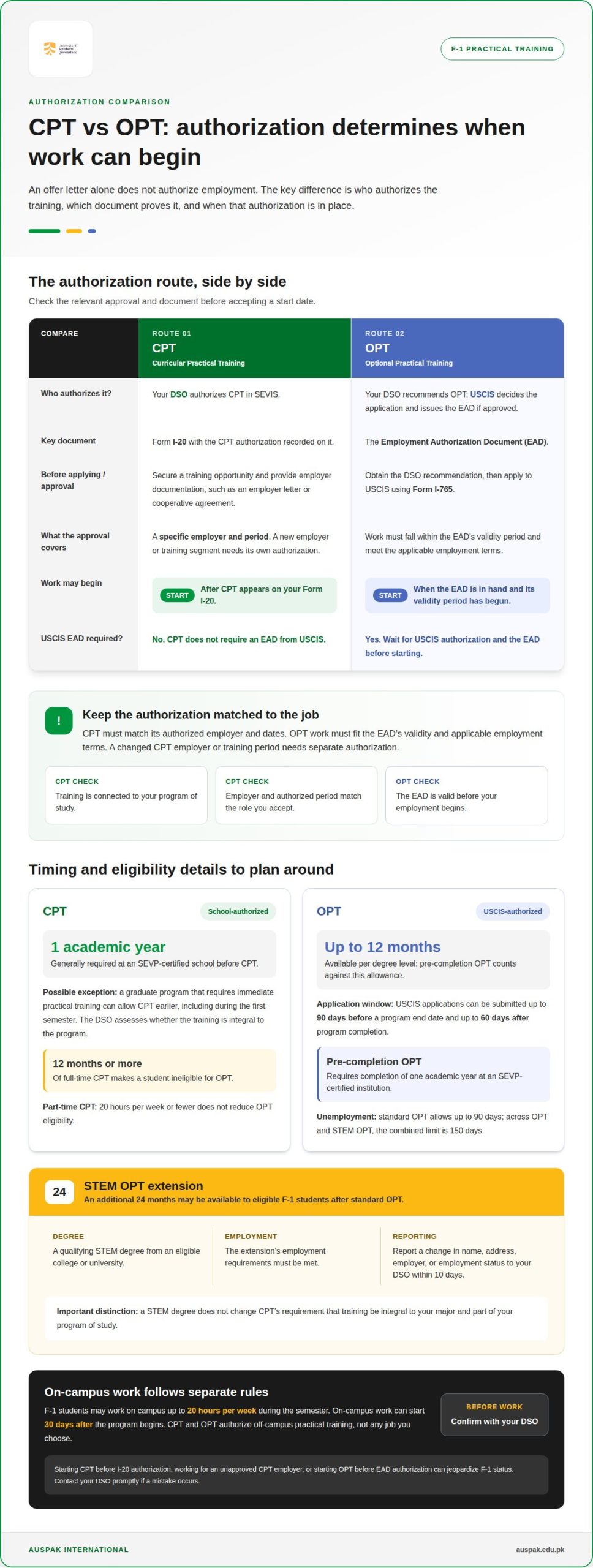
The internship you’ve secured isn’t necessarily one you can start immediately. For Pakistani students, understanding CPT vs OPT for international students in the USA starts with authorization: CPT must be approved by your school’s DSO and recorded on your Form I-20 before you begin, while OPT requires a DSO recommendation, USCIS authorization and an Employment Authorization Document (EAD) before work starts.
It’s easy to assume CPT and OPT differ only in when you use them. In practice, their authorization processes, eligible work periods, work-hour rules, and potential STEM extension all affect your decision. This guide compares those details and explains how your DSO and international student office fit into the process, so you can understand the rules before accepting a role or planning your next step.
Key Takeaways
- Compare how school-authorized CPT and USCIS-authorized OPT affect when you can begin employment.
- Understand how full-time CPT could affect your eligibility for OPT.
- Learn how study schedules shape the work-hour limits for pre-completion OPT.
- See what STEM degree and employer requirements matter when considering an OPT extension.
- Use your DSO’s guidance to plan the authorization steps and keep your student status on track.
Authorization documents and work start dates
CPT and OPT follow different approval routes, so an offer letter alone does not authorize you to work. The key distinction is whether your school records specific training authorization or USCIS issues work authorization.
CPT Authorization and Employer Records
CPT is practical training connected to your program of study. Before it can be authorized, you need a training opportunity and formal documentation, such as an employer letter or cooperative agreement. Your DSO authorizes CPT in SEVIS, and the permission must appear on your Form I-20 before work begins.
Unlike OPT, CPT doesn’t require an EAD from USCIS. Keep the employer documentation and your updated I-20 together, and compare the authorized details with the role you’re accepting. F-1 students in the United States can receive up to 12 months of OPT per degree level, according to U.S. Citizenship and Immigration Services.
Employer and Date-Specific Work Approval
CPT authorization applies to a specific employer and period. A new employer or training segment requires its own authorization, so don’t assume an existing CPT entry covers a changed role or later dates.
OPT follows a different sequence: your DSO recommends it, you apply to USCIS using Form I-765, and USCIS issues an EAD if it approves the application. Wait until the EAD is in hand and its validity period has begun before starting OPT work.
Can students change employers or travel internationally while on CPT or OPT? Work for a different employer under CPT requires separate authorization. Before traveling, discuss your documents and return plans with your DSO, since work authorization alone does not resolve travel requirements.
On-Campus and Off-Campus Work Approval
On-campus employment and off-campus practical training follow different authorization rules. F-1 students may work on campus up to 20 hours per week during the semester, and on-campus work can start 30 days after the program begins.
CPT and OPT authorize off-campus practical training, not any job you choose. Match the proposed work to your authorization: CPT must match its employer and dates, while OPT must fall within the EAD’s validity and meet the applicable employment terms.
Common violations include starting CPT before the I-20 authorization, working for an unapproved CPT employer, or starting OPT before EAD authorization. Unauthorized work can jeopardize F-1 status; contact your DSO promptly if a mistake occurs.
Work Authorization Timeline Planning
Build your timeline around the document that controls your start date. For CPT, secure the training opportunity, submit employer documentation to your school, and wait for the authorized I-20. For OPT, plan for the DSO recommendation, Form I-765 filing, and EAD delivery.
According to U.S. Citizenship and Immigration Services, OPT applications can be submitted up to 90 days before a programme end date and up to 60 days after programme completion. How do students apply for OPT and an EAD through USCIS? Obtain your DSO recommendation, submit Form I-765 to USCIS, and wait for the EAD before starting work.
| Option | Approving authority | Key document | Work start point |
|---|---|---|---|
| CPT | DSO through SEVIS | Form I-20 with CPT authorization | After authorization appears on the I-20 |
| OPT | DSO recommendation and USCIS decision | EAD | When the EAD is valid |
| On-campus work | F-1 on-campus rules | School employment records | 30 days after the program begins |
Choose the route that fits your program-linked training, employer, and available start date. Follow the required approval process before you begin working.
What Is a 24-Month STEM OPT Extension?
STEM OPT can extend practical training after standard OPT, but it does not replace CPT eligibility rules. Your degree, academic program, training history, and employment record each affect which route is available.
STEM OPT Eligibility
Eligible F-1 students may receive an additional 24 months of OPT through a STEM OPT extension, according to U.S. Citizenship and Immigration Services. Eligibility depends on earning a qualifying STEM degree from an eligible college or university and meeting the extension’s employment requirements.
How do CPT and OPT rules differ for STEM degrees and students at universities in the USA? CPT must be integral to your major and part of your program of study. STEM OPT extends OPT for eligible STEM graduates. A STEM degree does not change CPT’s academic connection requirement.
Unemployment Limits and Reporting
Standard OPT allows up to 90 days of unemployment, according to the U.S. Department of Homeland Security. Across OPT and STEM OPT, the combined unemployment limit is 150 days; track each period without qualifying employment.
Students must report changes in name, address, employer, or employment status to their DSO within 10 days of a change. How do unemployment limits and reporting requirements apply? Record employment dates, notify your DSO promptly, and monitor both limits through OPT and any STEM extension.
For CPT, F-1 students generally need to complete one full academic year at an SEVP-certified school. A graduate program that requires immediate practical training can allow CPT earlier, including during the first semester. The DSO assesses whether the training is integral to the program.
Full-time CPT carries a separate consequence: under U.S. F-1 rules, students with 12 months or more of full-time CPT are ineligible for OPT, according to the U.S. Department of Homeland Security. Part-time CPT of 20 hours per week or fewer does not reduce OPT eligibility. Keep a record of authorized CPT periods and hours so you can understand how previous training affects later plans.
OPT may be available before or after program completion. Pre-completion OPT requires completion of one academic year at an SEVP-certified institution, and its use counts against the 12-month OPT allowance per degree level. Post-completion OPT follows program completion. Compare the timing against your academic calendar and the practical training your program supports.
Before choosing a route, map your program requirements, CPT history, degree level, and intended work period. If you’re also considering another study destination, Australian university admission support can help with the admissions process.
OPT work-hour limits while school is in session
During an academic term, F-1 students on OPT may work no more than 20 hours per week while school is in session. Your schedule matters: distinguish pre-completion OPT, used before program completion, from post-completion OPT, used afterward. A job offer doesn’t change the applicable limit or authorize work by itself.
Pre-completion OPT is available before the program end date, after completing one academic year at an SEVP-certified institution. Students may work part-time for 20 hours or fewer per week, or full-time before the program end date. While classes are in session, the 20-hour weekly maximum applies. Plan around your course timetable and confirm the relevant dates with your designated school official (DSO).
For post-completion OPT, your employment must relate to your field of study. Evaluate an offer by its duties, not just its title: the role should use knowledge or skills from your academic program. Keep the offer, job description, and employment dates together. These records help you explain the connection to your degree and report your employment accurately.
On-campus work follows a separate route from OPT and curricular practical training (CPT). F-1 students may work up to 20 hours per week on campus during the semester, and may start 30 days after their program begins. Don’t treat an on-campus job as off-campus OPT, or assume an OPT document authorizes a different kind of role.
CPT is tied to practical training that forms part of the academic program. Its hour categories differ from the OPT limit: part-time CPT means 20 hours or fewer per week, while full-time CPT means more than 20 hours per week. Those labels describe CPT authorization, not a wider allowance to work on OPT during classes.
- Before accepting: Match the role to your degree and the correct authorization.
- Before starting: Compare weekly hours and dates against the authorization and academic calendar.
- After starting: Keep offer and job-duty records, and share required employment details with your DSO.
For example, a graduate student with evening classes still needs to count all OPT hours worked that week. Splitting a job between employers does not erase the weekly total. Ask your DSO how your school’s recordkeeping and reporting process applies to each role, especially if your schedule or duties change.
Keep the distinction clear: the weekly OPT cap applies during the academic term, while CPT hours depend on the school-authorized training category. Review your calendar, job duties, and authorization documents together to assess an opportunity before accepting its start date.
STEM OPT extension
The STEM OPT extension can add time for eligible F-1 graduates to work in practical training. Plan its degree, employer, training plan, and filing sequence together.
Eligible F-1 students may receive an additional 24 months of OPT through a STEM OPT extension, according to U.S. Citizenship and Immigration Services. The extension follows standard optional practical training; it is not a separate degree or a substitute for the initial OPT period. Combined, standard OPT and the extension can provide 36 months of OPT.
Eligibility starts with your degree. You must have earned a STEM degree at the bachelor’s, master’s, or doctoral level from an SEVP-certified college or university. The job and employer must also meet the extension’s requirements. A STEM major alone does not make every position eligible.
The employer must participate in USCIS E-Verify, and the student and employer must sign Form I-983, the training plan. Use the plan to set out the practical training and its connection to the student’s learning. Before filing, compare the degree, employer, job duties, and training plan for consistency.
Apply before current OPT authorization ends, and coordinate the filing with your designated school official (DSO). A pending extension does not mean you can assume work authorization continues under every circumstance. Eligible students with a pending 24-month STEM OPT extension petition may continue working on an expired OPT employment authorization document for up to 180 days, if they meet the stated conditions.
Keep the filing receipt, current and prior employment authorization documents, Form I-983, and employer details together. If duties or training arrangements change, discuss the update with your DSO and maintain accurate records. This helps you track which authorization applies to each period and avoid treating a pending application as approval beyond the permitted conditions.
Cap-gap planning is a separate issue from the STEM extension. If your next step involves H-1B status, map the relevant dates with your DSO rather than assuming STEM OPT changes your status automatically. H-1B status allows temporary employment for up to six years. Keep that path distinct from the additional OPT period and its STEM-specific employer and training requirements.
Before choosing a start date, build a timeline that includes your current EAD end date, STEM filing, the employer’s E-Verify participation, and the signed training plan. Record your weekly work hours and job duties against that plan, too. A clear document trail helps you and your DSO assess whether your employment fits your authorization.
DSO and international student office guidance
Your designated school official (DSO) connects your academic record with practical-training authorization. For CPT or OPT, involve your international student office before accepting a start date, changing employment, or filing an application.
How do students apply for CPT through their university DSO? First, secure a training opportunity and gather employer documents, such as an offer letter or cooperative agreement. Then submit the school’s CPT request and course details. The DSO assesses whether the training is integral to your major and part of your program.
F-1 students generally must complete one full academic year at an SEVP-certified school before qualifying for CPT, according to the U.S. Department of Homeland Security. An exception applies when a graduate program requires immediate CPT. Your university determines how its course, academic calendar, and training requirements fit that rule.
After reviewing your request, the DSO authorizes CPT in SEVIS. The authorization must appear on your Form I-20 before you begin work. Compare the employer name and authorized dates on that document with your offer. Each employer and CPT segment needs separate authorization, so a changed placement requires a new review.
For OPT, the DSO’s role is a recommendation, not the final employment authorization. The student then files Form I-765 with USCIS and waits for an Employment Authorization Document. Ask the international student office about its recommendation process and required school records. USCIS permits filing up to 90 days before a program end date and up to 60 days after completion.
Use each meeting to resolve a specific decision. Bring the relevant documents and ask your DSO to explain the next step:
- For CPT: Discuss how the role connects to your major, course, and employer records.
- For OPT: Confirm the recommendation process, filing window, and documents needed for Form I-765.
- For changes: Report a new name, address, employer, or loss of employment to your DSO within 10 days.
Keep dated records of submissions, school responses, and revised documents. If an offer changes after your university reviews it, pause and ask how the change affects the authorization already recorded. This helps distinguish a school recommendation from USCIS approval, and an application from permission to work.
If your education plans include another destination, explore options for your next study step.
AusPak International: Australian University Admission Support
If comparing U.S. work options leads you to consider studying elsewhere, AusPak International can help you explore other study destinations. Its Australian University Admission Support helps Pakistani students plan applications to Australian universities, while UK Student Visa Consultancy and Canada Study Permit Assistance support students pursuing those routes.
Choose your next step based on your study destination and the support you need. CPT or OPT does not authorize work in another country. If Australia is on your shortlist, start by organizing your academic plans and application documents. For the UK or Canada, focus on the relevant student visa or study permit process.
Contact AusPak International to discuss your study plans, or visit auspak.edu.pk.
Plan your next academic move with confidence
Your next decision can shape more than your work timeline. Consider how your academic goals, preferred destination, and career plans fit together before committing to a study route. For Pakistani students comparing CPT vs OPT for international students in the USA, keep U.S. work authorization decisions with your school’s DSO. Treat a change of destination as a separate education plan.
If you are considering another country, AusPak International offers Australian University Admission Support, UK Student Visa Consultancy, and Canada Study Permit Assistance. These services can support your plans for study destinations beyond the United States, while your university remains your point of guidance for U.S. CPT and OPT authorization.
Take the next step at a pace that suits your plans. Contact AusPak International for guidance about your study pathway. A thoughtful plan can turn a complex transition into a clear direction forward.
Frequently Asked Questions
What Is The Difference Between CPT and OPT?
CPT is practical training built into an F-1 student’s course of study, while OPT is temporary employment authorization connected to the student’s major. For example, a required internship during a program may fit CPT; a graduate seeking related work after finishing may use post-completion OPT. The key distinction is the training’s academic connection and timing. For CPT vs OPT for international students in USA, compare your program stage with the role’s connection to your field.
What are the eligibility requirements?
CPT generally requires F-1 status, a training opportunity, and work integral to the major and program. Students typically complete one full academic year at an SEVP-certified school first, with an exception for graduate programs requiring immediate training. OPT generally requires one academic year of full-time enrollment at an SEVP-certified institution, a DSO recommendation, and USCIS authorization. Check how your enrollment history and intended work align with each route.
Can You Apply for CPT and OPT at the Same Time?
You can discuss both pathways with your DSO, but don’t assume they authorize the same job or overlapping work periods. CPT is tied to specific employer details and dates, while OPT requires USCIS authorization. OPT periods cannot overlap. Before accepting schedules with dates that touch or overlap, ask your DSO to review the proposed dates, program requirements, and existing authorizations. Keep each application and approval record separate.
Does CPT Affect OPT?
Part-time CPT of 20 hours per week or fewer does not reduce OPT eligibility. Full-time CPT has a different effect: under U.S. F-1 rules, students with 12 months or more of full-time CPT are ineligible for OPT, according to the U.S. Department of Homeland Security. Keep records of CPT authorization dates and whether each period was part-time or full-time, so you can assess your training history accurately.
How Can I Learn More About OPT or CPT?
Start with your university’s international student office and ask your DSO to explain the process for your program, employer, and intended dates. Bring your course details and any job documentation so the discussion can focus on your circumstances. For OPT filing steps, use USCIS information about Form I-765 and the Employment Authorization Document. Keep notes on required documents and submission steps for your records.
How long does it take to receive the authorization?
CPT timing depends on your school’s request and review process. For example, the University of Minnesota ISSS says issuing an I-20 with CPT authorization can take up to 7 business days after a request is submitted and reviewed. OPT processing can take more than 90 days, so plan around your program end date and intended start date. Never begin work before the required authorization is active.
What Is Curricular Practical Training (CPT)?
Curricular Practical Training is off-campus practical training that forms an integral part of an F-1 student’s established curriculum. It may connect with a course, cooperative education arrangement, or required internship. A student needs a qualifying training opportunity before the school can authorize CPT. For instance, a placement connected to a program requirement may qualify, while an unrelated job does not meet that academic connection.
What are CPT and OPT for international students in the USA?
CPT and OPT are two forms of practical training available to eligible F-1 students in the United States. CPT connects work to a student’s curriculum and is authorized by the school; OPT is employment authorization linked to the student’s field and requires USCIS approval. Understanding CPT vs OPT for international students in USA also means matching the route to your study and employment plans. Your DSO can help assess that fit.