A strong F-1 visa file needs more than a balance on paper: it needs clear evidence that the money can cover your first year. The financial documents for a US student visa should generally show funding that matches or exceeds the first-year cost listed on your Form I-20. There’s no single fixed checklist, so the documents need to make your funding sources easy to understand.
If you’re applying from Pakistan, it can be difficult to know whether your own savings, family support, a loan or a scholarship will count, and how to present each source clearly. An F-1 visa is for study at a U.S. college or university certified by the Student and Exchange Visitor Program (SEVP), and proof of funds helps demonstrate how you’ll meet your education and living costs.
This guide explains what proof of funds means, which personal and family documents may support your application, and how estimated annual costs connect to the amount on your I-20. You’ll also see how to organize evidence from different sources into a coherent funding picture.
Key Takeaways
- Compare your documented funding with the first-year cost on your Form I-20, and make each source easy to trace.
- Organize personal and family bank records so the account holder, balance, currency, and date are clear.
- Prepare to explain who is sponsoring your studies, how you’re related, and where the funds come from.
- Separate available funds from assets that may not be readily accessible, and document loans or awards with official records.
- Use your university’s estimated annual costs to plan for tuition and living expenses, while accounting for visa-related fees separately.
What does “proof of funds” mean for a US student visa?
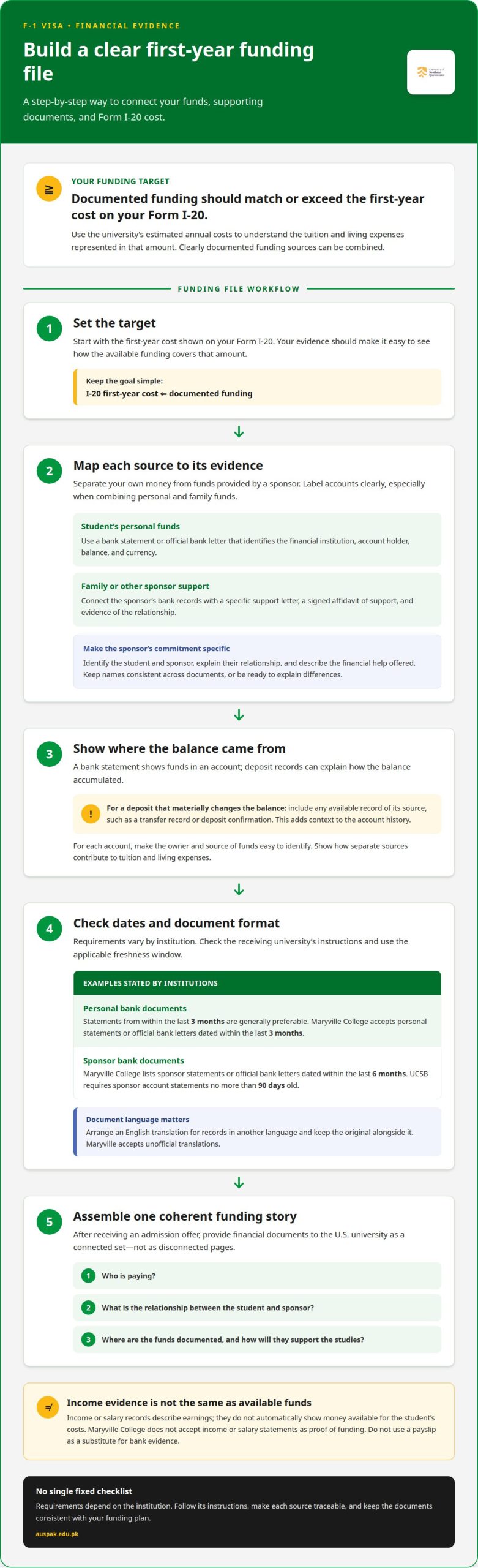
Proof of funds is documented evidence that you can finance your studies. Funding generally needs to match or exceed the first-year cost on your Form I-20, and clearly documented sources can be combined.
What sponsor affidavit and proof of income documents are required? There is no single fixed checklist. A student relying on a sponsor may provide a signed affidavit of support, evidence of the relationship, and the sponsor’s bank statements. Income or salary statements alone may not count as proof of funds; Maryville College does not accept them for this purpose.
Sponsor Letters and Support Affidavits
A sponsor letter explains who will support the student and what financial help they will provide. An affidavit of support records that commitment in a signed statement. Together, these documents connect the sponsor’s documented resources to the student’s studies.
Make the letter specific: identify the student and sponsor, explain their relationship, and describe the support offered. Include an affidavit and financial evidence rather than relying on a general promise. Be ready to explain the arrangement clearly at the interview.
Sponsor Relationship Evidence
Relationship evidence shows how the student and sponsor are connected. It helps an officer understand why a parent or another family member is funding the student’s education.
For example, a student supported by a parent can arrange documents showing their parent-child relationship alongside the sponsor letter and bank records. Keep names consistent across the documents, or be prepared to explain any differences clearly. The evidence should tell a consistent story: who is paying, for whom, and how the funds will support the studies.
Sponsor Bank Statement Requirements
A sponsor’s bank statement records account ownership and available funds that may support the student’s expenses. Make sure the sponsor’s name and financial resources are easy to identify.
Document dates vary by institution. Maryville College lists sponsor bank statements or official bank letters dated within the last 6 months as acceptable. UCSB requires sponsor account statements no more than 90 days old. Follow the receiving university’s requirements, and keep the statement and sponsor letter consistent about the person providing support.
Sponsor Income Documents
Sponsor income documents describe earnings, but do not automatically show that funds are available for the student’s costs. A bank statement or official bank letter provides evidence of account funds; an income record serves a different purpose.
Maryville College does not accept income or salary statements as proof of funding. Do not treat a payslip as a substitute for financial evidence. Instead, organize the sponsor affidavit, relationship evidence, and bank records together. If asked about funding in the visa interview, explain the sponsor’s role and point to the document that supports each part of your answer.
Personal and family bank statements and deposits
A bank statement documents funds held in an account, while deposit records can help explain how the balance accumulated. For a clear file, match each account to its owner and source of funds.
Personal Bank Statement Requirements
A personal bank statement shows the student’s account balance and available funds. Keep it current: statements from within the last three months are generally preferable for a U.S. student visa application.
Check that each statement shows the financial institution’s name, account holder’s name, balance, and currency. These details identify whose funds are shown and help compare the balance with the student’s funding plan. If the document is in another language, arrange an English translation. Keep it with the original statement so both can be reviewed together.
Family Bank Statements and Deposits
A family bank statement records funds held by a relative who may help pay for the student’s studies. Keep the account holder’s name visible, then organize the statement with family support documents explaining how the funds will be used.
For a deposit that materially changes the balance, keep any available record of its source, such as a transfer record or deposit confirmation. This provides context for the account history instead of leaving a large credit unexplained. Students combining personal and family funds can label each account separately and show how the sources contribute to tuition and living expenses.
After receiving an admission offer, students provide financial documents to their U.S. university. Prepare the statements and any required support affidavit as a coherent set rather than sending disconnected pages.
Bank Certificates and Statements
A bank certificate or official bank letter summarizes account information, while a statement shows account activity and balance. A university may accept either format, so compare the document type with its instructions.
Maryville College accepts personal bank statements or official bank letters dated within the last 3 months. Its financial statement requirements include the institution’s name, account holder, balance, and currency. Maryville also accepts documents from multiple accounts, which can help present funds held in separate accounts. Translate documents into English; Maryville accepts unofficial translations. Keep the original-language record alongside the translation for clarity.
Personal Funds and Support Affidavits
Personal funds are money held by the student, while an affidavit of support records another person’s commitment to contribute. If both sources apply, distinguish them clearly in the funding presentation.
Match the student’s account statements to the personal funds listed, then pair family funds with the supporting affidavit and relevant account records. Include a scholarship or department award with its official award documentation, which should identify the support and covered costs. This organization distinguishes savings, family contributions, and scholarships instead of presenting them as one unexplained balance.
Students also weighing Australian study options can explore Australian university admission support as a separate pathway.
Estimated annual costs for international students
An annual cost estimate is the university’s projected budget for one academic year of study. For an F-1 application, compare that budget with the first-year funding shown on your Form I-20, then prepare documents that explain how tuition and living expenses will be covered.
University estimates differ, so use the figure for your own programme rather than relying on a general U.S. average. These figures illustrate why your programme, study level, and accompanying family members matter when planning.
Separate education funding from visa application expenses. F-1 students pay a $350 I-901 SEVIS fee as part of the US student visa application process, according to U.S. Immigration and Customs Enforcement. The MRV fee is $185 when submitting the DS-160 application and booking an interview. Include these charges in your personal budget, but don’t confuse them with the university’s estimated annual cost.
Explaining Your Financial Plan at the Interview
A financial plan is a clear explanation of how documented funds will meet your education and living costs. At the interview, connect the amount on your I-20 with the sources shown in your paperwork.
Prepare concise answers to questions such as: Who is funding your studies? What is your relationship to the sponsor? How will you cover costs beyond a scholarship? If several sources contribute, identify each one and its role. Pakistani applicants should be ready to explain their funding clearly; interviews may allow only three or four minutes for that explanation.
Documents to Bring to the Visa Interview
Interview documents are the records you carry to support your application and explain your funding. Keep originals of key papers together, including your passport, Form I-20, bank letters, and sponsor letters, with copies arranged alongside them.
Use a simple order: identity and study documents first, followed by funding records. If a scholarship reduces the amount you need to show, bring its official award letter and make sure the covered costs and award amount are clear. This helps you answer questions without searching through unrelated papers.
Before the visa application, compare your funding records with the I-20 and university estimate. Check that each contribution has supporting evidence, and that your explanation distinguishes annual study costs from application charges. That detail helps you present a consistent financial plan and answer interview questions directly.
Meaning and purpose of proof of funds for an F-1 student visa
Proof of funds is evidence that you can meet the financial demands of your planned education. For an F-1 student, it connects university costs with documented funding sources.
The Form I-20 identifies the student’s programme and estimated costs, giving the financial plan a specific reference point. Funding generally needs to match or exceed the first-year cost shown there. UCSB requires proof of resources for the first year before issuing visa documents, while Maryville College requires funding for at least one year before issuing an I-20. These examples show why the university’s own process matters.
Financial evidence also helps explain how tuition and living expenses will be covered over time. UCSB recommends gathering evidence for the entire programme because a U.S. embassy or consulate may request it before issuing a visa. Prepare a funding summary that distinguishes available funds, scholarships, approved loans, and sponsor contributions. The documents should support one coherent plan, not present balances without context.
Financial Proof for an I-20 Request
Financial proof for an I-20 request is the documentation a university uses to assess funding before preparing visa documents. Follow the university’s upload instructions after receiving an admission offer.
Match each document to a funding source, then label it clearly. For example, identify a personal bank statement separately from a sponsor’s statement or scholarship award letter. If an award covers only part of the tuition, show how you will fund the remainder. This helps the university understand the full plan rather than seeing only an account balance.
Funding records should show the amount and when it will be available. Documents for government or sponsoring-agency awards should identify the agency, state the award amount and first-year availability, and show that the award was made to the student.
Financial Proof for F-1 Eligibility
Financial proof for F-1 eligibility demonstrates that the student has a credible plan to pay education and living expenses. It supports the application, but it is not the only consideration in a visa interview.
An F-1 visa is for study at a U.S. college or university certified by the Student and Exchange Visitor Program. Organize funding evidence around that specific study plan: programme, institution, expected costs, and documented sources. If the plan combines family support and a scholarship, explain how both contribute without counting the same funds twice.
Proof of funds and proof of ties to Pakistan serve different purposes. Under Section 214(b), students are presumed to be intending immigrants until they demonstrate otherwise. Financial records explain how studies will be funded; evidence of personal circumstances can help explain the student’s plans after study. Keep those explanations consistent with the application and interview answers.
Acceptable financial documents
Financial documents for a US student visa should show available funds and connect them to a clear source. Bank statements, official bank letters, approved loan documents, and award letters can support an application. Documents in another language need English translations; the university requirements described focus on translation, not notarization. There is no single fixed checklist specifically for applicants at the U.S. Embassy in Islamabad.
Accepted Bank Statement Types
An accepted bank statement is a personal or sponsor account record that identifies the account and its available balance. Personal statements, official bank letters, and records from multiple accounts can document funding.
Maryville College accepts personal bank statements or official bank letters dated within the last 3 months. UCSB requires sponsor statements no more than 90 days old. Check that each record shows the financial institution’s name, account holder, balance, and currency. These details help the school connect the account to the person funding the student’s academic plans.
For financial documents for a US student visa, consistency matters as much as document type. A sponsor’s statement should align with the support letter, while a student’s statement should match the personal funds described in the application. If a large deposit appears, include available records explaining its source, such as a transfer confirmation. This makes the account history understandable rather than leaving a significant credit unexplained.
Financial Documents for Pakistani Students
For Pakistani applicants, financial documents support the funding sources in their study plan. Organize them by source, such as personal savings, family sponsorship, a loan, or a scholarship.
Students using family support can group the sponsor’s bank statement with an affidavit of support and relationship evidence. An approved education loan should have a current sanction letter, not just proof that an application was submitted. This arrangement makes it easier to identify who is funding the studies and which records support each contribution during the visa interview.
A scholarship or assistantship award letter should state its amount, duration, and covered costs. For university department support, the relevant documents should identify the department and show the support’s first-year availability. Keep these records with evidence for costs the award does not cover.
Some documents describe wealth without showing accessible funds. UCSB does not accept life insurance, property values, or other non-liquid assets as proof of funding. Maryville College also excludes salary statements and tax documents for this purpose. Use records that demonstrate available funds, and follow the school’s submission instructions when organizing your final financial documents for a US student visa.
AusPak International: Australian University Admission Support
AusPak International supports students considering Australian study through Australian University Admission Support. If preparing U.S. funding documents has led you to compare destinations, this service can help you explore another education pathway. The right route depends on your chosen destination and admission plans.
For students weighing other options, AusPak International also offers UK Student Visa Consultancy and Canada Study Permit Assistance. Onshore Arrival Support helps students preparing for arrival. These services cover distinct stages and destinations, so choose the pathway that aligns with your study plans.
To discuss your education plans and relevant support, visit auspak.edu.pk.
Make Your Funding Plan Ready for the Next Step
Your next step is to prepare a clear, consistent account of how you will study and fund your plans. Before submitting, review your financial documents for US student visa purposes as one connected file: each record should have a clear role, and your explanations should match the evidence. A brief document index can help you locate key records quickly and keep your answers focused.
Consider what support would help you move forward. AusPak International guides students exploring education pathways and related application support. Choose the next step that fits your goals and bring your questions to AusPak International.
Contact AusPak International for guidance on your study plans. Your next chapter starts with a thoughtful plan and a confident step forward.
Frequently Asked Questions
What is an F-1 visa?
An F-1 visa allows a student to pursue academic study at a U.S. college or university certified by the Student and Exchange Visitor Program (SEVP). It is intended for students enrolled full-time during the academic term. For example, an applicant planning a university degree should make sure the intended institution and programme match the study documents used for the application.
Can Your Father or Another Relative Sponsor You?
Yes, a father or another relative may provide financial support if the arrangement is clearly documented. Present the sponsor’s signed support affidavit or letter alongside evidence of your relationship and records showing the funds. For example, a student whose father is paying can organize his bank records with documents establishing their relationship. Be ready to explain the sponsor’s role in your studies.
How Many Months of Bank Statements Do You Need?
Use recent statements, but the required age depends on the university’s instructions. Statements from within the last three months are generally preferable; UCSB requires sponsor statements no more than 90 days old. Maryville College lists sponsor statements or official bank letters dated within the last 6 months as acceptable. Follow the relevant school’s rule and keep the issue date visible on each record.
How Much Money Do You Need to Show for an F1 Visa in 2026?
Use the first-year amount on your Form I-20 as the main target, rather than a single nationwide figure. Costs depend on the university, programme, study level, and dependents.
What Counts as Liquid Funds for an F1 Visa?
Liquid funds are resources that can be accessed to pay education and living expenses. Bank account balances, documented scholarships, and approved education loans can support a funding plan when their availability is clear. A home’s estimated value or a life insurance policy is different: UCSB does not accept property values, life insurance, or other non-liquid assets as proof of funding.
What If Your Funds Are Not Enough?
Build a documented plan using eligible sources instead of relying on an unexplained balance. You may combine personal savings with a sponsor’s documented support, a scholarship award, or an approved education loan. Make sure the records show each source and its contribution. Do not count future CPT or OPT employment as funding, and avoid short-term borrowed money that must be repaid immediately.
When should you start preparing proof of funds?
Start arranging evidence as soon as you accept a university offer, or earlier if possible. Early preparation gives you time to collect sponsor records, obtain an approved loan letter, or organize scholarship documentation before submitting your university’s I-20 request. For example, identify which source covers each part of your plan, then gather the corresponding records while completing admission steps.
Which Documents Are Accepted and Which Are Weak?
Useful records include recent bank statements or official bank letters, approved loan letters, and scholarship or government award documents. Sponsor support is better documented when accompanied by relationship evidence and account records. Weak evidence includes informal promises without documents, a loan application without approval, or assets that are not liquid. Maryville College also excludes salary statements and tax documents as proof of funding.