
Your actual budget depends on the university, programme and U.S. city you choose. The key point is that tuition is only part of the financial plan.
It’s reasonable to start by asking whether a degree’s tuition fits your budget, but accommodation, food, insurance and other living costs also shape the total. Scholarships may reduce your expenses, while online study can change which costs apply.
This guide explains how tuition and day-to-day expenses add up, what can affect your budget, and how scholarships and online master’s programmes fit into the picture. Use it to compare options and plan the financial commitment before applying.
Key Takeaways
- Compare tuition by programme, university and location to understand why master’s costs can differ widely.
- Build your budget around both university charges and everyday expenses, including housing, food and insurance.
- Explore scholarships and funding options early, as eligibility and award amounts depend on the programme and institution.
- Consider how online study may change your overall expenses and which costs still apply.
- Use the cost breakdown to compare study options and plan your next steps with greater confidence.
How much does it cost to study and live in USA for Pakistani students?
Choosing Affordable Universities and Cities
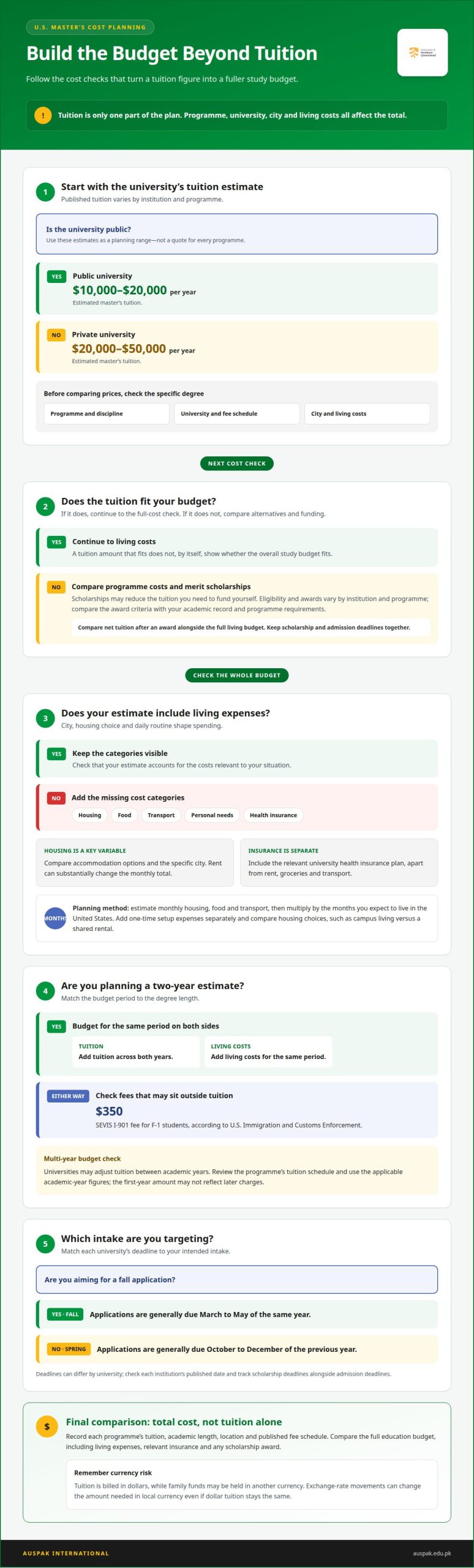
Affordable study choices balance a suitable master’s programme, university tuition and the city’s living costs. That comparison matters because a lower tuition figure may not mean a lower overall budget. Public university master’s tuition is estimated at $10,000 to $20,000 per year, while private university tuition is estimated at $20,000 to $50,000. City choice also affects accommodation and daily spending.
Compare programme requirements and total costs, not tuition alone. For example, when choosing between public and private universities, compare housing costs in each location as well. Make sure the institution offers the graduate programme you need.
Application timing also shapes your university selection. Fall applications are generally due March to May of the same year, while spring applications are due October to December of the previous year. Match each university’s deadline to your intended intake.
Merit Scholarships at Affordable Universities
Merit scholarships recognize academic achievement or other strengths in an applicant’s profile. An award can reduce the tuition you need to fund yourself. Compare scholarship criteria with programme requirements, and check whether your academic record matches the stated selection factors.
Consider scholarships while comparing affordable universities, rather than treating funding as a separate decision. Awards and eligibility vary by institution and programme, so compare the net cost after an award with your full tuition and living budget. Organize your application documents and note scholarship deadlines alongside admission deadlines.
Average Master’s Tuition and Two-Year Costs
Master’s tuition depends on the discipline, institution and location, so use an average only as a planning range. Some programmes cost less or more, making the specific course and university central to any estimate.
For a two-year estimate, budget tuition across both years, then add living costs for the same period. According to U.S. Immigration and Customs Enforcement, the SEVIS I-901 fee for F-1 students is $350.
Do tuition fees change every year?
Tuition can change between academic years and varies by school and programme. Discipline and location also shape the published fee, so compare specific degrees rather than relying on a single average.
Factors That Shape Tuition
Tuition variation means different universities charge different amounts for comparable academic subjects. It matters because the degree title alone cannot tell you the full cost.
Discipline matters, too. A school’s location can also affect living expenses, changing your total budget even when tuition is similar. Compare programme fees and city costs together.
Annual Increases and Currency Risk
Universities may adjust tuition between academic years. This matters for a multi-year degree because the published first-year amount may not reflect later charges. Review each programme’s tuition schedule and budget using the applicable academic-year figures.
Currency risk describes how exchange-rate movements affect the amount families pay from Pakistan. Tuition is billed in dollars, while a family’s funds may be held in another currency. Exchange-rate changes can therefore alter the amount needed in local currency, even if the university’s dollar tuition stays the same.
Computer science, IT, engineering and business can have different tuition levels. Compare the field and programme structure before shortlisting universities.
Other academic subjects also vary substantially. Teaching-focused programmes may have different fee structures from research-intensive degrees, so compare the specific course rather than assuming one price applies across a subject.
Published examples show the range across U.S. universities. These ranges vary by programme, not simply by institution name.
For a practical comparison, record each programme’s tuition, academic length, location and published fee schedule. Then compare the total education budget, including living expenses discussed in the previous section. If you’re also weighing destinations, Australian university admission support can help you consider an alternative study pathway.
Living expenses
Living costs are an important part of a U.S. degree budget, in addition to tuition. For Pakistani students, the city, housing choice and daily routine shape how much money they need for their studies.
Monthly Living Expenses
Monthly living expenses include recurring costs such as housing, food, transport and personal needs. They matter because affordable tuition can still come with a demanding monthly budget.
Actual spending depends on accommodation and location. Compare housing options first, since rent can substantially change your monthly total.
Costs can differ considerably by location. California has varied local markets, so compare the specific city and campus rather than relying on a statewide assumption.
Annual Living Expenses
Annual living expenses show how monthly costs add up over an academic year. Use them to compare the full cost of a degree instead of judging affordability by tuition alone.
For planning, separate recurring costs from one-time setup expenses. Multiply your expected monthly housing, food and transport costs by the months you’ll live in the United States, then compare the total with the annual estimate. A student living on campus may budget differently from someone sharing a rental near a university.
Undergraduate living estimates may not match every master’s student’s spending. Campus location, course schedule and personal routine all matter. For example, a student in a high-rent city should research housing before estimating meals or local travel. This makes university comparisons more practical.
Living Costs and Health Insurance
Health insurance is a separate budget item from rent, groceries and transport. Include it to avoid understating the amount needed for your studies.
Because those ranges differ, use the relevant university plan and its stated cost when preparing your budget. Add that amount to living costs rather than treating it as part of tuition or housing.
Create an annual worksheet with separate lines for housing, food, transport, personal expenses and insurance. Compare the worksheet across cities and campuses, then review it alongside tuition. This helps Pakistani students assess whether a location fits their overall budget, not just their academic plans.
Does the USA offer scholarships for Pakistani students?
Yes, scholarships and other funding options can help reduce the amount a student pays for graduate education. Compare each award’s eligibility, coverage and application requirements with your admission plans.
Scholarships and Loans for International Students
Scholarships provide funding that can reduce education costs, while loans must be repaid. Keep this distinction in mind when comparing offers and calculating future financial commitments.
Start with each college’s graduate funding information, then check whether awards are open to international applicants. Find out whether support covers tuition, living costs or both. For loans, review repayment terms and eligibility before including borrowed funds in your plan.
Scholarships for Pakistani Students
Pakistani students can assess university scholarships by matching their academic record and programme choice to each award’s criteria. Eligibility and funding terms differ across institutions and graduate courses.
For each application, prepare the requested academic records, recommendation letters and personal statement. Track admission and scholarship deadlines separately, since award applications may require additional materials. Compare the award terms with your full study budget before accepting an offer.
Graduate Assistantships and Financial Aid
A graduate assistantship combines a student’s graduate work with university support, such as teaching or research duties. The offer may therefore involve both academic responsibilities and financial assistance.
Read assistantship terms carefully, including the required duties, duration and type of support. Compare them with the programme workload before relying on the award. Financial aid is a broader category that may include scholarships or assistantships, while a loan must be repaid.
Create a funding comparison for each shortlisted university. Record the award name, eligibility, covered costs, renewal conditions and decision date. For example, one university may offer a tuition scholarship, while another may provide a research assistantship with defined academic duties. Compare the amount you would still need to fund, not just the headline award.
Funding can influence your choice among programmes. A scholarship tied to a department may make that academic option more practical than another with higher uncovered costs. An assistantship may require time for teaching or research, so include those duties in your study plan.
Loans require a different comparison. Review the repayment schedule, interest terms, repayment currency and who is responsible for the debt. A loan can bridge a funding gap, but it adds a future obligation beyond tuition and living expenses. Keep scholarships, assistantship support and borrowed funds in separate budget lines.
Before accepting admission, compare the written funding terms with the programme costs for the period covered. Confirm how support is applied and whether continued eligibility depends on academic progress or assigned work. This gives Pakistani applicants a clearer picture of the funding available for a U.S. master’s degree.
Average US Master’s Tuition for Pakistani Students
Estimate the cost of a master’s in the USA for Pakistani students using a range, not one fixed average.
Programme examples show why one figure can mislead.
Other university examples show higher amounts. These figures relate to different programmes, not interchangeable degrees.
Discipline can shift the estimate substantially.
Use the average as a starting point, then find the exact programme’s tuition. Check whether the university quotes a per-year amount or uses another billing basis. A master’s course may take one to two years, so calculate tuition across the stated programme length instead of treating one year’s fee as the full degree cost.
Keep tuition separate from living expenses, insurance and application costs in your budget. Add these categories using the city-specific estimates in the living expenses section, then compare the total across your shortlisted universities.
For each option, record the institution, programme, annual tuition and duration in one comparison table. Add a scholarship amount only after checking its terms. This makes it easier to see whether a lower first-year figure also means a lower overall tuition commitment.
Pakistani students should account for currency movements when planning dollar-denominated tuition from funds held in another currency. The university’s quoted tuition may stay unchanged while the amount needed in local currency shifts. Revisit your budget when each academic-year fee schedule becomes available.
As you refine the cost of a master’s in the USA for Pakistani students, compare the study destination alongside tuition and programme fit. If your comparison also includes the UK, explore UK student visa consultancy as you assess study destinations and their requirements.
AusPak International: Australian University Admission Support
If your cost comparison leads you to consider study destinations beyond the USA, AusPak International can help. Its Australian University Admission Support is relevant if you’re exploring an Australian university pathway, while UK Student Visa Consultancy and Canada Study Permit Assistance support students considering those destinations.
Turn to AusPak International when you’re weighing these options and want support with the relevant admission or visa process. Onshore Arrival Support is also available for students preparing for arrival.
To discuss your study plans, contact AusPak International or visit auspak.edu.pk.
Turn Your Study Plans Into a Clear Next Step
Planning the cost of a master’s in the USA for Pakistani students is most useful when it helps you make a decision. Choose an academic direction that fits your goals, identify universities to consider, and map out a manageable funding approach. A clear shortlist turns a broad ambition into a focused study plan.
Before moving forward, write down the questions that matter most: Which programme supports your career plans? What funding options could apply? Which destination best matches your priorities? Use your answers to guide your next conversation and keep your choices connected to your long-term goals.
If you’re ready to discuss your study plans, contact AusPak International for study advice. Take the next step with a clear sense of what you want to achieve, and give your international education plans room to move forward.
Frequently Asked Questions
Can I work in the USA to cover costs?
Yes, F-1 students are usually permitted to work on campus up to 20 hours per week during active academic sessions, according to U.S. Immigration and Customs Enforcement. Treat potential earnings as support for eligible day-to-day spending, not as a replacement for a complete funding plan. Before relying on a campus job, include the permitted work schedule and your study commitments in your personal budget.
How much is tuition at a US public university?
For a master’s applicant, compare that figure with the exact degree’s tuition schedule, as programme fees can differ within one university. Check whether the quoted amount covers the full academic year and identify any separately billed course or campus charges before comparing offers.
Is it possible to study in the USA cheaply from Pakistan?
Yes. Treat these programmes as options to investigate, not as a guarantee that every expense is covered. Compare each course’s admission requirements, location and living budget, then assess scholarships that could reduce your remaining education costs.
How much do master’s programs cost at public versus private US universities?
Master’s tuition estimates are $10,000 to $20,000 per year at public universities and $20,000 to $50,000 at private universities. These are broad ranges, so a specific programme can sit outside the typical comparison. For example, an MBA or a specialised technical degree may require a different budget from another master’s course at the same institution.
What are typical living expenses for Pakistani students in the USA per year?
A student sharing housing and preparing meals will budget differently from someone renting alone in a high-cost city. To make your estimate useful, separate housing, food, transport and personal spending, then compare those categories with each shortlisted university’s location.
What fees and extra expenses should Pakistani students budget for, including health insurance and books?
Include health insurance, books and course materials, application charges, housing deposits and daily transport in addition to tuition. Book costs depend on the programme’s reading lists and required materials, so add course-specific expenses when building your budget rather than treating tuition as the complete cost.
What scholarships and assistantships are available to Pakistani students pursuing master’s degrees in the USA?
Pakistani applicants can explore university scholarships and graduate assistantships, with eligibility and support varying by institution and programme. An assistantship can involve teaching or research responsibilities, so review the duties alongside its financial terms. Compare each award’s coverage, renewal conditions and application deadline with your admission offer, and calculate the amount you would still need to fund.
How much are US student visa, SEVIS, and university application fees?
Budget $160 for the indicative student visa application fee and $350 for the SEVIS I-901 fee, according to U.S. Immigration and Customs Enforcement for the SEVIS amount. Your total application spending depends on how many institutions you apply to, so list each fee separately in your pre-departure budget.