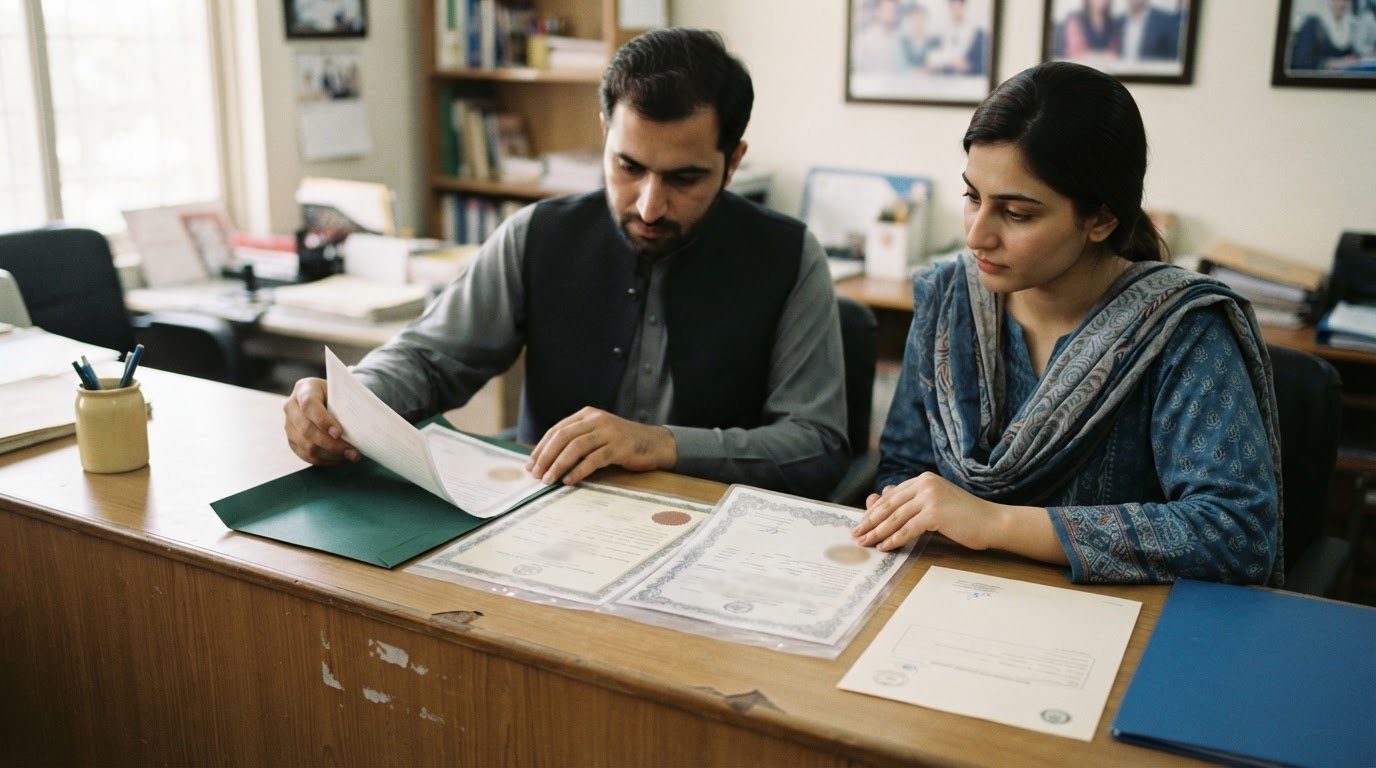
Germany can offer tuition-free study at public universities, but “free” does not mean every study cost disappears: students generally pay semester contributions, and tuition may apply depending on the institution and programme. Understanding German university admission requirements for Pakistani students starts with checking whether your school qualification supports bachelor’s entry or whether your completed degree meets the academic and subject requirements for a master’s programme.
It is natural to focus first on tuition, but choosing the right admission route matters just as much, particularly if you are seeking direct entry to a German master’s programme. This guide explains the academic documents, qualifications, and language skills bachelor’s and master’s applicants from Pakistan typically need, and how to assess programme requirements before applying. It also explains how tuition and semester contributions differ, helping you plan your next steps with a clearer picture of eligibility and costs.
Key Takeaways
- Sort your application documents into academic records, identity documents and any required qualification assessments before preparing a submission.
- Identify whether your Pakistani school or university qualification supports direct entry or requires a preparatory pathway.
- Match your language evidence to the programme’s teaching language and stated proficiency requirements.
- For master’s admission, focus on how your previous degree’s subject area and academic record align with the specific programme.
- Use AusPak International’s Australian University Admission Support if you’re considering an Australian study pathway instead.
Academic and personal documents required for admission
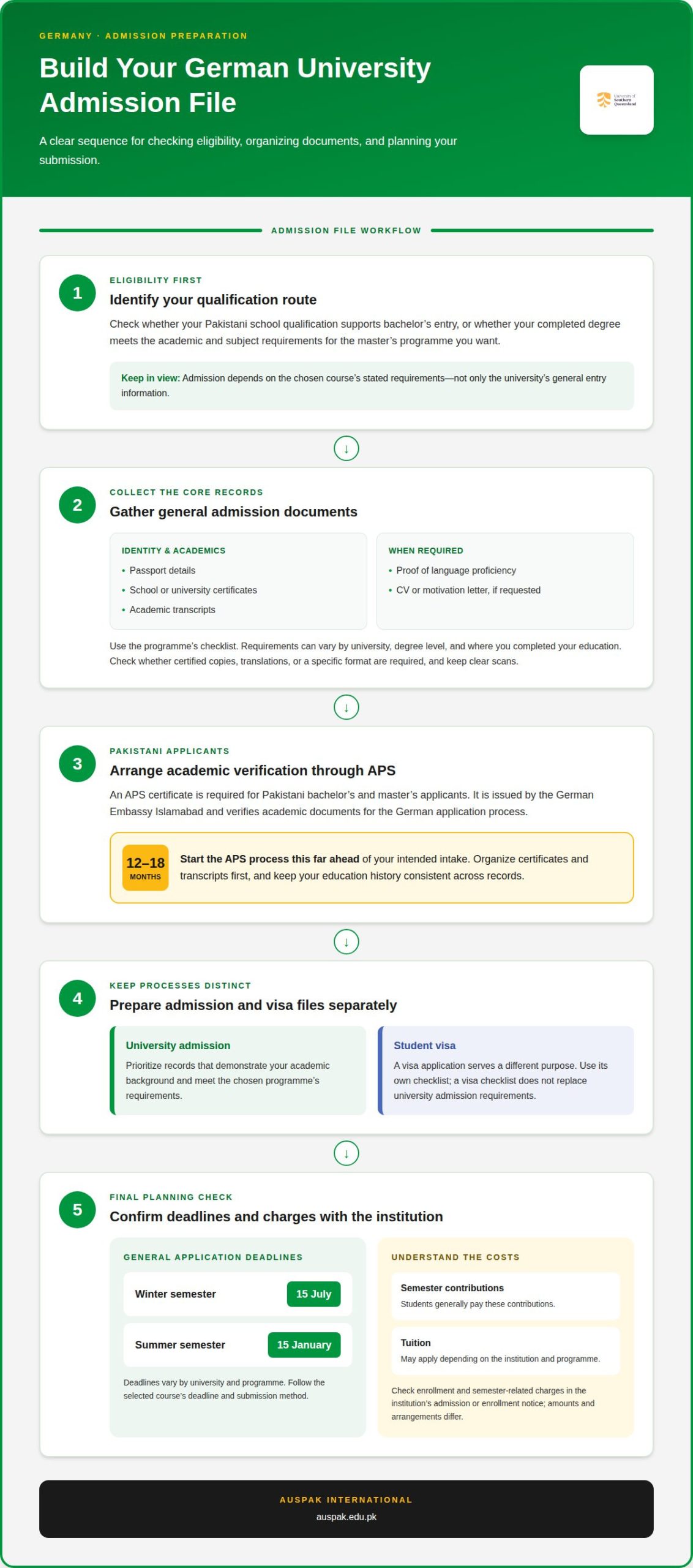
For winter-semester admission, deadlines generally fall by 15 July; summer-semester applications generally close by 15 January. According to DAAD, winter-semester application periods at most German higher education institutions run from early May to 15 July, though deadlines vary by university and programme.
Prepare your records in order: identify your entrance qualification, gather personal and academic documents, and complete any required verification.
Gather General Admission Documents
Gather your passport details, school or university certificates, transcripts, and proof of language proficiency. Include a CV or motivation letter if the programme requests one. These records help the admissions office assess your identity, academic background, and readiness for your chosen course.
Use the programme’s document checklist as your guide. Requirements vary by university, degree level, and the country where you completed your education. Keep clear scans of each document, and note whether the institution requires certified copies, translations, or a particular format. A visa checklist is not a substitute for the university’s admission requirements.
Verify Academic Documents Through APS
Arrange the APS certificate early. It is required for Pakistani bachelor’s and master’s applicants and is issued by the German Embassy Islamabad. The assessment verifies academic documents for the German application process, so include it when preparing your qualification file.
Allow 12-18 months before your intended intake to begin the APS process. Organize your certificates and transcripts before applying, and ensure that your education history is represented consistently across the records. A missing or mismatched document can complicate an application, so keep the APS paperwork alongside the original academic documents.
- Keep admission records separate from later visa paperwork. A university application and a German student visa application serve different purposes, so prepare each file using its own checklist. For admission, prioritize documents that demonstrate your academic background and meet the chosen programme’s stated requirements.
- Review enrollment charges before accepting a place. German universities set their own enrollment and semester-related charges, so check the amount and payment instructions in the institution’s admission or enrollment notice. Consider these charges separately from tuition: public universities may have different fee arrangements, and the total depends on the university and programme.
- Submit a complete application ahead of the relevant semester deadline. Winter applications generally need to reach the university by 15 July, while summer applications generally close by 15 January. Since institutions and programmes can set different dates, use the selected course’s deadline and submission method to plan your final document check.
Academic qualifications for bachelor’s and master’s programs
German universities assess whether your previous education qualifies you for entry to your chosen degree. Follow these steps to understand how Pakistani and other international qualifications are considered.
- Applicants may need to provide proof that they can cover their living costs when applying for a German student visa. Applicants should check the visa requirements and arrange any required proof of living costs before applying.
Prepare the general visa file with two completed application forms and two biometric portrait photographs. Processing is listed as 5-10 weeks and may extend to 16 weeks during peak summer.
- Do not treat admission and visa applications as one process. Common mistakes include assuming a school certificate guarantees direct entry, overlooking subject requirements, or submitting documents that do not match the chosen course. Assess your qualification first, then prepare each application according to its own requirements.
Check Pakistani Qualification Recognition
Identify the institution and qualification that awarded your Pakistani credential, then assess its recognition status. Germany’s admission database was developed with the German Academic Exchange Service (DAAD), using evaluation proposals published in the anabin database of the Central Office for Foreign Education (ZAB).
Use these records as guidance, not as a binding certification decision. For a master’s course, a completed four-year bachelor’s degree from an HEC-recognised H+ university is generally accepted for direct admission, subject to subject match and competitive grades.
Confirm School-Leaving Qualification Recognition
Check whether your school-leaving certificate provides a higher education entrance qualification, known as a Hochschulzugangsberechtigung (HZB). A high-school diploma, school-leaving certificate, or university entrance exam result may support undergraduate admission, subject to recognition by the chosen university.
Compare your qualification with the intended bachelor’s course, not just the university’s general entry page. Evaluation proposals help certification authorities assess which international school qualifications can provide access to higher education in Germany.
Verify GCE Recognition Requirements
For GCE qualifications, confirm that your education includes 12 consecutive years of schooling. Then check whether your A-Level subjects and grades meet the chosen course’s requirements, since subject combinations affect eligibility.
Cambridge A-Level students with the required subject combination and grades may enter a German bachelor’s programme directly without Studienkolleg. Do not assume that every A-Level combination qualifies: recognition depends on the specified subjects and academic record.
- If you’re also considering the UK, UK Student Visa Consultancy can support that separate study route.
Is German language necessary to study in Germany?
German is not required for every degree: language requirements depend on the programme’s teaching language. Match your test results to the course, including for graduate study and programmes that combine English and German.
Identify the Program’s Language Requirements
Start with the programme page and identify its teaching language before selecting a language test. The DAAD database lists 1,389 programmes in English, giving international students options across fields such as sciences and higher education. Check whether all classes use English or whether German instruction is part of the course.
Then record the exact test and score stated by the programme. English-taught master’s programmes commonly require IELTS overall scores of 6.0-6.5 or TOEFL iBT scores of 80-90. Treat these as common ranges, not a universal threshold; each university sets its own admission criteria.
- Prepare English proficiency evidence that meets the selected course’s requirements. Compare the required test, score, and any section-level conditions with your results before applying. For example, a stated IELTS overall requirement is not interchangeable with a TOEFL iBT score. Submit a test format the university accepts instead of assuming that any proof of English will meet its rules.
Also distinguish admission requirements from scholarship requirements. A scholarship application may assess language evidence separately from the degree application, so organize the criteria for each application independently. Do not rely on English-medium education alone unless the programme explicitly accepts it as proof.
Prepare German Proficiency Test Results
For a German-taught course, prepare evidence of German proficiency because applicants to most such programmes must demonstrate language ability. TestDaF and DSH are two available examinations. The listed qualifications include TestDaF TDN 4 in all sections or DSH-2.
Check the programme’s specified examination and required result before booking a test. An English-language certificate does not automatically meet German-language requirements, and one examination’s score may not substitute for another. Submit evidence in the format the course specifies.
- Check whether an undergraduate course is taught in both languages. Some programmes begin with English instruction for the first two to four semesters, then switch to German. This structure may let you start coursework in English, but German becomes important for later study.
Map the teaching language for each semester, not just the first year. If the course transitions to German, plan language preparation alongside your academic work. This matters when comparing a science degree with an English-only graduate programme, since their language pathways may differ.
Studienkolleg and Feststellungsprüfung requirements
Pakistani students with FSc alone are not eligible for direct entry to a German bachelor’s programme. The listed alternatives are completing Studienkolleg and the Feststellungsprüfung, completing one university year in Pakistan, or holding Cambridge A-Levels.
- Compare your current certificate with the entry route for your intended bachelor’s course. FSc alone does not provide direct bachelor’s entry in Germany, so plan for an alternative pathway rather than applying as a direct-entry student.
Keep your academic documents together, including your school certificate and transcripts. This helps you identify which qualification the university will assess and whether your intended route involves preparatory study or previous university education.
- Consider Studienkolleg if your school qualification does not qualify you for direct undergraduate admission. It is a preparatory course for international students, and a German Studienkolleg lasts one year, divided into two semesters.
Choose a course pathway that matches your intended field of study. The preparation is designed to bridge academic entry requirements, so connect the subjects you plan to study with the bachelor’s programme you want to enter.
- Plan to complete the Feststellungsprüfung after Studienkolleg. This assessment examination follows the preparatory course and forms part of the route for students whose qualifications require preparation before undergraduate study in Germany.
Keep the sequence clear: Studienkolleg first, then the Feststellungsprüfung, followed by an application based on the resulting qualification. Attendance at Studienkolleg alone does not complete the pathway.
- Assess whether one completed year of university study in Pakistan is an alternative route for you. The listed pathways include this option alongside Studienkolleg and Cambridge A-Levels, so organize your university records if you have studied after school.
Distinguish this route from the preparatory-course option. One involves prior university education in Pakistan; the other involves a German foundation course and its final examination.
- Review Cambridge A-Level eligibility based on the required subject combination and grades. Students with the required combination and results may enter a German bachelor’s programme directly without Studienkolleg.
An A-Level certificate alone does not guarantee direct entry. Subject choices and grades matter, so compare your academic record with the intended course before choosing this route.
- Use your chosen pathway to organize applications to public or other German universities. International qualifications are assessed for higher education access, and admission guidance is not a binding certification decision.
For studying in Germany, keep together the documents for your school qualification, any Pakistani university study, or Studienkolleg and its examination. This makes your academic route clear when applying for a bachelor’s programme.
Direct admission to German Master’s programmes
Pakistani applicants may qualify for direct master’s admission when their previous degree meets the programme’s academic criteria. A completed four-year bachelor’s degree from an HEC-recognised H+ university is generally accepted, subject to subject match and competitive grades. Use German university admission requirements for Pakistani students as a planning guide, then assess each programme’s criteria separately.
- Identify master’s programmes that match your previous degree. Subject alignment matters: your undergraduate studies should provide relevant preparation for the course. Compare the stated prerequisites with your transcript before applying, rather than choosing a university by name alone.
The DAAD database lists almost 2,000 programmes in Germany. Use its subject categories to find possible academic matches, then review each programme’s own entry criteria. A database listing can help you explore options, but it doesn’t replace the university’s specific requirements.
- Assess your bachelor’s qualification and awarding institution. A four-year degree from an HEC-recognised H+ university is generally accepted for direct admission, but recognition alone does not establish eligibility for every master’s course. Subject fit and competitive grades also matter.
Keep your degree certificate and full transcript together. Admissions teams use these documents to assess your qualification, academic history, and suitability for the programme.
- Compare your previous coursework with the target programme’s prerequisites. For example, if you are considering a technical master’s, identify relevant undergraduate subjects in your transcript. Match courses and academic content to the stated criteria instead of relying only on similar degree titles.
Record required subjects or credits in a comparison sheet. This practical step helps you identify suitable programmes before preparing an application.
- Review how your transcript presents grades. The German grading scale described here runs from 1 to 5, with 1 the highest mark and 5 a failing grade. Don’t assume a Pakistani grade converts directly into a German grade without the university’s assessment.
Submit a complete academic record in the format the institution requests. Missing semesters or unclear course results can make it harder to assess whether your academic background meets the programme’s standards.
- Consider the structure of the master’s degree as well as its entry criteria. In Germany, 60 ECTS credits correspond to one full year of study or work, and a master’s degree must have 90 to 120 ECTS credits. Use these figures to understand programme scope, not as a substitute for admission requirements.
Check whether the course continues your bachelor’s subject area. A related academic progression can support your application, while a substantial change of field may require different preparation.
- Keep admission and student visa preparation as separate stages. First establish whether your previous degree meets the master’s programme criteria and submit the requested academic documents. Then organize visa steps around your admission outcome.
German university admission requirements for Pakistani students are programme-specific, so use the criteria for each selected course to guide your application.
- If your plans shift to the UK, explore UK student visa support for that separate study route.
AusPak International: Australian University Admission Support
AusPak International provides Australian University Admission Support for Pakistani students considering study in Australia. After assessing German programmes, you may decide another destination better suits your academic plans; AusPak can support your Australian university admission process.
For students considering other pathways, AusPak also offers UK Student Visa Consultancy and Canada Study Permit Assistance. Onshore Arrival Support can help with the transition after you reach a destination. These services are relevant if your plans extend beyond Germany and you need support for one of these study pathways.
Turn Your Study Plans Into a Clear Next Step
Choose the destination and degree pathway that best match your academic direction, then turn that decision into a focused application plan. Use German university admission requirements for Pakistani students as a planning framework, while keeping your next step centered on the programme and future you want to pursue.
If you are considering another destination, AusPak International offers Australian University Admission Support, UK Student Visa Consultancy, and Canada Study Permit Assistance. These services can support your next steps toward studying in one of those countries.
Take the next step at a pace that suits your plans. Contact AusPak International for guidance on the support relevant to your chosen destination. Your international study goal can begin with one well-considered decision.
Frequently Asked Questions
Is Studying in Germany Free for Pakistani Students?
Study at most public universities can be tuition-free, but students still need to budget for semester contributions and living costs. Tuition arrangements vary by institution and programme, so “free” does not cover every expense. Before accepting an offer, review its fee notice and consider the full study period, including accommodation, insurance, and other personal costs.
How to apply for undergraduate study in Germany?
Start by selecting a bachelor’s course and identifying the admission route for your school qualification. Then prepare the academic records and language evidence the programme requests, submit through the university’s stated application channel, and follow its instructions for any further assessment. FSc alone does not allow direct entry; the listed alternatives include preparatory study, university study in Pakistan, or Cambridge A-Levels.
Is it possible to study in Germany without IELTS?
Yes, IELTS is not the only possible English proficiency test: English-taught master’s programmes commonly accept TOEFL iBT scores as well. The programme determines which evidence it accepts, so check its language criteria before choosing a test. For German-taught courses, English test results do not replace German proficiency evidence. Some programmes teach in both languages, so review the course’s language of instruction.
What Documents Do I Need?
Prepare your passport information, school or degree certificates, academic transcripts, and language-test results. A programme may also request a CV, motivation letter, translations, or certified copies. Pakistani applicants should include the APS certificate in their academic planning. Keep university application documents separate from visa paperwork because admission and immigration processes assess different requirements.
What academic qualifications do Pakistani students need for admission to German universities?
For bachelor’s study, eligibility depends on whether your school qualification is recognized as a higher education entrance qualification. Pakistani FSc alone does not provide direct bachelor’s entry; alternatives include Studienkolleg followed by the Feststellungsprüfung, one completed year of university study in Pakistan, or Cambridge A-Levels with the required subjects and grades. For a master’s, subject fit and recognition of your previous degree matter.
What German or English language test scores are required for admission to German universities?
Requirements depend on the teaching language and programme. English-taught master’s programmes commonly ask for IELTS overall 6.0-6.5 or TOEFL iBT 80-90. German-taught courses list qualifications such as TestDaF TDN 4 in all sections or DSH-2. Treat these as programme-specific benchmarks: use the examination and score stated for your selected course rather than assuming one threshold applies everywhere.
How do Pakistani students apply to German universities through Uni-Assist or directly?
First, check the selected university’s application instructions to see whether it accepts applications directly or uses uni-assist. Follow that route, complete the required forms, upload the requested records, and submit before the programme deadline. As of June 2020, approximately 170 universities used uni-assist to process international applications. The application channel is institution-specific, so don’t assume every German university uses the same portal.
What documents must Pakistani students submit for German university applications?
Most applications begin with proof of identity, school or university certificates, transcripts, and evidence of the required language proficiency. The course may also request supporting documents such as a CV or motivation letter. Applicants may need additional certification documents as part of their academic file, so check the requirements for their application. Create a separate checklist for each programme, since document formats and additional requirements can differ between institutions.