A Malaysian student visa doesn’t give you unrestricted permission to work: international students are generally allowed to work part-time for up to 20 hours per week during semester breaks or holidays, subject to immigration rules and approval. The Malaysian student visa process for Pakistanis also depends on choosing an eligible institution and completing the steps from application to Student Pass.
It’s understandable to want clear answers before committing to a course abroad. This guide explains the Malaysian student visa process for Pakistanis, including the application sequence, documents to prepare, English-language and medical requirements, and what to do after receiving your Visa Approval Letter so you can progress to a Student Pass.
You’ll also learn how Malaysian universities for Pakistani students fit into your decision, what work rules mean in practice, and how to plan your next steps with confidence.
Key Takeaways
- Understand the limits on part-time work and when international students may be eligible to work in Malaysia.
- Follow the application sequence from your institution’s submission through your Visa Approval Letter and Student Pass endorsement.
- See which English-language evidence may meet university requirements, including alternatives to IELTS at some institutions.
- Plan for the required medical screening after arrival and understand how it fits into your Student Pass process.
- Assess Malaysian university options by institution type, approval to recruit international students, and fit with your study goals.
Can Pakistani students work on a student visa in Malaysia?
International students may work part-time for up to 20 hours per week during semester breaks or holidays, subject to immigration rules and approval. Work permission is limited, so plan your education budget around available funds rather than assuming you can work during regular teaching weeks.
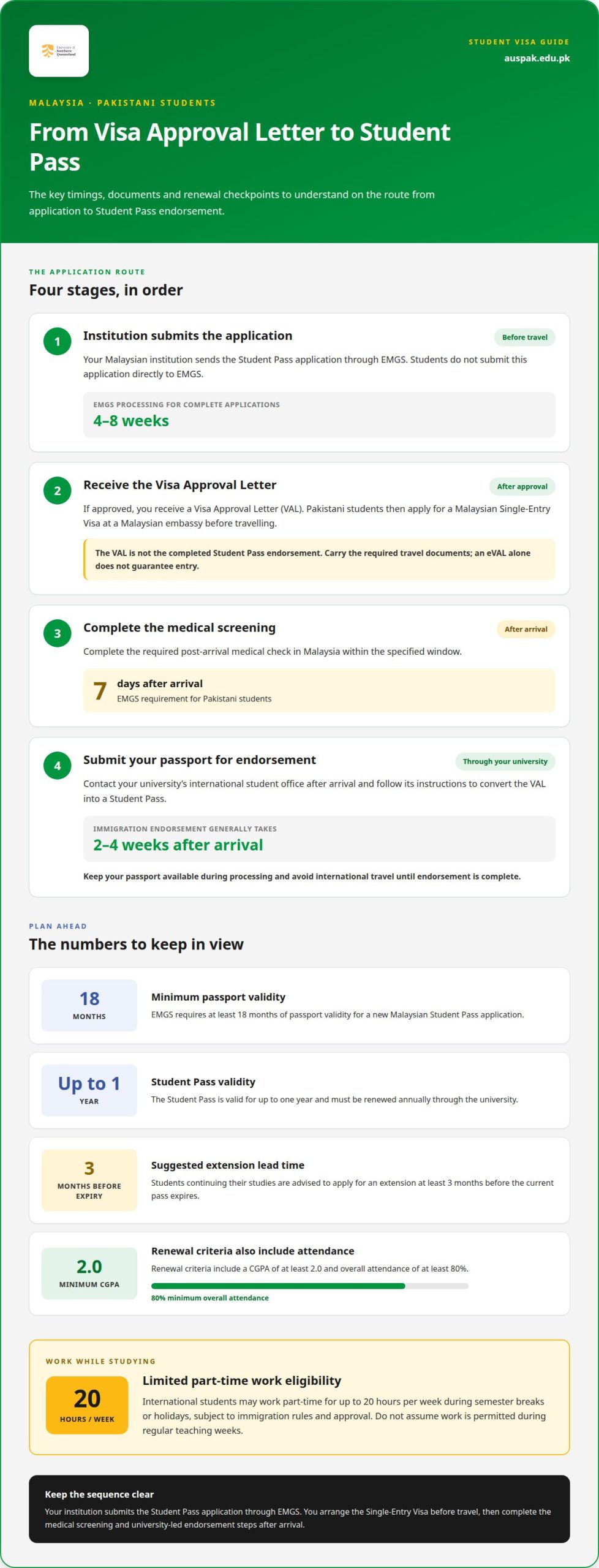
- Confirm your study and passport eligibility. Malaysia grants Student Passes to non-citizen students aged three (3) years and above who study in Malaysia, according to Immigration Department of Malaysia. For a new Malaysian Student Pass application, Education Malaysia Global Services (EMGS) requires a passport with at least 18 months of validity. Start with a full-time course offer from an eligible institution.
- Prepare the application documents. Gather your offer letter, academic certificates and transcripts, completed Health Declaration Form, Personal Bond, No-Objection Certificate (NOC), and Letter of Eligibility (LOE). The institution may also require documents for its own application process. Keep your personal and education details consistent across all documents, as discrepancies can prompt requests for corrections.
- Have your institution submit the Student Pass application. The student does not submit the Student Pass application directly to EMGS; the Malaysian institution sends it through EMGS. Provide the documents in the format requested by the institution, then respond promptly if it requests a correction or further information. EMGS typically processes complete applications within 4 to 8 weeks of submission.
- Follow the Visa Approval Letter and entry steps. After your institution submits the application and EMGS processes it, you’ll receive a Visa Approval Letter (VAL) if approved. Pakistani students then apply for a Malaysian Single-Entry Visa at a Malaysian embassy before travelling. Allow time for both application stages and carry the required travel documents when entering Malaysia.
- Plan renewals before your current pass expires. A Student Pass is valid for up to one year and must be renewed annually through the university. Students continuing their studies are advised to apply for an extension at least 3 months before expiry; renewal criteria include a CGPA of at least 2.0 and overall attendance of at least 80%.
- Reduce avoidable delays and refusals. Incomplete documents, errors, and inconsistent application details can slow processing. Accurate submissions may help avoid requests for corrections. The Malaysian institution submits the Student Pass application through EMGS, while you apply for the Single-Entry Visa at a Malaysian embassy before travel. Follow the institution’s instructions for the current process.
Converting a Visa Approval Letter into a Student Pass
Your Visa Approval Letter (VAL) is an important pre-arrival document, but it isn’t the final Student Pass endorsement. Follow the steps in order, from arranging entry to submitting your passport after arrival.
Understand the Visa and Student Pass
Distinguish the entry visa from the Student Pass before travelling. The Malaysian Single-Entry Visa enables a Pakistani student to travel to Malaysia after receiving a VAL; the Student Pass is the immigration endorsement for study. Treat the VAL as approval to proceed with entry arrangements, not as the completed pass. An eVAL alone doesn’t guarantee entry, so carry the required travel documents.
Obtain the Student Pass Endorsement
After arrival, contact your university’s international student office and follow its instructions for converting the VAL into a Student Pass. Complete the required medical screening and submit your passport for endorsement. Immigration endorsement generally takes 2 to 4 weeks after arrival. Keep your passport available during processing, and avoid international travel until the endorsement is complete.
- Complete arrival formalities promptly. Education Malaysia Global Services (EMGS) requires Pakistani students to complete the post-arrival medical check in Malaysia within 7 days of arrival. Your university’s international student office can guide you through its process for arranging the examination and submitting your passport. Keep your VAL and travel documents accessible for these steps.
- Don’t use a tourist pass as a substitute. A Malaysian tourist or social visit pass cannot be converted into a Student Pass inside Malaysia; this has been prohibited since 2014. Complete the student application and entry steps using the appropriate documents instead. Arriving on a different pass doesn’t replace the VAL, required entry visa, or university-led endorsement process.
- Plan for your pass, not just your letter. The Student Pass or sticker is valid for up to one year and is renewed annually through the student’s university. Track its validity alongside your course dates, and follow the institution’s instructions for endorsement and renewal. A VAL is one stage of the process, not permission to overlook the pass after arrival.
- Check post-study options separately. As of June 2026, Pakistani students aren’t eligible for Malaysia’s Graduate Pass. The Graduate Pass is a 12-month Social Visit Pass, but it isn’t an automatic extension of a Student Pass. If you plan to remain in Malaysia after graduation, understand that continuing to stay requires a separate immigration route.
English language requirements
Pakistani applicants generally need an academic offer, suitable English-language evidence, and travel documents for their chosen course. Undergraduate applicants need HSSC or equivalent; postgraduate applicants need a bachelor’s degree.
- Match your English evidence to the degree level. The listed IELTS minimum is 5.5 for undergraduate study and 6.0 for postgraduate study. PTE Academic minimums are 42 and 50, respectively. TOEFL minimums are 500 paper-based, 173 computer-based, or 61 internet-based. These scores are reference points; the institution sets the requirement for its programme.
- Ask whether your previous education can meet the language requirement. Some Malaysian universities accept an English Proficiency Certificate from a previous institution if it states that your last degree was taught in English. Submit the certificate with your academic documents for the institution’s assessment. Don’t assume an English-medium background automatically replaces a test score; acceptance depends on the university and course.
- Prepare the academic and identity documents for submission. Assemble your offer letter, completed application form, HSSC or bachelor’s degree certificate, transcripts, passport copy, Health Declaration Form, Personal Bond, No-Objection Certificate (NOC), and Letter of Eligibility (LOE). The Malaysian institution submits the Student Pass application through EMGS, so follow its document format and submission instructions.
- Confirm passport validity before the institution submits. Education Malaysia Global Services (EMGS) requires at least 18 months of passport validity for a new Malaysian Student Pass application. Include a clear passport copy and ensure the biographical details match your offer letter and academic records. Inconsistent names or passport details can lead to correction requests during processing.
- Complete the approval and travel-visa sequence. After your institution submits the application through EMGS, wait for the Visa Approval Letter (VAL). Pakistani students then apply for a Malaysian Single-Entry Visa at a Malaysian embassy before travelling. The VAL does not replace the entry visa, so arrange travel only after completing the required visa step.
- Separate pre-arrival forms from medical screening in Malaysia. Include the Health Declaration Form with your application documents, then complete the post-arrival medical check within the required timeframe. Keep copies of your passport, offer letter, VAL, and entry visa together for travel and arrival formalities. Follow your institution’s instructions for submitting these documents at each stage.
Is a medical check required?
Yes. Pakistani students must complete the post-arrival medical check in Malaysia within 7 days of arrival, according to Education Malaysia Global Services (EMGS). Build this appointment into your arrival plan alongside immigration formalities, insurance, tuition, and living expenses.
- Schedule the post-arrival examination promptly. Contact your university’s international student office after arriving and follow its medical-screening instructions. EMGS requires completion within 7 days, so don’t leave the appointment until the end of your first week. The screening forms part of the Student Pass process, rather than replacing the health declaration submitted with the visa application.
- Use the clinic and process specified for your screening. International students applying for a Malaysian Student Pass must complete medical screening at an EMGS-registered clinic. Follow the university’s instructions for booking, documents, and attending the examination. Keep your passport and relevant application papers available so the clinic and institution can match your details to your student record.
- Keep medical and identity formalities distinct. Medical screening assesses health; identity or biometric registration, if included in your university’s arrival instructions, is a separate administrative step. Follow the institution’s schedule for each process and keep appointment details together. Don’t assume completing one automatically completes the other or finishes your immigration endorsement.
- Arrange health insurance for the required period. Health insurance is mandatory for a minimum of 12 months for a Malaysian student visa. Include the premium in your first-year study budget and keep the policy information accessible after arrival. Insurance, medical screening, visa charges, and tuition are separate budget items, so allow for each rather than treating them as one payment.
- Budget for the full academic and living picture. Plan for tuition, EMGS processing and visa fees, medical screening, insurance, accommodation, and day-to-day living costs in Malaysia. The amount depends on your institution, course, housing, and personal spending. Set aside funds for required immigration steps as well as regular expenses, so appointments or payments don’t disrupt your study plans.
- Keep your passport and application details consistent. A new Student Pass application requires at least 18 months of passport validity, according to EMGS. Make sure the passport details used for screening and immigration paperwork match your application. Carry the passport when attending appointments if your university instructs you to do so, and retain copies of submitted health and insurance documents.
Malaysian universities for Pakistani students
Choose your institution and course before beginning the Student Pass process. Malaysia’s approved public universities, private universities, and branch campuses all offer routes for international students.
- Start with the degree you intend to pursue. For undergraduate study, Pakistani applicants need HSSC or an equivalent qualification; postgraduate applicants need a bachelor’s degree. Match your academic background to the course entry criteria, then identify programmes that suit your education goals. The degree level also shapes which English-language evidence the institution may request.
- Compare institution types, not just names. Malaysian institutions recruiting international students include public universities, private universities, and branch campuses, provided they’re approved to do so. Consider which type offers your intended subject and course structure. The institution’s approval to recruit international students matters because it must support the Student Pass application process.
- Check the course and institution’s international admissions route. Find out how the programme handles applications from Pakistan, which academic documents it requires, and how it communicates offer decisions. Requirements vary between institutions and courses. Follow the specific programme’s entry criteria rather than assuming another university’s rules apply.
- Assess the offer in light of visa steps. The offer letter is a key document for a new Student Pass application. The institution submits the application through EMGS, so its ability to recruit international students and manage the process is central. Consider the course start date alongside application preparation and processing, leaving time to address any document corrections.
- Choose a university that fits your study plans. Compare the academic subject, degree level, entry requirements, location, and the institution’s instructions for international students. For example, an applicant seeking postgraduate education should first confirm that their bachelor’s qualification meets the course criteria. Then consider whether the programme and institution support the next steps towards a Visa Approval Letter.
- Make your choice before arranging travel. Accept the offer and follow the institution’s instructions for submitting application documents. The Student Pass application is made through the university, not directly by the student. Wait for the required approval and complete the entry process before travelling to Malaysia. If you’re also considering Australia, explore Australian university admission support for that separate study destination.
AusPak International: UK Student Visa Consultancy
AusPak International supports students pursuing study abroad through its UK Student Visa Consultancy, Australian University Admission Support, and Canada Study Permit Assistance. If you’re committed to Malaysia, follow the university-led application steps in this guide. If you’re weighing destinations, AusPak can help you pursue options in the UK, Australia, or Canada. The right support depends on your chosen country and stage of education.
Contact AusPak International to discuss your study plans and available support.
Move from planning to your next decision
Your study plan should connect the course you want with a realistic path to enrolment and arrival. Use the Malaysian student visa process for Pakistanis as a framework for making those decisions in sequence, then focus on the next step that applies to your education plans.
If Malaysia is your chosen destination, continue working with your selected institution on its application process. If you’re still weighing destinations, AusPak International offers Australian University Admission Support, UK Student Visa Consultancy, and Canada Study Permit Assistance. Your next step depends on where you intend to study and the support you need to move forward.
Contact AusPak International for guidance about your study plans and available support. Take the next step with a clear direction and keep building toward your international education goals.
Frequently Asked Questions
Can You Work During and After Your Studies?
International students may work part-time for up to 20 hours per week during semester breaks or holidays, subject to immigration rules and approval. This permission doesn’t mean students can rely on paid work throughout their studies. After graduation, a Student Pass doesn’t itself authorize continued employment; graduates who want to remain in Malaysia need a separate work pass from an employer. Plan post-study work around that separate requirement.
What is a Visa Approval Letter?
A Visa Approval Letter (VAL) is issued after the Malaysian Student Pass application has been approved for the next stage. It supports your travel arrangements, but it isn’t the Student Pass endorsement placed in your passport after arrival. For example, a Pakistani student still needs to complete the required entry-visa step and university arrival formalities. Keep the VAL accessible with your offer and travel documents.
How do Pakistani students apply for a Malaysian student visa through EMGS?
The Malaysian student visa process for Pakistanis begins with an offer from a Malaysian institution, which submits the Student Pass application through Education Malaysia Global Services (EMGS). Students don’t submit it directly. Provide the documents requested by the institution and follow its instructions for corrections or missing items. After approval, the university’s international student office guides arrival steps, including the medical examination and passport endorsement.
What documents are required for a Malaysian student visa application from Pakistan?
Common application documents include an offer letter, completed application form, passport copy, academic certificates and transcripts, Health Declaration Form, Personal Bond, No-Objection Certificate (NOC), and Letter of Eligibility (LOE). The institution may request other materials for its submission process. Prepare readable copies and use consistent personal details across records. For example, make sure the name on your passport matches the name on your academic documents and offer.
How long does the Malaysian student visa process take for Pakistani applicants?
For Pakistani applicants, the Malaysian student visa process for Pakistanis includes university document preparation and EMGS processing, which typically takes 4 to 8 weeks for a complete application. The overall timeline can also include the Single-Entry Visa application, travel arrangements, and post-arrival endorsement. Start early enough to handle document corrections without disrupting your course start. Delays can arise if the institution needs replacement documents or further information.
What are the Malaysian student visa and EMGS application fees for Pakistani students?
Costs may include EMGS processing, immigration charges, medical screening, insurance, and the Single-Entry Visa. The total depends on which charges apply and how the institution handles payment and billing. Ask the institution for an itemised breakdown in US dollars before paying, and keep receipts for each transaction. Budget these administrative costs separately from tuition, accommodation, and regular living expenses to plan your study funding clearly.
Do Pakistani students need a Single Entry Visa to travel to Malaysia after receiving a VAL?
Yes. After receiving the VAL, Pakistani students must apply for a Malaysian Single-Entry Visa at a Malaysian embassy before travelling. The VAL and entry visa serve different purposes, so receiving the letter doesn’t replace the visa requirement. Keep both documents available for your journey, along with your offer letter and passport. An eVAL alone doesn’t guarantee entry to Malaysia, so complete the entry formalities before departure.
What medical screening, insurance, and biometric requirements apply to Malaysian student visa applicants?
Pakistani students must complete the post-arrival medical check in Malaysia within 7 days of arrival, according to Education Malaysia Global Services (EMGS). Medical screening must take place at an EMGS-registered clinic, and student health insurance is mandatory for a minimum of 12 months. Follow the university’s instructions for any identity or biometric registration, since it’s a separate arrival task from the medical examination.