
A tuition quote can look manageable until you discover it covers only one semester, while visa processing, insurance, accommodation and arrival expenses sit outside the headline figure. For Pakistani families assessing the study in Malaysia for Pakistani students cost, the challenge is building a complete budget and converting changing Malaysian Ringgit expenses into a useful plan in Pakistani rupees.
Look beyond tuition before choosing a programme. The total depends on what the university’s fee covers, how long the course runs and where you live, so comparing headline figures alone can lead to costly surprises.
This guide explains how to organise your 2026 budget around tuition, monthly living expenses, student-pass and insurance costs, and one-time expenses before and after arrival. You’ll learn how to compare programmes and accommodation on a like-for-like basis, account for currency fluctuations, and identify the fee details to verify before paying a deposit or submitting an application.
Key Takeaways
- The study in Malaysia for Pakistani students cost depends on programme length, institution, tuition structure and living choices, so plan beyond the headline fee.
- Separate tuition from accommodation, food, transport and personal spending to build a budget that reflects your circumstances.
- Compare programmes at the same qualification level and duration, noting the tuition basis and compulsory charges.
- Build your budget in sequence: confirm programme duration and tuition, then add recurring living expenses, official charges and one-time setup costs.
- Once your budget is clear, organise programme research and application documents with counselling and application-processing guidance.
Malaysia Study Costs for Pakistani Students in 2026
The total cost of studying in Malaysia depends on the programme, institution, course duration and living choices. Tuition is only one part of the calculation: a realistic plan also accounts for living expenses, required administration, travel and initial setup. Assess the study in Malaysia for Pakistani students cost across the full study period, rather than inferring it from a single fee quote.
Separate recurring costs from one-time or periodic payments. Tuition and housing may recur by semester or month, while application-related charges, medical screening, insurance, travel and arrival purchases may fall due at different stages. Comparing only tuition can leave substantial expenses out of your plan.
What does a complete Malaysia study budget include?
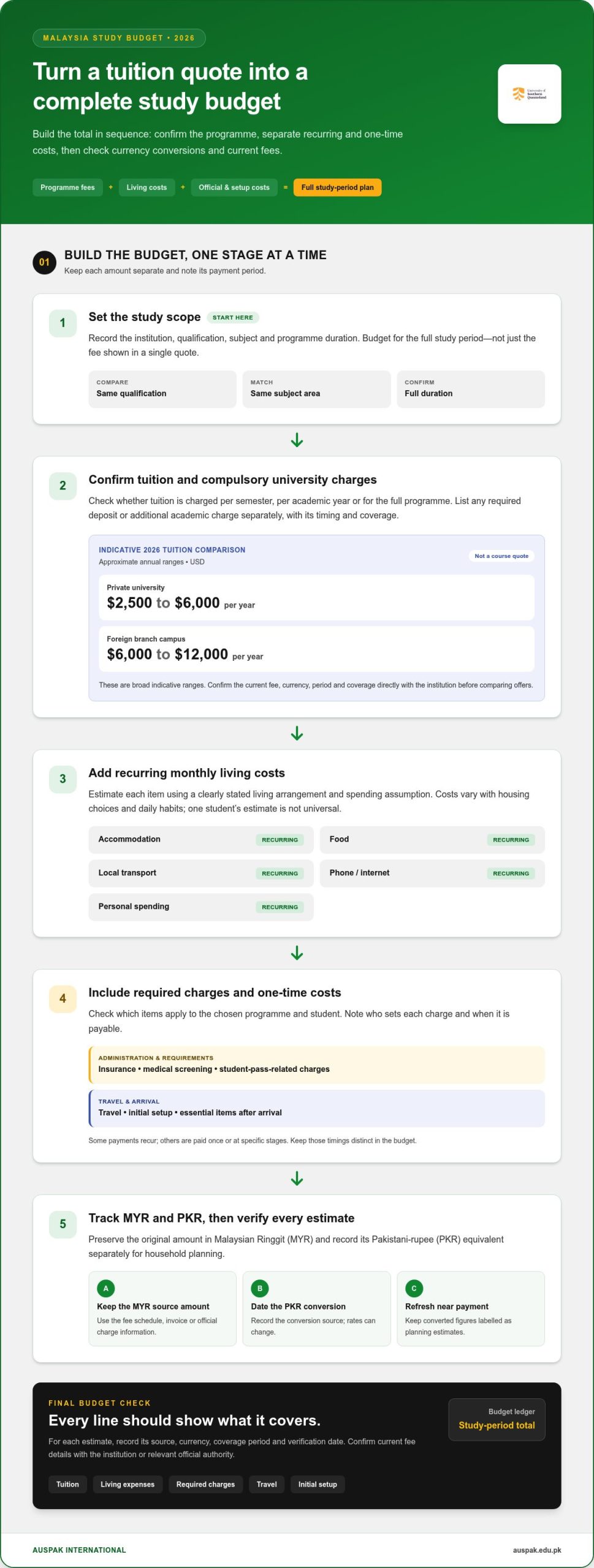
Build your budget as a set of distinct line items, then check which charges apply to the chosen programme and student. Keep estimates separate from confirmed amounts, and write the fee period beside every quote.
- Education: tuition and compulsory institutional charges listed separately. Record whether each tuition quote is per semester, per academic year or for the full programme.
- Monthly living: accommodation, food, local transport, communications and personal spending. These depend on the student’s housing arrangement and daily choices, so don’t treat one lifestyle estimate as universal.
- Administration and arrival: applicable insurance, medical screening and student-pass-related charges, plus travel and initial setup expenses such as essential items after arrival.
Some charges recur, while others are paid once or at specific stages. Label each line accordingly and note who sets the charge, such as the university or relevant authority. For a general overview of the government body responsible for higher education, see the Malaysian Ministry of Higher Education. Use the relevant institution or official authority for current fee details.
Why should Pakistani students track both MYR and PKR?
Keep the original amount in Malaysian Ringgit (MYR) as it appears on the university’s fee schedule, invoice or official charge information. Record its Pakistani-rupee (PKR) equivalent in a separate column for household planning. This preserves the source figure while making the expense easier to assess from Pakistan.
Currency rates change, so a conversion made during early research may not match the amount used when arranging funds or paying a charge. Date each conversion, record its source and refresh it close to the payment date. Keep the original currency visible rather than replacing it with a converted estimate. If you also use US dollars for comparison, label that figure as a planning conversion and retain the dated source behind it.
A complete study budget includes tuition, living expenses, required charges, travel and initial setup costs, separated by payment timing and checked against current sources. Treat every 2026 estimate as date-sensitive. Before relying on a figure, confirm its source, currency, coverage period and verification date. This helps prevent a semester quote from being mistaken for the cost of an entire programme.
Malaysia tuition and living expenses: where the money goes
Tuition and day-to-day expenses are major parts of many student budgets, but neither has one fixed price. Fees vary with institution, qualification, subject, programme length and billing structure. For a broad 2026 comparison, private-university tuition is approximately $2,500 to $6,000 per year and foreign branch-campus tuition is approximately $6,000 to $12,000 per year. Treat these as indicative ranges, not a quote for a particular course. Confirm the current fee, currency, period and coverage with the institution before comparing offers.
How do programme and university choices affect tuition?
Compare like with like: the same qualification level, subject area and study duration. A one-year fee and a full-programme total are not interchangeable, and a lower headline figure may cover fewer study periods. Check whether tuition is quoted per semester, per year or for the entire programme, and read any stated conditions that could affect the amount.
Keep compulsory institutional costs separate from tuition. Record any required deposit and additional academic charge as its own line, with payment timing and coverage noted. Use current university fee schedules or written fee information for your estimates. A useful comparison labels each amount with its currency, period, source and date checked.
Which living and administrative costs need separate line items?
Estimate housing and everyday spending separately. Your accommodation choice affects the budget, while food, local transport, communications and personal purchases depend on individual habits. Use a clearly described living assumption, such as shared housing and mostly home-prepared meals, rather than presenting one student’s routine as a universal cost. The Department of Statistics Malaysia publishes official statistics that can add economic context, but it should not replace a university fee schedule or your own housing estimate.
- Recurring costs: accommodation, food, transport, phone or internet access, and personal spending. State the time period for each estimate.
- Required charges: insurance, medical screening and student-pass-related expenses. Check current amounts and requirements through relevant official sources, and note when renewals or repeat payments may apply.
- One-time or arrival costs: travel and initial setup purchases. Keep these separate from monthly living estimates so they don’t appear to recur throughout the programme.
Recurring living expenses cover day-to-day life; one-time arrival costs cover the initial journey and setup. Mark mandatory charges separately from optional spending, such as leisure or non-essential purchases, so you can see which costs are essential and where personal choices can change the estimate.
For each figure in a budget, display the amount in US dollars, identify the billing period and specify what it covers. Retain the institution’s original fee information when checking the conversion. Rates and published fees can change, so date each source and refresh estimates before making payment decisions. Once you’ve mapped the main cost categories, organise your study application and documentation with counselling and application-processing guidance.
Compare Malaysia study costs fairly before choosing a programme
A fair comparison starts with equivalent choices, not the lowest number in a search result. Compare programmes at the same qualification level and over the same study duration, then check whether each published fee covers the same academic period and required expenses. This helps Pakistani students assess the study in Malaysia for Pakistani students cost consistently, rather than relying on headline tuition alone.
How can students compare university fee information?
Create one row for each programme and use the same fields throughout. Record the institution’s published tuition in US dollars, its billing period, programme length, source and the date you checked it. If the original fee is published in another currency, retain that information and use a dated conversion for the USD comparison.
- Programme and duration: name the qualification and subject, and state the full course length.
- Tuition basis: specify whether the amount is per semester, per academic year or for the programme.
- Compulsory charges: list deposits, administration, insurance and other required academic costs separately from tuition.
- Coverage and conditions: note what the published fee includes or excludes, and whether it may vary by subject, intake, student status or programme structure.
- Evidence: record the current institutional source and verification date. Mark any unclear fee as “verify with source” rather than treating it as zero.
For example, a programme-wide tuition figure cannot be compared directly with another programme’s annual charge unless you calculate the same study period and account for the full duration. Similarly, a fee that excludes a compulsory deposit isn’t equivalent to one that includes it. Avoid ranking institutions by affordability until the figures have matching coverage, periods and documented sources.
How do accommodation choices change the total budget?
Compare institution-managed housing with private accommodation only when current figures describe a comparable period and similar arrangements. A room price may not cover the same items as another option. Check whether the source includes utilities, deposits, meals and transport, and record each separately when those details are available. Flag unclear costs or inclusions for verification instead of making assumptions.
Keep living assumptions consistent across options. For instance, compare the same meal pattern and transport needs, and state whether the estimate assumes shared or individual accommodation. Don’t pair a basic housing estimate with a higher-spending lifestyle in one scenario and a more economical routine in another. That makes the comparison misleading.
Separate fixed, compulsory charges from personal choices such as eating out or leisure. Then calculate a comparable total for the same course duration, adding recurring expenses over the same number of months. The result won’t predict every student’s spending, but it will show which differences come from programme fees, housing arrangements or lifestyle assumptions. Before deciding, revisit “verify” entries and update sources so your comparison reflects current, documented information rather than incomplete estimates.
Build a realistic 2026 Malaysia study budget from Pakistan
A useful budget shows what is confirmed, what is estimated and what still needs checking. Start with the full programme duration, not just the first payment. Then map each expense to when it is due, so tuition, monthly living costs and arrival expenses don’t get blended into one misleading total. For Pakistani families, keeping a dated currency-conversion record also makes it easier to review how expenses in Malaysia affect their plans.
What steps should families follow to calculate the total?
- Confirm the programme and tuition basis. Record the qualification, full course length and institution-published tuition schedule. Note whether tuition is stated per semester, academic year or entire programme. Add compulsory institutional charges separately, with payment timing, source and verification date.
- Estimate recurring living costs. Create individual lines for accommodation, food, local transport, communications and personal spending. Use assumptions that match the student’s intended living arrangement and multiply each monthly estimate by the planned stay. If the length of stay may differ from the academic calendar, keep that assumption visible.
- Add one-time and official expenses. Include applicable travel, initial setup, insurance, medical screening and student-pass-related charges as separate entries. Mark each item as confirmed or estimated, and use current institutional or relevant official information for required charges.
- Convert and document. Keep a record of the original charge, its currency, the conversion-rate source and the date used. For family planning, show the converted amount in Pakistani rupees alongside the US-dollar budget figure. Exchange rates can change before payment, so recalculate major expenses using a current, dated rate instead of relying on an old conversion.
Leave a contingency line for costs that may change, such as a revised fee, exchange movement or an additional setup need. Don’t assign a universal percentage or treat this line as a guaranteed estimate. Base it on the uncertainties in the student’s own plan, and make clear that it is a planning buffer rather than a quoted charge.
How can students keep the plan current before paying?
Use separate columns for confirmed, estimated and not yet verified amounts. Before a major payment, revisit the relevant tuition schedule, required charges and exchange-rate source. Update the verification date and retain the earlier figure so your family can see what changed and why. This record helps prevent an outdated estimate from being mistaken for a current payment requirement.
Once the budget framework is in place, counselling and application-processing guidance can help organise programme research and application documents around the student’s plan. Explore study application guidance to take the next step with a clearer view of the process.
Plan your Malaysia study application with informed guidance
A clear budget gives you a practical starting point. Next, turn your preferred option into an organised application plan. Shortlist programmes by academic fit, duration, published fees and how well the total fits your budget. Then review application deadlines and current requirements before committing funds. The study in Malaysia for Pakistani students cost is only one part of the decision; the programme and documentation pathway also need attention.
What should students prepare after estimating their budget?
Move from broad research to a focused shortlist. Compare each option against your academic background and goals, then keep fee information and budget assumptions alongside programme details. This makes it easier to identify unanswered questions before an application or deposit deadline approaches.
- Shortlist suitable programmes: compare qualification, subject, duration, published fee coverage and fit with your budget.
- Organise academic records: gather transcripts, certificates and other documents requested for the chosen application. Keep clear copies and check that personal details are consistent across records.
- Review current requirements: use up-to-date university information for admission documents and authoritative Malaysian guidance for student-pass documentation. Requirements can depend on the individual application, so work from current instructions rather than an old checklist.
- Track progress: note deadlines, documents prepared, items still outstanding and the source or date of any requirement you’ve checked.
Preparing early helps you identify gaps while there’s still time to address them. It also makes the application easier to review as a complete set, rather than a collection of documents assembled at the last minute.
How can AusPak International support the next stage?
Student counselling and application processing can bring programme research, application documents and next steps into a clearer sequence. This support is useful when you’re comparing options or organising materials for submission, while admission decisions remain with the institution. Keep your own record of programme choices, deadlines and communications so you can follow the process with confidence.
Visa-documentation guidance can help you understand and organise documents relevant to your application. It’s preparation support, not a promise of visa approval or a particular outcome. Check requirements against current authoritative guidance, and make sure your submission is complete and consistent with the instructions that apply to you.
With your budget, shortlist and records in order, you’re better placed to move forward deliberately. Discuss your study plans and application steps with AusPak International. Plan your study-abroad application with AusPak International.
Turn your study plans into a clear next step
A well-planned budget can help your family prepare financially and guide which programmes you shortlist, when you apply and what you need to clarify before committing. Use your estimate of the study in Malaysia for Pakistani students cost as a practical planning tool. Then organise your records and build a timeline around your intended intake.
You don’t have to organise every stage alone. AusPak supports students with counselling and application processing, visa-documentation guidance, and arrival support as they prepare for overseas study. This guidance helps bring practical steps into focus, while admission and visa decisions remain with the relevant institutions and authorities.
Take the next step with a plan that connects your study goals to the work ahead. Plan your study-abroad application with AusPak, and move forward with greater clarity.
Frequently Asked Questions
How much bank balance do Pakistani students need to show for a Malaysian student pass?
There isn’t a single bank-balance figure that can be safely applied to every Pakistani applicant. Financial evidence requirements may depend on the current student-pass process and the student’s circumstances. Use the latest instructions from the relevant Malaysian authority and the university handling your application, rather than an old online checklist. Make sure your financial documents match the requested format and cover the period or purpose specified.
Can Pakistani students work while studying in Malaysia?
Work options are restricted, so don’t build your tuition or essential living budget around expected job income. International students are generally permitted to work during semester breaks, subject to a cap of 20 hours per week. Rules can change and conditions apply, so check current requirements with the relevant Malaysian authorities before accepting work or making financial plans based on it.
Are scholarships available for Pakistani students in Malaysia?
Yes, scholarship opportunities may be available, but eligibility and coverage differ by award and programme. The Malaysia International Scholarship and Malaysian Technical Cooperation Programme are identified as fully funded opportunities for postgraduate study, while some private universities offer partial tuition waivers. Pakistani applicants can also monitor opportunities advertised through the Higher Education Commission of Pakistan. Treat funding as uncertain until you receive an official award and understand its conditions.
Does Malaysian university tuition usually include accommodation?
Don’t assume accommodation is included in a tuition quote. University fee schedules may list tuition separately from housing, and details depend on the institution and programme. Look for a distinct accommodation line in the offer or fee information, including the covered period and any stated inclusions. If housing is offered separately, budget for it independently so the tuition figure doesn’t create a false impression of the full amount due.
What currency should Pakistani students use when budgeting for Malaysia?
Keep the original charge in Malaysian Ringgit (MYR), the currency used for Malaysian expenses, and record a dated conversion for planning. For this guide’s cost presentation, show monetary estimates in US dollars while retaining the MYR source amount in your private worksheet. Exchange rates change, so note the rate source and date and refresh the conversion before a major payment rather than treating an earlier estimate as fixed.
When do students usually pay university tuition and deposits?
Payment timing varies by institution, programme and intake. A university may require a deposit after an offer, then set tuition deadlines by semester or another academic period. Use the offer letter and current fee instructions to build a payment calendar, noting due dates, amounts and whether a deposit is credited toward tuition. Don’t assume a quoted programme total is payable all at once or that every institution follows the same schedule.
Are student-pass and insurance charges included in tuition fees?
Not necessarily. Tuition and student-pass-related or insurance charges may appear as separate items, and what applies can vary by institution and application. Review the offer and current official fee information for each charge, its payment timing and what it covers. If a fee schedule doesn’t say whether an item is included, list it separately for verification rather than assuming tuition covers it.