
The right Dubai student visa from Pakistan starts with admission and sponsorship, not a visa form alone. International students who aren’t GCC nationals need a university-sponsored student visa or proof of another visa sponsor to study in the UAE, and the university usually manages the student visa application.
It’s understandable to focus first on Dubai, but your study options may also include universities in Abu Dhabi and Sharjah. Your destination, programme and visa route will shape the steps ahead.
This guide covers the main UAE student visa routes, financial evidence, documents to prepare and how the application process works from Pakistan. It also outlines study destinations and decisions that can affect your plans, helping you prepare for the next step with greater clarity.
Key Takeaways
- Understand what financial evidence may be required and how sponsorship relates to your study plans.
- Prepare for the document checklist, including your passport, university acceptance letter and medical fitness steps.
- Follow the application sequence from admission and document preparation through online visa submission.
- Compare the student visa routes covered in the guide, including university and family sponsorship options.
- Plan around the stated processing timeframe and the visa’s usual validity period.
How much bank balance is required for a UAE student visa?
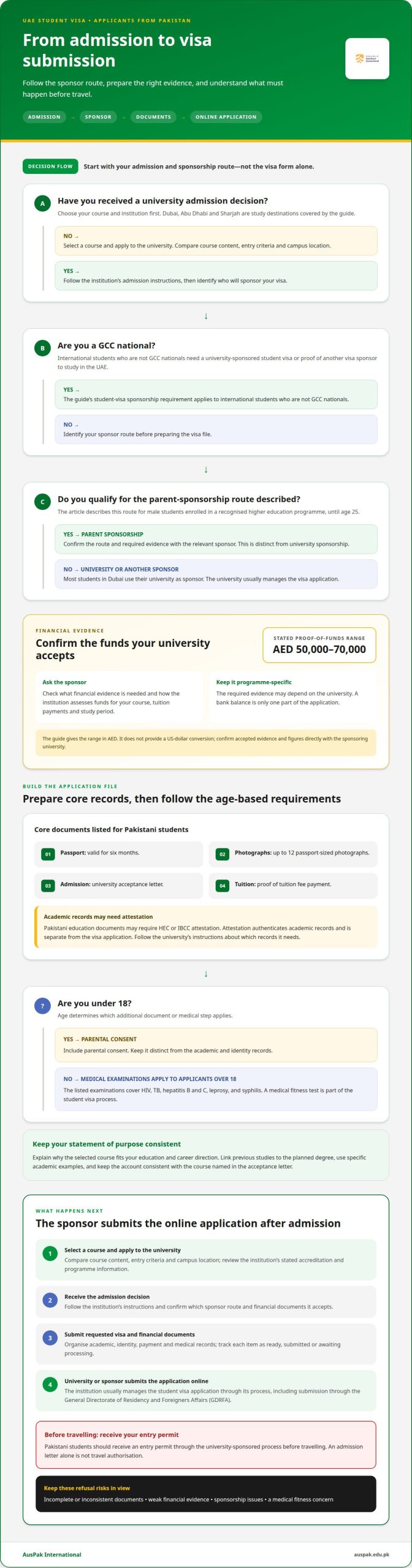
Applicants should check with their university what financial evidence is needed. The stated proof-of-funds range is AED 50,000 to AED 70,000, but costs and evidence requirements should be planned with the university sponsoring the application. Because this guide is for applicants in Pakistan and monetary figures must be shown in US dollars, no unsupported currency conversion is given here. Ask how the institution assesses funds for your course, tuition payments and study period.
A bank balance is only one part of the application. International students who aren’t GCC nationals need a student visa sponsored by a university or proof of another visa sponsor to study in the UAE. Most students in Dubai use their university as sponsor. After receiving the student’s documents, the institution manages the application through the General Directorate of Residency and Foreigners Affairs (GDRFA).
Start by choosing a course, then confirm the institution’s admission and sponsorship steps. Dubai, Abu Dhabi and Sharjah are all UAE study destinations. Compare course content, entry criteria and campus location, then ask the chosen university which financial documents it accepts. This ensures your financial evidence is relevant to the programme, rather than just a generic balance statement.
Consider degree recognition before accepting an offer. Review the institution’s stated accreditation and how the qualification fits your academic or career plans. Visa approval and degree recognition are separate matters: admission and sponsorship relate to studying in the UAE, while recognition concerns the qualification’s standing for your future plans. Keep the university’s written programme information with your admission records.
University sponsorship follows a clear sequence:
- Select a course and apply to the university.
- Receive an admission decision and follow the institution’s instructions.
- Submit the requested visa and financial documents to the university or sponsor.
- The university submits the student visa application through its process.
Some applicants have another sponsorship route. Male students enrolled in a recognised higher education programme can remain on a parent’s sponsorship until age 25. This is distinct from university sponsorship, so identify the sponsor and route before preparing documents. For a Dubai student visa from Pakistan, the practical starting point is matching your course, sponsor and evidence requirements before the visa application proceeds.
Visa documentation and statement of purpose assistance
Build the university’s requested visa file around your admission and personal records. If you’re applying from Pakistan, organise each document clearly and keep your statement of purpose consistent with your chosen course.
Required Documents for Pakistani Students
Build the application file from the university’s instructions. Core items include a passport valid for six months, up to 12 passport-sized photographs, a university acceptance letter and proof of tuition fee payment. If you’re under 18, include parental consent. Keep these records together so the sponsor can review the admission and identity details as one application.
Pakistani education documents may need HEC or IBCC attestation during preparation. Attestation authenticates academic records and is separate from the visa application. Keep original documents and attested copies organised, and follow the university’s instructions on which records it needs for your course.
Medical Examinations and Visa Documents
Applicants over 18 must undergo medical examinations for HIV, TB, hepatitis B and C, leprosy, and syphilis. A medical fitness test is part of the student visa process. For applicants under 18, parental consent is a distinct document requirement. Keep medical paperwork separate from academic records so each part of the application is easy to identify.
Medical examinations address health requirements, while the acceptance letter and tuition payment evidence link your application to a specific programme. Follow the university’s sequence for submitting these items to the sponsor. This helps keep admission documents separate from medical records.
Your statement of purpose should explain why the selected course fits your education and career direction. Link your previous studies to the degree you plan to pursue, then describe the opportunities you hope to develop by studying in the UAE. Use specific examples from your academic background rather than broad claims, and keep your account consistent with the course named in your acceptance letter.
Track document versions and status as you prepare your file. Make a simple list of each item, such as your passport copy, photographs, acceptance letter, tuition payment evidence, attestation papers and medical documents. Mark each as ready, submitted or awaiting processing. This makes it easier to respond when the university sponsor requests a specific file.
Education consultants can help organise an application narrative and related paperwork for other destinations. If you’re also considering the UK, explore UK student visa consultancy for support with that separate study route.
UAE student visa application process
The process starts after admission: the university or sponsor submits the student visa application online. Before submission, Pakistani applicants should align their documents, sponsor details and travel plans.
Pakistani students should receive an entry permit through the university-sponsored process before travelling. An admission letter alone is not travel authorisation. Common refusal risks include incomplete or inconsistent documents, weak financial evidence, sponsorship issues or a medical fitness concern. Keep records accurate and submit every requested item.
Application Steps and Practical Tips
After admission, the university explains how to submit documents to its visa sponsor. The sponsor then manages the online application through the relevant process. Keep your passport details, admission letter and sponsor information consistent across forms. Respond promptly to document requests and retain copies of submitted files to track your application.
Before submission, organise records by category and use clear file names. Check that your course and personal details match the university’s admission record. These steps can help reduce avoidable processing delays caused by missing or conflicting information.
Application Help and Common Questions
Does admission mean your visa is settled? No. The university submits the visa application after receiving the required documents, and sponsorship alone doesn’t guarantee approval. Financial support, sponsor details, a clean criminal record and medical fitness are relevant when preparing a complete file.
Pakistani applicants can reduce common documentation risks by checking that names, passport details and course information match across records. Provide the requested financial evidence and respond directly to university requests. These steps help create a coherent application, but don’t replace the sponsor’s submission process.
Student Visa Application Cost
Visa expenses depend on the visa duration and processing charges. Your overall budget may also include entry-permit processing, medical tests and Emirates ID costs. These are separate from tuition and living expenses, so plan for them as distinct parts of your study budget.
For applicants in Pakistan, the final amount depends on the university’s sponsorship process and the charges attached to the application. Request the university’s itemised payment instructions before paying. This helps separate visa-related charges from tuition and other study expenses.
Processing Time and Visa Validity
UAE student visa processing is stated to take about 2-5 weeks. Build this period into your admission and travel planning, and submit documents promptly so the university can begin its process. Missing records or follow-up requests can affect the sequence of steps.
A UAE student visa is valid for one year. Record its expiry date and coordinate any continuation steps with your university sponsor. After arrival, students complete a medical test before receiving an Emirates ID and residence visa, so allow time for these in-country steps.
Dubai student visa types
For international students, the key distinction is usually the sponsor, not a separate academic visa category. Most students in Dubai use a university-sponsored student visa, while some may study under another valid visa sponsorship. Identify the route before planning arrival, accommodation and the study period.
University-sponsored student visa: A Dubai university sponsors the student and manages the application through the General Directorate of Residency and Foreigners Affairs (GDRFA). The student submits the documents requested by the institution, and the university applies through its process. This is the usual route for an international student admitted to a course who needs a student visa to study in the country.
This arrangement links the visa application to an academic institution and its admission process. For example, a student admitted to a degree programme in Dubai should follow that university’s sponsorship instructions rather than treating the visa as a separate application. The university’s role as sponsor does not guarantee approval.
Other visa sponsorship: A student may provide proof of another visa sponsor instead of relying on university sponsorship. This is a different sponsorship arrangement, not a reason to skip the university’s admission or document steps. Keep the sponsor route clear in your application, since the institution needs the required documents before the visa process can proceed.
Parent sponsorship: Male students in Dubai may remain on a parent’s sponsorship until age 25 if enrolled in a recognised higher education programme. This option depends on both the student’s age and enrolment in that programme. It differs from a university-sponsored student visa, so establish which route applies before organising the application.
Use these questions to distinguish the routes:
- Is the chosen institution sponsoring the student visa, or is another sponsor involved?
- Does the student meet the stated parent-sponsorship criteria, including age and recognised higher education enrolment?
- Which documents does the university need for the selected sponsorship route?
- How does the visa duration align with the course and the institution’s process?
The practical approach is to choose your course and institution first, then identify the sponsor. Later plans, such as seeking work after graduation, are separate from the student visa route. Accommodation planning matters for your study period but does not determine sponsorship. For applicants from Pakistan, a clear sponsor and matching university application help keep the visa route aligned with the intended course.
How long does a Dubai student visa take to process, and how long is it valid?
UAE student visa processing is stated to take about 2-5 weeks, and the visa is valid for one year. For applicants in Pakistan, plan around both the university’s submission process and the course start date.
Processing begins after the university or sponsor receives the required documents and submits the application. Admission, document preparation and visa submission are separate steps, so allow time for each in your study timeline. A complete file helps the sponsor proceed without waiting for missing records.
Use the processing window as a planning guide, not as a travel date. Keep your admission details, application status and planned course start together in one timeline. If the university requests further documents, respond promptly and retain the updated submission record. These steps help you understand where your application sits during the stated 2-5 weeks.
A practical timeline can track these milestones:
- Admission decision and course start date.
- Document handover to the university or sponsor.
- Online visa application submission.
- Visa decision and travel preparation.
Because the visa is valid for one year, consider its period alongside your academic calendar. Record the expiry date as soon as you receive approval, then compare it with the dates provided by your institution. If your programme continues beyond the visa period, discuss the next steps with your university sponsor before the expiry date approaches.
Keep your admission letter and visa records accessible as you plan your studies. The sponsor’s instructions are central because the university manages the application. If a document request arrives while you’re arranging travel, respond through the university’s stated process and update your timeline. Don’t treat a processing estimate as confirmation of a particular decision date.
For applicants from Pakistan, an organised timeline also helps coordinate practical arrangements around the course start. Keep accommodation planning separate from visa approval, and avoid making plans that depend on an unissued visa. Once approval arrives, use the visa validity period and your institution’s academic dates to organise the next steps.
If your study plans are focused on the UK instead, explore UK student visa guidance for that route.
AusPak International: UK Student Visa Consultancy
If your study plans shift from Dubai to the UK, AusPak International’s UK Student Visa Consultancy can guide you through that destination’s visa pathway. Students considering Australia or Canada can explore Australian University Admission Support and Canada Study Permit Assistance.
Turn to the relevant support once you’ve chosen a destination and need guidance with its admission or visa process. If you’re continuing with UAE plans, the university-sponsored application route remains separate from these services.
Contact AusPak International to discuss support for your study plans.
Make your next study decision with clarity
Your next step is to align your academic plan with the right destination and application pathway. For a Dubai student visa from Pakistan, keep your chosen course, university sponsorship route and application timeline aligned as you prepare to move forward. A clear plan helps you focus on the decisions that matter, rather than treating admission, sponsorship and travel as separate goals.
If your plans extend beyond the UAE, AusPak International offers Australian University Admission Support, UK Student Visa Consultancy and Canada Study Permit Assistance. These services can help you explore other study destinations and understand the support available for each route. Choose the destination that fits your education goals, then take the next step with focused guidance.
Contact AusPak International for visa assistance and discuss your study plans. Your international education journey can begin with one considered decision.
Frequently Asked Questions
Why Study In UAE?
The UAE offers international students programmes in fields such as engineering, business, information technology and healthcare. Consider institutions in Dubai, Abu Dhabi or Sharjah, then compare course content and campus location with your academic plans. English-language requirements also differ: some Dubai universities require IELTS, while others don’t. Reviewing each institution’s programme and entry requirements helps you identify a suitable study destination and prepare your application.
What are the eligibility requirements for a Dubai student visa for Pakistani students?
Pakistani students need admission and a valid student-visa sponsorship route to study in the UAE. Non-GCC international students require a university-sponsored student visa or proof of another sponsor. Applicants should also prepare financial-support evidence, maintain a clean criminal record and complete the required medical fitness process. Male students enrolled in a recognised higher education programme may remain under a parent’s sponsorship until age 25.
Which documents do Pakistani applicants need for a Dubai student visa?
Prepare a passport with at least six months’ validity, up to 12 passport-sized photographs, the university acceptance letter and proof of tuition payment. Applicants under 18 need parental consent. The university may request academic records and other documents for its application process. Pakistani education documents may require HEC or IBCC attestation. Keep digital copies organised by document type, so the sponsor can locate a particular record quickly.
How do Pakistani students apply for a Dubai student visa step by step?
First, apply to a UAE institution and receive an admission decision. Then follow its instructions for submitting visa documents and financial support evidence. The university or sponsor submits the application online through its process. After approval and arrival, complete the required medical test before receiving an Emirates ID and residence visa. Keep your admission record and sponsor correspondence together to track each stage.
Which UAE universities or colleges sponsor student visas in Dubai?
A Dubai institution sponsors a student visa when it admits the student and manages the visa application through its process. Sponsorship isn’t automatic for every institution or course, so confirm the route during admission. Establish whether the institution will act as sponsor, which documents it needs and how it submits the application. Don’t assume that admission alone includes visa sponsorship.
What is the cost of a Dubai student visa for Pakistani students, including application and medical fees?
Costs depend on visa duration and processing charges. Medical tests and Emirates ID expenses are additional parts of the budget, separate from tuition, accommodation and daily living expenses. The total varies with the application route and the institution’s process. Request an itemised breakdown in US dollars before budgeting, and separate visa-related charges from tuition and other study costs.
What medical tests, health insurance, or Emirates ID requirements apply to Dubai student visa applicants?
Applicants over 18 undergo medical examinations that include screening for HIV, TB, hepatitis B and C, leprosy and syphilis. International students in Dubai must also have valid health insurance; some universities arrange cover after arrival. Students complete a medical test in Dubai before receiving an Emirates ID and residence visa. Check how insurance fits the institution’s arrangements and keep medical documents separate from academic records.
Where can Pakistani students apply for a Dubai student visa, and what official UAE sources should they check?
Start the application through the university or other visa sponsor, which submits the student application online. For information about the process, consult the institution’s official admissions or visa guidance and the General Directorate of Residency and Foreigners Affairs (GDRFA) information relevant to Dubai. Use official UAE government channels for current requirements. Keep the guidance relevant to your sponsor and application rather than relying on general advice alone.