
France offers more than 1,500 English-taught programs, making it a practical option for Pakistani students who want to study in France from Pakistan in English. French proficiency isn’t a prerequisite for a degree taught in English, although learning basic French can help with daily life. The application journey also involves important admission and visa steps, including Campus France procedures.
It’s understandable to focus first on finding a suitable course and managing the costs. Scholarships may be available through French universities, Pakistan’s Higher Education Commission, and the Embassy of France in Pakistan, but funding options and eligibility vary.
This guide explains why France may suit you, how to explore programs and scholarships, and what to expect from Campus France, admission applications, and the student visa process. You’ll get a clearer picture of the steps ahead before deciding how to move forward.
Key Takeaways
- Assess whether France’s academic options and student experience align with your study and career goals.
- Explore scholarship opportunities and build a financing plan around your program and destination.
- Understand how Campus France fits into the application journey for Pakistani students.
- Compare English-taught programs carefully and identify the language evidence each course requires.
- See how admission preparation and student visa steps connect, so you can plan the process in the right order.
Why study in France?
France combines internationally recognised higher education with study, work, and cultural opportunities for international students. For Pakistani applicants, compare academic fit, city costs, and the practical benefits available during study.
France’s Appeal to International Students
France ranks fourth among destinations for internationally mobile students, according to UNESCO’s latest data. That standing reflects its appeal as a higher education destination, but popularity alone shouldn’t determine your choice. Compare course structure, subject specialisation, teaching language, and career-related opportunities before selecting a program.
France also offers student discounts in areas such as housing, healthcare, transportation, and cultural activities. These can make day-to-day life more manageable, though the benefits most relevant to your budget depend on your city and personal circumstances.
Pakistani Students in French Higher Education
More than 650 Pakistani students are studying at French higher education institutions. Their presence offers a concrete sign that France is already part of the education choices Pakistani students make. Consider how a course’s academic focus, language of instruction, and location fit your own plans rather than relying on destination popularity alone.
France also has a substantial international research community: international students make up 41% of doctoral candidates. This may be especially relevant if you plan to master a specialist subject or pursue research. Check whether the program’s level and academic content match your previous studies and your longer-term goals.
Student Living Costs
There isn’t one monthly living-cost figure that applies across France. Housing, food, transport, and health insurance all contribute to your budget, while your city and accommodation choices affect the total. Compare these categories for your intended destination before deciding whether your study plan is financially workable.
Include healthcare and campus-related expenses in your budget. International students can receive healthcare discounts, and the CVEC is an annual student life contribution. List these separately from housing and daily expenses so your plan accounts for both regular living needs and student-related costs.
Work can form part of the student experience. International students in France may work up to 964 hours per year, described as 20 hours per week during term time. This provides a defined limit to consider when planning study and employment together. France also allows international students to work during and after their studies, with post-study options depending on the relevant route.
France’s Choose France for Higher Education plan aims to enable 500,000 international students to study in the country. This national ambition signals a continuing focus on attracting students from abroad. For an applicant, the practical decision remains personal: weigh program fit, funding, language, and the realities of living in your chosen city.
Scholarships and study financing
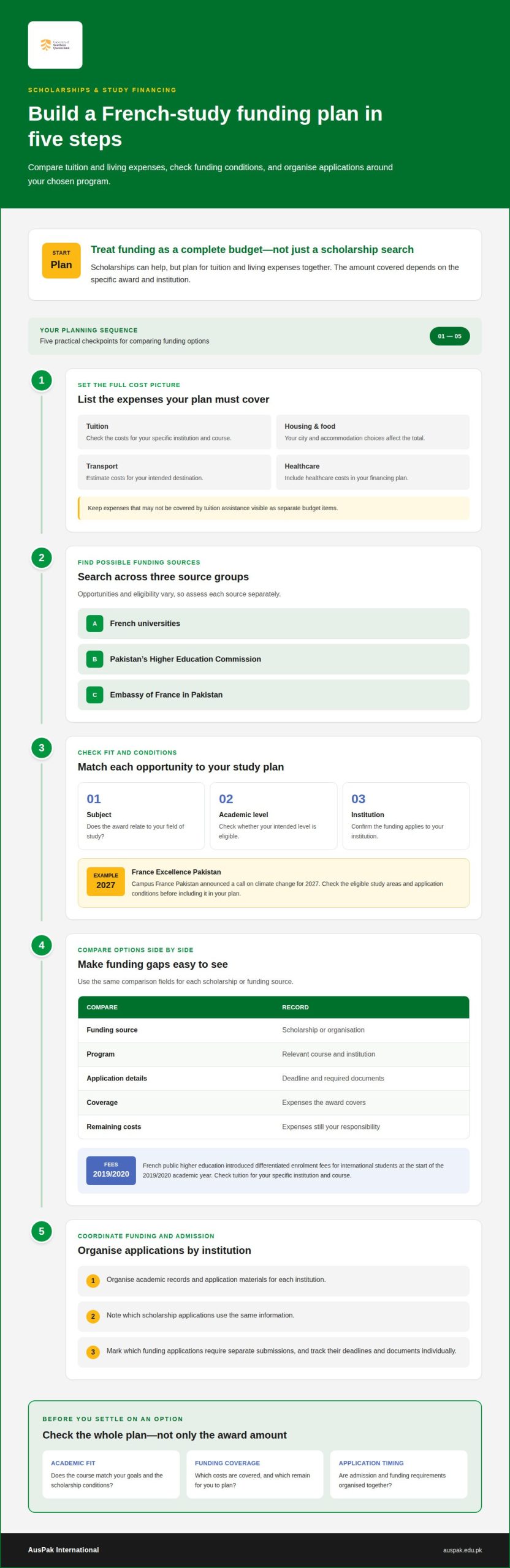
Funding a French degree means planning for tuition and living expenses together. Pakistani students can explore scholarships and funding from French universities, Pakistan’s Higher Education Commission, and the Embassy of France in Pakistan.
Scholarship Opportunities
Start by matching each scholarship opportunity to your subject, academic level, and institution. French universities, the Higher Education Commission, and the Embassy of France in Pakistan are possible funding sources. Their opportunities may have different application processes, so track each source’s requirements and deadlines separately.
For a specific example, Campus France Pakistan announced a France Excellence Pakistan call on climate change for 2027. Applicants interested in climate-related study can use this named call as a starting point for exploring relevant funding. Review the eligible study areas and application conditions for each opportunity before building it into your financing plan.
Financial Aid and Funding
Scholarships are one part of a wider funding plan, not a substitute for calculating the full cost of study. Consider tuition alongside housing, food, transport, and healthcare, then identify which expenses each award covers. Tuition assistance alone may leave living costs for you to plan separately.
French public higher education introduced differentiated enrolment fees for international students at the start of the 2019/2020 academic year. Tuition planning should therefore account for the institution and course, as well as any scholarship support. Don’t assume that funding from one institution applies to another or covers every cost.
Use a comparison table to keep your options clear. Record each scholarship or funding source, the relevant program, application deadline, required documents, and covered expenses. Add a separate line for costs that remain your responsibility. This makes funding gaps visible before you commit to a course and helps you compare offers on the same basis.
Keep academic fit central as you assess financial aid. A scholarship tied to a particular subject or institution may not suit a different course, even if the funding appears attractive. Check how the taught program aligns with your goals, then assess the funding conditions against your study plan. Cultural or subject interests, such as climate change, can help narrow your search to relevant calls.
Coordinate funding applications with admission planning. Organise academic records and application materials by institution, then note which scholarship applications use the same information and which require separate submissions. This reduces last-minute confusion without assuming every funding body follows the same process.
If you’re also considering Canada, explore Canada study permit assistance as a separate part of your destination planning.
What is Campus France and is it mandatory from Pakistan?
Campus France supports international student applications and connects applicants with French higher education. For Pakistani students, Campus France procedures are a required part of the route to a French student visa.
Campus France Application Steps
For most non-EU/EEA applicants to bachelor’s or master’s programs, a DAP pre-admission application must be submitted through Campus France’s “Mes Services” platform. Pakistani applicants must register, upload documents, and attend a Campus France interview at the French Embassy in Islamabad before applying for a student visa.
Campus France operates a network of 255 offices and branches in 124 countries. For applicants in Pakistan, the key step is completing the relevant online application and interview process in the required order.
Application Roadmap
Plan the process in sequence: identify a suitable course, prepare the institution’s admission application, complete the applicable Campus France procedure, attend the interview, then apply for a student visa. The route can depend on the program and degree level, so distinguish the institution’s admission requirements from Campus France steps.
Build a clear application file around your academic history and intended course. Organise your records, program details, and supporting information so each part of your application presents a consistent study plan.
Admission requirements vary by institution, program, and academic level. An English-taught course may assess your previous education and English-language evidence, while another program may set different criteria. Treat each program’s requirements as its own checklist rather than assuming one set applies to every French institution.
Keep documents for admission and Campus France organised together. Your file should make your education history easy to follow and show why the chosen program fits your plans. If a program requests specific evidence, prepare it for that application rather than relying on a general document bundle.
The Campus France interview is a distinct stage before the visa application. Be ready to explain your course choice, academic background, and study intentions clearly. Your answers should align with your application, so keep your program details and supporting documents consistent.
Pakistani applicants may need to pay a Campus France registration fee of PKR 30,000. Factor this application expense into your planning separately from tuition and living costs.
Campus France procedures and institutional admission are connected, but they are not interchangeable. Admission concerns the institution’s decision on your application; Campus France covers the designated pre-visa process for eligible applicants. Keeping these stages separate helps you track what has been submitted and what remains before the visa application.
Start by confirming the program’s application route and requirements, then arrange your documents around those instructions. A clear roadmap helps Pakistani students move from course selection to Campus France and the visa stage without treating each application as unrelated.
English-taught programs and French-language requirements
France has more than 1,500 programs taught in English, giving international applicants options across higher education. For Pakistani students planning to study in France from Pakistan in English, compare the course’s teaching language, academic content, and admission criteria before applying.
English-Taught Program Options
Start with the course itself, not just its English-language label. Confirm the degree level, subject focus, and language of instruction across the program. An English-taught master’s, for example, may suit a different academic goal than an undergraduate course, even at the same institution.
IELTS isn’t mandatory for every program in France, but some English-taught courses may require it. Check which evidence each institution accepts and whether the requirement applies to your chosen program. This lets you prepare for the course’s actual criteria instead of assuming one language-test rule applies everywhere.
French-Language Requirements
French proficiency isn’t a prerequisite for degrees taught in English. Still, basic French is highly recommended, particularly for everyday communication beyond lectures. Treat the classroom language and practical language needs as separate considerations: a program may be taught in English while daily life involves French.
Review the course language alongside the institution’s admission requirements. If a program includes French-taught modules or other language conditions, factor those into your preparation. Applicants comparing France with Germany should make the same distinction between a course’s teaching language and language needs outside class.
For each application, record the program name, degree level, teaching language, and English-language evidence required. Compare these details with your academic background and application documents. This can show whether a course fits your previous education before you invest time in applying.
French higher education includes public universities and other institutions, so identify the institution type while comparing programs. Tuition planning should be tied to the specific course and institution, rather than treated as one amount for every student. From September 2027, tuition fees for non-EU students at French public universities are becoming standardised. Include this timing when planning for a later intake.
Choose France is associated with international education and research activity. General information about French higher education can provide context, but it doesn’t replace course-specific requirements. If you want to study in France from Pakistan in English, use each program’s academic details, teaching language, and application criteria to guide your decisions.
Before submitting, confirm that the program is taught in the language you expect and that your application addresses its stated requirements. For an English-taught course, identify any requested English-language evidence. For French-language study, understand the course’s French requirements. Aligning these details early makes your application more coherent.
Study visa and admission support
For Pakistani students, French admission and visa preparation involve connected but distinct steps. Campus France registration, an interview at the French Embassy in Islamabad, and a subsequent visa application form part of the process.
Keep the order clear. First, apply to the university and follow the relevant Campus France process. Pakistani applicants must register on Campus France, upload documents, and attend an interview at the French Embassy in Islamabad before applying for a student visa. Treat each stage as its own checkpoint.
Admission and visa applications serve different purposes. The university considers your application for its program; Campus France handles the designated pre-visa process. Organise both files around the same course, academic history, and study plan. Consistent information helps the sequence make sense from admission through the visa application.
Prepare documents according to the institution’s admission requirements and Campus France’s upload instructions. Keep your education records and program details organised so you can present information clearly at each stage. Requirements vary by course and application route, so follow the relevant instructions rather than assuming every university requests identical materials.
Your passport also matters. A passport for a French student visa application should have at least two blank pages for visa stamps. Add this practical check to your preparation alongside the course and application documents. A clear file helps you move from university admission to the visa stage without mixing their separate requirements.
The Campus France interview takes place at the French Embassy in Islamabad before the student visa application. Be prepared to explain your academic background, chosen university, and reasons for selecting France. Keep those points aligned with the program information and application you submitted.
After arrival in France, the process continues. Students must validate their long-stay visa online through the ANEF portal within 3 months of arrival. A titre de séjour is required for stays in France longer than 3 months. These are separate residence-related steps, so include both in your arrival planning.
Build a practical roadmap around this sequence: university admission, Campus France registration and document upload, the Islamabad interview, the visa application, then post-arrival visa validation. Track each stage and its required documents separately. This makes it easier to distinguish university actions from Campus France steps and what follows after you reach France.
Include tuition fees and living expenses in your financial plan while preparing your application. Public universities and individual programs can have different requirements, so connect your course choice with its admission process before moving to the visa stage. A well-organised sequence helps you manage the process with greater clarity.
AusPak International: Canada Study Permit Assistance
AusPak International can help if your destination plans include Canada alongside France. Its Canada Study Permit Assistance is for students preparing to study in Canada rather than applying for a French student visa.
For other study-abroad plans, AusPak International also offers Australian University Admission Support and UK Student Visa Consultancy. If you’re comparing destinations, identify which country and application process best match your academic goals before choosing your next step.
Contact AusPak International to discuss your study plans.
Turn your study plans into a clear next step
Choosing a destination is only part of your decision. Next, connect your academic priorities with a realistic application plan so each choice supports the future you want to build. If you’re planning to study in France from Pakistan in English, focus on selecting a course that fits your goals and organising your next actions around its requirements.
If you’re weighing other destinations, AusPak International offers Australian University Admission Support, UK Student Visa Consultancy, and Canada Study Permit Assistance. These services can support your planning when Australia, the UK, or Canada is a better fit for your education plans.
Start with the destination you’re ready to pursue, then take the next step with confidence. Contact AusPak International today to discuss your study plans and move forward with a clear direction.
Frequently Asked Questions
How to apply?
Apply by coordinating your university application with the Campus France steps required for your program. First, identify a course and follow its institution-specific admission instructions. Then complete the relevant Campus France registration and document submission, attend the required interview, and proceed to the student visa application. Keep a record of submission stages and correspondence so you can distinguish university decisions from Campus France and visa requirements.
How to finance your studies?
Build your study financing plan around scholarships and other funding opportunities from French universities, Pakistan’s Higher Education Commission, and the Embassy of France in Pakistan. Compare each opportunity’s eligible subjects, academic level, application conditions, and covered expenses. For example, Campus France Pakistan announced a France Excellence Pakistan call on climate change for 2027. Treat scholarship applications as separate from university admission, and plan for expenses an award may not cover.
What is titre de séjour and how do students get it?
A titre de séjour is a residence permit required for stays in France longer than 3 months. Students should also account for the separate requirement to validate a long-stay visa online through the ANEF portal within 3 months of arrival in France. These are post-arrival immigration steps, not university admission tasks. Keep the visa and arrival timeline organised so you can complete the required process after reaching France.
Which universities in France offer English-taught bachelor’s and master’s programs for Pakistani students?
France has 79 universities listed and more than 1,500 programs taught in English, but the right institution depends on your subject and degree level. Start by narrowing your choices to bachelor’s or master’s study, then compare course content and teaching language. Check each program’s own admissions details, because the available English-taught options and requirements differ across institutions.
How can Pakistani students find English-taught programs in France and verify language requirements?
Search program information by subject and degree level, then confirm the teaching language on the individual course details. France has more than 1,500 English-taught programs, but that figure doesn’t mean every course at a university is taught in English. Review the admission page for each selected program, including any language evidence it requests and whether all course components use English.
What IELTS, TOEFL, or other English test scores are required for studying in France?
There isn’t one English test score that applies to every French program. IELTS isn’t mandatory for every course, although some English-taught programs may require it. Check the specific institution’s language-evidence rules, accepted tests, and minimum score for your chosen course. Don’t assume TOEFL or another test is accepted unless the program’s admission information lists it.
What are the admission requirements and application deadlines for Pakistani students applying to French universities?
Requirements and deadlines depend on the university, program, and level of study. Review the course’s admission criteria for academic records, language evidence, and program-specific documents, then organise submissions around the institution’s application calendar. For most bachelor’s and master’s applications by non-EU/EEA students, a DAP pre-admission application goes through Campus France’s “Mes Services” platform.
How do Pakistani students apply through Campus France and the Études en France procedure?
Pakistani students register on Campus France, upload the required documents, and attend an interview at the French Embassy in Islamabad before applying for a student visa. For most non-EU/EEA applicants to bachelor’s or master’s programs, the DAP pre-admission application is submitted through “Mes Services.” Follow the route linked to your program and keep your university application details consistent with your Campus France file.