
What if the foreign degree with the highest ranking isn’t the best-value choice for your future in Pakistan? The return on investment of a foreign degree in Pakistan depends on more than a university’s name. Your total study investment, intended career, prospects for finding relevant work, and the qualification’s recognition in Pakistan all deserve careful consideration. It’s understandable to want a clearer picture before making a decision that may affect your finances and career for years.
This guide offers a practical framework for weighing those factors without relying on unsupported salary promises or headline rankings. You’ll learn how to compare study costs and foregone earnings with possible career pathways, assess financial and non-financial outcomes, and account for recognition requirements before choosing a course or destination. AusPak International’s counseling and free profile assessment can help connect your academic background and career goals with study options. Its application and visa documentation support can guide you through key steps. Compare your options carefully, then make a decision grounded in your goals and circumstances.
Key Takeaways
- Assess the return on investment of a foreign degree in Pakistan by weighing the full study commitment against potential financial and career outcomes.
- Include tuition, living expenses, travel, insurance, and income you may forgo while studying in your investment estimate.
- Compare foreign and local study using the same field, qualification level, career goal, and time horizon, rather than destination reputation alone.
- Use relevant job advertisements and professional requirements to test whether a qualification and its skills fit your intended career in Pakistan.
- Connect your academic background and career goals to a suitable study plan, and treat application and visa support as guidance, not a promise of approval.
What Does a Foreign Degree’s Return on Investment Mean in Pakistan?
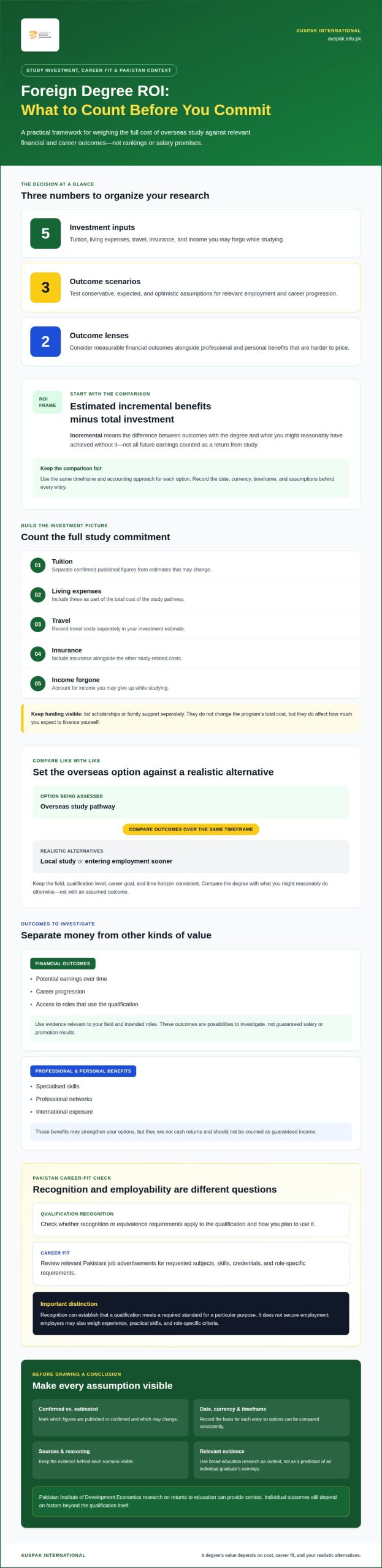
The return on investment of a foreign degree in Pakistan is an assessment of what a student invests in an overseas qualification compared with the financial and career outcomes it may support. Investment can include more than tuition: living expenses, travel, insurance, and income forgone while studying may all affect the calculation. Potential outcomes might include higher earnings over time, access to relevant roles, or progress towards a specific career goal. These are possibilities to investigate, not guaranteed results.
For a conventional financial measure, ROI compares an investment’s gain with its cost. The basic idea behind calculating return on investment can help structure an education decision, but a degree’s value is difficult to reduce to one number. Benefits may emerge over different periods, and career outcomes depend on factors beyond the qualification itself.
Value also varies with the qualification level, subject, institution, and your plans. A course that supports a defined role or further-study pathway may be a better fit than a more prestigious option unrelated to your goals. Compare the degree with a realistic alternative, such as local study or entering employment sooner, rather than assuming overseas study will automatically be worthwhile.
Which benefits belong in a degree ROI assessment?
Separate measurable financial outcomes from professional and personal development. For the financial side, investigate potential earnings, career progression, and access to roles that use the qualification. Look for evidence relevant to your field and intended career instead of assuming that a foreign credential will lead to a particular salary or promotion.
Then consider benefits that are meaningful but harder to price, such as specialised skills, professional networks, and international exposure. These may strengthen your options, but they are not cash returns and should not be counted as guaranteed income. Rankings, reputation, and destination choice can inform your research; none proves that the overall investment will pay off.
Why does the Pakistan context matter?
A qualification’s practical value depends partly on how it fits the Pakistani job market and the requirements of your intended role. Review relevant job advertisements to see which subjects, skills, and credentials employers request. For regulated professions or particular academic purposes, recognition and equivalence requirements may also matter. The relevant process can differ according to the qualification and how you plan to use it.
Recognition can help establish that a qualification meets a required standard, but it does not secure employment by itself. Employers may also weigh experience, practical skills, and role-specific criteria. Keep these factors distinct: recognition concerns whether a credential can be accepted for a particular purpose, while career fit concerns whether it helps you compete for your intended opportunity.
When researching career outcomes, look for evidence that relates to your specific field and intended roles. Use broad information about overseas-study outcomes as context, not as a substitute for checking the requirements and opportunities relevant to your plan.
How to Calculate the Potential Return of a Foreign Degree
Choose a consistent timeframe and compare the overseas study pathway with a realistic alternative, such as local study or starting work sooner. A useful starting point is: estimated incremental benefits over the chosen period minus total investment. “Incremental” matters: count the difference between expected outcomes with the degree and what you might reasonably have achieved without it, rather than treating all future earnings as a return from study.
Build the calculation from your own information. Separate amounts you’ve confirmed, such as a published tuition figure, from estimates that may change. Record the date, currency, timeframe, and assumptions behind each entry. Use the same accounting approach for every option so the comparison is fair.
Which inputs should students gather before comparing options?
Start with the program duration and a complete investment record. Include tuition, living expenses, travel, insurance, and income you may give up while studying. Note funding sources separately, so scholarships or family support don’t obscure the program’s total cost or the amount you must personally finance. Mark each item as confirmed or estimated, and record when the estimate was prepared.
Next, research roles connected to the course and earnings evidence from current, credible sources. Pakistan Institute of Development Economics research on returns to education in Pakistan can provide context, but broad findings aren’t a prediction of what an individual foreign graduate will earn. Test conservative, expected, and optimistic assumptions for relevant employment and progression. Keep the sources and reasoning behind each scenario visible.
- Program: duration, qualification, and field.
- Investment: tuition, living expenses, travel, insurance, and foregone income.
- Funding: available support and the share you expect to finance yourself.
- Outcomes: plausible earnings and career progression compared with your alternative pathway.
How should students interpret payback and net return?
Payback is the time it takes for accumulated incremental benefits to offset the study investment. Use net earnings where possible, and compare like with like: projected graduate income against what you could otherwise have earned over the same period. A simple working template can keep assumptions clear:
- Chosen period: Define the specific starting calendar year and ending year for your analysis
- Total investment: Add verified tuition and expense fees together with calculated living costs and salary losses
- Alternative-pathway outcome: Project the total earnings and career growth you expect without studying abroad
- Degree-pathway outcome: Project the expected earnings and career advancement achievable with your foreign qualification
- Estimated net return: Subtract your alternative-pathway earnings and total expenses from your foreign degree earnings
This is an estimate, not a forecast or a promise of employment. Currency conversion can shift comparisons; inflation, taxes, and changing employment conditions can also affect the value of future earnings. State your assumptions, then test how the result changes if outcomes are less favourable or take longer. To align study options with your academic background and goals, a free profile assessment with AusPak International can be a useful next step.
Foreign Degree vs. Local Study: Compare the Outcomes, Not Just the Destination
A fair comparison starts with like-for-like options. Choose the same field, qualification level, career objective, and time horizon, then assess what each pathway offers. The return on investment of a foreign degree in Pakistan depends on whether its specific advantages support your plans enough to justify the additional investment, not simply on the country or institution name.
Use this matrix to organise your research. Fill it with details from the actual programs you’re considering, rather than general assumptions about overseas or local education.
| Comparison factor | Foreign study | Local study |
|---|---|---|
| Total investment | Record tuition, living expenses, travel, insurance, and foregone income. | Record the equivalent study and opportunity costs over the same period. |
| Curriculum fit | Compare course modules and learning outcomes with your target role. | Check how local course content aligns with that same role. |
| Practical learning | Look for documented projects, placements, facilities, or applied learning. | Assess comparable practical components and their relevance. |
| Networks | Consider the professional and academic connections you could build. | Consider access to networks relevant to your intended career in Pakistan. |
| Relevant roles | Investigate where graduates may seek work and what employers require. | Review access to relevant roles and the qualifications they request. |
When might overseas study align with a student’s goals?
Overseas study may suit you if a chosen course offers documented curriculum features, practical learning, or professional exposure that matches a clear career objective. Check the module list, teaching format, and stated learning opportunities. Don’t assume these benefits come with every foreign institution or are unavailable locally. Base the comparison on the specific programs, not a country’s reputation.
Your intended work location matters, too. If you plan to return to Pakistan, assess how local employers view the subject area and qualification. If you plan to seek work elsewhere, consider the relevant employment context. In either case, distinguish what a program explicitly provides from what you hope its location or institutional reputation will lead to.
How can recognition influence the comparison?
Recognition is a practical part of the decision, but its relevance depends on the qualification level and why you need it. Broadly, IBCC guidance relates to school-level qualifications, while HEC guidance covers higher education qualifications. Requirements and processes can change, so consult current official HEC or IBCC equivalence guidance for your specific qualification and purpose. If your intended profession has its own requirements, research those separately.
Recognition may help establish that a qualification can be used for a particular purpose; it doesn’t guarantee employment or make two courses equivalent in career value. For an Australian pathway, compare specific universities and programs using the same criteria in the matrix, then check current recognition guidance before relying on the qualification for a future step. Neither local nor overseas study is universally superior. The stronger choice is the one whose verified features, recognition pathway, and likely opportunities best fit your priorities.
How to Test Whether a Foreign Degree Fits Your Career Plan in Pakistan
Start with a specific career or further-study goal, not a general expectation of a better salary. Name the role you want in Pakistan or the next academic step you’re working towards. Then check what that pathway requires: relevant qualifications, subject knowledge, practical skills, experience, and any professional credentials. This gives you evidence to compare with a course instead of relying on broad claims about overseas graduates.
Use a simple course-to-career check:
- Define the goal: Identify a specific role, profession, or next academic step.
- Gather requirements: Review current job advertisements and relevant professional guidance for recurring qualifications and skills.
- Map the course: Compare modules and stated learning outcomes with those requirements, noting matches and gaps.
- Test the evidence: Look for credible graduate-employment information, and record its date, scope, and limitations.
For example, if advertisements for your target role repeatedly request a particular technical skill, check whether the course teaches and assesses it. A module title alone may not show the depth of learning, so examine its description and learning outcomes. This helps you judge whether the qualification supports your career plan rather than assuming that a foreign credential will automatically improve your prospects. Discuss your findings with family and academic advisers, and use credible career information to challenge assumptions before committing.
What evidence can indicate career relevance?
Compare current job descriptions with course content and any professional credentials required for your pathway. Graduate-employment data can add context, but read the details: when was it collected, which graduates were included, and what does it measure? Rankings and testimonials may help you understand reputation or individual experience. They don’t replace field-specific evidence about skills, employment, or progression.
- Save relevant job advertisements and note repeated requirements.
- Match each requirement to a course module or stated learning outcome.
- Record the source and date of employment information, including gaps in its coverage.
- List skills or credentials you may need to gain separately.
What should students check about qualification recognition?
First clarify the intended use: employment, further study, or entry to a regulated profession. Recognition requirements can depend on the qualification and purpose. Consult the relevant official authority for current equivalence guidance, and check the applicable professional regulator if your career path requires it. Recognition may support eligibility for a particular purpose, but it does not establish that a course meets every employer’s needs or guarantee a job.
The return on investment of a foreign degree in Pakistan is easier to assess when you test career fit and recognition alongside the financial case. Keep your evidence, assumptions, and unanswered questions together, then review them with people who understand your academic background and intended pathway. A free profile assessment with AusPak International can help connect your academic history and study goals with course and destination options.
Plan Your Study Abroad Decision with AusPak International
Once you’ve compared potential costs, career fit, and recognition requirements, the next step is turning your research into a workable study plan. AusPak International’s free profile assessment helps connect your academic background and study goals with relevant course and destination options. A focused discussion can help you identify what to explore further instead of choosing a pathway based on reputation alone.
What can a structured study plan clarify?
A study plan brings your academic history, intended subject, and future direction into the same conversation. It can help you consider pathways that may fit your profile across the destinations AusPak supports and identify remaining questions about course content, career relevance, or qualification recognition. AusPak International represents over 40 Australian universities, giving students a range of Australian university options to consider alongside their goals.
Planning can also make the application process more manageable. Once you identify a potential pathway, application processing and visa documentation support can help you understand the relevant steps and prepare the necessary materials. This is process guidance, not a promise of admission or visa approval. For additional detail about the application process, explore the university application assistance article as part of your research.
AusPak International was founded in 1995 and has supported 1K+ satisfied students. These facts provide context about the consultancy, but your decision should still centre on your academic profile, course choice, and career aims. A suitable pathway is one you can assess on its specific merits.
How can students move from research to a next step?
Before discussing options, prepare a short summary of your intended career or further-study goal, the courses and destinations you’re comparing, and the evidence you’ve gathered. Note unresolved questions, such as whether the course teaches skills requested in relevant roles or whether recognition may be needed for your intended purpose. This preparation makes the conversation practical and helps focus counseling on your circumstances.
- Academic background: List your previous qualifications and relevant subjects.
- Study objective: Describe the field and qualification level you’re considering.
- Career direction: Identify a target role, profession, or further-study plan.
- Open questions: Record uncertainties about course fit, documents, or recognition.
The return on investment of a foreign degree in Pakistan can’t be judged from destination or degree title alone. Use your findings to decide which practical question to address next, then refine your plan with guidance shaped around your profile. A free profile assessment is a useful starting point for personalized counseling and a clearer view of possible study pathways.
Shape your future with AusPak International by beginning a study-plan discussion and identifying your next practical step.
Turn Your Research Into a Confident Next Step
The return on investment of a foreign degree in Pakistan is personal: it depends on how well a study pathway supports the future you’re working towards. Before committing, write down the key decision you still need to resolve, whether it’s course fit, recognition, or the financial assumptions in your comparison. A clear question can make the next conversation more useful and help you move forward with purpose.
You don’t need every detail settled before exploring your options. Start with your academic background, intended career direction, and the evidence you’ve gathered so far. Then use personalized guidance to identify a practical next step and refine your study plan.
Start your free profile assessment with AusPak International and take a considered step towards a study pathway that fits your goals. Your future plan can begin with one informed decision.
Frequently Asked Questions
Does a foreign degree guarantee a higher salary in Pakistan?
No. A foreign qualification doesn’t guarantee a higher salary, a particular job, or faster progression. Employers assess how your subject, skills, experience, and credentials match a role. For a practical comparison, look at current advertisements for the same job type and experience level, and note the qualifications they actually request. Treat reported earnings as context, not a promise that your outcome will match someone else’s.
How do I calculate the return on investment of a foreign degree?
Build a dated comparison for a defined period, using the overseas program and a realistic alternative, such as local study. Record which figures are confirmed and which are assumptions, then test how the result changes if employment takes longer or your first role differs from your target. The return on investment of a foreign degree in Pakistan is a planning estimate, not a guaranteed financial outcome or job forecast.
Is a foreign degree automatically recognized in Pakistan?
No. Recognition isn’t automatic simply because a qualification was earned abroad. The relevant route depends on the credential’s level and intended use, and a regulated profession may have additional recognition requirements. For example, a qualification intended for further study may raise different questions from one used for a professional role. Check current HEC or IBCC guidance for your credential, and consult the relevant professional authority where applicable.
Can I use a foreign degree to apply for jobs in Pakistan?
Yes, you can apply, but meeting an employer’s requirements depends on the particular vacancy and your profile. Before applying, compare your qualification with the advertisement’s stated education, skills, and experience criteria. If formal equivalence or professional recognition is relevant, understand its status and provide accurate information about it. A degree alone doesn’t guarantee eligibility, an interview, or a job offer.
What should I compare before choosing a foreign degree over a local one?
Compare programs at the same qualification level and against the same career goal. Beyond overall investment, examine course modules, practical learning, professional requirements, and whether the course develops skills relevant to your preferred roles. You might also weigh access to useful academic or professional networks. Decide which factors matter most to you, then assess both pathways against those priorities rather than assuming one is always better.
Does a higher university ranking mean a better return on investment?
Not necessarily. A university-wide ranking may not show whether a particular course prepares you for the work you want to do. Look for course-level details, relevant graduate outcome information, and evidence that employers or professional bodies recognise the qualification for your intended purpose. Rankings can help you understand institutional context, but they don’t predict your personal employment or earnings outcome.
When should I check HEC or IBCC equivalence requirements?
Check official guidance as soon as you know the qualification level and how you may use the degree in Pakistan, ideally before making a study commitment based on assumed recognition. HEC and IBCC cover different qualification levels, and requirements or procedures may change. Revisit the relevant authority’s current instructions before preparing an application or submitting documents, so your plans reflect the latest guidance for your specific credential.