
The most popular study destination may not be the best fit for your budget or goals. For Pakistani students, a practical way to decide how to choose the right country to study abroad is to compare tuition, living expenses, visa requirements and work rights alongside academic quality. The right choice is the one that fits your finances and supports your plans for the future.
University rankings, career prospects and a country’s reputation can all be appealing, but they tell only part of the story. Your overall budget, the realities of student life and the value of your course also matter when turning an international education goal into a workable plan.
This guide shows how to compare destinations by rankings, visa rules, student experiences, costs, work opportunities and study benefits. It also outlines how Canada, the UK, Australia and Germany differ, helping you focus on destinations that suit your priorities before deciding what to do next.
Key Takeaways
- Compare destinations by course fit and recognised academic quality, not rankings alone.
- Build a realistic budget that accounts for tuition, accommodation, daily expenses and location.
- Understand visa conditions and work options during and after study before making a shortlist.
- Use current student experiences to learn how campus life and everyday costs may differ from expectations.
- Weigh Canada, the UK, Australia and Germany against your academic goals, finances and career plans.
How a study-abroad adviser uses rankings, visa information, and student experiences to help you choose a country
Rankings offer a useful starting point, but they cannot select a destination by themselves. An adviser can use the QS World University Rankings 2026 to identify universities, then assess course relevance, recognition, facilities and faculty expertise. A high position may not indicate the best programme for a student’s goals or budget. Advice on how to choose the right country to study abroad should connect university quality with visa conditions, living costs and practical fit.
Visa information provides another essential comparison. An adviser reviews each destination’s application rules, required documents, permitted activities and post-study options. According to UK Government, a UK Graduate visa lasts 2 years for applications made on or before 31 December 2026. It lasts 18 months from 1 January 2027; doctoral graduates get 3 years. UK Student visa applicants must be able to speak, read, write and understand English, according to UK Government.
Student and alumni accounts can add detail beyond official university information. Former exchange students, graduates and current international students may share firsthand perspectives on course workload, campus routines and housing searches. Use their experiences to picture daily life, while relying on official university and visa information for application and eligibility decisions.
Parents’ networks can offer another practical perspective. You might hear from families whose children study in a destination on your shortlist. For example, a Pakistani parent can ask a family with direct experience about accommodation, transport and daily expenses. Online forums, Facebook groups and student websites also offer peer accounts. Compare those experiences with your own course and circumstances.
Visa rules can affect family plans, too. Canadian study permit holders may bring immediate family if the permit is valid for at least a year. A partner may be included if they have lived together for at least a year, and children may be included if they are under 18. An adviser considers these conditions alongside course choices and household needs, rather than assuming dependent rules are the same in every destination.
Compare healthcare, housing, transport and student support using university and location information alongside student accounts. Consider how support services and accommodation options relate to campus and daily travel. For example, housing farther from campus can affect your transport arrangements. These practical details help you understand the living environment, not just a university’s academic profile.
Assess safety and welcome through specific campus resources and student experiences, rather than broad claims about an entire country. Compare support services and accounts from international students in the relevant location. To understand how to choose the right country to study abroad, weigh these details alongside course fit, entry requirements, visa conditions, expenses and family needs. The right balance depends on your priorities and plans.
How a study-abroad adviser assesses tuition, monthly costs, and accommodation for your budget
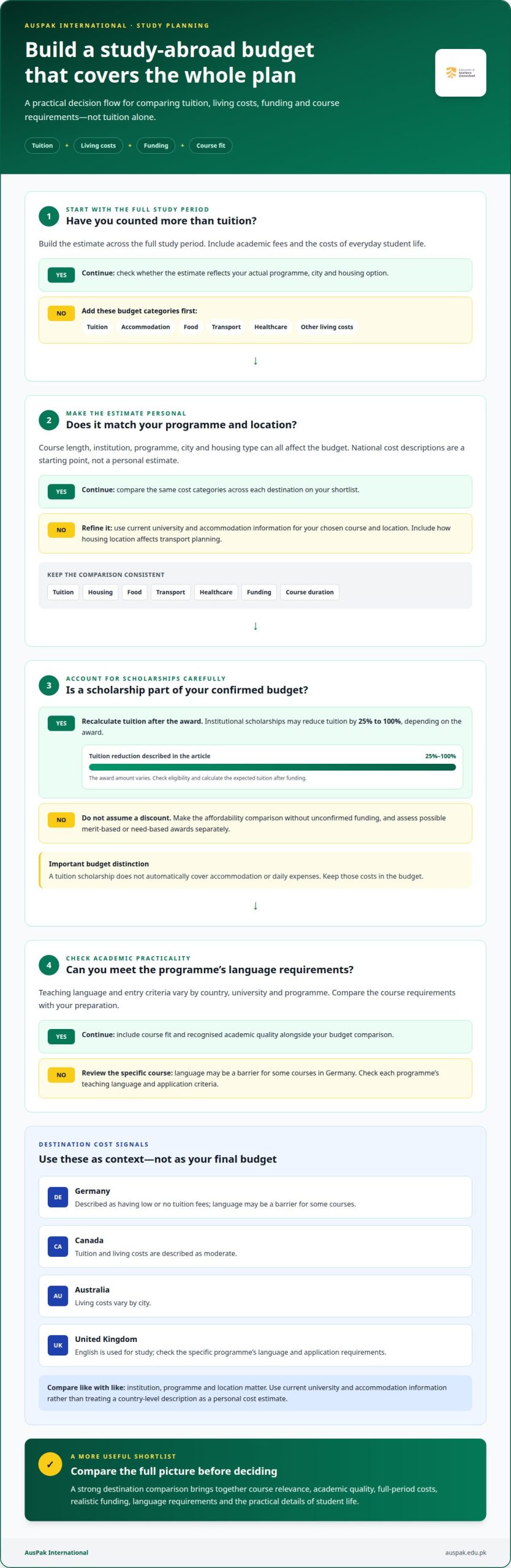
Start your comparison with the full study period, not tuition alone. Separate academic fees from accommodation, food, transport, healthcare and other living costs. Then factor in course length, city and housing type, as each can change the budget. For Pakistani students, a useful destination plan accounts for expenses beyond the first tuition payment.
Country-level cost estimates need context. Germany is described as having low or no tuition fees, while Canadian tuition and living costs are described as moderate. Living costs in Australia vary by city. The institution, programme and location are therefore essential to a meaningful comparison. Use current university and accommodation information to estimate likely costs, rather than treating a national estimate as a personal budget.
Scholarships can change the tuition calculation. Institutional scholarships may reduce tuition fees by 25% to 100%, depending on the award. An adviser considers whether merit-based or need-based funding may apply to the student’s academic profile and chosen programme. The budget should distinguish tuition before funding from the amount expected after an award, so the student can assess affordability without relying on an assumed scholarship.
Review housing separately. Compare accommodation by location and facilities, and consider how each option fits your study routine. Housing farther from campus can affect transport planning, while a central location changes the balance between rent and commuting. Include food, transport, healthcare and other expenses in your first-year budget for a fuller picture than tuition figures alone.
Financial aid and affordability are separate questions. A scholarship may reduce tuition, but it does not automatically cover accommodation or daily expenses. Review the award’s eligibility conditions and how its value affects your overall study budget. Check when cost information was published, too, since tuition and living costs can change. An outdated estimate may not reflect your chosen programme or city.
The language of instruction is another practical factor. English is used for study in destinations such as the UK, while language may be a barrier for some courses in Germany. Requirements vary by country, university and programme. Compare the teaching language with your preparation and the application criteria to understand both academic fit and how much time you may need to prepare.
The final comparison should put the same categories beside each destination: tuition, housing, food, transport, healthcare, funding and course duration. An adviser can then identify which costs are fixed, which depend on location, and where scholarships may change the picture. Students considering Canada can also explore Canada Study Permit Assistance as they progress from budget planning to permit preparation.
3. Part-time work and post-study work rights
Part-time work can support an international student’s budget, but it should not determine your destination on its own. Compare study-work rules with course demands, tuition and career plans. Permission to work during study and options after graduation are separate considerations. Understanding both helps you assess the value and practical demands of an overseas degree.
In the UK, students can work no more than 20 hours a week during term time. That limit matters when estimating whether employment can fit around classes, assessments and essential study time. The adviser also distinguishes work during a course from post-study options, then considers whether the student’s intended career aligns with opportunities after graduation.
For the United States, international students on an F-1 visa may work only on campus during their first year of study. After the first year, they may have an opportunity to work off campus through their university’s Curricular Practical Training (CPT) or Optional Practical Training (OPT) programs. F-2 visa holders cannot take paid employment without changing their visa status. These distinctions matter for students planning around family circumstances or expected earnings.
Rules differ elsewhere. In Sweden, students may work without a term-time hours limit if they study for at least 40 hours per week. Australia offers international students work rights during their studies, while the specific work conditions need to be considered alongside each course plan. An adviser weighs these arrangements against academic workload, living costs and the student’s need to focus on studies.
Post-study options can shape longer-term career planning. Canada’s Post-Graduation Work Permit allows graduates to work for up to three years, depending on their degree length. Ireland’s Graduate Scheme offers international graduates a two-year period to transition from education to work. These pathways can provide time to gain relevant experience, but their value depends on the student’s field and career direction.
When comparing work rights, identify whether each option covers work during study, after graduation, or both. Connect those options to your course, intended occupation and preferred destination. Permission to work is not the same as a job offer, so career planning should also consider relevant skills and local opportunities. Do not treat expected earnings as guaranteed funding.
Keep immigration pathways separate from post-study work options. A graduate work option may provide time to build experience, but does not itself establish a permanent immigration outcome. Compare the destination’s stated work route with your professional goals and likely study timeline. This helps you assess whether a course supports a realistic career plan, rather than choosing a country on work rights alone.
For a clear comparison, map each destination against work permission during study, post-study duration, course demands and career relevance. The right balance depends on whether you prioritise help with expenses during study or experience after graduation. Consider these factors alongside tuition and academic fit before settling on a destination.
4. Why Study Abroad?
Studying abroad can connect academic training with international perspectives, specialist facilities and faculty expertise. Rankings offer one comparison point, but they don’t show whether a university’s programme supports a student’s goals. The USA has at least 33 universities among the world’s top 100. An adviser can use that context to identify options, then assess course content, teaching approach and location for each student.
Check accreditation and recognition carefully, especially if you plan to work in a regulated profession. Review the university and programme information relevant to your chosen field, then consider whether the course aligns with your intended career. Facilities matter, too. A laboratory-based programme calls for a different facilities review than a course centred on libraries, studios or clinical learning.
Faculty expertise can help distinguish similar programmes. Compare course structures, faculty profiles and the academic areas each department emphasises. For example, an engineering student may value a programme whose teaching and facilities align with that focus. This takes you beyond broad university rankings to assess the learning experience and resources relevant to your subject.
Study-abroad fairs offer another way to compare universities. Representatives can discuss programmes and locations, and brochures give you material to review side by side. Organise your comparison around course structure, admission criteria, facilities and student support. This makes conversations at a fair more useful than collecting institution names without connecting them to your academic plan.
Admissions requirements also shape the shortlist. Applications commonly involve academic transcripts and certificates, English language test results, a statement of purpose and recommendation letters. Postgraduate applicants should prepare a resume or CV. An adviser maps these documents against each university’s application requirements, helping identify where preparation differs between programmes and which parts of an application need attention.
Term dates affect planning from Pakistan, including when to prepare applications and arrange your transition. Universities in the UK and France typically begin semesters in September. In Australia and New Zealand, students are typically welcomed in February or March. Compare these calendars with your readiness and preferred intake to make sure course timing fits your wider study plan.
Choose a university by combining academic fit with affordability and the cost of living in its location. Compare programme quality, facilities, faculty, admission requirements and term dates, then weigh them against your priorities. A university with a strong subject match may suit you better than a higher-ranked institution that does not fit your goals. A structured review makes global study choices more purposeful.
5. Country comparisons: Canada, the UK, Australia, and Germany
For Pakistani students, a useful comparison starts with course fit, overall affordability and plans after graduation. Canada, the UK, Australia and Germany each offer distinct academic and career advantages. Their differences matter more than a destination’s popularity. Compare the programme, location, accommodation needs and work options as parts of one decision.
Canada combines a broad international student community with post-study work possibilities. The country hosts around 580,000 international students, and its tuition and living costs are described as moderate. Canada’s Post-Graduation Work Permit allows graduates to work for up to three years, depending on degree length. This may suit students seeking time to gain relevant experience after graduation, provided the course and career direction align.
The UK can suit students seeking a shorter postgraduate route. Several UK universities offer one-year Master’s programmes, which can affect the overall study timeline. Still, compare programme content, tuition, accommodation and living costs in your chosen city. A shorter course does not automatically mean lower total expenses, so weigh the full budget against the academic value.
Australia offers diverse programmes and research institutions, with STEM and healthcare identified as strong study areas. It has approximately 570,000 international students. For a Pakistani applicant, course specialisation and campus location should guide the comparison, since accommodation and everyday costs vary by city. Students interested in Australian study can explore Australian university admission support as they assess programme options.
Germany is worth considering for engineering and technology studies, and it offers low or no tuition fees. However, language can be a barrier for some courses. Weigh the programme’s teaching language against your academic preparation and future goals. Language can also shape daily life beyond lectures, so consider it alongside accommodation and course suitability.
Use the same comparison for all four countries: subject strengths, course duration, tuition, living costs, work opportunities and post-study options. Then relate each factor to your priorities. An engineering student might shortlist German programmes, while someone seeking a research-intensive STEM course may consider Australia. These are starting points, but the individual programme and location determine the practical fit.
The clearest takeaway is to compare specific courses, not just country labels. Canada may appeal for its post-study work period, the UK for shorter Master’s options, Australia for programme breadth, and Germany for engineering and technology. Match those strengths to your academic goals, budget and plans after graduation to build a more informed shortlist for studying abroad from Pakistan.
AusPak International: Canada Study Permit Assistance
AusPak International provides Canada Study Permit Assistance for Pakistani students who have chosen Canada and are preparing a permit application. Its application processing and visa support can help make the next stage more structured. Turn to this assistance when your destination and study plans are taking shape and you need guidance with the study permit process.
For other destinations, AusPak International also offers Australian University Admission Support, UK Student Visa Consultancy and Onshore Arrival Support. Choose support that matches your destination and stage of planning. Keep your course choice, budget and application documents aligned as you move from comparing countries to preparing to study abroad.
Contact AusPak International to discuss your study-abroad plans.
Turn your destination choice into a clear next step
Knowing how to choose the right country to study abroad is only the beginning. Next, connect your preferred destination with a suitable course and a well-prepared application. For Pakistani students, this means moving from comparing possibilities to planning a route that fits their education goals. A focused discussion with AusPak International can help clarify whether university admission or visa preparation needs attention first.
AusPak International offers Australian University Admission Support, UK Student Visa Consultancy and Canada Study Permit Assistance. Choose the support that matches your destination and stage in the process. Be ready to discuss your preferred course, study plans and application needs, then take the next step with greater clarity.
Contact AusPak International to discuss your options, and move forward with confidence.
Frequently Asked Questions
How can a study-abroad adviser help you choose the right country for higher education?
A study-abroad adviser connects your academic profile and career aims with suitable destinations and application routes. For example, an adviser can help distinguish a course that matches your subject interests from one that appeals mainly because of a country’s reputation. They can also organise requirements into practical stages, such as shortlisting programmes, preparing academic records and planning visa documents, so you know what needs attention before applying.
Which countries offer the best universities and programs for my field of study?
The best destination depends on your subject, preferred teaching environment and career plans. Germany is known for strength in engineering and technology, while Australia is a potential option for STEM and healthcare studies. Treat these as starting points, not universal rankings. Compare specific course modules, faculty expertise, facilities and programme recognition, then consider whether the university’s admission requirements and location fit your academic background and budget.
How do tuition fees and living costs compare across popular study destinations?
Costs vary by country, institution, programme and city, so compare complete budgets rather than tuition alone. Germany is described as having low or no tuition fees, while Canadian tuition and living costs are moderate. Australian living costs vary by city. Include accommodation, food, transport, healthcare and course duration in a fair comparison. Use recent university and location-specific estimates, since published cost information can change.
What scholarships and financial aid are available for international students?
International students may find merit-based or need-based scholarships offered by universities. Institutional scholarships can reduce tuition fees by 25% to 100%, depending on the award. Eligibility and coverage vary, so distinguish tuition reductions from support for accommodation or everyday expenses. For example, a tuition award may lower academic costs without covering rent. Match each scholarship’s criteria with your academic record, chosen programme and overall funding plan.
Which countries offer the best post-study work visas and pathways to permanent residency?
Post-study work options vary by destination and course, and a work visa should not be treated as a permanent residency pathway. Canada’s Post-Graduation Work Permit can allow graduates to work for up to three years, depending on degree length. The UK Graduate visa lasts 2 years for applications made on or before 31 December 2026, or 18 months from 1 January 2027; doctoral graduates get 3 years. Compare work options with your field and career goals.