
A message that appears to come from a university, embassy or visa centre can still be a scam. A practical approach to avoiding common scams targeting international students is to pause, verify unexpected payment or document requests through official contact details, and never let threats or urgency rush your decision. In Australia, scams can be reported to police on 131 444 or online to the Australian Competition & Consumer Commission through Scamwatch.
It’s understandable to trust a message that uses familiar names or looks formal, especially when it concerns admission, a visa, or accommodation. But unexpected calls and emails, pressure to pay quickly, and requests for personal or financial information deserve careful scrutiny.
This guide explains how to spot impersonation and phishing, verify requests before sending money or documents, protect your accounts, and report a scam in Australia. Use these steps to respond calmly and protect your study plans.
Key Takeaways
- Treat unexpected messages claiming to come from a university, embassy or visa centre with caution, especially if they demand urgent payment or threaten consequences.
- Verify payment and document requests using contact details you find independently on the institution’s official website.
- Be cautious of unsolicited offers of admission, visa or housing help, and don’t share personal or financial information under pressure.
- If you suspect a scam in Australia, report it to police on 131 444 or online through Scamwatch.
- If a suspicious message may have exposed your bank details, contact your bank immediately to secure your account.
1. Impersonation of embassies, universities, and visa centres
Scammers may impersonate an embassy, university, visa centre, or government agency to make a request seem official. A message might use a familiar logo, formal wording, and a sender name resembling a real institution. Look beyond the display name. Fake websites and social pages may use university logos but have an incorrect domain or missing contact details.
How do phishing messages and fake payment requests target international students? They imitate trusted organisations, then use urgent warnings or attractive offers to prompt a click, payment, or disclosure of personal information. A link may lead to a fake sign-in page, or an email may ask directly for private details.
Some impersonation attempts exploit visa concerns. Scammers have pretended to work for the Canadian government’s Immigration, Refugees and Citizenship Canada Call Centre. Other messages claim students owe an “international student tariff” and threaten visa cancellation. Treat unexpected demands and threats as warning signs. Don’t reply with personal or financial details, and don’t use payment instructions in the message.
Phishing can also arrive as a parcel notification. For example, a text may claim that a delivery needs attention and direct you to a link. The link could lead to a page requesting personal or payment information. Don’t follow it just because it names a delivery company or looks routine. Check for an order or delivery using records you already have, and avoid entering details on a page opened from an unsolicited message.
Police impersonation can use fear instead of a delivery alert. A caller or message may claim you’re connected to an investigation, then demand money or a security deposit through a personal account. Police will not collect security deposits through personal accounts. End the conversation if threats and intimidation persist, and don’t transfer funds to an account provided by the caller.
Use these checks before acting on any unexpected message:
- Inspect the sender’s full email address and the website domain, not just the logo.
- Find the university or visa centre’s contact details independently, then ask whether the request is genuine.
- Don’t open attachments, share passwords, or enter bank details through unsolicited links.
- Save the message and sender details if you suspect impersonation, especially before reporting it.
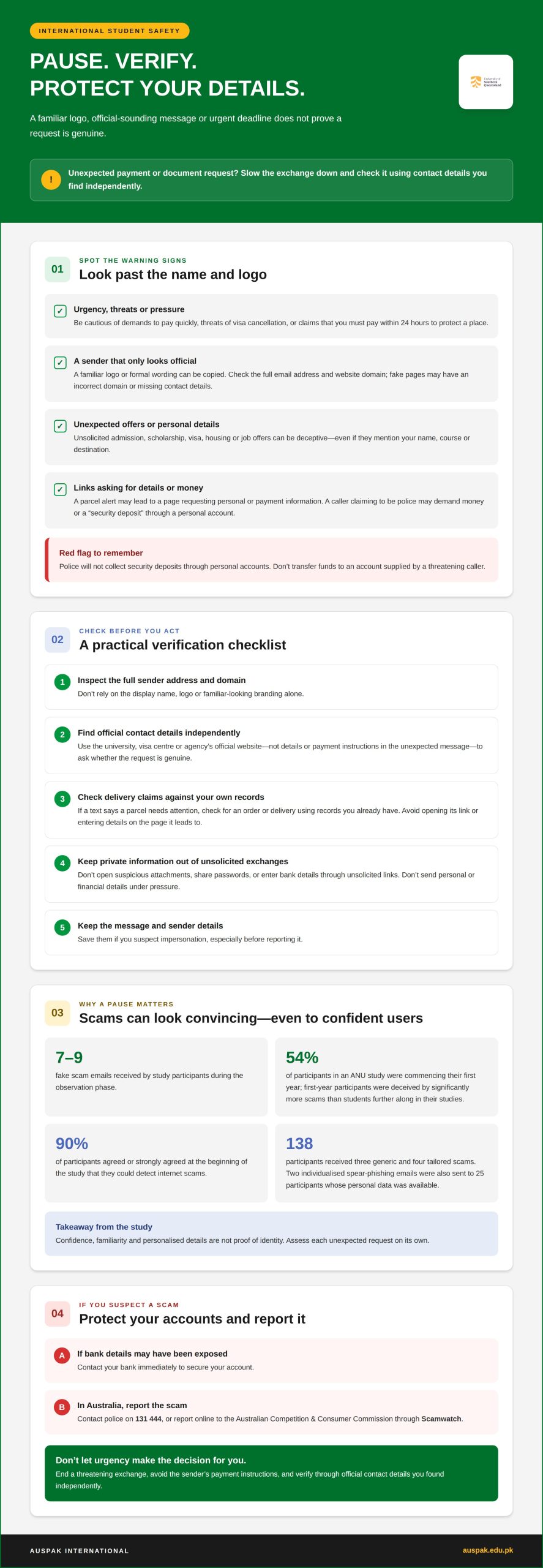
Scam messages can feel convincing because they borrow the language of admissions, immigration, deliveries, or law enforcement. Slow the exchange down. A familiar logo or urgent deadline isn’t proof of identity.
Scammers may impersonate government agencies and demand an “international student tariff”, threatening to cancel the student’s visa. Treat an official-sounding demand as a reason to verify it, not as proof that it is genuine. Find the agency’s contact details independently, and don’t pay or share personal information through the message.
Study participants received between seven and nine fake scam emails during the observation phase. This shows why it’s useful to assess each unexpected email on its own, even if its wording or appearance seems familiar. Check requests using contact details you find independently, and avoid acting on links, payment instructions, or requests for private information in unsolicited messages.
2. Which tactics do scammers use against international students like me, and how can I spot them?
Scammers exploit important decisions, including admission, visas, scholarships, and work abroad. An unexpected call or email may claim to offer a place, scholarship, or job. The sender may mention your course or destination to make the offer feel personal. Avoiding common scams targeting international students starts with treating unexpected claims as unverified, even when they include familiar details.
First-year students can be especially vulnerable while learning unfamiliar processes. In an ANU study, 54% of participants were commencing their first year. First-year participants were deceived by significantly more scams than students further along in their studies. Use a deliberate pause before acting on unfamiliar requests, particularly during the first stages of planning overseas study.
Personalised emails can seem more convincing than generic messages. The study sent three generic and four tailored scams to 138 participants. It also sent two individualised spear-phishing emails to 25 participants whose personal data was available. A message mentioning your name, intended destination, or course may still be deceptive. Personal details can make a false offer feel credible without proving the sender’s identity.
Digital confidence isn’t enough on its own. At the beginning of the study, 90% of participants agreed or strongly agreed that they could detect internet scams. Yet first-year participants were deceived by more scams. Avoiding common scams targeting international students means assessing each request carefully, rather than relying on confidence or technical familiarity.
How can students spot fake student visa and immigration agents? Be wary of unsolicited calls or emails claiming they can secure admission, a scholarship, or a visa, especially if they demand payment within 24 hours to protect a seat. Don’t give personal or financial information to someone claiming to be a government official.
Job, internship, and work-permit scams may use similar pressure. Treat an unexpected offer as suspicious if it asks for money or sensitive details before you can establish who sent it. An urgent role doesn’t prove the sender represents a real employer or authority.
Watch for these warning signs:
- A 24-hour payment deadline tied to losing a place.
- An unexpected offer of admission, scholarship, employment, or visa help.
- A request for passwords, financial details, or identity documents.
- A message using personal study details to make its claims seem trustworthy.
Check the sender’s full email address and inspect links without opening them. Verify an offer through contact details you find independently. If the sender keeps pressuring you, stop responding and preserve the email or message. These habits help you assess opportunities calmly, whether they concern study, immigration, or work.
4. Verifying requests before paying or sharing documents
Before acting on a request, separate the claim from the payment instructions. A message may refer to a real university, landlord, or visa centre while directing you to a scammer’s account. Don’t reply through the message or use its links to confirm the request. Find the organisation’s official contact details independently, then ask whether the specific payment or document request is genuine.
How can international students verify university admission offers and scholarships? Contact the university using details you find independently on its official website, and ask it to confirm the offer and any requested payment. Don’t rely on a sender’s email address, logo, or attached letter as proof.
For any payment request, compare the amount, purpose, recipient, and payment method with information from the relevant institution. If the details differ, stop before sending money. Scammers may demand processing fees before providing official documentation, so a payment request alone doesn’t establish that documents or an offer are genuine. Ask the institution directly what the fee covers and how it should be paid.
Rental requests need a separate check. If someone emails new bank details or asks you to transfer rent to a different account, contact the landlord directly using details you already have. Don’t rely on the phone number or email in the change request. If you’re arranging accommodation, don’t pay a bond or deposit before viewing the property.
A caller claiming to be a government official may demand money or personal information. Try to collect the caller’s contact information, but don’t share sensitive details or transfer funds during the call. End the conversation if threats and intimidation persist. If the caller says police require a security deposit, remember that police will not collect one through a personal account.
Use this sequence when a request feels unusual:
- Pause. Don’t click links, open attachments, or send documents.
- Identify the organisation named in the request, such as a university or visa centre.
- Find its official website yourself and use its published contact details.
- Ask whether the exact request, recipient, and payment method are legitimate.
- Save the message and any payment details if the request appears fraudulent.
For document requests, confirm the purpose and recipient before sharing identity or financial records. A request that arrives unexpectedly, demands immediate action, or uses payment details that differ from previous instructions needs independent confirmation. Keep copies of relevant messages and records. If you’ve already sent money or shared bank details, contact your bank immediately to secure your account.
A mismatch is a reason to verify, not to improvise a new payment route. Shanghai police will not instruct individuals to transfer funds to a purported designated account.
5. Reporting scams in Australia
Reporting a scam in Australia creates a clear record and helps you take practical next steps. For police assistance with a non-emergency scam report, call 131 444. You can also report scams online to the Australian Competition & Consumer Commission through Scamwatch. Choose the reporting route that fits what happened, and keep any evidence available.
What steps should international students take after losing money or sharing personal information with a scammer? Contact your bank immediately if the scammer may have your bank details or you’ve transferred money. Then report the incident to police on 131 444 and submit a report through Scamwatch.
Act promptly if your account information is exposed. Tell your bank what information you shared, when you shared it, and whether money moved. Follow its instructions to secure your accounts. If you shared a password, change it on the affected account and any other account using the same password. Don’t continue communicating with the scammer or send further payments.
Preserve evidence before deleting messages or blocking a sender. Keep the original email or text, screenshots, phone numbers, email addresses, payment instructions, receipts, and records of any contact. Note the sequence of events while it’s fresh. These details can help you describe what happened when reporting to police or Scamwatch.
Make your report clear and factual. Include how the person contacted you, what they claimed, what they asked you to do, and whether you paid or shared information. For example, explain that a caller claimed to represent a government agency and requested a transfer. Avoid guessing about the sender’s identity. State what you observed and attach relevant evidence through the reporting process.
Reporting a crime to Australian police won’t affect your visa, police checks, job applications, studies, or grades. Fear about immigration consequences shouldn’t prevent you from seeking help after a scam. If threats continue, end the conversation and keep the threatening messages as evidence.
Use this sequence to organise your response:
- Contact your bank immediately if your bank details may be exposed.
- Save messages, call details, receipts, and payment instructions.
- Call Australian police on 131 444 to report the scam.
- Submit an online report through Scamwatch to the Australian Competition & Consumer Commission.
- Keep a record of when you reported the incident and the information provided.
A report doesn’t require you to confront the scammer or prove who they are. Focus on recording the facts and securing any affected accounts. If the scam involved a university, visa centre, or rental request, include that context to explain why the message seemed credible.
5. What scams commonly target international students in Pakistan?
For students in Pakistan planning to study abroad, fake offers of admission, visa help, or housing assistance can be especially tempting. A scammer may present a service as free, then use the offer to start a conversation, collect personal details, or request money. The key warning sign is an unexpected offer, particularly one promising help without a clear process.
Consider a message claiming to arrange admission at a foreign university at no cost. It may ask you to send identity documents or academic records before explaining who will process them. Don’t treat a free offer as proof of legitimacy. First identify the university named and verify the offer directly using contact details you find independently.
Visa assistance can be used in a similar scam. An unsolicited caller may claim they can secure a visa, then ask for payment or sensitive information. Be cautious of guaranteed-sounding claims, pressure to act quickly, or requests to send money to a personal account. A familiar logo or formal message doesn’t prove the sender represents an official organisation.
Housing help can also be used to attract students preparing to leave Pakistan. For example, a message may offer to arrange accommodation abroad and ask for a deposit before providing verifiable property details. Don’t pay based only on photos or a persuasive message. Confirm the property and the person receiving payment independently before sending funds.
Use a simple process for each unsolicited offer:
- Identify the exact university, visa service, or property mentioned.
- Find official contact details independently, rather than using links or numbers in the message.
- Ask the named organisation whether the offer and sender are genuine.
- Don’t share identity documents or financial information until you understand who receives them and why.
- Pause any payment request that relies on urgency, secrecy, or a personal account.
Keep the original message, sender details, and payment instructions if an offer seems suspicious. If you’ve already shared bank details, contact your bank immediately to secure your account. When reporting a questionable admission or visa offer, keep the institution’s name and the exact claims available.
Students and families in Pakistan can also reduce confusion by agreeing on a verification routine before applications begin. Decide who will review unexpected offers, how university contact details will be found, and what information must never be sent through an unsolicited message. This gives families a practical pause before a convincing offer turns into a payment or document request.
AusPak International: UK Student Visa Consultancy
AusPak International provides UK Student Visa Consultancy for students preparing to study in the United Kingdom. Turn to this support when you need guidance through the visa application process and want to understand the steps involved before submitting your application.
If your study plans point elsewhere, AusPak International also offers Australian University Admission Support and Canada Study Permit Assistance. For students already in Australia, Onshore Arrival Support can help with the transition after arrival. Choose support that matches your destination and stage of the study journey.
Keep using the checks in this guide for unexpected payment or document requests, even while preparing an application. For guidance on your UK student visa journey, contact AusPak International.
Make verification part of your study-abroad plan
Protecting your study plans starts before you submit an application and continues as you prepare to travel. Make careful verification a regular habit, not a response reserved for suspicious messages. A steady approach to avoiding common scams targeting international students helps you make decisions based on independently confirmed information rather than urgency, promises, or pressure.
Set a practical routine with your family: agree how you’ll review unexpected offers, where you’ll keep important application records, and whom you’ll tell if something feels wrong. If a message raises concerns, pause before replying or paying. Keep your attention on your genuine education goals, and take each step with clarity.
For guidance with your international study plans, contact AusPak International for support. Take the next step with confidence and keep your plans moving forward thoughtfully.
Frequently Asked Questions
Which tactics do scammers use against international students like me, and how can I spot them?
Scammers often exploit important decisions, such as choosing a course or arranging work abroad. For example, an unexpected message may offer a scholarship but request identity documents before explaining the application process. Look for inconsistencies between the sender’s claims and information you can confirm independently. If an offer depends on secrecy, immediate action, or an upfront transfer, pause and discuss it with someone you trust before responding.
What are common rental and accommodation scams targeting international students in Pakistan?
Students arranging overseas housing may encounter listings for properties that aren’t available or requests to send a deposit before viewing. Another warning sign is a sudden change to rent-payment details sent by email or message. Contact the landlord using details you already have, and don’t pay a bond or deposit before viewing the property. Keep the listing and payment instructions so you can refer to them if concerns arise.
What warning signs help distinguish legitimate education consultants from fraudulent agents?
A legitimate education consultant should explain the service, application steps, required documents, and payment arrangements clearly. Be cautious of an agent who guarantees a visa or admission outcome, pressures you to pay a personal account, or discourages you from contacting the university directly. Confirm any claimed university relationship with the institution using contact information you find independently. Keep written records of the service and instructions you receive.