
When comparing study abroad consultants, the biggest promises are not always the best guide to choosing support. For Pakistani students, promotional claims can make providers difficult to distinguish, particularly when it is unclear what admissions guidance, visa-documentation support, or help after an offer actually involves.
Compare services using the same practical criteria: destination and course fit, the steps included in application and visa support, fee transparency, and help beyond admission. This guide explains what to look for at each stage and how to judge whether the support suits your circumstances. Admission and visa outcomes are decided by universities and immigration authorities, not consultants.
AusPak International supports students with counseling, application processing, visa guidance, and arrival services. Its work includes Australian university admission support, UK student visa consultancy, Canada study permit assistance, and a free IELTS mock test. Use the criteria below to compare support with your destination and goals in mind.
Key Takeaways
- Compare destination and course guidance against your academic background and study goals.
- Check exactly what application, communication, and documentation support covers.
- Map the help you need from early planning through an offer and departure, and keep your own responsibilities clear.
- Use a written checklist to compare services and identify which support fits your student journey.
Why comparing study abroad consultants takes more than reading promises
Students and families often hear similar claims from study-abroad consultants: personalised advice, application support, and help with visa documents. Those phrases can describe very different levels of involvement. One service may focus on discussing course options; another may also coordinate an application or guide document preparation. When comparing study abroad consultants in Lahore, look past broad claims and identify the actual tasks, process, and responsibilities involved.
A consultant provides guidance and process support. They can help you understand options, organise application steps, and prepare documents, but they do not decide whether a university admits you or an immigration authority grants a visa. Those decisions belong to the relevant institution and authority. No consultant can guarantee admission or visa approval.
Use a consistent framework to compare support with your own plans. Focus on whether the service is relevant to your destination, course, academic profile, and current application stage, rather than treating a general promise as proof of a good fit.
What study abroad consultants can help students manage
Consultancy support can cover several distinct tasks. Counseling helps you think through study options; application coordination helps organise submissions; document support focuses on preparing and reviewing materials; and visa guidance helps you understand documentation for your intended destination. These tasks are related, but they are not interchangeable. Before choosing support, make sure you can describe what it covers, what you must provide or do yourself, and which decisions remain with the university or immigration authority.
- Counseling: Connecting destination and course options with your goals and academic history.
- Application coordination: Organising application steps and the documents needed for submission.
- Visa guidance: Helping you understand and prepare visa documentation without controlling the outcome.
- Continuing support: Clarifying whether assistance extends beyond an offer, including preparation for arrival.
Why the right consultant depends on your study plan
The support you need depends on where you want to study, the course you intend to pursue, your academic history, and how far you have progressed. If you are still weighing destinations, you may need help narrowing options and understanding course fit. If you have selected a programme and are preparing an application, your priorities may be application coordination, document guidance, or help understanding the next stage.
Your academic profile matters, too. Previous study, results, and the level of the intended course shape the questions you need to resolve. Someone exploring undergraduate options may have different priorities from a student applying for postgraduate study. Start with your circumstances, not a provider’s broadest service description.
Before comparing services, write down your destination, intended course or level, application stage, and the specific tasks you want help with. Then assess each service against that list: what fits, what falls outside its scope, and what remains your responsibility. This makes differences easier to see and reduces the chance that a persuasive claim will distract from a practical mismatch.
AusPak International supports students with counseling, university applications, visa documentation, and arrival services. Its services include Australian university admission support, UK student visa consultancy, and Canada study permit assistance. Partnerships with over 40 Australian universities and an onshore office in Australia are relevant points of comparison for students considering Australian study. Weigh these details against your own destination and support needs.
How to compare study abroad consultants using practical criteria
A side-by-side comparison helps reveal what each service actually includes. Use the criteria below for each option, recording specific details and how they relate to your plans. The most useful comparison is based on clear evidence and your destination, course, academic profile, and application stage.
| Criterion | Useful evidence | Why it matters to you |
|---|---|---|
| Destination and course fit | Guidance that relates your intended course and academic history to relevant institutions; specific partnership information where applicable. | Broad destination coverage is useful only when it includes options aligned with your goals. |
| Application workflow | A clear explanation of application stages, the information you need to provide, and who handles each task. | You can prepare the right materials and understand your responsibilities. |
| Communication | Clear instructions, understandable updates, and a defined way to discuss questions as the process progresses. | You can keep track of decisions, requests, and outstanding tasks. |
| Documentation support | An explanation of how documents are organised or reviewed and what remains your responsibility. | Your academic and personal records need to reflect your circumstances accurately. |
| Post-offer guidance | A clear account of whether support continues after an offer, including relevant visa-documentation or arrival guidance. | You can compare the help available beyond the initial application. |
Assess destination knowledge and university fit
Look for advice that connects your course choice to your academic background and the institutions relevant to your plans. A long list of destinations does not show whether a consultant’s guidance fits your priorities. For Australian study, AusPak’s partnerships with over 40 Australian universities provide a specific point of reference. Consider that information alongside your intended course and circumstances, rather than assuming every option suits every applicant.
Financial planning may also shape your shortlist. For background research, explore scholarships for Pakistani students alongside a careful assessment of course and destination fit.
Compare process clarity and communication
Check whether the service explains the sequence of work in plain language: what happens first, which documents you need to supply, what the consultant helps coordinate, and which decisions remain yours. A useful explanation makes your participation clear. Handing over documents does not remove your responsibility to review them and ensure the information is accurate.
Clear communication helps you keep track of application tasks. Compare the instructions and updates you receive rather than relying on promotional descriptions such as “best” or “leading.” Specific details, such as a stated university partnership or a clearly explained workflow, give you more useful information about the service.
Record your findings and note any responsibilities or process details you need to understand. This brings the decision back to your needs. Explore AusPak’s study-abroad guidance to learn about support for your plans.
Compare consultants by the support they provide at each study stage
A consultant’s role can change as your plans develop. Compare the support available at each point, from early course research to preparation for departure, and note which tasks belong to you. The stages below are a practical guide, not a fixed sequence. Application requirements and individual circumstances can affect the order and level of support needed.
From study planning to a university application
- Initial profile discussion: Consider whether the guidance takes account of your academic history, interests, intended study level, and goals. A useful discussion should help clarify which questions to resolve, not simply produce a broad list of destinations.
- Destination and course planning: Assess whether course recommendations relate to your profile and preferred destination. If you are still exploring, you may need help comparing study pathways. If you have chosen a course, you may be ready to focus on institution-specific application requirements.
- Document preparation: Understand how support covers gathering, organising, and checking application materials. Application coordination may include reviewing documents for completeness and helping manage submission steps. You remain responsible for supplying accurate information and reviewing your application before submission.
- Application submission and follow-up: Establish which steps the consultant helps coordinate and which actions you must complete yourself. The university assesses the application and makes the admission decision. For practical preparation guidance, read the university application assistance guide.
From an offer to visa and arrival preparation
- Understanding an offer: If an institution makes an offer, review its conditions and next steps carefully. Clarify what guidance is available to help you understand the offer and prepare for the tasks that follow. You remain responsible for deciding whether to accept and for meeting the offer’s conditions.
- Visa-documentation preparation: Compare how the service helps you understand and organise the relevant documents for your destination. A consultant can guide preparation, but you must provide accurate information, and the immigration authority makes the visa decision. Visa guidance is process support, not a promise of approval.
- Preparing for departure: Consider whether you need help beyond the application and visa stages. AusPak provides arrival support, and its onshore office in Australia is relevant for students considering support connected with the destination after arrival. Arrival support does not remove your responsibility to make and manage your own practical arrangements.
For each stage, record the support provided, the actions you retain, and the decisions made by the university or immigration authority. AusPak supports students with counseling, university applications, visa documentation, and arrival services, connecting different parts of the student journey while keeping responsibilities clear. Use the stages as a comparison tool, but remember that the process may vary with your application and circumstances.
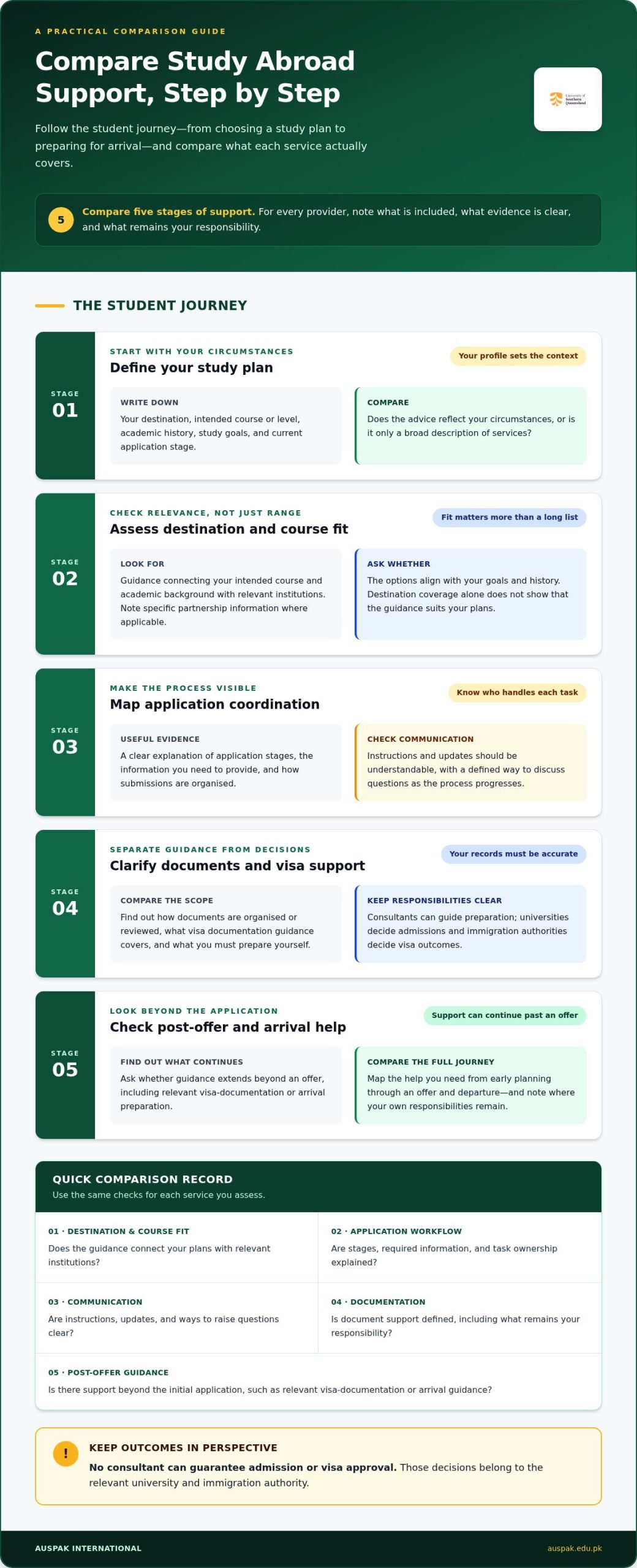
Use this checklist to shortlist study abroad consultants with confidence
A useful shortlist reflects your study plan, not just a consultant’s service names or promotional claims. Compare services consistently and record what each one covers, what you are expected to do, and which decisions belong to the university or immigration authority.
- Destination and course fit: Does the guidance relate to your intended destination, course level, academic history, and goals?
- Service scope: Is it clear whether support covers counseling, application coordination, document preparation, visa guidance, or help after an offer?
- Communication: Are instructions and updates understandable, and do you know how to raise questions during the process?
- Written fee clarity: Are fees and the services they cover set out in writing? Note what is included, what may cost extra, and what you are responsible for paying directly.
- Responsibilities and next steps: Can you identify the documents you must provide, actions you must complete, and tasks the consultant helps coordinate?
- Realistic outcomes: Does the consultant explain its role without suggesting it controls admission or visa decisions?
Questions to resolve before selecting support
Write down your intended destination, course level, current application stage, and main support need. Compare each service against that list. Ask for the service scope and fee information in writing, and make a note of who prepares, reviews, and submits each document. Keep track of agreed responsibilities, outstanding materials, and next steps so you and your family can follow the process.
Consultancy support can help you organise tasks and understand application steps, but it cannot control whether a university admits you or an immigration authority approves a visa. For broader context on service types and support, see this comprehensive study abroad consultant guide.
Warning signs and realistic expectations
Promises of guaranteed admission or visa approval are not evidence of expertise. They imply control over decisions made by institutions and authorities. Unclear service boundaries also warrant careful consideration, particularly when you cannot tell what support includes or what remains your responsibility. Pressure to decide immediately can make it harder to compare terms thoughtfully. Take time to review written information and use current requirements from official university and immigration sources.
Use your shortlist to select support that fits your destination, application stage, and practical needs. Discuss your study plans with AusPak to explore counseling, application support, visa-documentation guidance, and arrival services relevant to your journey.
How AusPak supports students through the study abroad journey
AusPak International supports students at different points in their plans, from counseling and university applications to visa documentation and arrival services. It supports study plans across several destinations, while the steps depend on the destination and service involved. Australian university admission support, UK student visa consultancy, and Canada study permit assistance are distinct pathways, not interchangeable versions of one process.
When comparing study-abroad support, consider how a provider’s services relate to your destination, course, and application stage. AusPak’s partnerships with over 40 Australian universities are a specific reference point for students considering Australian study. Its onshore office in Australia is also relevant to students considering support after arrival.
Match AusPak’s support to your destination and application stage
Students considering Australia can connect course and institution research with AusPak’s Australian university admission support and university partnerships. The Australian university admission guide can help with early planning. If you are still weighing options, counseling can help you clarify your priorities; if you are preparing to apply, application coordination and document support may be more relevant.
For the UK, AusPak provides student visa consultancy; for Canada, it offers study permit assistance. Each destination has its own application and visa process, so understand the support in relation to your chosen route and stage. Students may also be considering the USA or other destinations, but requirements and processes differ by country.
The free IELTS mock test is an additional preparation resource for students working on English-language readiness. It can complement your planning, but it does not replace course selection, application support, or destination-specific guidance.
Take the next step with clear expectations
A practical first discussion starts with the details that shape your options. Be ready to talk about your academic profile, destination interests, intended course or level, and whether you are exploring, preparing an application, or responding to an offer. This helps focus the conversation on relevant next steps and support for your current stage.
Counseling and documentation support can help organise the process and clarify what you need to prepare. They do not determine admission or visa outcomes: universities make admission decisions, and immigration authorities decide visa applications. Keep those responsibilities clear as you plan.
Start with your goals, questions, and current application stage. Start planning your study abroad journey with AusPak by discussing the support relevant to your plans.
Turn your study plans into a clear next step
A useful comparison ends with a decision you can explain: why the support fits your destination, what you will handle yourself, and what you need to understand before proceeding. As you compare study-abroad support, keep your priorities visible and choose a path that helps you move forward with informed expectations rather than pressure or promises.
Set out your academic background, the courses or destinations you are considering, and your current application stage. A focused discussion can help you identify what to work on first and which guidance is relevant to your plans. Admission and visa decisions remain with the institutions and authorities involved, but an organised process can make your responsibilities clearer.
Plan your study abroad journey with AusPak International and take the next step with purpose. Share your goals and current plans to discuss support for your study journey.
Frequently Asked Questions
Can a study abroad consultant guarantee university admission or a student visa?
No. A consultant can help organise an application or prepare visa documents, but cannot guarantee an outcome. Universities assess admission applications, and immigration authorities decide visa applications. Treat promises of guaranteed approval as unrealistic, not as proof of expertise. Even a complete application is assessed against the institution’s criteria and the authority’s requirements. Keep copies of what you submit and make sure the information is accurate.
Is it compulsory to use a study abroad consultant when applying overseas?
No. Students can apply directly to institutions and follow the relevant visa process themselves. A consultant is an optional source of guidance and coordination that may help you understand application steps or organise documents. Before deciding, consider how comfortable you are managing forms, deadlines, and official instructions independently. Whether you apply with support or on your own, use current information from the university and immigration authority.
How do study abroad consultancy fees usually work?
Fee arrangements vary by provider and by the work involved. A consultancy may charge for services such as application processing or visa-documentation guidance; revenue may also include commissions from partner universities for successful student enrolments. When comparing services, look for a written explanation of any professional fee, which tasks it covers, and whether other costs are separate. Do not assume a service is free or paid without clear terms.
Can one consultant help me apply to universities in more than one country?
A consultancy may support students considering more than one destination, but application steps and visa processes differ by country. AusPak supports students considering destinations including Australia, the UK, the USA, and Canada, among others. Keep a separate list of institutions, courses, documents, and next steps for each destination. This makes it easier to see how your plans differ and which guidance relates to each application.
What documents should I prepare before discussing my study plans?
Bring the documents and information you already have; you do not need to wait until everything is ready to discuss your plans. Useful starting materials may include passport details, academic transcripts, English-language test results if available, and any university offer or application correspondence. A record of your previous studies and intended course can also make the discussion more focused. Requirements vary by institution and destination, so treat this as preparation for discussion, not a complete application checklist.
When should I start working with a study abroad consultant?
Start when you begin seriously exploring a destination or course, especially if you still need to compare study options. Early planning gives you time to understand application steps, gather academic records, and identify questions about English-language preparation or finances. If you already have an offer or have begun an application, guidance may still help you organise the next tasks. Work from the relevant institution’s deadlines and current official requirements.
Does a study abroad consultant choose my course and university for me?
No. A consultant can help you explore choices in light of your interests, academic background, and intended destination, but the decision is yours. You might compare course content, study level, and how each option fits your goals before deciding where to apply. The university then assesses your application independently. Share accurate information about your priorities so any guidance is relevant, and review your options before making a commitment.