
What if your tuition estimate is accurate, but your study-abroad budget still falls short? For Pakistani families, the full cost can also include living expenses, visa and health-related charges, travel, and funds that must be documented. Exchange-rate changes can add another layer of uncertainty. That’s why study abroad financial planning for Pakistani students needs to go beyond a single tuition figure. Build a flexible plan that accounts for expected costs, payment dates, and changes that may arise.
Expenses vary by destination and institution, and funding may not cover every gap. This guide shows you how to build a first-year budget, compare the cost categories that matter, identify potential funding sources, and plan for shortfalls. It also explains what to verify with universities and official authorities, including current fees, financial-evidence requirements, and scholarship timelines. Use it as a decision framework, then update your figures as your destination, institution, and application plans become clearer.
Key Takeaways
- Compare destinations and institutions using the same expense categories, from tuition and accommodation to setup costs, so your shortlist reflects the full financial commitment.
- Separate confirmed funding from conditional or pending support to see actual budget gaps before committing.
- Build your plan around key milestones, including applications, deposits, visa documentation, travel, and arrival. Review it when costs or plans change.
- Check current fees and financial-evidence requirements with universities and official authorities because destination-specific details can change.
- Prepare course options, budget assumptions, funding sources, and unanswered questions before seeking guidance on choices or documentation.
What study abroad financial planning means for Pakistani students
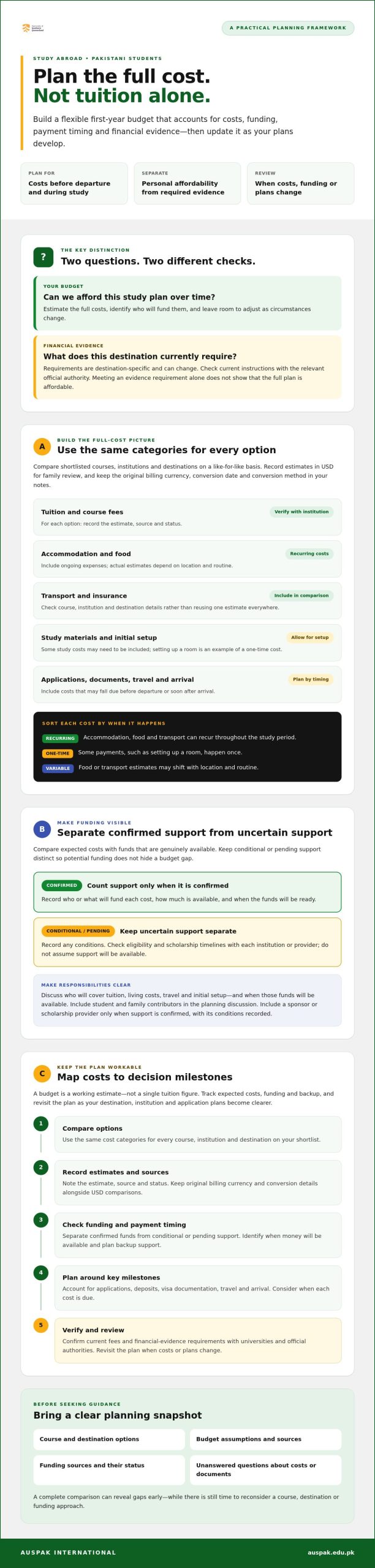
Feeling unsure about the full cost is understandable: tuition is only one part of the commitment. A useful plan estimates what you’ll need before departure and during your studies, identifies who or what will fund those costs, and leaves room to adjust when circumstances change. A study-abroad financial plan is a working estimate of costs, funding, and financial backup, reviewed as your plans develop.
Keep two questions separate: “Can I afford this plan?” and “What financial evidence does my destination require?” Your personal budget helps you judge whether costs are manageable over time. Visa or permit financial-evidence requirements are destination-specific and can change, so check current instructions with the relevant official authority. Meeting an evidence requirement alone doesn’t show whether the full study plan is affordable.
Why a tuition-only estimate can mislead
Tuition may be the largest visible cost, but it isn’t the whole budget. Accommodation, food, and transport can recur throughout the study period. Insurance and study materials may also need to be included, while travel and initial setup costs can fall due before or soon after arrival.
Sort costs by timing: recurring expenses, one-time payments, and variable costs. Rent may be a regular expense, while setting up a room is a one-time cost. Transport or food estimates may shift with your location and routine. Categories, course-related expenses, and official requirements vary by country, institution, and course. Compare options using the same categories, and verify figures with the university and relevant authorities rather than assuming one estimate applies everywhere.
Who should contribute to the planning process
Bring the student and family contributors into the discussion early. Include a scholarship provider or sponsor only when their support is confirmed, and record any conditions attached to it. For a broader overview of aid concepts such as grants, loans, and work-study in the United States, see this guide to understanding student financial aid. The programmes described there don’t automatically apply to international students, so check eligibility with each institution or provider.
Make responsibilities clear. Who will pay tuition, living costs, travel, or initial setup expenses, and when will those funds be available? Discuss affordability, payment timing, and backup support before applications or commitments make decisions harder. These conversations can help everyone spot gaps while there’s still time to reconsider a course, destination, or funding approach.
How to map the full cost of studying abroad before choosing a destination
Compare complete study options, not just countries. Use the same expense categories for each shortlisted course, institution, and destination, and record estimates in USD so your family can review them consistently. Keep each institution’s original billing currency in your notes, too, along with the conversion date and method. This makes currency changes visible instead of hiding them inside a total.
| Expense category | Course and destination A | Course and destination B |
|---|---|---|
| Tuition and course fees | Estimate, source, status | Estimate, source, status |
| Accommodation and food | Estimate, source, status | Estimate, source, status |
| Transport and insurance | Estimate, source, status | Estimate, source, status |
| Study materials and initial setup | Estimate, source, status | Estimate, source, status |
| Applications, documents, travel, and arrival | Estimate, source, status | Estimate, source, status |
Use the relevant destination guide to identify details to verify: the Australia university guide, UK student visa guide, and Canada study permit guide. Confirm current university charges and official application or document requirements before adding figures. For possible institutional funding, NAFSA provides an overview of international student aid options. Check each provider’s eligibility conditions rather than assuming support will be available.
One-time, recurring, and variable expenses to record
Label every line item with its timing, frequency, payer, source, and status, such as confirmed or estimated. Tuition, rent, and food may recur; application or document charges may be one-time; travel and arrival costs occur at specific milestones. Include deposits or setup expenses only if they apply to your chosen institution and destination. Flag variable items, especially transport assumptions and exchange-rate movements, for review.
How to compare destinations without relying on misleading totals
Match like with like: compare equivalent courses and study periods, and use consistent assumptions for accommodation and daily spending. Record where each estimate came from and when you checked it. A destination comparison is only useful when each option is measured using the same course, time period, and cost assumptions. If you need help clarifying institution choices before committing, AusPak International provides university application support and destination guidance for Pakistani students.
How to assess funding, savings, and financial evidence responsibly
A budget becomes useful when each expected cost is matched to a realistic funding source. List savings, family contributions, confirmed scholarships, sponsorship, and any other legitimate support. For every source, record the amount in USD, who provides it, when it will be available, and what documentation supports it. Then label its status clearly:
- Confirmed: Available and supported by reliable documentation.
- Conditional: Expected only if stated conditions are met.
- Pending: An application or request is still under review.
- Unavailable: Not accessible for this study plan.
Don’t count a pending scholarship as awarded funding. For each study period, subtract confirmed funds available by the relevant due dates from the costs due in that period. Keep conditional and pending support in a separate scenario, so you can see how the plan changes if it comes through. Avoid relying on future earnings or other income unless the source, timing, and availability are sufficiently certain to include responsibly.
How to assess scholarships and other funding sources
Before including an award in your working budget, check eligibility, covered expenses, conditions, payment timing, and renewal criteria. A scholarship may reduce tuition but not cover living costs, or it may arrive after an early payment is due. Build a baseline budget without any pending award, then show the potential award as a separate adjustment. Research destination-specific scholarships through relevant university and destination guidance, and confirm availability and terms with the provider. Don’t make a financial commitment based on an application alone.
This distinction makes funding gaps visible before they become urgent. It also helps the student and family discuss whether they can cover costs if an award is delayed, reduced, or not granted.
How to handle financial evidence requirements
Your affordability calculation and visa or study-permit evidence are related, but they serve different purposes. The personal budget estimates whether you can manage the full cost over time. Official financial-evidence rules specify what an authority requires for an application. Requirements can differ by destination and applicant, and the accepted evidence format, amount, or timing may change.
Check the latest instructions directly with the relevant official immigration authority before preparing documents or submitting an application. Keep a copy of the source and note when you checked it. Make sure the evidence reflects funds that are genuinely available and can be documented. A personal budget, financial estimate, or consultant’s documentation guidance cannot guarantee a visa decision. Treat it as preparation, not an assurance of approval.
A step-by-step study abroad financial plan for Pakistani students
Turn your comparison into a plan you can update as application decisions and payment deadlines become clearer. Follow six steps: shortlist, research, estimate, identify funding, test affordability, and review. This sequence helps you move from possible destinations to a budget grounded in costs, available funds, and timing.
- Shortlist: Choose courses and institutions that fit your academic goals and initial affordability range.
- Research: Verify current tuition, living costs, payment dates, and official financial-evidence instructions.
- Estimate: Record recurring costs and one-time expenses in a consistent worksheet.
- Identify funding: Match savings, family contributions, and confirmed awards to expenses and due dates.
- Test affordability: Check whether funds will be available when each payment is due, not only whether the overall total appears manageable.
- Review: Update the plan when an offer, fee change, funding decision, or exchange-rate movement changes an assumption.
Build the timeline around real milestones: application submission, any required deposit, visa or study-permit application, travel arrangements, and arrival. For each milestone, note the expected date, amount due in USD, responsible payer, and funding source. Check university and official authority instructions for current deadlines and requirements.
Turn estimates into a usable monthly and milestone budget
Keep monthly living costs separate from payments due at particular stages. A simple worksheet can track each major expense, due date, responsible payer, and planned funding source. Use separate columns for estimated, confirmed, and paid amounts. This prevents an estimate from being mistaken for money already secured and highlights upcoming payments that need attention.
Set aside a contingency buffer suited to your circumstances, not an arbitrary percentage. Consider how stable your funding is, how much flexibility your family has, and which costs could change before or after arrival. If there’s little room to absorb surprises, identify a backup plan or revisit the shortlist before making a commitment.
Review exchange rates and changing assumptions
For costs converted into Pakistani rupees, record the exchange-rate source and conversion date alongside the USD figure. Recheck rates and institution updates at planned decision points, especially before a deposit or other major payment. Then test a cautious scenario: if the exchange rate shifts or a cost rises, which payment becomes difficult to cover, and what would you change?
Use qualified destination and institution guidance to clarify choices before committing. For support with Australian university admissions, UK student visa documentation, or Canada study permit preparation, visit AusPak International’s study guidance.
When to seek study-abroad financial planning support
Consider getting guidance when university estimates conflict, the funding picture is unclear, or you’re unsure how to organise application and visa documents. Support can be especially useful before paying a deposit or making another commitment, when clarifying course and destination details may help you reassess the budget. Education and visa-documentation guidance is not a substitute for your own affordability assessment or confirmation of current requirements from universities and official authorities.
What to prepare before speaking with an education adviser
Bring the information you already have so the discussion can focus on specific decisions. Prepare:
- Your shortlisted institutions, destinations, and course details.
- A preliminary expense worksheet, with estimates, sources, and dates checked.
- A list of available savings, family contributions, confirmed awards, and other funding, noting what remains conditional or pending.
- Questions about assumptions that still need confirmation from a university or official authority.
Ask what the consultancy can support, such as application processing or organising visa documentation, and which decisions remain your responsibility. You and your family remain responsible for judging affordability, confirming funds, and checking official financial-evidence instructions. Clear boundaries help you use guidance effectively without mistaking it for a financial commitment or an assurance of an application outcome.
How to move from planning to the next application decision
Revisit the budget when admission details arrive and before major payments or visa steps. Replace estimates with confirmed figures where possible, check current official requirements, and update the plan if your course, funding, or exchange-rate assumptions change. If a new figure creates a shortfall, pause and assess your options before committing further.
AusPak International supports Pakistani students with university applications and visa-documentation guidance, including Australian university admission support, UK student visa consultancy, and Canada study permit assistance. This support can help you organise the application process, but it doesn’t guarantee a visa decision or determine whether your personal budget is affordable.
Once you’ve prepared your course choices, expense assumptions, and funding questions, you can contact AusPak International to discuss your destination and the next study-abroad application step.
Turn Your Study Plans Into a Clear Next Step
A strong study-abroad decision starts with more than a tuition estimate. Build a full-cost budget, distinguish confirmed funding from possibilities, and revisit the figures as your course, application timeline, and exchange-rate assumptions change. Keep your personal affordability assessment separate from the financial evidence required by destination authorities, and verify current instructions with official sources.
That’s the practical foundation of study abroad financial planning for Pakistani students: a flexible plan that helps you spot gaps early and make informed decisions before committing. When you’re ready to clarify your destination or application pathway, AusPak International provides application and visa-documentation guidance for Pakistani students. Its partnerships include more than 40 Australian universities.
Discuss your study-abroad plans with AusPak International and explore the next steps for your chosen destination. With careful preparation and the right guidance, your international study goal can become a more manageable plan.
Frequently Asked Questions
How should Pakistani students start financial planning for study abroad?
Start by shortlisting courses and destinations, then estimate tuition, living expenses, one-time costs, and when each payment is due. Identify who will fund every item and label figures as estimated or confirmed. This is the foundation of study abroad financial planning for Pakistani students. Check cost information with universities and financial-evidence instructions with official authorities. Review the plan as admission details, funding decisions, and exchange-rate assumptions change.
What expenses should a study abroad budget include?
Include tuition and other institution charges, accommodation, food, local transport, insurance, and study materials. Add relevant application, document, travel, and arrival expenses. Separate recurring costs, such as regular living expenses, from one-time payments and costs due at particular milestones. Categories and requirements vary by destination, institution, and course, so verify each item using current sources rather than relying on a general online total.
How can Pakistani students compare the cost of studying in different countries?
Compare equivalent courses and study periods, using the same assumptions for accommodation, transport, and other living expenses. Record each estimate’s source, original currency, and date, then note the exchange-rate source and date used for conversion. Keep scholarships and conditional support separate from confirmed funds. This lets you compare underlying costs fairly without making a destination appear more affordable because of an award you haven’t received.
Can a scholarship cover all study abroad expenses?
It depends on the award’s terms. A scholarship may cover only part of tuition or apply to specified costs. Read the official information carefully, including eligibility, conditions, payment timing, and any renewal criteria. Prepare a baseline budget that doesn’t depend on a pending award, then show the scholarship as a possible adjustment. Once the provider confirms the award and its details, update the plan to reflect what it actually covers.
How should students account for exchange-rate changes when budgeting?
Record the exchange-rate source and date whenever you convert an expected expense into Pakistani rupees. Rates can change, so revisit your conversion at key decision points, such as before a major payment, and test whether a less favourable rate would create a shortfall. Don’t assume today’s rate will hold. Check the currency and payment timeframe specified by the institution when planning how funds will be available.
Are a study abroad budget and visa financial evidence the same thing?
No. A personal budget helps you and your family assess affordability and plan expenses over time. Visa financial evidence is based on the destination’s current official requirements, which may specify acceptable documents, amounts, or timing. Check the relevant immigration authority’s latest instructions for your application. A personal worksheet, pending scholarship application, or adviser’s guidance isn’t a substitute for required evidence or a guarantee of a visa decision.
When should Pakistani students begin financial planning for overseas study?
Begin while comparing destinations and institutions, before paying application or enrolment-related amounts. Early planning gives you time to identify funding gaps, review scholarship conditions, and discuss financial responsibilities with family contributors. Keep updating your figures after admission details arrive and before major application, visa, travel, or arrival milestones. Costs, funding assumptions, and official requirements may change, so treat the budget as a working plan, not a one-time calculation.