
What if your post-study work options depend less on holding a Pakistani passport than on choosing the right visa stream and meeting its requirements? For Pakistani graduates, the post study work visa Australia requirements for Pakistanis can be difficult to untangle, especially as stream names and eligibility rules change. Nationality may matter for specific provisions, so check how the current rules apply to your circumstances.
It’s understandable to worry about selecting the wrong stream, gathering unsuitable evidence or missing the application window. Australia’s Temporary Graduate visa (subclass 485) now uses the Post-Higher Education Work and Post-Vocational Education Work stream names. Applicants generally need to lodge within six months of completing their course, so careful preparation matters.
This practical checklist explains how to identify the relevant stream, review key eligibility points and organise information and documents before applying. It also highlights what to verify with the Australian Department of Home Affairs, including current age, English-language and qualification rules. Clear course planning and well-organised documentation can help you prepare for your next steps.
Key Takeaways
- Use the post study work visa Australia requirements for Pakistanis checklist to assess your situation. A Pakistani passport alone doesn’t determine eligibility.
- Compare the Temporary Graduate visa streams by your qualification type, then verify the relevant criteria with the Department of Home Affairs.
- Check age, Australian study, qualification and application-timing rules before preparing your application.
- Organise identity, qualification and other supporting evidence, and confirm which documents apply to your stream.
- Use current government instructions to verify requirements before lodging. Education and documentation guidance can’t determine the Department’s visa decision.
Australian Post-Study Work Visa: Overview and Eligibility
Completing a qualification in Australia can open a post-study pathway, but graduation alone doesn’t grant permission to remain or work. The Temporary Graduate visa (subclass 485) is a temporary visa pathway for eligible international graduates. It may allow qualifying graduates to stay in Australia temporarily after their studies, subject to the requirements of the relevant stream and the conditions attached to the visa granted.
In plain English, the subclass 485 is a temporary Australian visa that may allow eligible graduates to remain after their studies and work under the conditions attached to their visa. It is different from a student visa, which supports study, and it is not permanent residence. A 485 visa doesn’t itself provide permanent residency. Any later pathway would have separate eligibility rules. For general background on Australia’s visa policy, Wikipedia offers an overview, but use the Australian Department of Home Affairs for current visa criteria and instructions.
Which subclass 485 stream may suit an Australian graduate?
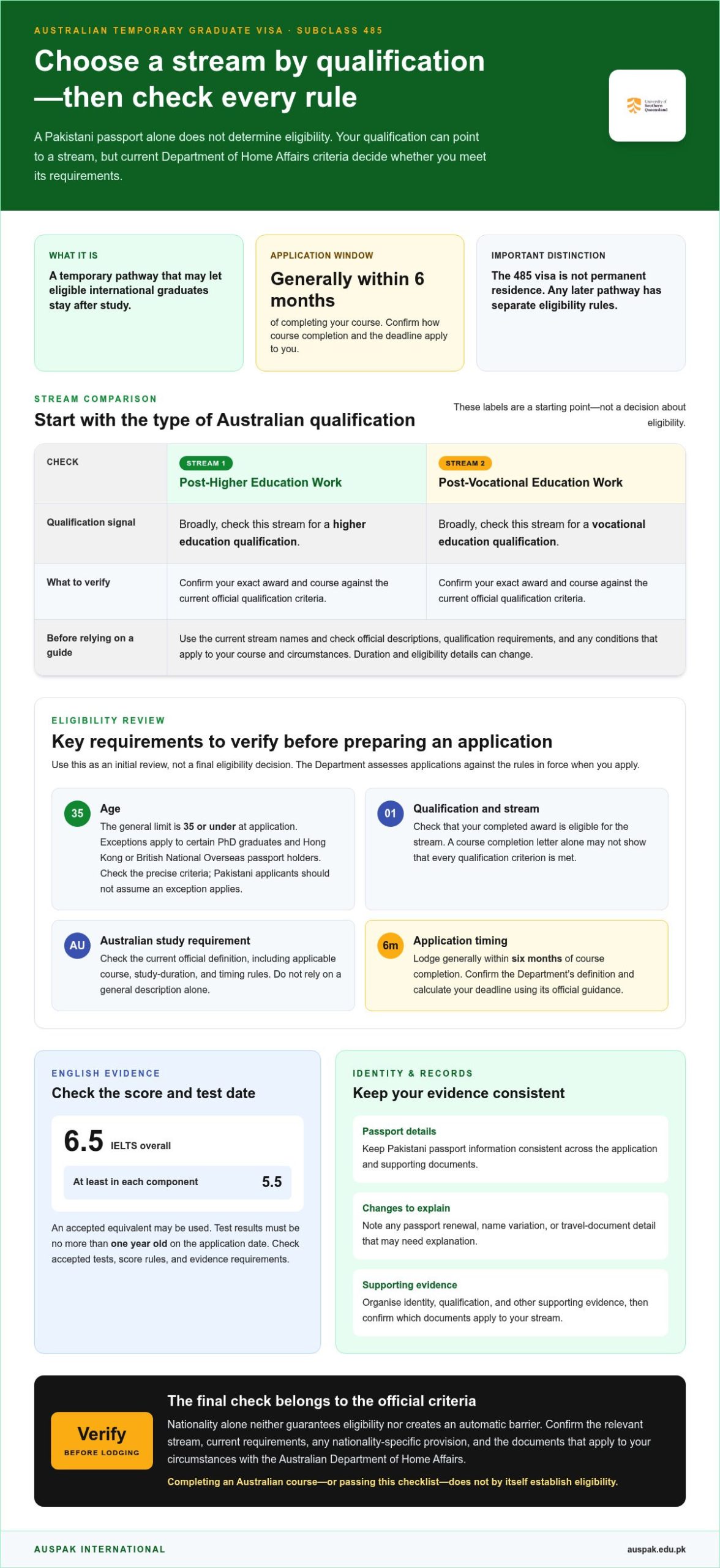
As of October 2026, the two stream names to investigate are the Post-Higher Education Work stream and the Post-Vocational Education Work stream. Your qualification can indicate which stream may be relevant: broadly, check the first for higher education qualifications and the second for vocational education qualifications. These labels are a starting point, not a decision. Confirm your exact award and course against current Home Affairs criteria before assuming you fit a stream.
Don’t rely on an older guide that uses previous stream names. Check the official stream description, qualification requirements and any conditions that apply to your course and circumstances. Duration and eligibility details can change, so verify them when planning and again before lodging.
Do Pakistani graduates have different post-study work visa rules?
When reviewing the post study work visa Australia requirements for Pakistanis, separate nationality from the core eligibility assessment. A Pakistani passport by itself is neither a guarantee of eligibility nor an automatic barrier. The relevant stream, qualification and application requirements still need to be assessed against current rules. At the same time, don’t assume every provision is identical for every passport holder. Verify any nationality-specific exception in the official guidance. For example, an age exception applies to certain PhD graduates and Hong Kong or British National Overseas passport holders. Pakistani applicants should not assume that exception applies to them.
Prepare your identity details carefully. Keep your Pakistani passport information consistent across your application and supporting documents, and note any passport renewal, name variation or travel-document detail that could require explanation. These checks help keep records aligned, but they don’t replace the visa criteria or establish eligibility on their own.
Think of the process as a sequence: identify the stream suggested by your qualification, check the current subclass 485 requirements for that stream, then prepare evidence that matches the official instructions. This helps you approach the post study work visa Australia requirements for Pakistanis without mistaking graduation or citizenship for automatic approval.
Australian Temporary Graduate visa requirements: the eligibility checklist
Use this checklist to organise your first review, not to make a final eligibility decision. Subclass 485 criteria can depend on the stream, your course and your circumstances. Before preparing an application, compare your details with the Temporary Graduate visa (subclass 485) official requirements from the Department of Home Affairs. The Department assesses applications against the rules in force when you apply.
You must meet the requirements for your chosen subclass 485 stream when you apply. Completing an Australian course or passing this checklist alone doesn’t establish eligibility.
- Age: The general age limit is 35 or under at the time of application. Exceptions apply to certain PhD graduates and Hong Kong or British National Overseas passport holders. Check the precise exception criteria before relying on one.
- Qualification and stream: Confirm that your completed award is eligible for the stream you’re considering. A course completion letter alone may not show that every qualification criterion is met.
- Australian study requirement: Check that your course and study history satisfy the current official definition. Verify the applicable course, study-duration and timing rules rather than relying on a general description of Australian study.
- Application timing: The application must generally be lodged within six months of completing the course. Confirm how the Department defines course completion and calculate your deadline using the relevant official guidance.
- English evidence: The stated IELTS requirement is 6.5 overall, with at least 5.5 in each component, or an accepted equivalent. Test results must be no more than one year old on the application date. Check accepted tests, score rules and evidence requirements before booking or relying on a result.
- Health, character and insurance: Follow any health examination and character documentation instructions that apply to your case. Adequate health insurance is required. Verify the cover and evidence needed for your circumstances.
Qualification and Australian study requirement
Start with the award you actually completed, not only the institution’s name or your course title. The Post-Higher Education Work stream and Post-Vocational Education Work stream have different qualification pathways, so match your award to the current stream-specific rules. For the Australian study requirement, use Home Affairs’ current definitions and confirm how your course and study history are assessed. You can begin planning with this Australian university guide for Pakistani students.
Age, English, health and character checks
Check dates as carefully as scores. An English result that meets the stated score may still fall outside the allowed validity period by the time you apply. Age is assessed at application, and exceptions have specific conditions. Health, character and insurance evidence can depend on individual circumstances, so follow the instructions that apply to your application rather than assuming one document set suits everyone.
Pakistani students planning their Australian education can organise course and document questions through Australian study and application guidance, while using Home Affairs instructions to confirm visa criteria. Treat each checklist item as something to verify, then assemble evidence that directly supports the requirement.
How to choose the right stream and avoid common eligibility assumptions
Start with the qualification you completed, then compare it with the two subclass 485 streams. Pakistani citizenship doesn’t determine which stream fits. Your qualification pathway and the stream’s current criteria are the relevant starting points. Use this comparison to identify what to investigate, not as a final assessment.
| Stream | Broad qualification pathway | Key checks | Official verification prompt |
|---|---|---|---|
| Post-Higher Education Work | Higher education qualifications | Check whether your exact award and study history meet the stream’s current rules. | Confirm eligible qualifications, study requirements and any other stream-specific criteria with the Department of Home Affairs. |
| Post-Vocational Education Work | Vocational education qualifications | Check the qualification pathway and whether any field, occupation or other criteria apply to your case. | Verify the current qualification and field-related rules, including any relevant lists or conditions. |
The stream names help orient your search, but they don’t settle eligibility by themselves. For example, two graduates from the same institution may have different awards and need to assess different pathways. Rules can also change, so check current Department of Home Affairs guidance rather than relying on an old article, a friend’s outcome or a broad course label.
Post-Higher Education Work stream versus Post-Vocational Education Work stream
Compare the streams by qualification type, not passport. First identify the exact award shown on your completion documents. Then check the official stream criteria for that award and any field-related requirements. Don’t infer a visa duration from another graduate’s experience. Stay periods and conditions can differ, so verify them against current official guidance for your stream.
A course choice can support your education and career plans, but it can’t promise a subclass 485 visa or a job after graduation. Employment outcomes depend on factors beyond visa eligibility, while the Department makes the visa decision under the rules that apply to your application.
Common assumptions Pakistani applicants should check
- “I completed an Australian course, so I qualify.” Course completion is not automatic eligibility. Check the award, study history, timing and all applicable stream criteria.
- “My university offer confirms my post-study visa.” An offer relates to admission, not a future visa grant. A consultant’s assessment can help organise information, but it cannot replace the Department’s decision.
- “Student visa and graduate visa requirements are the same.” They’re separate applications with different purposes and criteria. The Genuine Student requirement relates to student visa assessment. It isn’t a substitute for meeting subclass 485 rules after study.
- “A Pakistani applicant automatically gets a particular stream or work period.” Don’t assume nationality decides the pathway or duration. Check the qualification-based stream criteria and any passport-specific provision that may apply.
For the post study work visa Australia requirements for Pakistanis, keep these decisions distinct: course selection, student visa assessment, graduate visa eligibility and future employment planning. Verify each at the right stage, and don’t make course or career decisions on the assumption that one outcome guarantees the next.
Post-study work visa Australia documents and application-readiness checklist
Good preparation means more than collecting a large folder of paperwork. First identify your likely stream, then use the Department of Home Affairs’ current instructions to determine which evidence applies to your application. The document list can differ by stream and personal circumstances, so treat the categories below as prompts, not a universal upload list.
Evidence requirements depend on your visa stream and circumstances, so follow the current checklist and instructions shown in the official application system.
- Identify the stream. Match your completed qualification to the relevant Temporary Graduate visa stream before organising evidence. This helps you focus on the criteria and documents that apply to your pathway.
- Check current requirements. Review the Department’s instructions for eligibility, document specifications and any evidence requested for your circumstances. Don’t assume a past applicant’s checklist still applies.
- Gather supporting records. Collect the relevant identity, qualification, English, insurance, health and character documents specified for your application.
- Review details for consistency. Compare names, dates and other personal information across your passport, course records and application answers. Resolve differences or prepare explanations where the official instructions call for them.
- Apply through official channels. Complete the application using the current government system, attach evidence in the required format and retain copies of submitted documents and notices.
Documents to prepare before starting an application
Begin with a valid passport and identity information. Check that your name and personal details match across records. If a passport renewal, spelling difference or other change creates a discrepancy, follow the application instructions for explaining it. For qualification evidence, locate your completion letter and award documents, along with study records if the Department asks for them to assess your course or study history.
English test evidence, health-insurance details, medical information and character documents may also be relevant, but don’t assume a standard set applies to everyone. The type, format and timing of evidence can depend on current rules and your circumstances. For related test-planning context, see this IELTS guide for Australian student visa applicants. It is not a substitute for checking the separate English evidence rules for a subclass 485 application.
Timing, application details and final checks
Protect your deadline. Current guidance states that applicants must generally lodge within six months of completing their course. Check the Department’s instructions for how completion is defined and how the relevant date is established for your case. Avoid leaving document collection until the final days, especially if you need to request records from your education provider or arrange current evidence.
Before submitting, read each form answer beside the source document it relies on. Check passport numbers, course and award details, dates, test information and uploaded files. Confirm the current checklist in the application system, since outdated web pages or saved forms may omit changed instructions. Pakistani applicants preparing the post study work visa Australia requirements for Pakistanis can use professional guidance to organise records and understand application steps. Get support organising your Australian study and visa documentation, then rely on official instructions for the application and the Department’s decision.
Plan your next step with informed post-study visa guidance
A clear plan separates what you can prepare from what only the Australian Government can decide. Identify the subclass 485 stream that may match your qualification, verify the current criteria, assemble the relevant evidence and follow the Department of Home Affairs’ official application instructions. Recheck the rules close to lodgement, since your application will be assessed against the requirements in force when you apply.
When to seek help reviewing your study and visa pathway
Guidance can be useful if your study history is complex, you’re unsure which stream to investigate or your records contain inconsistent details. AusPak International supports Pakistani students with Australian admissions guidance, document verification and visa documentation, helping organise information and understand the process. This support doesn’t replace official criteria. The Department assesses applications and decides whether to grant a visa, and no adviser can guarantee a visa grant.
Planning starts before graduation. The university and course you choose shape your study experience and the qualification you may later need to assess against subclass 485 stream criteria. Explore Australian university admission guidance as you consider study options, and keep post-study plans realistic. Course selection can inform your direction, but it cannot promise visa eligibility, a particular work period or future employment.
A responsible checklist before you proceed
Before taking your next step, put the decisions in order. This helps you keep education planning, document preparation and the visa decision-making process distinct.
- Confirm the stream: Match your completed or planned qualification to the current subclass 485 stream descriptions.
- Verify the criteria: Use Australian Government information to check eligibility, deadlines, evidence and instructions applicable to your circumstances.
- Organise your records: Keep identity, academic and application documents together, and compare names, dates and other details across them.
- Prepare questions early: If study history, qualification evidence or document requirements are unclear, identify the issue before it becomes a last-minute obstacle.
For Pakistani students, the post study work visa Australia requirements for Pakistanis are criteria to verify, not a promise tied to nationality, admission or graduation. Education and documentation guidance can help you plan and prepare, but visa decisions remain with the Department of Home Affairs.
If you’re still planning your course, explore Australian university admission guidance to connect your study choices with a considered post-study plan.
Ready to organise your next steps? Get guidance for your Australian study and visa journey.
Turn your Australian study plans into a clear next step
Your next move is to turn visa information into a plan that fits your qualification, timeline and goals. Keep checking current Australian Government instructions as you prepare, and verify every requirement against your circumstances. The post study work visa Australia requirements for Pakistanis can shape your planning, but thoughtful course choices and organised documents are valuable well before graduation.
AusPak International supports Pakistani students across the broader study journey, from Australian university applications and document verification to visa documentation and onshore arrival support in Australia. Its partnerships with more than 40 Australian universities help students explore study options with their future plans in view. Guidance can help you prepare and understand the process, while the Department of Home Affairs remains responsible for visa decisions.
Take the next step with a plan built around your education goals and the official requirements that apply to you. Plan your Australian study and visa journey with AusPak International. With clear preparation and informed decisions, you can move forward with greater confidence.
Frequently Asked Questions
What is the post-study work visa in Australia called in 2026?
It’s the Temporary Graduate visa, subclass 485. In 2026, its graduate pathways include the Post-Higher Education Work stream and the Post-Vocational Education Work stream. The names distinguish broad qualification pathways, but they don’t determine eligibility on their own. If you’re comparing advice that uses older stream names, check the current terminology and criteria on the Australian Department of Home Affairs website before acting on it.
Can Pakistani students apply for an Australian Temporary Graduate visa after completing their studies?
Yes, Pakistani graduates may apply if they meet the requirements for an available subclass 485 stream and satisfy the application criteria. Pakistani citizenship alone doesn’t guarantee eligibility or automatically prevent an application. Check that your passport and identity details are accurate, then assess your qualification and study history against current rules. If you’ve seen a nationality-specific exception mentioned, verify its exact scope in official Australian Government guidance.
What are the age requirements for Australia’s subclass 485 visa?
The general age limit is 35 or under when you apply. Exceptions apply to certain PhD graduates and holders of Hong Kong or British National Overseas passports. These exceptions are limited, so don’t assume that a postgraduate qualification or another passport connection is enough. Check the Department of Home Affairs’ current wording, including how age is assessed on the application date.
How long can Pakistani graduates stay in Australia on a post-study work visa?
There isn’t one stay period that applies to every Pakistani graduate. The period depends on the subclass 485 stream and the rules applicable to the applicant’s qualification and circumstances. Don’t use a friend’s visa grant or an outdated online estimate as your own likely duration. Check the current stream details and any conditions in Department of Home Affairs guidance, then rely on the period stated in an actual visa grant.
Does every Australian qualification make a graduate eligible for subclass 485?
No. Completing a course in Australia doesn’t automatically meet subclass 485 requirements. For example, a graduate may need to check whether their exact award fits the relevant stream and whether their study history meets the applicable criteria. Course titles and institutional admission decisions aren’t a substitute for checking visa rules. Before enrolling, consider how the qualification aligns with current official eligibility requirements, while recognising that rules may change before graduation.
Is IELTS required for the Australian post-study work visa?
Applicants generally need to provide evidence of the required English level, but IELTS may not be the only accepted test. The IELTS requirement is 6.5 overall with at least 5.5 in each component, or an accepted equivalent, and test results are valid for one year before application. Confirm accepted tests, score thresholds and validity rules with Home Affairs before booking or lodging.
When must I apply for the Temporary Graduate visa after completing my course?
Current 2026 guidance states that you must generally apply within six months of completing your course. Don’t calculate the deadline from your graduation ceremony unless official instructions say that date is relevant. Check which completion date applies to your records, and allow time to obtain documents and review your application. The Australian Department of Home Affairs’ current instructions should guide your deadline calculation and the date you lodge.