
There’s no single “best” European country for every Pakistani student. If you’re asking how to study in Europe, start with your academic profile, preferred programme, language requirements and budget. Germany, Sweden, Finland, Hungary and France each offer a different pathway.
It’s understandable to feel unsure where to begin. Admission criteria, application deadlines and visa documents vary by destination, so choosing a country before comparing its requirements can make planning harder. A country-by-country approach helps you focus on programmes that match your qualifications and prepare your application in the right order.
This guide explains the main European study options for 2026 and how to compare destinations, programmes, language evidence, documents and finances. You’ll also learn why a long-term study visa follows the rules of the country where you plan to study, rather than one universal European process. AusPak International, an educational consultancy established in 1995, supports Pakistani students with counselling, profile assessment and university application guidance.
Key Takeaways
- Compare Germany, Sweden, Finland, Hungary and France by programme fit, teaching language, application route and living considerations, not by a single “best country” label.
- To study in europe, begin with your academic goals, then shortlist programmes that match your qualifications and preferred field.
- Universities set their own entry criteria and application processes. Keep a separate record of each programme’s requirements, official portal and deadline.
- Plan your application in sequence: check eligibility, prepare documents, submit applications and organise your next steps.
- AusPak International supports Pakistani students with counselling, profile assessment, document verification and university application support across several European study pathways.
Why study in Europe? Start with the opportunities, and the differences
Studying in Europe means choosing among distinct national higher-education systems, not following one shared admissions process. The region offers Pakistani students a range of subjects and programmes, opportunities to learn alongside international peers, and pathways from undergraduate degrees to doctoral research. The right destination depends on your academic background, intended subject, language preferences and the institution’s requirements.
Keep three terms distinct. Europe is a geographic region; the European Union (EU) is a political and economic union; and the Schengen Area is a group of countries with shared arrangements for short-stay travel across internal borders. They do not include exactly the same countries, and studying in one does not give you the same study permission across all three. The European Higher Education Area supports greater comparability between participating higher-education systems, but it does not make every degree structure or admissions rule identical.
What can Pakistani students study in Europe?
Depending on the country and institution, options may include undergraduate degrees, postgraduate programmes such as master’s degrees, and doctoral study. Some students may also find preparatory or pathway courses, but availability and entry conditions are programme-specific. Start with your current qualifications and intended subject. Then check whether each course’s academic prerequisites and language of instruction fit your profile, rather than assuming your qualifications will be assessed the same way everywhere.
What makes European study pathways different?
Courses may be taught in English or a national language, while qualification structures, language evidence and application steps vary between institutions and countries. Some applications go directly to a university; others use a national or centralised portal. Follow the instructions for each programme and intake. Universities set their own entry criteria, and each destination has its own process for student permission, so check admission and visa requirements country by country.
For a course lasting longer than a short visit, students generally need to follow the destination country’s national student visa or residence-permit process. A Schengen short-stay visa is not a substitute for permission to undertake long-term study. Once granted, a national permit may allow travel to other Schengen countries for short visits under applicable conditions, but it does not automatically grant the right to study or reside there. Distinguish travel mobility from study authorisation.
That distinction matters when comparing destinations. An English-taught programme may suit your language profile, while another may require evidence of the local language. Application routes and document requirements can differ too. Treat each country and university as a separate pathway. This gives Pakistani applicants a practical basis for matching academic goals with the steps required to apply.
How European universities assess applications and prepare students to apply
A strong application starts with a clear match between your academic history and the programme’s published requirements. Universities set their own prerequisites, document rules and assessment procedures, so prepare a separate checklist for every course. Finding a programme is not the same as qualifying for it: the university’s formal entry requirements and assessment determine whether your application meets its criteria.
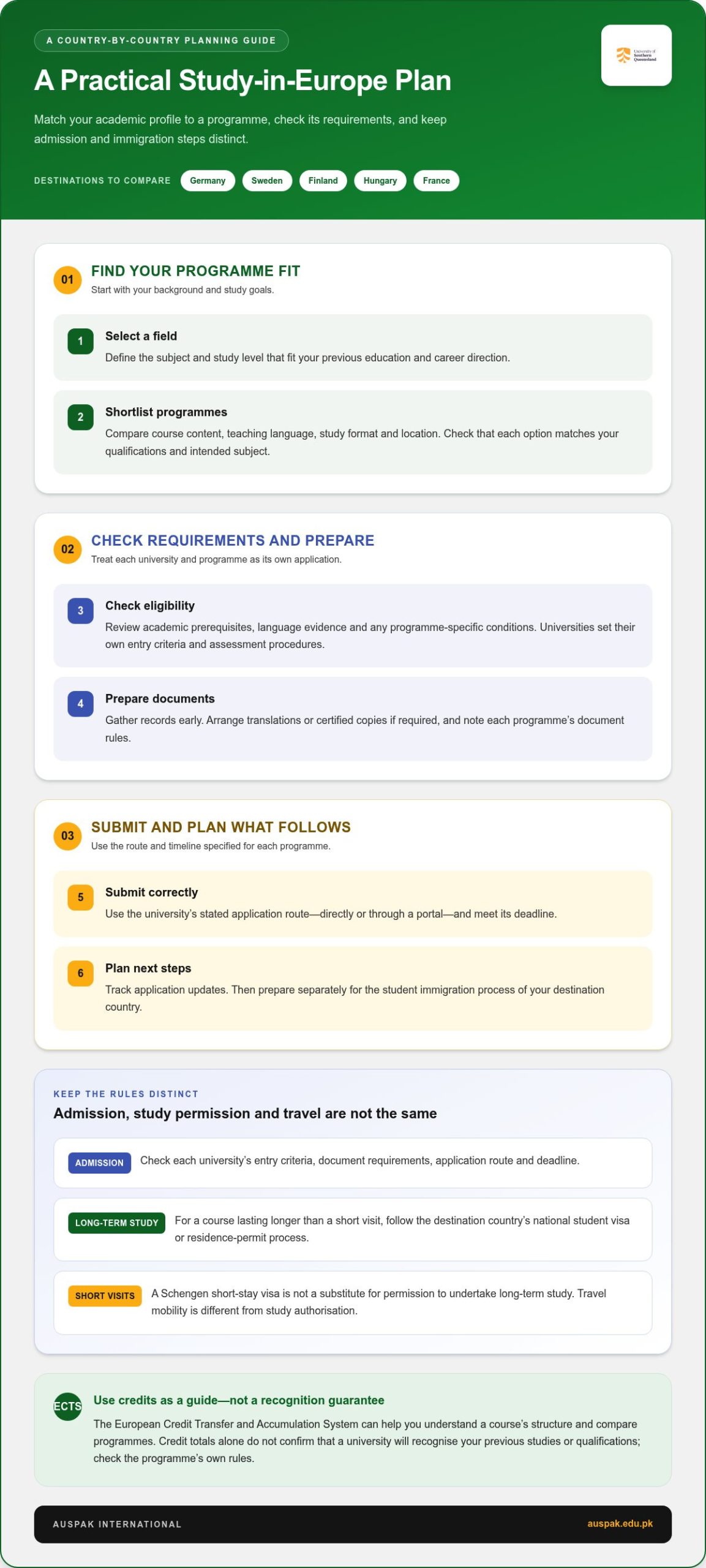
Follow a practical sequence:
- Select a field. Define the subject and study level that fit your previous education and career direction.
- Shortlist programmes. Compare course content, teaching language, format and location.
- Check eligibility. Review academic prerequisites, language evidence and any programme-specific conditions.
- Prepare documents. Gather records early and arrange translations or certified copies if required.
- Submit correctly. Use the university’s stated application route and meet its deadline.
- Plan next steps. Track application updates, then prepare separately for the destination’s student immigration process.
You may encounter the European Credit Transfer and Accumulation System (ECTS), a framework for expressing study credits and supporting comparisons between programmes. Credit totals can help you understand a course’s structure, but they don’t by themselves confirm that a university will recognise your previous studies or qualifications. Check the programme’s own rules. The official Study in Europe portal can help with initial programme and destination research. Use university and official country sources to verify details before applying.
How to shortlist programmes that match your profile
Compare each option against your academic record, intended subject, degree level, teaching language and preferred study format. On the programme page, note the prerequisites, deadlines, required documents and application route. Record them in one tracker so you can compare options and follow up on each requirement. An official portal can help you discover courses, but the institution’s admissions information should guide your application decisions.
Which academic and language documents may be required?
Requirements vary, but applicants may be asked for transcripts, certificates for completed qualifications and identity documents. Some institutions request translations or specific document formats, so follow their instructions rather than assuming there is one standard. Language evidence depends on the programme’s teaching language and admissions policy. IELTS, TOEFL or other evidence may be accepted or required in different circumstances; no single test or score applies universally.
How do European student visa requirements fit into the plan?
University admission and immigration permission are separate processes. Student visa or residence requirements are set by the destination country, not through one Europe-wide student visa. After identifying where you intend to study, consult that country’s current official immigration guidance for the correct application steps and documents. Keep a separate visa checklist and timeline alongside your university tracker, and don’t treat an offer of admission as a visa decision.
AusPak International’s counselling, profile assessment and document support can help Pakistani students organise these steps and narrow programme choices. Explore European study application guidance as you build a plan around your qualifications and target programmes.
How to compare European study destinations without assuming one is best
Choosing where to study in Europe is about fit, not finding the easiest or cheapest country. Germany, Sweden, Finland, Hungary and France each have universities and programmes with their own entry criteria, teaching languages and application procedures. A rule or advantage that applies to one destination shouldn’t be treated as a Europe-wide standard.
For a Pakistani applicant, begin with programme eligibility and subject fit. Then compare the teaching language with your current preparation, and consider whether each application route and destination’s living arrangements suit your plans. Verify current admission, immigration, funding and student-life information through the university and relevant official country sources. Costs and conditions can vary by programme, location and year, so avoid relying on broad country labels alone.
Which factors matter when comparing countries?
Use the same questions for every destination. Does the programme suit your academic background? Can you meet its prerequisites? Is the language of instruction realistic for you? What application route and documents does the institution require? Then review current official information about immigration, funding and day-to-day student life. A consistent comparison is more useful than relying on reputation alone.
| Destination | Study language | Academic fit | Application route | Living considerations |
|---|---|---|---|---|
| Germany | Check the language listed for your chosen programme. | Match prerequisites to your previous qualifications and subject. | Follow the institution’s stated application instructions. | Research current housing and funding information for your study location. |
| Sweden | Confirm the course language and any language evidence required. | Compare course content and entry criteria with your profile. | Record the official route and deadline for each programme. | Review current costs and student-life guidance for the location. |
| Finland | Check each programme’s teaching language and admission policy. | Assess whether your academic background meets its prerequisites. | Use the application route specified by the institution or official portal. | Research local living arrangements and available funding information. |
| Hungary | Verify the language of instruction for each course. | Prioritise programme requirements over general country assumptions. | Check the university’s official submission process and timeline. | Compare current student-life and housing information for your destination. |
| France | Confirm whether the programme is taught in English or French. | Check subject prerequisites and how your qualifications are assessed. | Follow the published institutional or official application instructions. | Review current local living and funding details before deciding. |
The table is a starting framework, not a ranking. Country-level summaries can’t replace programme pages, and neither a shared European education framework nor travel arrangements create one admissions or student-visa process for every destination. For a closer look at one pathway, explore this Germany study guide, then apply the same checks to your other shortlisted options.
A practical study-in-Europe plan for Pakistani students
A clear plan turns a broad goal into manageable decisions. Start with your academic direction, then work through programme selection, applications, funding and pre-departure preparation. Each destination and university may require different documents and timelines, so keep decisions and evidence organised from the beginning.
Build a destination and programme shortlist
First, identify the subject you want to study and the level that matches your qualifications. If you’re completing intermediate studies, your next steps may differ from those of a graduate applicant; use this study abroad after intermediate guide to consider your qualification stage. Then compare programmes against consistent criteria: subject content, eligibility, teaching language, location and study format. Avoid applying simply because a destination is popular.
Create one tracker and give every programme its own entry. Record the official programme page, published requirements, deadline, application route and follow-up tasks. Save links to the university’s admissions information and relevant official country guidance so you can refer to the original instructions if details change. This is especially useful when comparing study in europe options across different national systems.
Prepare an application timeline and document checklist
Work backwards from each programme’s deadline. Set personal target dates for collecting records, reviewing forms and submitting the application, leaving time to address missing items. Your checklist may include academic transcripts and certificates, identity documents, language evidence and translations where the institution requires them. Check whether documents need a particular format or verification process; don’t assume the same instructions apply to every application.
Keep admission and visa tasks in separate sections of your tracker. An institution’s document list supports its admissions decision, while immigration authorities set their own requirements for student permission. After selecting a destination, use its current official immigration guidance to build a separate visa checklist and timeline. Update both lists when you receive new instructions.
Plan beyond admission
An offer is an important milestone, not the end of preparation. Research accommodation options, arrival procedures, student support and funding through current official university and country sources. Build your financial plan around the destination’s applicable requirements and up-to-date information. Avoid relying on old cost estimates or assuming another student’s budget will match yours. Keep copies of key records and note which tasks must be completed before departure.
Think ahead about how the qualification may connect to your longer-term goals, while treating post-study work conditions as country-specific and subject to current rules. This career opportunities after studying abroad guide can help you consider that next stage. For practical guidance with programme choices, applications and documents, explore AusPak’s European study support.
How AusPak International can support your European study journey
Turning a study goal into an application takes more than choosing a country. Pakistani students need to match their academic profile with programme criteria, organise documents, follow university procedures and prepare for the destination’s separate immigration process. AusPak International, an educational consultancy established in 1995, supports students with counselling, profile assessment, document verification, university applications and visa documentation.
AusPak supports European study pathways including Germany, Sweden, Finland, Hungary and France. Each has its own institutional and official processes, so support is shaped around the destination and programmes you’re considering, not a single Europe-wide admissions or visa route.
Where application support can make the process clearer
Profile assessment connects your previous education, intended study level and subject goals with programme selection. It can help you focus on options whose published criteria align with your background. Counselling can also help you compare destinations and decide which application steps to prioritise as you plan to study in europe.
Application support may include checking documents for completeness, organising application materials and supporting submission through the relevant university route. Document verification can help identify missing or inconsistent information before you apply. Requirements come from each institution, so use its official instructions as the final reference for forms, deadlines and supporting evidence.
Take your next step with a country-aware plan
Start with three details: your preferred study level, the subject you want to pursue and the destinations you’re considering. AusPak can use these as a basis for counselling and profile assessment, then support the university application and document-preparation process for pathways including Germany, Sweden, Finland, Hungary and France.
Visa documentation is a separate part of planning. AusPak supports students in preparing visa documents for their chosen pathway, while the relevant country’s official authority sets current requirements and makes the visa decision. Application support doesn’t guarantee a university offer, scholarship or visa outcome. Keep official university and immigration guidance central to your plan.
Ready to turn your shortlist into clear next steps? Plan your European study journey with AusPak International and discuss application and visa-documentation support that fits your goals.
Turn your European study goal into a clear next step
Your next move doesn’t need to be a final decision about every detail. Start by writing down the subject you want to pursue, the study level you’re aiming for and the questions you still need to answer. A focused conversation about these priorities can help turn your interest in study in europe into a practical direction suited to your ambitions.
Keep your goals at the centre of the process. The right pathway is one that makes sense for your academic profile and plans, with each decision grounded in current programme and official guidance. Clarify what matters most, then move forward with purpose.
Plan your European study journey with AusPak International and take the next step with a country-aware plan. Your international study goal can begin with one informed decision.
Frequently Asked Questions
Can Pakistani students study in Europe in English?
Yes, Pakistani students can find English-taught programmes at European universities, although options vary by country, institution, subject and study level. Before shortlisting a course, check its official page for the language of instruction and the exact evidence accepted to demonstrate proficiency. An English-taught programme doesn’t waive academic prerequisites, document requirements or destination-specific immigration conditions, so assess each part of your application separately.
Is there one student visa for all of Europe?
No, students generally need to follow the immigration process of the country where they intend to study; there isn’t one universal European student visa. Permission to study and permission to travel are separate matters, even if a student’s plans include visiting other countries. Before making arrangements, consult the chosen destination’s current official immigration guidance and identify the correct process for your course and intended length of stay.
How much does it cost to study in Europe?
There’s no single cost for studying in Europe. Your budget depends on the destination, institution, programme, accommodation choices and personal circumstances. Separate tuition from living expenses, and account for any visa-related financial requirements that apply to your destination. For a realistic estimate, review the university’s current fee information and official country guidance, then build a budget around your course, location and circumstances rather than broad regional averages.
Do Pakistani students need IELTS to study in Europe?
Not always. Language evidence depends on the programme, institution and language of instruction. A course taught in English may specify an accepted test and minimum result, while another programme may set different evidence requirements. Don’t assume IELTS, another English test or a particular score is required everywhere, or that one institution’s policy applies to another. Check the admissions page for your chosen course and intake before booking a test.
Can Pakistani students work while studying in Europe?
Possibly, but work permissions and conditions depend on the destination country’s current rules and your student status. Don’t assume that a work allowance in one country applies across Europe, or that student employment can cover all your expenses. Before including work income in your budget, review the relevant official immigration guidance and your institution’s student-support information. Plan for essential costs using funds you can document independently of future employment.
Are European university qualifications recognised internationally?
Recognition depends on the qualification, awarding institution, country where you want to use it and purpose, such as further study or professional practice. ECTS can describe academic credit and help compare study workloads, but it doesn’t automatically guarantee that every institution or regulator will recognise a qualification. Before enrolling, identify where you may use the degree next and review the relevant university, professional body or official recognition authority’s requirements.
When should I start applying to European universities?
Start by checking the published calendar for each programme and intake, because deadlines vary by institution, course, country and application route. Work backwards from the earliest relevant deadline, allowing time to gather academic records, arrange any required translations, meet language-evidence conditions and prepare funding documents. Keep visa preparation on a separate timeline, using the destination’s official guidance. Avoid relying on one general application lead time for every European university.