
What if adjusting to Australia doesn’t mean choosing between fitting in and staying true to yourself? For Pakistani students, a new study environment can bring unfamiliar social expectations, communication styles and classroom routines. Cultural adjustment for Pakistani students in Australia is a gradual process, not a demand to leave your identity behind.
It’s understandable to wonder how you’ll make friends, manage homesickness or know what lecturers expect. Preparation can make these changes easier to navigate. This guide covers everyday differences, ways to build supportive relationships while maintaining your personal values, and practical steps to take when adjustment feels difficult.
You’ll explore communication and social situations, classroom participation, ways to stay connected with home and how to seek support. Preparation can begin before departure, too. AusPak International’s Education Counseling, Accommodation Guide and Onshore Arrival Support can help you organise your study journey. Take each step at your own pace and give yourself room to build a sense of belonging.
Key Takeaways
- Cultural adjustment is personal: learn unfamiliar routines while keeping the values and identity that matter to you.
- For cultural adjustment for Pakistani students in Australia, consider how classroom participation, independent learning and feedback may differ. Observe what’s expected in your own course.
- Missing familiar people, routines or foods can be part of settling in. Small, repeatable opportunities to connect can help you build a sense of belonging.
- Use a flexible plan: prepare before you go, observe, connect with others, reflect on what’s working and seek support when useful.
- AusPak International’s Education Counseling, Accommodation Guide and Onshore Arrival Support can contribute to preparation for your study-abroad transition.
Cultural Adjustment for Pakistani Students in Australia: What to Expect
Cultural adjustment means learning to take part in unfamiliar routines while retaining the values and identity that matter to you. It isn’t a test of how quickly you can change or a requirement to become someone else. For Pakistani students, the experience may involve learning how people communicate, what a course expects, how social connections develop and how daily routines fit together.
There’s no single adjustment timeline. Your experience may be shaped by your personality, course, community, circumstances and time to settle in. A student who enjoys meeting new people may find some social situations energising, while another may prefer quieter ways to connect. Even familiar habits can feel different when you’re balancing study, new surroundings and responsibilities independently.
People sometimes use “culture shock” to describe feelings that can arise during a major transition. The overview of Understanding Culture Shock offers background on the concept, but it shouldn’t be treated as a fixed sequence that everyone experiences. Adjustment is learning to move through a new environment without leaving your identity at the door.
What cultural adjustment can feel like during the transition
You might feel curious and excited one day, then tired or uncertain when a conversation, class activity or routine takes more effort than expected. Confidence can grow in one area while another still feels unfamiliar. These reactions aren’t universal stages or proof that you’re falling behind. Notice what takes energy, what feels comfortable and what helps you recover.
Can you adapt while keeping your Pakistani identity?
Yes. Adapting doesn’t require rejecting your language, faith, food or family connections. You can participate flexibly in a new setting while holding your personal beliefs and boundaries. For example, you might try a study group or campus activity while keeping regular family calls or making time for familiar meals. Choose what to preserve and which new practices you’re genuinely interested in exploring.
Make the process manageable by paying attention to specific moments rather than judging your overall progress. After a class or social event, ask yourself what felt clear, what felt unfamiliar and what you’d like to try differently next time. If you’re unsure about an expectation, ask for clarification. That’s a practical way to learn, not a sign that you’ve failed to adjust.
- Notice patterns: Identify situations that feel comfortable or demanding without comparing yourself with another student.
- Keep meaningful routines: Protect the connections and practices that help you feel grounded.
- Explore at your pace: Try new ways of studying or socialising that feel appropriate to you, then reflect on how they fit.
Cultural adjustment for Pakistani students in Australia is a personal process of learning and choice. You can build familiarity with everyday expectations, stay connected to what matters to you and let confidence develop over time.
How Australian Study and Everyday Life May Feel Different
A new academic setting can bring expectations that aren’t immediately obvious, from how students contribute in class to how they arrange a meeting with a lecturer. These are possibilities, not rules that apply to every Australian institution or person. Expectations vary across institutions, courses and individuals, so observe your setting and follow its own guidance rather than assuming one approach fits everywhere.
For cultural adjustment for Pakistani students in Australia, treat unfamiliar moments as opportunities to learn, not evidence that you’ve made a mistake. A classmate may expect open discussion, a lecturer may give brief written feedback, or an invitation may be casual and specific. The meaning depends on the people and context. Ask questions when you need clarity.
Understanding classroom communication and learning expectations
Some courses may involve discussion, group work or independent preparation alongside lectures. If you’re unsure how participation works, review course materials and institutional guidance first. Notice whether students ask questions during class, contribute to a forum or raise queries after a session. You could prepare one relevant question in advance, then contribute when it feels appropriate. Listening attentively is useful, but don’t assume silence is the only respectful way to take part.
Feedback may identify what is working and where an assignment could improve. Separate comments about the work from judgments about you as a person. If a note is unclear, ask a focused question such as, “Could you explain what a stronger example would look like?” For questions about assessment criteria, deadlines or course procedures, use the communication channels and instructions provided by your institution. Clear, courteous questions help you act on feedback instead of guessing.
Navigating social interactions and everyday routines
Everyday conversation can include informal greetings, short exchanges before class or invitations to join a group activity. You could start with, “How did you find today’s lecture?” or “Would you mind explaining what that expression means?” Asking someone to clarify a phrase is a practical communication skill, not a sign you don’t belong.
Social plans may be made casually or with details agreed in advance. People also differ in how they prefer to spend their free time. If you receive an invitation, ask about the time, place or plan before deciding. It’s fine to decline politely: “Thanks for inviting me, I can’t make it this time.” Choose a pace that respects your energy and boundaries. Taking part doesn’t mean accepting every invitation.
- Observe: Notice how communication works in your specific class or setting.
- Clarify: Ask direct, respectful questions when expectations or expressions are unclear.
- Choose: Take part in ways that feel comfortable while staying open to new routines.
Small acts of preparation can make unfamiliar situations easier to approach. AusPak International’s Australian study guidance can help you prepare for the transition.
Homesickness, Misunderstandings, and Belonging: A Balanced Perspective
Missing people you love, familiar routines or foods from home can be difficult, especially when study and daily life also demand your attention. That feeling doesn’t mean you’re ungrateful or unable to settle in. Students’ experiences differ, so there’s no universal pattern or fixed timeline for adjustment. You may enjoy some parts of life while other moments feel lonely or tiring.
Belonging can develop through ordinary, repeated interactions: recognising someone in class, sharing a meal or finding a comfortable place to study. These connections don’t replace family or friendships in Pakistan. They add support to your life while you’re abroad. For cultural adjustment for Pakistani students in Australia, maintaining close ties to home and building new connections can both matter.
Responding constructively to homesickness and isolation
Keep meaningful contact with family, while making room for local routines too. You might plan regular calls, prepare a familiar meal, take part in a course activity or arrange a short conversation with a classmate. Small, repeatable actions can make the week feel less unstructured. Choose steps that suit your schedule and energy. You don’t need to fill every free moment.
Identify someone you trust, such as a friend, family member, course contact or student support staff member. Your institution’s student support or wellbeing services may also be a place to discuss concerns. If distress persists or starts affecting sleep, study, relationships or daily tasks, consider speaking with a qualified health professional. Seeking support is a practical response, not a personal failure.
Handling cultural misunderstandings without losing confidence
A brief comment, a missed invitation or an unfamiliar expression can be easy to interpret through assumptions, particularly when you’re still learning how someone communicates. Pause before deciding what the other person intended. If it feels appropriate, ask calmly: “Could you explain what you meant by that?” or “I’m not sure I understood. Can you clarify?”
You can explain a boundary without turning it into a conflict: “I appreciate the invitation, but I’m not comfortable with that,” or “I’d prefer to do it another way.” Clear, respectful language gives others a chance to understand your perspective while allowing you to decide what feels right for you.
After a difficult interaction, consider what you know and what you’re assuming. Was the meaning clear? Could a direct question help? You don’t have to dismiss an uncomfortable experience, but one interaction doesn’t define an entire class, community or country. Look for patterns over time and notice who treats you with consideration.
- Stay connected: Keep valued relationships while developing manageable local routines.
- Reach out: Talk with a trusted person or suitable student support contact when you need perspective.
- Clarify and reflect: Ask about intent where appropriate, state your boundaries and consider each experience on its own terms.
Adjustment isn’t about avoiding every hard day. It’s about having practical ways to respond, seek support and keep building connections at a pace that works for you.
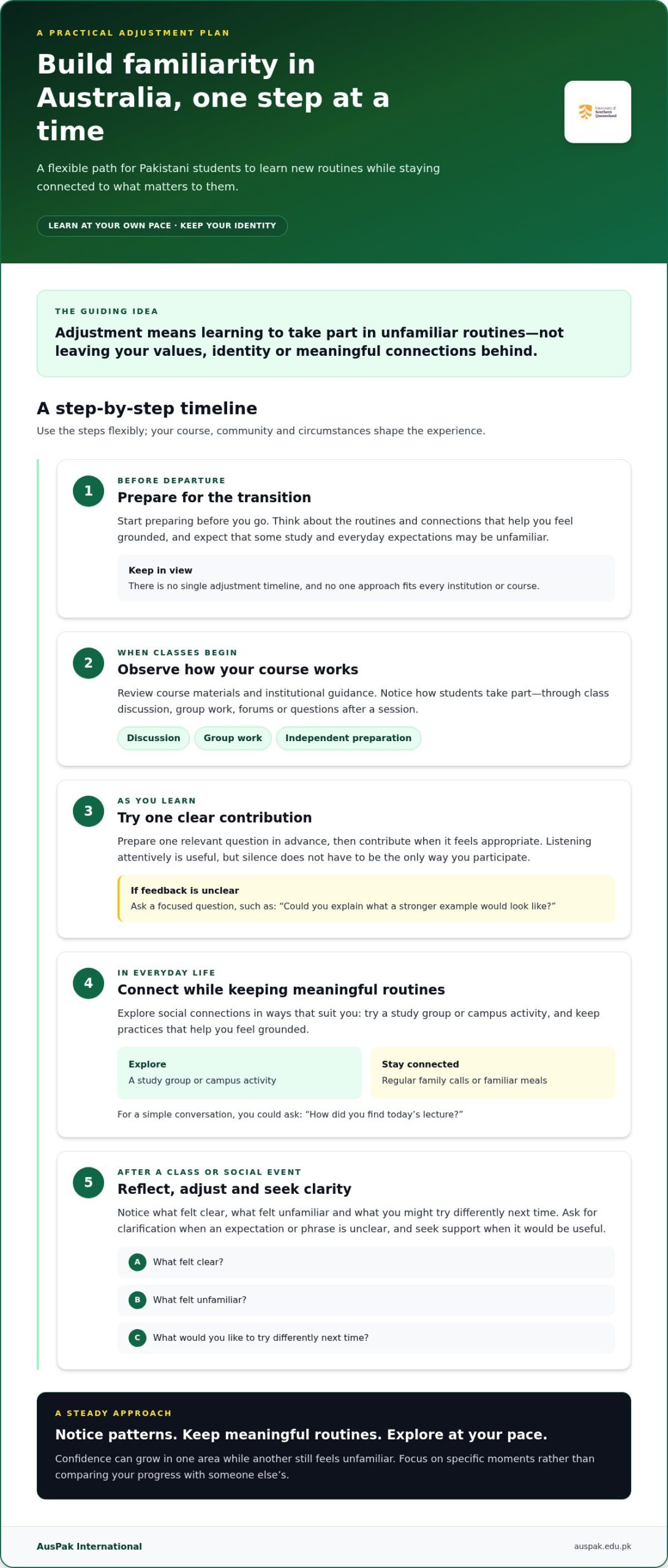
A Practical Adjustment Plan for Pakistani Students in Australia
Cultural adjustment for Pakistani students in Australia is easier to approach when you turn a broad challenge into manageable actions. Use this sequence as a guide, not a timetable or a test. Move at your own pace, adapt the steps to your circumstances and seek support when useful. This preparation is separate from admissions or visa decisions and can’t guarantee a particular outcome.
Prepare before departure with realistic expectations
Before leaving Pakistan, review your course information, accommodation guidance and student resources provided by your institution. These can help you identify practical questions about getting to classes, accessing course materials and finding student support. For broader study planning, the Australia University Guide 2026 for Pakistani Students can help you consider what to organise before departure.
Think about what helps you feel grounded. Make a note of important contacts, plan how you’ll stay connected with family and consider which familiar personal items or routines you’d like to bring along. Keep preparation realistic: focus on what you can organise now and leave room to learn details once you’re there.
Build confidence through small actions after arrival
Start by learning the practical routines that support your study: how to find your classroom, where course information is shared and how to contact teaching or support staff. If a process isn’t clear, ask where to find the relevant guidance. Choose one suitable activity or student community to explore when you feel ready. You don’t have to build a full social network immediately.
Use a weekly check-in to recognise progress and choose a manageable next step. Write down:
- One success: What felt easier this week, such as finding a class or completing a study task?
- One question: What expectation, routine or process would you like to understand better?
- One next step: What small action could help, such as reviewing course guidance or asking a staff member for direction?
This reflection helps you notice practical changes without expecting every week to feel better than the last. If a question keeps coming up, use the support channels your institution provides or speak with someone you trust. Adjust the plan as your priorities change.
Quick preparation checklist
- Review course information, accommodation guidance and institution-provided student resources.
- Save important contacts and note how you’ll keep in touch with family.
- Choose familiar routines or personal items that may help you feel settled.
- After arrival, learn essential campus routines and locate student support.
- Complete a weekly check-in: one success, one question and one next step.
Take the next practical step in your plans. AusPak International’s study-abroad guidance can help you organise your Australian study preparation.
How AusPak International Can Support Your Study-Abroad Transition
Preparing to study overseas involves more than choosing a course. You’re also thinking about where you’ll live, what questions to ask before departure and how to approach unfamiliar routines once you arrive. For cultural adjustment for Pakistani students in Australia, structured planning can help organise these decisions while leaving space to shape your own experience.
Connect study planning with practical transition preparation
AusPak International’s Education Counseling can help you consider your Australian study plans and prepare questions about your options. Use that conversation to clarify what matters to you, such as course expectations, your priorities for student life and the information you still need. Counseling supports informed planning; it doesn’t determine your personal adjustment or guarantee a particular study outcome.
Practical arrangements matter, too. The Accommodation Guide can help you consider living arrangements and what you want to understand before departure. AusPak International also provides Onshore Arrival Support for students pursuing education abroad. These offerings can complement your own preparation, including reviewing institution-provided resources and identifying the people you may turn to with questions.
AusPak International is an official representative of over 40 Australian universities and is licensed to officially use the Future Unlimited brand of an Australian Government body. These credentials provide context for its role in Australian education guidance. They don’t replace your own research into course information, institutional expectations or the practical details that will shape your transition.
If you’re considering longer-term plans, the Career Opportunities After Studying Abroad guide offers optional context to explore alongside your immediate study and arrival preparations. Keep the focus on the decisions in front of you, then build your plans step by step.
Take a clear next step without expecting guarantees
A useful first step is to outline what you know, what remains uncertain and what you’d like to discuss. You might note your study interests, questions about accommodation and the support you want to understand before departure. The Free Profile Assessment can provide a starting point for discussing your study plans and identifying what to consider next.
Guidance can help organise decisions, but it can’t guarantee admission, visa approval, a particular adjustment experience or future outcomes. Your circumstances and choices remain central. Start with the question that matters most to you and take the next step when you’re ready.
Begin with AusPak International’s Free Profile Assessment to discuss your Australian study plans and identify a practical next step.
Take Your Next Step with Confidence
Your experience in Australia will be your own, shaped by the choices you make and the connections you build. Cultural adjustment for Pakistani students in Australia doesn’t require having every answer before you leave. It begins with deciding what you want to understand next and giving yourself permission to learn as you go.
If you’re planning your studies, use that next decision as a starting point. AusPak International’s Free Profile Assessment can help you discuss your plans and consider practical questions for your study-abroad journey. It’s a step towards clearer preparation, not a promise of a particular outcome.
Start with AusPak International’s Free Profile Assessment to discuss your plans, priorities and aspirations. You can move forward thoughtfully, stay connected to what matters to you and make room for new experiences. Your next chapter can begin one considered step at a time.
Frequently Asked Questions
What is cultural adjustment for Pakistani students in Australia?
Cultural adjustment for Pakistani students in Australia means learning to interpret and respond to new academic, social and everyday situations while keeping your priorities in view. For example, if a class instruction seems unclear, check the written course requirements before assuming it reflects a broader cultural expectation. Treat adjustment advice as a set of possible approaches, not a prediction of how you’ll feel or a standard you must meet.
Is it normal to feel homesick after moving to Australia as a Pakistani student?
Yes, missing familiar people, food, language or routines can happen during a major move. It doesn’t mean your decision was wrong. Notice when the feeling is strongest, such as during a quiet evening or a family occasion, and plan a supportive activity for that time. If distress continues or makes everyday responsibilities difficult, seek appropriate support through your institution or a qualified professional.
How long does it take Pakistani students to adjust to life in Australia?
There’s no set adjustment period that applies to every student. Course demands, living arrangements, personal circumstances and social connections can all shape the experience. Instead of comparing yourself with a classmate, look for changes that matter to you: perhaps you can manage a routine more independently, or you know whom to ask about a recurring issue. Use those observations to decide what would help next.
Can Pakistani students maintain their culture while studying in Australia?
Yes. Studying in a new environment doesn’t require giving up your language, faith, food, family relationships or personal values. You might keep a familiar weekly routine while trying an unfamiliar activity that interests you. Consider which practices are important to maintain and which you’re comfortable adapting to fit your schedule. That balance is personal, and you can revisit it as your circumstances change.
What should I do if I experience a cultural misunderstanding in Australia?
Pause and seek clarification before deciding what someone intended, if you feel comfortable doing so. You could say, “I understood that to mean this. Is that what you meant?” If a comment crosses a boundary, explain calmly what you’re comfortable with. For a misunderstanding involving coursework or institutional procedures, keep relevant details and use the appropriate university channel. One difficult exchange doesn’t define every interaction.
How can Pakistani students make friends in Australia without feeling pressured?
Choose a social setting that suits your interests and energy, then set a small goal, such as speaking with one person after a shared activity. If the conversation goes well, you could suggest continuing it another time. If not, you can try a different setting. Friendship doesn’t require a large circle or immediate closeness. Keep your existing relationships and allow new ones to develop naturally.
Where can Pakistani students get help adjusting to study in Australia?
For course-related questions or wellbeing concerns, start with the student support channels provided by your institution and identify the right contact for your situation. AusPak International offers Education Counseling, an Accommodation Guide and Onshore Arrival Support as part of its study-abroad support. These can help you consider study plans and practical preparation, while university services are the appropriate starting point for issues tied to your enrolled course or campus.