
Working in Canada after graduation for Pakistani students can be possible for up to three years through a Post-Graduation Work Permit (PGWP), depending on the eligible programme. Graduates of eligible programmes lasting two years or more may receive a PGWP of up to three years. For an eligible programme lasting eight months to under two years, the permit may match the programme’s length.
It’s natural to focus first on how long you can stay and work after your studies. The permit’s duration is only one part of the transition: you’ll also need to understand when you’re authorized to work, how to obtain a Social Insurance Number (SIN), and how Canadian work experience may support a future permanent-residency application.
This guide covers the main PGWP duration rules, the SIN requirement, and how eligible Canadian work experience may relate to pathways such as the Canadian Experience Class. It also explains key conditions to consider as you plan your move from study to work.
Key Takeaways
- An eligible programme lasting two years or more may lead to a PGWP of up to three years; shorter eligible programmes can have a different permit duration.
- Check your PGWP application timing and language-test requirements early, as they affect your transition from study to work.
- A SIN is a nine-digit number you need for employment in Canada; understand when and how to obtain one before starting work.
- Canadian work experience may support permanent-residency pathways, including the Canadian Experience Class, which requires at least one year of skilled work experience in Canada.
- Your study permit conditions, programme eligibility and work history all shape the options available after graduation.
Pathways from Canadian work experience to permanent residency
Canadian work experience may support permanent-residency applications through Express Entry and Provincial Nominee pathways. Start by understanding which work you’re authorized to do during your studies and after graduation.
Student Work Rules and Options
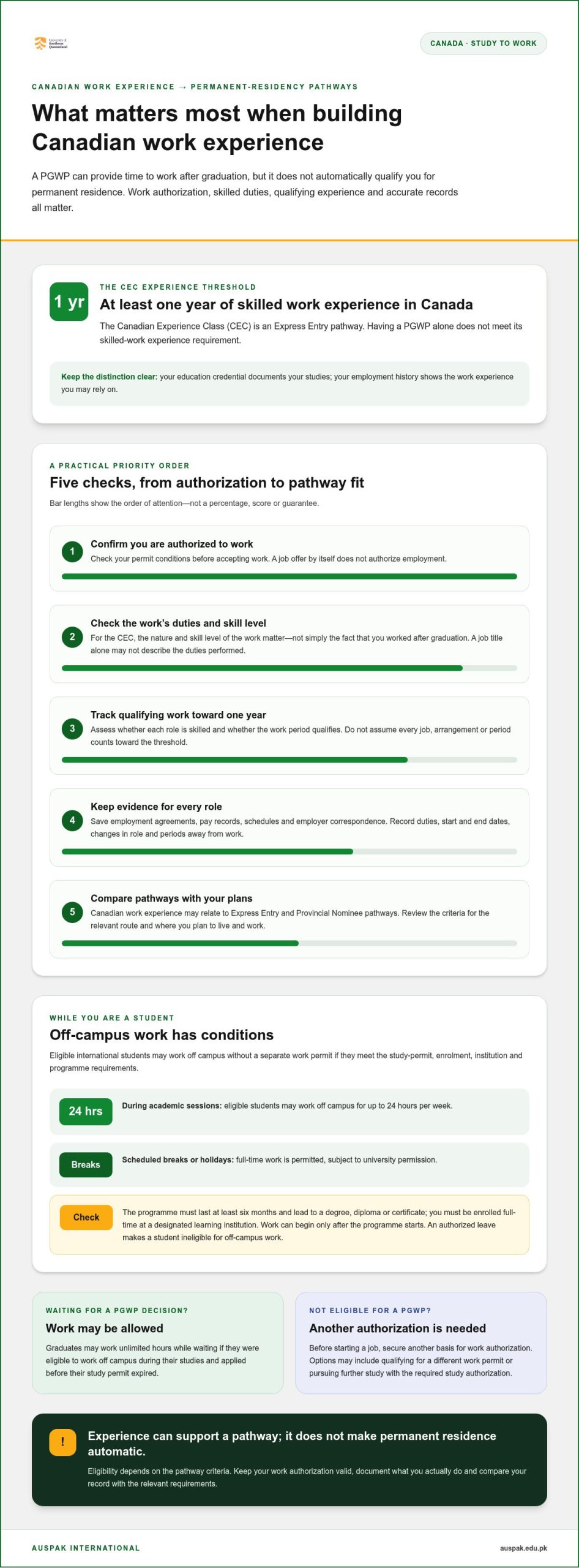
International students may work off campus without a separate work permit if they meet the requirements for their study permit, enrolment, institution and programme. The programme must last at least six months and lead to a degree, diploma or certificate, and the student must be enrolled full-time at a designated learning institution. Work can begin only after the programme starts.
During academic sessions, eligible students may work off campus for up to 24 hours per week. Full-time work is permitted during scheduled breaks or holidays, subject to university permission. An authorised leave from the institution makes a student ineligible for off-campus work, so confirm your enrolment status before accepting shifts. Staying within the applicable conditions protects your authorization and avoids unauthorized work.
Canadian Experience for Express Entry
Express Entry includes immigration pathways where Canadian work experience may help a graduate qualify. The Canadian Experience Class requires at least one year of skilled work experience in Canada. The job’s duties and skill level matter, not simply the fact that you worked after graduation.
Keep records of your role and employment history, including your duties and dates of employment. When comparing job offers, consider whether the work is skilled and could contribute to the experience requirement. Canadian study and work experience may also relate to Provincial Nominee pathways. Neither route makes permanent residence automatic: eligibility depends on the criteria for the pathway.
Alternatives to a Post-Graduation Work Permit
If you’re not eligible for a PGWP, you need another basis for work authorization before starting a job in Canada. Options may include qualifying for a different work permit or pursuing further study with the required study authorization. The appropriate route depends on your circumstances, including your status, proposed work and eligibility for that category.
A job offer alone does not authorize you to work. Review your current permit conditions and secure authorization that covers the proposed employment before starting. If you’re planning a new Canadian study programme, Canada Study Permit Assistance can help with study-permit matters.
Can graduates work while waiting for a PGWP decision? According to the Government of Canada, graduates may work unlimited hours while waiting if they were eligible to work off campus during their studies and applied before their study permit expired.
What are the risks of losing PGWP eligibility or working without authorization? Working outside your permit conditions is unauthorized and may affect your ability to work legally. Protect your options by checking your eligibility, application timing and permit conditions before starting employment.
Canadian Experience Class eligibility
The Canadian Experience Class (CEC) is an Express Entry pathway based on skilled work experience in Canada. For Pakistani graduates, the key threshold is at least one year of skilled Canadian work experience. A PGWP may allow a graduate to gain work experience, but holding one alone does not meet that threshold.
Think of CEC eligibility as a work-history question, not simply an outcome of graduating. Your education credential documents your studies; your employment record shows the work experience you may rely on. Before accepting a role, understand its duties and keep records of what you actually do. A job title alone may not describe the work performed.
For example, a graduate might move from campus employment during university to a full-time role after graduation. The key is to assess whether the later work qualifies as skilled experience and track its duration. Don’t assume that every position, work arrangement or period of employment counts toward the one-year requirement.
Keep an organized employment file as you work. Save employment agreements, pay records, schedules and employer correspondence. Record your start and end dates, changes in duties, and any periods away from work. These documents can help you describe your history accurately when preparing an Express Entry profile or application.
Your intended destination in Canada also matters. Canadian work experience may relate to Provincial Nominee pathways as well as Express Entry, so consider whether a provincial route aligns with where you plan to live and work. Compare the relevant pathway criteria before making decisions based on a job alone.
Use this sequence to assess your position:
- Identify the duties and skill level of each Canadian job.
- Track qualifying work periods and retain employment evidence.
- Compare your record with the CEC’s one-year skilled-experience threshold.
- Review whether Express Entry or a Provincial Nominee pathway matches your plans.
If your work history includes several roles, document each position separately. This makes it easier to distinguish duties, dates and periods worked, rather than treating every job as one continuous stretch. Accurate records also help show whether a change of role affects the experience being counted.
Canadian study and learning can help prepare you for the labour market, but the CEC threshold concerns skilled work experience. Keep your graduation documents and employment evidence together, then assess the work history against the pathway before planning around permanent residence. If you’re still preparing to study in Canada, Canadian study permit guidance can support that earlier stage.
Canadian immigration pathways after graduation
Graduation can create a route from Canadian education to employment and potentially to permanent residence. The Post-Graduation Work Permit (PGWP) connects eligible study programmes with Canadian work experience, while Express Entry and Provincial Nominee pathways provide separate routes to apply for permanent residence.
PGWP length depends partly on programme duration. Graduates of eligible programmes lasting two years or more may receive a work permit for up to three years. For an eligible programme lasting eight months to under two years, the permit may match the programme’s length. A master’s graduate may receive a three-year PGWP even after a shorter programme.
The institution and credential also matter. The described PGWP programme requires graduation from a public or private institution with a recognised degree from a Canadian province or territory. Bachelor’s, master’s and doctoral degrees have no field-of-study restriction for PGWP eligibility. When comparing education options, consider programme duration, credential and institution, as these can affect the work period available after graduation.
Plan the work permit and permanent-residency decisions separately. A PGWP gives eligible graduates a period to work in Canada, but it does not itself grant permanent residence. Canadian work experience may support an application through Express Entry or a Provincial Nominee pathway, subject to the criteria for that route.
PGWP applicants have had to submit a language test since November 2024. Graduates with a degree need Canadian Language Benchmark (CLB) 7 on the language test. Include this requirement in your planning alongside your programme and permit timeline, rather than treating language preparation as a task to consider only after graduation.
Timing can affect whether you’re able to work while an application is being processed. According to the Government of Canada, graduates may work unlimited hours while awaiting a PGWP decision if they were eligible to work off campus during their studies and applied before their study permit expired. This applies in a specific situation, so keep your permit expiry date and application timing in view.
Use this sequence to map your transition:
- Compare eligible programme duration and credential before choosing education.
- Understand the potential PGWP length linked to that programme.
- Prepare for the applicable language-test requirement.
- Build a work history, then assess Express Entry and Provincial Nominee pathways.
For example, a master’s graduate completing a shorter eligible programme could receive a three-year PGWP. Another eligible programme lasting eight months to under two years may result in a permit matching its length. Compare the credential and duration first, then consider how the available work period could support your longer-term immigration plans.
Social Insurance Number requirements
A Canadian Social Insurance Number (SIN) is a nine-digit number assigned by the Government of Canada. For a Pakistani student moving from study into employment, it is important to understand the SIN alongside work authorization. A SIN and a study or work permit have different purposes: the permit relates to permission to work, while the SIN identifies you within Canadian systems.
Keep these documents distinct. A SIN does not replace a permit or change its conditions. For example, having a SIN does not by itself authorize a graduate to work after a study permit expires. Check the validity and conditions of your immigration document separately, especially when moving from a study programme to a PGWP.
Plan the administrative steps around your employment start. First, understand the work authorization that applies to your situation. Next, arrange your SIN and keep its details available for legitimate employment administration. Finally, store your records securely. This sequence helps prevent confusing a payroll identifier with proof of work eligibility.
Your study records can help keep the transition organized. Save documents identifying your programme and institution, including records from a public or private school where applicable. Keep your permit information, graduation documents and SIN details in separate, clearly labelled files. If a new permit is being processed, track that process separately from your SIN arrangements.
Consider a practical example: a graduate receives a job offer while their immigration status is changing. The offer, SIN and work authorization are separate matters. Before starting, identify which document authorizes the role and whether its conditions apply. Then provide employment administration details through the employer’s appropriate process, rather than assuming one identifier meets every requirement.
Protect sensitive information. Store your SIN securely, avoid sharing it in casual messages, and provide it only when there is a clear administrative need. If you keep digital copies, use a private location with access controls. These habits can reduce confusion when organizing tax, employment or immigration records.
Use this short preparation checklist:
- Remember that a SIN contains nine digits.
- Keep SIN records separate from your study permit and work permit.
- Review your authorized work conditions before accepting hours per week.
- Save program, institution and employment records together for easy reference.
The key distinction is simple: your SIN identifies you, while immigration documents define your work authorization. Keep both accurate and organized as you move from study to employment. This separation is useful when starting a role, managing permit processing or planning what comes after graduation.
How do Pakistani graduates apply for a PGWP, and what documents are required?
Apply for a Post-Graduation Work Permit (PGWP) within 180 days of graduation. Treat that deadline as the central date in your application plan. Gather your graduation and study-permit records, prepare the required language-test result, then submit your application to Immigration, Refugees and Citizenship Canada (IRCC).
Start by recording your programme completion date and checking your study permit’s expiry date. The 180-day application window runs from graduation, so avoid leaving preparation until the final days. A clear timeline helps you organize supporting documents and distinguish the PGWP application deadline from your permit’s expiry.
Prepare records that connect your identity, studies and application. Your document file should include:
- Your current study permit and its expiry information.
- Proof of graduation, such as an official completion record from your institution.
- Your language-test result, required for PGWP applicants since November 2024.
- Application information that matches the details in your study and graduation records.
Use consistent details throughout your application. For example, compare the name and programme information on your graduation record with your study documents before submitting. Keep clear copies of the records you rely on, so you can refer to the same evidence if you need to review your application later.
Language testing is part of PGWP preparation. Since November 2024, applicants have been required to submit a language test. Graduates with a degree need Canadian Language Benchmark (CLB) 7 on the language test. Arrange the test and result early enough to include the required evidence in your application, rather than treating it as a later task.
Application timing also affects whether you can work while waiting. Immigration, Refugees and Citizenship Canada states that your study permit must be valid when you submit your PGWP application to be eligible to work while awaiting a decision. Graduates may work unlimited hours while waiting if they were eligible to work off campus during their studies and applied before their study permit expired.
Keep your submission and status records together. Save the application confirmation, study permit, graduation evidence and language-test result in one secure file. If your permit is nearing expiry, prioritize the application timeline and understand the conditions that apply to you before continuing to work.
If you’re still preparing for Canadian study, explore Canada Study Permit Assistance as an earlier step in planning your education pathway.
AusPak International: Australian University Admission Support
AusPak International supports Pakistani students planning overseas study through Australian University Admission Support. If you’re considering a new study destination, use its admissions support while comparing programmes and preparing your application. For students planning Canadian study, Canada Study Permit Assistance can help with the study-permit stage, which is separate from a PGWP application or permanent-residency process.
Choose the next step that matches your plans. Students pursuing UK study can use UK Student Visa Consultancy, while those preparing for life after arrival can use Onshore Arrival Support. Each offering relates to a different stage of an international education journey, so start with the destination and task you’re planning.
Contact AusPak International to discuss the study pathway that fits your next move.
Make Your Next Study Decision With Purpose
Plan your next move around what you want your education to support. For Pakistani students, working in Canada after graduation is one possible part of a broader study and career plan. Consider how your destination, chosen programme and future priorities fit together before committing to a path.
AusPak International supports students through Australian University Admission Support, UK Student Visa Consultancy and Canada Study Permit Assistance. Choose support that aligns with your destination and the stage you’re planning, whether you’re preparing an application or exploring a new study route.
Take the next step with a clear idea of your destination and the questions you need answered. Discuss your study options with AusPak International, and move forward with a plan that reflects your ambitions.
Frequently Asked Questions
How long can I work after graduating?
An eligible graduate may work for up to three years with a PGWP, depending on the programme and permit duration. Completing an eligible programme of two years or longer may lead to a permit of up to three years. Your authorized work period is tied to the permit issued, so use its expiry date when planning employment and future steps.
Can Pakistani international students work in Canada after graduation?
Yes. Pakistani graduates can work in Canada if they hold a work permit or otherwise meet the conditions for authorized work. A PGWP is one possible route for graduates of eligible programmes, but it is not automatic for every student. Before accepting a job, match your intended start date with your immigration status and the authorization that applies after your studies.
What is Canada’s Post-Graduation Work Permit (PGWP), and who is eligible?
A PGWP is a work permit for eligible graduates of Canadian programmes. The programme must meet the applicable requirements, including graduation from a public or private institution with a recognised degree from a Canadian province or territory. When choosing a programme, consider its credential and institution, not only its subject. Completing a course alone does not establish PGWP eligibility.
What are the PGWP application deadlines and processing times?
Submit a PGWP application within 180 days of graduation. Processing can take several weeks to a few months, so prepare your application materials without waiting until the deadline approaches. For example, organize your completion record, study permit details and language-test result as soon as they’re available. Your study permit must be valid at submission to qualify for work while awaiting a decision.
How long can a PGWP last, and how does program length affect its duration?
An eligible programme lasting eight months to under two years may lead to a PGWP matching the programme’s length. An eligible programme lasting two years or more may lead to a permit of up to three years. Master’s graduates can receive a three-year PGWP after a shorter programme. Compare these duration rules when assessing study options, as they affect the possible post-study work period.
What are the latest PGWP rules for language tests and field of study?
Since November 2024, PGWP applicants have needed to submit a language test. Graduates with a degree need Canadian Language Benchmark (CLB) 7 on that test. There’s no field-of-study restriction for PGWP eligibility for bachelor’s, master’s or doctoral degrees. For planning, distinguish the language requirement from programme eligibility, then prepare the required test result for your application.
How can Canadian work experience after graduation help Pakistani students get permanent residence?
Canadian work experience may support permanent-residency pathways through Express Entry and Provincial Nominee pathways. For the Canadian Experience Class, the stated threshold is at least one year of skilled Canadian work experience. Keep a clear record of your roles and employment periods, then compare your experience with the pathway requirements. A job in Canada does not itself grant permanent residence.
Which Canadian colleges and programs qualify for a PGWP?
The described PGWP programme requires graduation from a public or private institution with a recognised degree from a Canadian province or territory. Eligible programmes lasting eight months or more may qualify; bachelor’s, master’s and doctoral degrees have no field-of-study restriction.