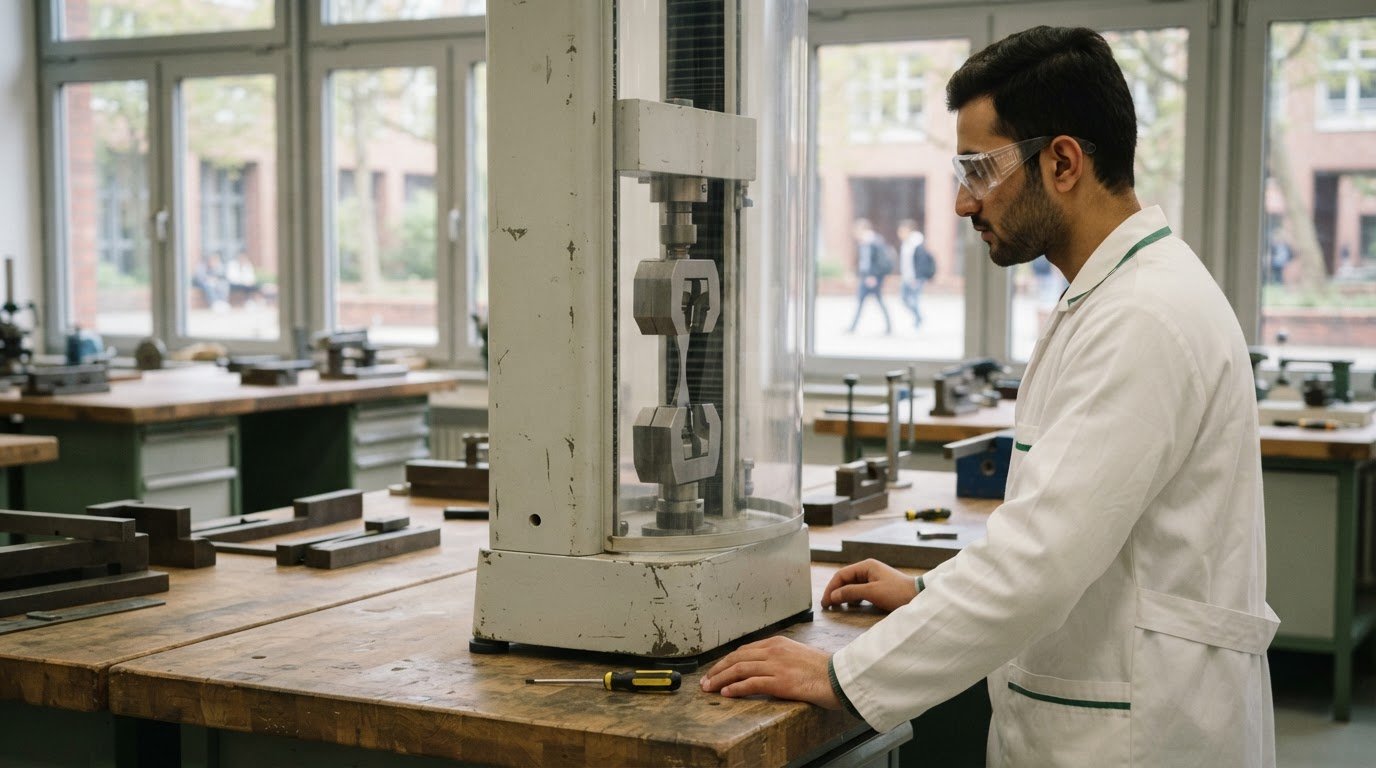
Free engineering study in Germany is possible, but it doesn’t mean every cost disappears. Public universities generally charge no tuition, including to non-EU students, so Pakistani applicants can study engineering in Germany for free at eligible institutions. You’ll still need to budget for semester contributions and living costs, and some programmes or states charge tuition.
It’s understandable to focus on affordability first, especially when planning an international degree from Pakistan. But the right choice also depends on your study level, language preference and academic background. English-taught engineering options are available, although programmes and admission requirements vary by university.
This guide explains why tuition may be free, which costs can remain and where exceptions apply. It also covers English-language options and what to expect from engineering bachelor’s and master’s programmes, helping you assess whether Germany fits your academic plans before preparing an application.
Key Takeaways
- Public universities generally charge no tuition, but semester contributions and some state or programme fees can still apply.
- English-taught engineering degrees are available; programme language, admission criteria and application route depend on the university and degree level.
- Compare bachelor’s and master’s options by subject, language of instruction and expected study duration before choosing a programme.
- Some states charge tuition to non-EU students, so the university’s location can affect your study budget.
- After completing a degree in Germany, foreign graduates who can support themselves can receive a job-search residence permit for up to 18 months, according to Gesetze im Internet.
1. Why Study Engineering in Germany?
Germany combines specialist technical universities, broad engineering course choices and public study options that may charge no tuition. Its 17 technical universities and more than 3,600 engineering degree courses give applicants a wide field of subjects to explore. For Pakistani students, the decision should begin with programme fit, admission eligibility and language of instruction, not tuition alone.
Engineering study suits applicants prepared for mathematics, scientific reasoning and applied problem-solving. A bachelor’s programme typically takes 3–4 years of full-time study, with courses shaped by the discipline, such as mechanical, electrical or civil engineering. Review each curriculum for its mathematics and science content, practical components, and progression into later modules. This helps you judge whether your prior studies support the programme’s academic demands.
Admission requirements depend on the university, degree level and course. For a bachelor’s application, the university assesses your secondary-school qualification against the programme’s entry conditions. A master’s application usually focuses on relevant previous university study and subject preparation. Gather academic records, certificates and required supporting documents, then follow the institution’s application route. Some applications go directly to the university; others use Uni-Assist to process international applications.
Language requirements also depend on the programme. German-taught courses require evidence of German proficiency, while English-taught options require proof of English ability under the university’s rules. A language certificate may be part of your application, so check which evidence and level your chosen course requires. Don’t assume the same certificate or standard applies across every university. Match your language preparation to the specific bachelor’s or master’s programme.
Pakistani students must also plan for the student visa process alongside admission. Plan to show that you can cover your living costs as part of your visa preparations. Treat this requirement separately from tuition fees, semester contributions and daily living expenses, since a tuition-free course does not remove the need to fund your stay. Start your financial planning while preparing academic documents, so visa preparations and application deadlines progress together.
Scholarships may form part of your funding plan, but eligibility depends on the award’s criteria and your academic profile. Compare those conditions with the course’s entry requirements before relying on an award. A practical sequence is to shortlist engineering courses, confirm academic and language eligibility, choose the application route, then prepare visa funding documents. This helps you assess whether you can study engineering in Germany for free while meeting the requirements of your chosen programme.
2. Can You Study in Tuition-Free Universities in English?
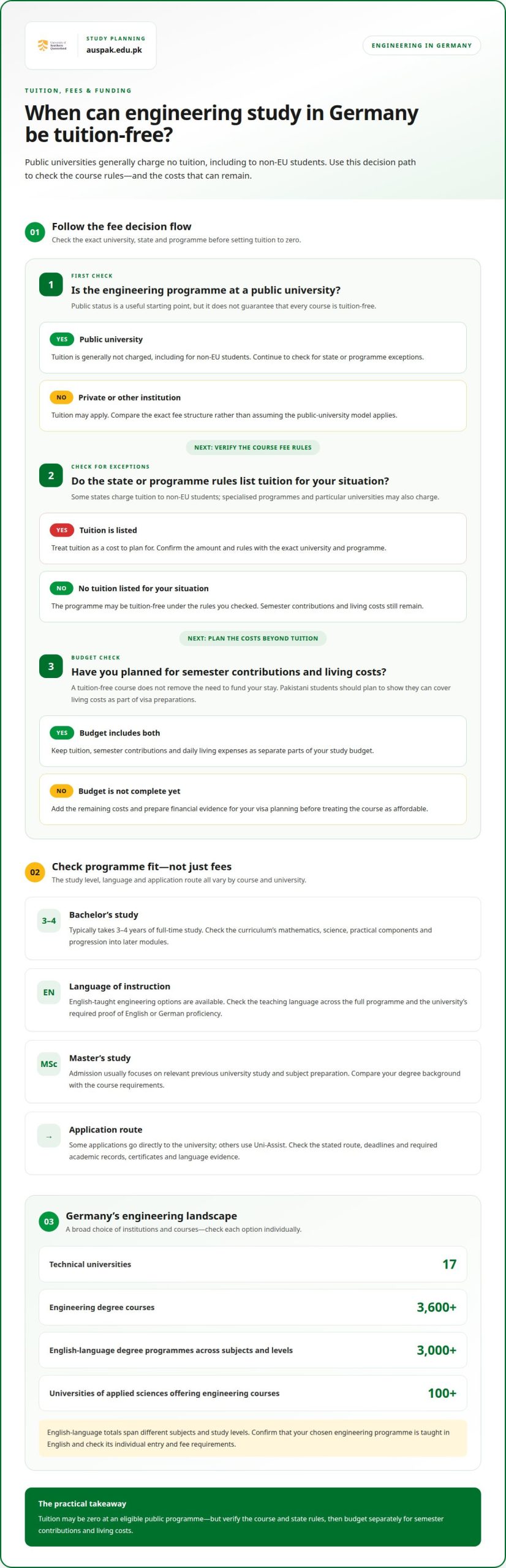
Yes. German public universities generally charge no tuition, including for non-EU students, and English-taught programmes are available. However, tuition-free doesn’t mean every programme is free: specialised courses and particular universities may charge tuition, while semester contributions are separate. Check the fee structure for the exact course and intake you’re considering.
Germany has more than 3,000 degree programmes in English, but that total covers different subjects and study levels. For engineering, compare the teaching language for the entire programme, not just selected courses. A degree may include English instruction while still requiring German for other parts, so read the programme description and language requirements carefully. Universities of applied sciences also offer engineering courses, with a focus that may suit students seeking applied learning.
The choice between a traditional university and a university of applied sciences depends on your academic priorities. Compare each course’s subject coverage, teaching approach, practical components and progression options. Germany has more than 100 universities of applied sciences offering engineering courses. Technical University of Munich is one example of a public institution, but non-EU tuition rules can differ between universities and states. Public status alone doesn’t guarantee that every programme is tuition-free.
For Pakistani applicants, the main cost comparison is between tuition-free public programmes and tuition-charging options, including private or specialized degrees. Germany’s public-university model can reduce tuition costs, but living expenses and semester contributions still matter. Engineering job prospects also depend on qualifications, specialisation and language skills; Germany’s engineer unemployment rate is under 3 percent. That figure describes Germany, not a direct comparison with another country.
Apply in a clear sequence: shortlist engineering programmes taught in English, then compare eligibility and fees. Check whether each university accepts direct applications or uses Uni-Assist. Prepare the required documents, such as academic records, certificates and evidence of language ability. Submit through the stated route and follow the programme’s deadlines. For a master’s, also assess whether your previous degree meets the subject requirements.
Tuition-free study depends on admission to a programme whose fee rules apply to your circumstances. Non-EU status doesn’t automatically mean you’ll pay tuition at a public university, but exceptions exist. Check the university, state and course together before treating tuition as zero. For English-taught study, match your English-language evidence to the programme’s stated requirement. German can also be useful for daily life and future work, even when your degree is taught in English.
3. Why is Education Free in Germany?
Germany’s tuition-free public university model reflects a decision to fund higher education through public resources rather than general tuition charges. This doesn’t mean every institution or programme is free. Private universities set tuition, and some states charge non-EU students, so the university’s location and your student status matter.
Baden-Württemberg is a key exception for Pakistani applicants. Its public universities charge non-EU/EEA students tuition, listed as €1,500 per semester, or €3,000 per year. Before applying, identify the state where the university is located, then review the programme’s fee rules for non-EU applicants. Don’t assume a public institution has the same tuition policy everywhere in Germany.
Engineering remains a major field within German higher education. In winter semester 2025/26, 752,687 students studied engineering programmes in Germany. More than one million students were enrolled in STEM subjects, which include science, technology, engineering and mathematics. These figures show the scale of technical study, but they don’t indicate that every course has identical fees, entry conditions or scholarship options.
International students can explore scholarships alongside public-university study. Eligibility depends on the award’s criteria and the applicant’s academic record; choosing engineering alone does not guarantee an award. Private universities may also have different fee structures, so compare scholarship conditions with the full tuition obligation before relying on funding.
International students must meet the chosen course’s academic and language requirements. The university assesses prior qualifications, subject preparation and programme-specific documents. Relevant mathematics and science study can support an engineering application. Keep admission eligibility separate from tuition status: qualifying for a course does not determine whether a non-EU student pays fees in that state.
Student work may help with expenses, but it should not replace a complete funding plan. International students may be able to work while studying, but should check the conditions that apply to their situation. Hourly pay depends on the job and location, so earnings vary. Plan work around classes, laboratories and examinations, particularly in technical courses with intensive practical schedules. Check that any job fits the applicable student work limit.
Free tuition is a feature of many public-university programmes, not a guarantee that studying costs nothing. For Pakistani applicants, the practical decision is to weigh state-specific tuition, eligibility, scholarship criteria and realistic work capacity before choosing an engineering course.
4. Engineering bachelor’s and master’s programs
Engineering study in Germany follows distinct bachelor’s and master’s pathways. A full-time bachelor’s degree typically takes 3–4 years, while a master’s takes 1–2 years. Bachelor’s programs build disciplinary foundations through academic courses; master’s programs develop more specialised knowledge. Choose your level according to your previous qualification and the subject depth you want.
English-taught options are available, including engineering degrees, but the programme list varies by institution and subject. Germany has 290 universities offering 2,753 English-language bachelor’s and master’s programmes to international students. More than 1,000 programs across Germany are taught entirely in English. These national totals are useful for understanding scale, not proof that every engineering specialisation is offered in English.
For a public-university shortlist, consider institutions such as Technical University of Munich, RWTH Aachen University, Technical University of Berlin and Technische Universität Dresden. Compare the exact degree title and language of instruction at each institution. The available information identifies these universities as engineering options, but doesn’t establish that each offers every engineering degree in English. Treat programme-level language details as decisive.
Pakistani applicants should compare language requirements with the degree’s teaching language. An English-taught programme may require evidence of English proficiency, while a German-taught degree calls for German-language preparation. Check whether all core courses use the advertised language rather than assuming the programme title describes every class. This distinction matters for lectures, assessments and technical projects.
Dual work-study engineering programmes combine academic study with periods of workplace learning. This format can connect engineering theory with practical tasks, while requiring students to balance course schedules and workplace commitments. Review the study plan, employer participation and language expectations before applying. A dual format may suit applicants who value applied experience; a conventional degree may better fit those who prioritise a more campus-centred academic route.
To compare programmes efficiently, start with your intended engineering field, such as mechanical or electrical engineering. Then filter by bachelor’s or master’s level, English or German instruction, and public or private institution. Review admission criteria and course structure before choosing an application route. This helps Pakistani students distinguish an English-language degree from a primarily German programme that includes only some English courses.
Your programme choice also shapes later academic options. A bachelor’s curriculum should provide the foundation required for your intended field, while a master’s application depends on the relevance of your previous university study. Compare module descriptions, practical components and specialisation options side by side. For an English-language pathway, check the full degree plan and language evidence requirements before applying.
5. Reasons to study engineering in Germany
Germany’s appeal is not simply the possibility of avoiding tuition. Its higher education system includes technical universities, applied learning routes and engineering degrees connected to varied specialisations. Technical University of Munich ranked 16th worldwide for Engineering & Technology in the QS World University Rankings by Subject 2026. For Pakistani students, that provides one concrete example of the country’s academic profile, not a guarantee that every university or course offers the same experience.
Public universities can make engineering education more accessible because they generally don’t charge tuition, including for non-EU students. However, Baden-Württemberg charges non-EU/EEA students tuition, and some programmes elsewhere also have fees. Treat “tuition-free” as a programme-specific possibility, not a national promise. Compare the university’s location, degree and fee rules before deciding whether the costs fit your plans.
Germany also offers a broad technical study environment. More than one million students are enrolled in STEM subjects, spanning science, technology, engineering and mathematics. This breadth can help applicants explore connections between engineering and fields such as computing or applied sciences. When comparing courses, look beyond a university’s reputation: assess the curriculum, specialist modules, practical work and language of instruction against your academic interests.
Career planning is another reason to consider a German degree. After successfully completing a degree in Germany, a foreign graduate can receive a job-search residence permit for up to 18 months, provided they can support themselves, according to Gesetze im Internet. In 2026, recent graduates and engineers in shortage occupations can qualify for an EU Blue Card with a gross annual salary of at least €45,934.20. These routes have distinct conditions and serve different stages of a graduate’s career.
Make your decision by connecting each advantage to a practical choice. First, select an engineering specialisation that matches your previous study. Then compare public universities, programme language and tuition rules, including whether the state charges tuition fees. Consider whether the course supports your intended career direction and whether you meet its academic and language requirements. This sequence is more useful than choosing based on “free” education alone.
For applicants weighing Germany against another destination, compare the full study pathway: degree fit, language, funding, and post-study options. A lower tuition bill matters only if the programme aligns with your qualifications and longer-term plans. If you’re also considering Australia as a study destination, explore your international study options as part of that comparison.
AusPak International: Canada Study Permit Assistance
AusPak International provides Canada Study Permit Assistance for Pakistani students considering Canada as an alternative study destination. If researching engineering in Germany has prompted you to compare countries, AusPak can support your Canadian study permit process and explain the steps involved. For English-language preparation, the Free IELTS Mock Test offers a way to practise before planning an application. Students considering other pathways can also explore Australian University Admission Support or UK Student Visa Consultancy. Choose support based on your intended destination and where you are in the planning process. If Canada is your next step, contact AusPak International to discuss Canada Study Permit Assistance.
Turn Your Engineering Ambition Into a Study Plan
Choose a path that fits your longer-term direction, rather than selecting a destination simply because it appears affordable. Consider the kind of engineering work you hope to pursue, the academic environment where you learn best and the language in which you can thrive. These priorities can help you shape a focused application plan.
If you aim to study engineering in Germany for free, build your shortlist around programmes that match your preparation and professional interests. Allow time to organise the application tasks and make deliberate choices about your future. A clear plan turns a broad ambition into practical next steps.
If comparing destinations has broadened your plans, AusPak International supports Australian university admissions, UK student visa applications and Canada study permits. Contact AusPak International to discuss your study plans and consider which pathway best fits your goals. Your next chapter can start with one informed decision.
Frequently Asked Questions
Why Study Engineering in Germany?
Germany can suit students seeking a choice of engineering disciplines and study formats. Start by identifying a field, such as mechanical or electrical engineering, then compare course modules with your academic strengths. Check whether the curriculum includes your preferred specialisation and whether its teaching language works for you. The best fit is the programme that supports your goals, not simply the most familiar university name.
Why is Education Free in Germany?
Public funding supports the tuition model at many German public universities, making higher education accessible without general tuition charges. But fees are not identical at every institution or programme. When choosing a public university, distinguish tuition from semester contributions and consider whether state rules affect non-EU students. These categories explain why “free education” refers to tuition in eligible cases, not every expense of studying abroad.
Can You Study in Tuition-Free Universities in English?
Yes, English-taught degrees are available, including at public universities, but language and fee rules apply to each programme individually. An English-language engineering degree may still require formal evidence of English ability for admission. Read the full programme description for its teaching language, assessment language and course requirements. Don’t assume a course is taught entirely in English just because its overview lists some English-language modules.
Cost Breakdown: What Are the Real Expenses?
Plan for more than tuition when estimating the cost of studying in Germany. A useful budget separates semester contributions from rent, food, health insurance, transport and personal spending. Housing choices and daily routines affect your costs, so estimate each category for your intended location and lifestyle. Keep application-related expenses and visa financial evidence in separate budget lines. This makes it easier to see whether a tuition-free programme is financially workable overall.
How Does “Free” Really Work?
“Free” usually refers to tuition, not the full cost of living and studying. You may still owe semester contributions and need to budget for accommodation, insurance and daily necessities. Fee rules can also vary by institution, state and programme. Before treating a degree as tuition-free, identify the exact course and university, then separate tuition from recurring study and living expenses. This gives you a more realistic picture than the headline alone.
Can international students study engineering tuition-free at public universities in Germany?
Yes, international students can find engineering programmes at public universities that charge no tuition, but eligibility depends on the specific institution and course. Non-EU students should pay particular attention to state-based exceptions, including Baden-Württemberg. Check the fee information for the exact degree and intake rather than relying only on the university’s public status. Also confirm that your academic qualifications meet the programme’s admission conditions.
What are the semester fees and living costs for engineering students in Germany?
Semester contributions and living expenses are separate budget items, and their amounts vary across universities and student circumstances. Include housing, food, health insurance, transport and personal expenses, alongside any contribution charged by the institution. For a useful estimate, build a monthly budget around your accommodation plan and expected routine, then add the university’s semester charge separately. This avoids mistaking low or zero tuition for a complete cost estimate.
What are the admission requirements for Pakistani students applying to German engineering programs?
Admission depends on the degree level, engineering subject and university. Bachelor’s applicants need academic qualifications accepted for the programme; some students may need a Studienkolleg, adding a year of preparation. Master’s applicants need previous university study relevant to their chosen specialisation. Applications may go directly to the university or through Uni-Assist. Prepare academic records and required language evidence, then follow the application route and document instructions for each course.